by SFXparish | Jun 1, 2018 | BLOG
“Christ… entered once for all into the sanctuary, not with the blood of goats and calves but with his own blood, thus obtaining eternal redemption. For if the blood of goats and bulls… can sanctify those who are defiled how much more will the blood of Christ…” (Heb 9:11-14)
While every Sunday Mass is a blessed participation in the Body and Blood of Jesus Christ (1 Cor 10:16) the Church sets aside one special day in its calendar to honor the Real Presence of Christ in the Holy Eucharist as the gracious and precious gift beyond all imagining. On this solemn feast of Corpus Christi not only do we celebrate in church the blood of the new covenant of Our Lord; we march this Body of Christ from church to church like King David and the Israelites advancing into Jerusalem with the Ark of the old covenant (2 Sam 6). Our procession is more solemn than that of David who danced before the Ark. This is because we recall the redemptive suffering (Lk 9:22), the crushing infirmity of Jesus (Is 53:10) and the pouring out of this Sacred Blood for our salvation (Jn 19:34). Nevertheless we are joyous of heart in thankful procession; yet still we lament over the plight of an unrepentant world to which we expose Our Blessed Lord for its deep conversion.
As to our quote from Sacred Scripture for this Sunday of Corpus Christi (Body of Christ), the sanctuary (or “Holy Place”) mentioned is the sanctuary of heaven. If for a while the natural blood of animals could make one ritually pure (as a foreshadowing and an instruction), only the divine blood of Jesus is able to thoroughly purify and sanctify the human soul. In the case of the human soul after the Fall of Adam – even to this present day – it is the defilement of sin that makes sanctification necessary. Without sanctification, there is no heaven for man. It is Jesus, this living Bread come down from heaven (Jn 6:51), this Holy Eucharist, which, through our sincere and worthy reception, strengthens us for a life in holiness.
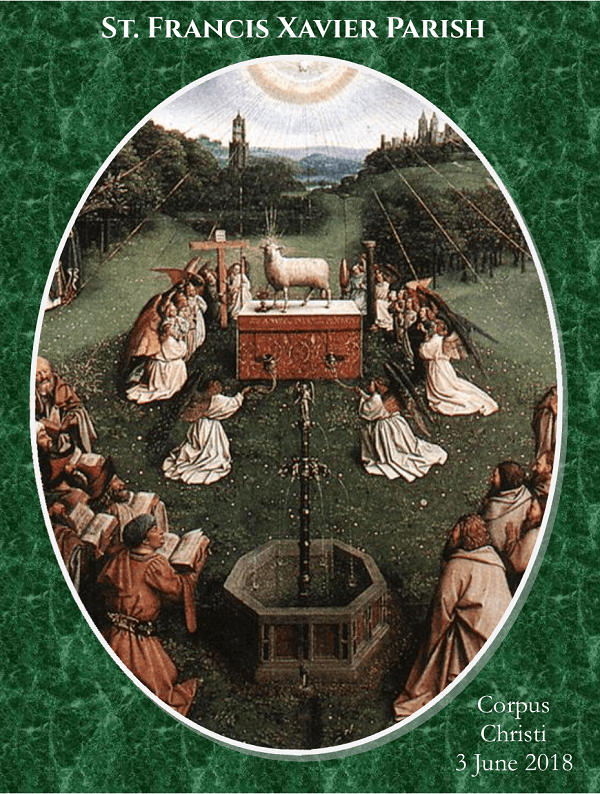
The image we have chosen for our bulletin cover for this wonderful feast day is Adoration of the Lamb (1429) by the great Northern Renaissance painter, Jan van Eyck. It is replete with heavenly (and therefore) liturgical significance. Jesus is represented as the Lamb whose arteries and vessels have been severed and whose blood is poured out into a chalice on the altar to signify the transformation of wine into the Eucharistic Blood. The precious Blood and holy Body are honored here in reverent Benediction by encircling angels, two who are seen incensing the sacrifice of the Son – a pleasingly, fragrant offering to the Father.
Jesus is also represented as the fountain of life (Ez 47:1) watering all the land producing a great orchard of healing (Ez 47:12) before the city of God. Clockwise from the lower left are four groups: laity, bishops and holy women (both here unseen), and monks or scribes – representing the worshipful People of God. All is lit in the divine light of the Holy Spirit (Rev 21:23).
All this abundant joy is for the Lamb of God, the Body of Christ, which takes away the sins of the world (Jn 1:29)
-Steve Guillotte (Director of Pastoral Services)
by SFXparish | May 30, 2018 | BLOG
The Word of God came forth to nest,
Within the womb of Virgin Blessed,
And there secured the very form,
With which He dwelt upon the earth
To scrutinize the world forlorn.
In Sion’s midst, He did survey.
His parents feared He went astray,
They sought his frame for all the day,
Once lost, now found. In rugged youth,
In Father’s house, he’d gone to pray.
On last return, he looked again,
Upon the hill, Jerusalem,
In sadness deep, divine regret,
He spoke the fall of Temple tall,
Downfall foretold, He sorely wept.
He fixed his tears upon the Cross,
To mend our wound, our weighty loss;
His flesh pierced through, His blood poured out,
Angelic hosts released the shout:
“The purpose met: Death put to rout.”
This day He gives His Body whole,
His precious Blood, His mighty soul,
On altar white, he lays the cure,
For every sin, for every snare;
A living source, a fountain pure.
(by Steven Guillotte)
by SFXparish | May 24, 2018 | BLOG
The Spirit himself bears witness with our spirit that we are children of God, and if children, then heirs, heirs of God and joint heirs with Christ, if only we suffer with him so that we may also be glorified with him. (Rom 8:16-17)
The most famous paintings of the Holy Trinity theme depict Jesus Christ crucified or recently lowered from the cross. Botticelli, Durer, Castagno, etc. portray Jesus in the passion of His crucifixion flanked by the Father shown as an older bearded man. Rubens and El Greco paint Jesus just taken down from the Cross – and dead – as in Pieta scenes, except that in these Trinity images the divine Son rests not in the arms of Mary His mother, but God His Father. Even those Trinity paintings presenting Jesus in glory at the right hand of the Father still show Him with pierced hands and feet (e.g. Baldung). What recurs through all these Holy Trinity renderings is the suffering Christ.
There are many other ways the Holy Trinity might have been presented. Jesus might have been painted as a young boy with his Father, say, holding a dove. It is interesting to consider that Nativity-topic paintings are not used to depict the Blessed Trinity, where the artist might have painted the Father skirting the barn or manger just as he does the cross in common Trinity works. Even works narrating the baptism of Jesus in the Jordan River (which picture also the Father and the Holy Spirit) are entitled “Baptism of Jesus” and not “Holy Trinity”.
Thus, there appears to be a tacit tradition which developed (at least since the medieval era) of rendering “Jesus the accomplished” in Holy Trinity artwork. The Jesus that most appears in Trinity depictions is Jesus the Redeemer: either accomplishing our redemption on the Cross or, after being taken down from Cross after declaring “It is finished” (Jn 19:30).
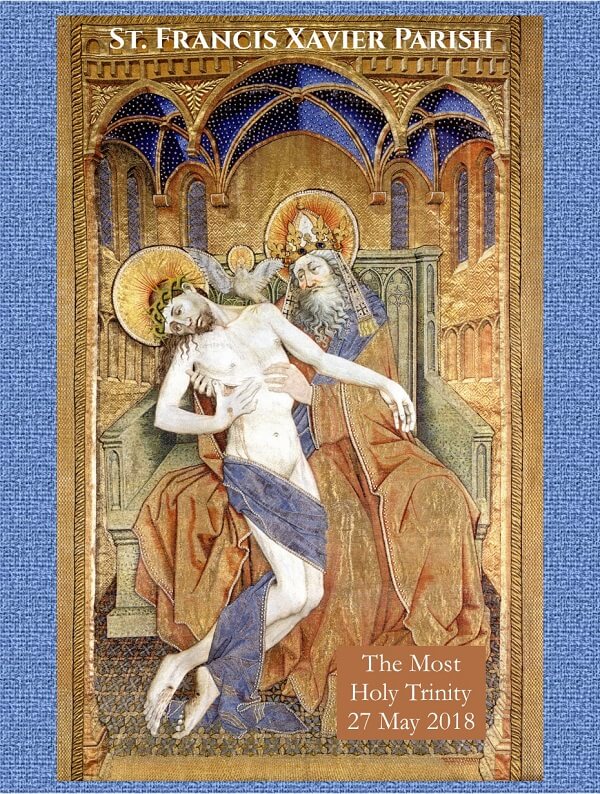
In order to further illuminate this point, we have placed on our bulletin cover for this Holy Trinity Sunday, a work by the pioneering Flemish painter, Robert Campin, entitled simply Holy Trinity (1433). This is an unusual selection for us because it is not a painting but a tapestry which would have been devised by Campin yet embroidered in a workshop by a tapestry master. This piece is of linen interwoven with velvet, silver and silk embroidery, glass beads and pearls. Such tapestries were expensive and would either hang in beautiful Churches or eventually the homes of the very prosperous.
Campin, a guild master of painters and goldsmiths, offers us a glimpse of Jesus “the suffering servant” (Is 53) upheld for all to see, wrapped in the flowing stole of his proud and loving Father while the Holy Spirit of consolation perches on Our Lord’s shoulder uniting visually Father and Son. God the Father sits upon a huge throne – large enough for two! Heaven is depicted as the interior of a Gothic cathedral indicating the Real Presence of Christ in the Holy Eucharist, which, as the Body of Christ contains mystically the union of the Holy Trinity.
Thus it is fitting that the Feast of Corpus Christi should follow swiftly upon that of the Holy Trinity; and that as Paul suggests – we embrace our own gracious suffering so as to also be glorified with Christ (Rom 8:17).
-Steve Guillotte (Director of Pastoral Services)
by SFXparish | May 23, 2018 | NEWS
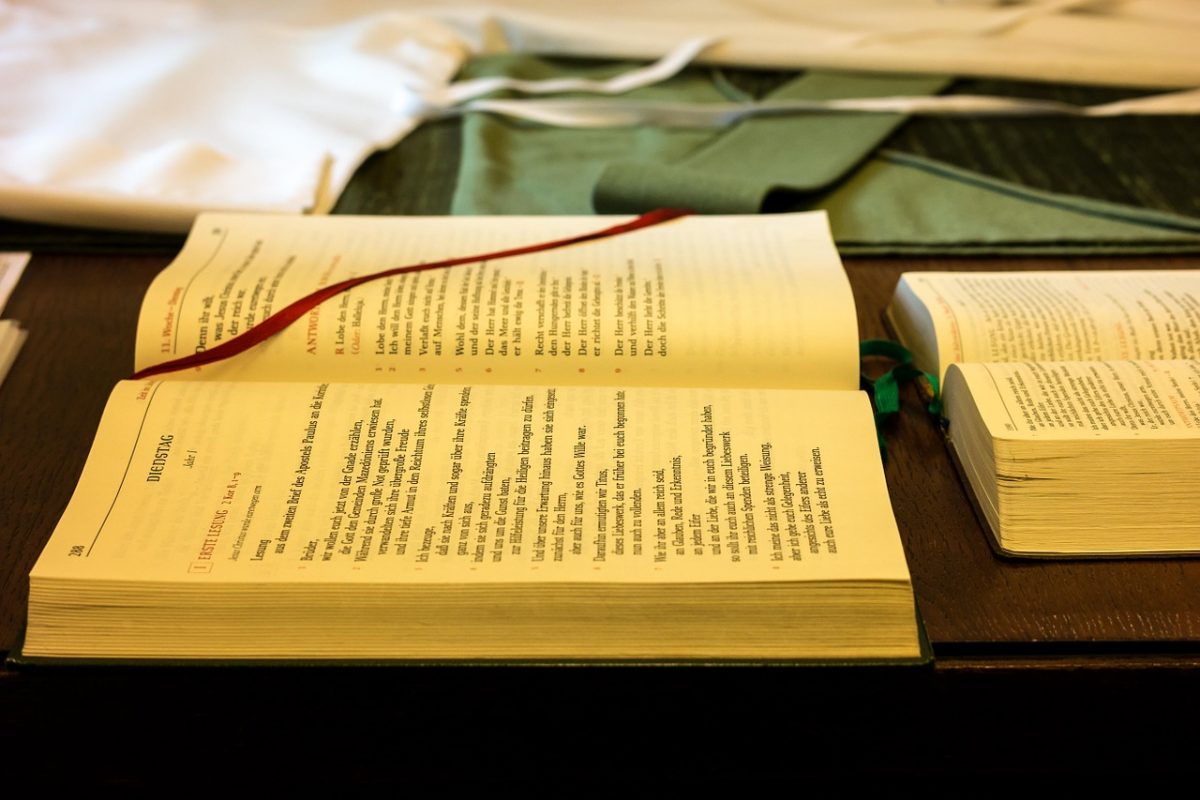
On June 19th at Holy Name of the Sacred Heart of Jesus Parish in New Bedford, SFX parishioner, Tony Pimentel, will be instituted into the Order of Acolyte as he is just a little more than one year away from ordination to the permanent diaconate. Tony has already been instituted as Lector and many of you would have seen him in his white alb at Holy Mass reading from the ambo.
Please note that every Tuesday we still dedicate our Eucharistic Adoration for vocations. No doubt all your sincere prayers have been heard by Our Lord who has been very generous to us with vocations! Please keep Tony in your prayers.

by SFXparish | May 23, 2018 | NEWS
We recently upgraded our parish center, church, and rectory to LED lighting (including the parking lot). We expect this to result in much savings on our electric bill over time. We contracted with Energy Source for the lighting fixtures and bulbs and our own parishioner Doug Corrigan completed the project and replaced all the lighting. This was a market value project of $26,897.29, however after the utility incentive we paid only $4,034.60. Once again we thank you for your generosity to our parish Building Fund which pays for such facility improvements.