by SFXparish | Jul 6, 2018 | BLOG
Jesus… came to his native place, accompanied by his disciples… When the Sabbath came he began to teach in the synagogue and many who heard him were astonished. They said, “Where did this man get all this…” And they took offense at him. (Mk 6:1-2;3)
The ancient Jews were always demanding signs from their prophets (1 Cor 1:22). Sometimes signs were given even when not asked for (Is 7:14). But just as often as the “stiff-necked” people required signs, they frequently rejected the admonitions and counsels of God’s prophets.
Israelite prophets were not like oracles of the Greek cult to which citizens would travel great distances to hear some wisdom at a revered shrine. The Jewish prophets walked amongst the people placing themselves into direct confrontation with those individuals they were sent to advise or forewarn.
Mind you, prophets were not evangelizers as such. They were not sent by God so much to preach and to teach but to caution away from an evil course or to encourage toward a good policy aligned with the will of God. This got the prophets into trouble when their counsel did not align with the will of man! Thus the Israelites often “took offense” at their prophets, rejecting them, exiling them, and even killing them.
For the most part, prophecy has come to completion since all Messianic prophecy pointed to the coming, dying, and rising of Jesus Christ. As to any prophecy about the return of Jesus, Jesus Himself tells us this: only the Father knows for certain (Mt 24:36). Still Catholics are called even today to lead others to God’s mercy while counseling the consequences for rejecting that mercy; while the Blessed Mother, as at Fatima, has been the great prophet of our age.
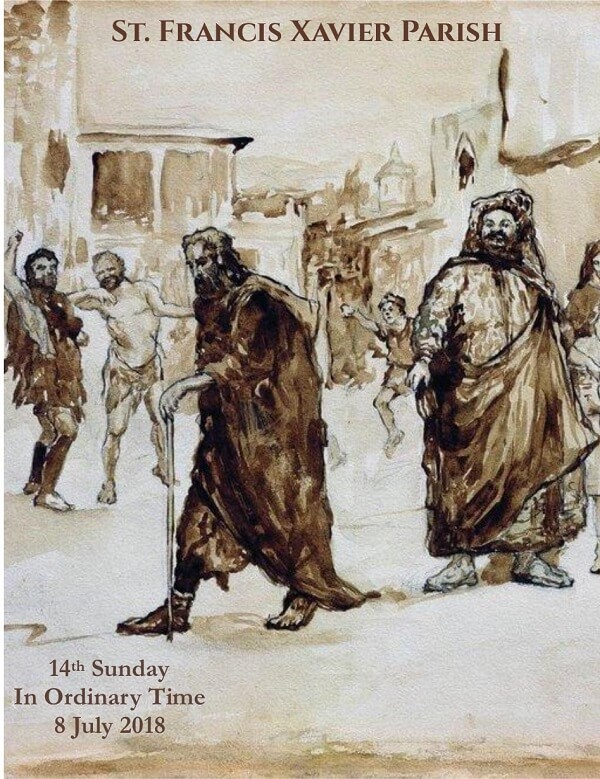
In order to offer a visual context to today’s Gospel reading for this 14th Sunday in Ordinary Time, we have placed on our bulletin cover a work by the Russian realist, Ilya Repin, entitled, Prophet (1890). Here we see an unnamed prophet walking among a people who have fallen into paganism and idolatry. Men stand around jeering and waving at the prophet, driving him from their midst while a boy comes up from behind wielding a rock. It is not clear if the prophet is visiting “his native place” (Mk 6:4) but he has spoken God’s word to this ancient city and now he takes his leave as one scorned and unheeded.
Repin began his artistic career as a restorer of religious icons. This experience could be one reason for his several paintings of prophets. Another may be that he saw himself as a Tolstoy of the visual arts, a presenter of realism during the insulated rule of Emperor Alexander III which set the stage for the 1917 Marxist Revolution. Repin, a voice for change who rejected Lenin’s Bolsheviks, eventually moved to Finland where he resided until his death.
While no one can take upon himself (without God’s call) the role of the prophet, we Catholics can surely see some “signs of the times” (Lk 12:54-56). Further, we are to be reminded that Christ cautions us to be on guard and to be prepared for his next and final coming (Mt 24:42-44).
-Steve Guillotte, Director of Pastoral Services
by SFXparish | Jun 28, 2018 | BLOG
“God did not make death, nor does he rejoice in the destruction of the living”… “For God formed man to be imperishable; the image of his own nature he made him.” (Wis 1:13; 2:23)
Modern man views death as something natural. There are three reasons for this. First, common sense indicates that no one lives forever and that human persons become old and die. Second, science proves the cellular and physical breakdown of the body over time indicating that mortality is natural. Lastly, pagan thought, still prominent in man, proposes death and life as a cyclical process such that life and death appear to be the intended balance of Nature and sentient existence.
Not so for the Christian. While the Christian admits the scientific evidence of human physiology and aging, he does not believe that God intended the process of dying as part of the natural order. The Christian believes that death arises as a consequence of sin. Man, made for immortality, was originally placed in a world of preternatural perpetuity (i.e. Eden) gifted with the life-sustaining supernatural grace of God. But man fell into sin and with him fell the endurance of that gift. As St. Paul teaches, man’s mind was darkened (Rom 1:21) the world was lessened (Rom 8:19-20) and death entered into the world as punishment until such time that the full promise of redemption was to be fulfilled in Christ (Jn 3:16). This may appear an odd and outdated notion to our modern, scientific minds; yet what do we actually believe and hope for as Christians if not the passing away of the old world for a renewed and eternal sustenance founded on the everlasting grace of God (Rev 21:1-3;23).
Such reflection ought to enlist a deep consideration on the Virgin Mary. Our Blessed Mother transcended our fallen nature leading to her Assumption into heaven. True, Mary died a natural death, but the earth could not hold her; for she of all humans was not inclined to the grave.
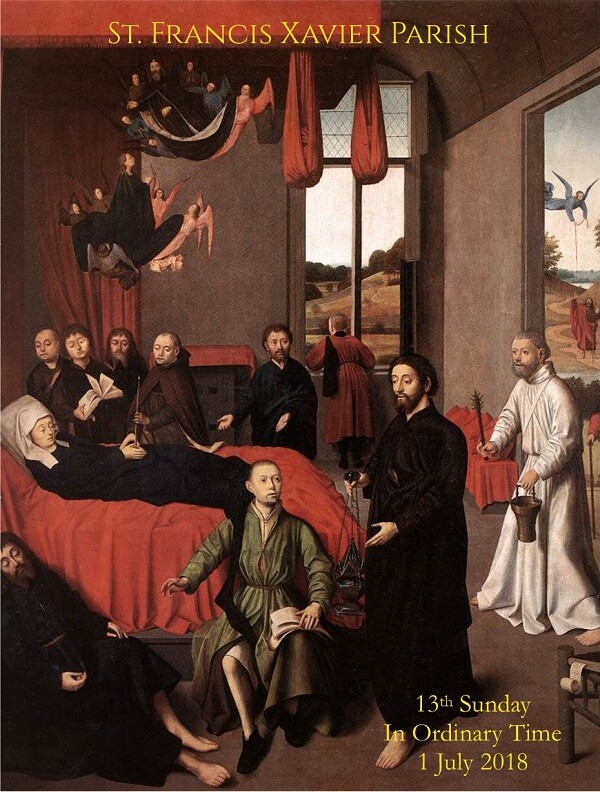
Thus we place on our bulletin cover for this 13th Sunday in Ordinary Time a work by the Northern Renaissance painter, Petrus Christus, entitled The Death of the Virgin (1460). Here we see Mary surrounded by the Apostles as at Pentecost. One Apostle gives Mary a candle to light her way as she soon arises above her death bed lifted by angels and greeted by the awaiting Father in heaven (as seen just below the bed canopy). One Apostle sleeps as at Gethsemane; yet ever-diligent John (in green) sits alert by the bedside as he once stood by the Cross. Near him is another Apostle holding a thurible indicative of the beautiful fragrance – which is Mary – rising into heaven. Another enters with an aspergillum representative of Mary’s sanctity. Finally, another Apostle looks out a window symbolic of one searching for Mary’s departed body, while in the upper right of the scene Thomas receives from an angel the girdle of Mary as proof of her Assumption.
Just as the Ascension of Jesus is proof of our future glory, the Assumption of Mary is proof of our intended immortality now restored in her and through her Son’s victory over our fallen human nature – a nature created in the image of God.
-Steve Guillotte, Director of Pastoral Services
by SFXparish | Jun 24, 2018 | BLOG
When they came on the eighth day to circumcise the child, they were going to call him Zechariah after his father, but his mother said in reply, “No. He will be called John.” But they answered her, “There is no one among your relatives who has this name.” (Lk 1:57-61)
The naming of a newborn is a very intimate activity. Expectant parents will often rummage over the meanings of names in order to select what they will call their child for the rest of its life. Others find the selection easier by using names of grandparents or other loved ones in the naming of their children. Sadly, many parents today select names without proper discernment and consideration. They see their choice as an exercise in personal freedom when they should see it as a duty gifted by God (Gn 2:19). Catholic parents are of course strongly urged by the Church to choose names from the list of saints. Those parents that don’t are still robustly encouraged to raise their baby to be a saint and thus expand the copious category of saintly nomenclature.
The Hebrew root of “John” means “God is Gracious”. This is very important since similarly “Jesus” means “God is Salvation” or “God Saves” and as we know grace and salvation are wholly united. Further, it is the Holy Spirit (working through an angel) that named John (Lk 1:13) and Jesus (Lk 1:31). It is God who gave new names to Abram, Jacob, and Saul. It is God who says: “To the victor I shall give some of the hidden manna; I shall also give a white amulet upon which is inscribed a new name, which no one knows except the one who receives it” (Rev 2:17). This quotation from the Book of Revelation appears to be a promise of heaven; but it is also a promise already fulfilled in one’s baptismal (and confirmation) name and the reception of the Holy Eucharist.
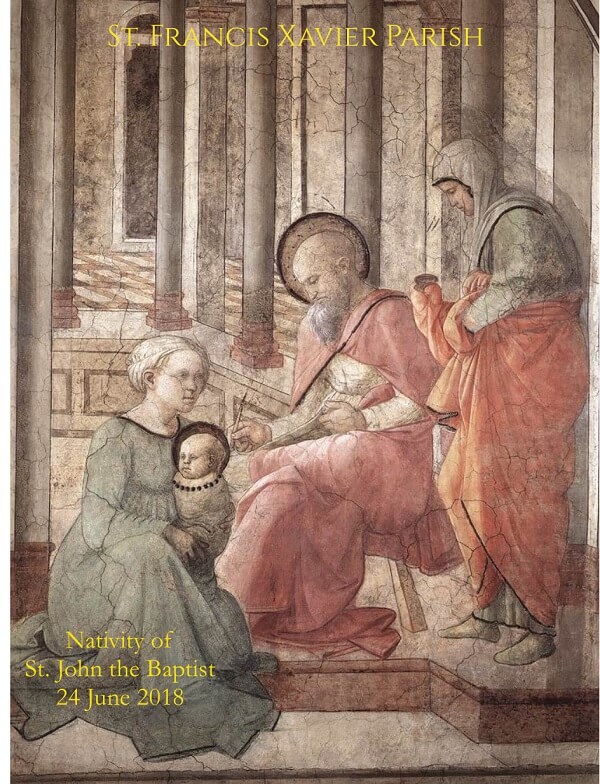
To proffer imagery for our Gospel “reading of the day” for this Sunday’s Feast of The Nativity of John the Baptist, we have placed on our parish bulletin cover a detail of a work from the great quattrocento painter, Fra Filippo Lippi, entitled The Birth and Naming of John (1465). This work is the epitome of Early Renaissance art: classical architecture, experimentation with spatial depth, reserved and statuesque figures, and an effective use of a new, realistic light. Here we see Elizabeth holding the baby John while Zacharias writes on a tablet “John is his name” (Lk 1:63). A servant or relative stands holding an inkwell for Zacharias to dip his pen. Her stance provides optical altitude creating a diagonal running through the four human figures. While Zacharias and the servant look down in concentration, Elizabeth and John both look away, yet in opposite directions, as if each can see their own future: Elizabeth’s perhaps not very long as she bore John in her older age (Lk 1:18); and John’s cut short by his prophetic mission of announcing the Messiah.
In our consideration, we cannot forget that the high value of a personal name finds its nobility in the Holy Name of God. In the case of the name “Jesus” we have a name that all persons, be they in heaven or hell, will in the end come to revere (Phil 2:9-10).
-Steve Guillotte, Director of Pastoral Services
by SFXparish | Jun 14, 2018 | BLOG
Therefore, we aspire to please [God]… For we must all appear before the judgment seat of Christ, so that each may receive recompense, according to what he did in the body, whether good or evil. (2 Cor 5:9-10)
At least since the Protestant Reformation, there has been much debate over what response to God is necessary for salvation. Protestants declare that faith alone is necessary for salvation, while it is said of Catholics that we hold both faith “and good works” to be necessary. What Catholics actually say is much more comprehensive. We speak of salvation, justification, and judgment such that a person is saved by grace, justified by faith, and judged by works. Evidence of this last claim is present throughout Sacred Scripture as in our quotation above from Paul’s Second Letter to the Corinthians taken from the second reading for this 11th Sunday in Ordinary Time. Paul is saying that in order to receive the compensation of heaven, we must first be judged by “what [we] did in the body” (i.e. in life). Considering this further, we know that while the mind “believes”, it is the body’s part to “act”. Hence, the criterion for Christ’s judgment is not faith alone, but good or bad actions performed through an earnest faith.
The wonderful thing about the judgment of Jesus is that it is a just and merciful judgment. Justice allows us to make our case before God by claiming how we served and loved others the way Jesus did on earth. Mercy allows us to approach the kingly court with sincerely contrite hearts, for having failed to meet the demands of God’s justice. However, we must never forget that there would be no salvation without God’s grace, and that we will be judged on how faithfully we invested this grace so as to offer a fruitful return to the Lord (Mt 25: 14-30).
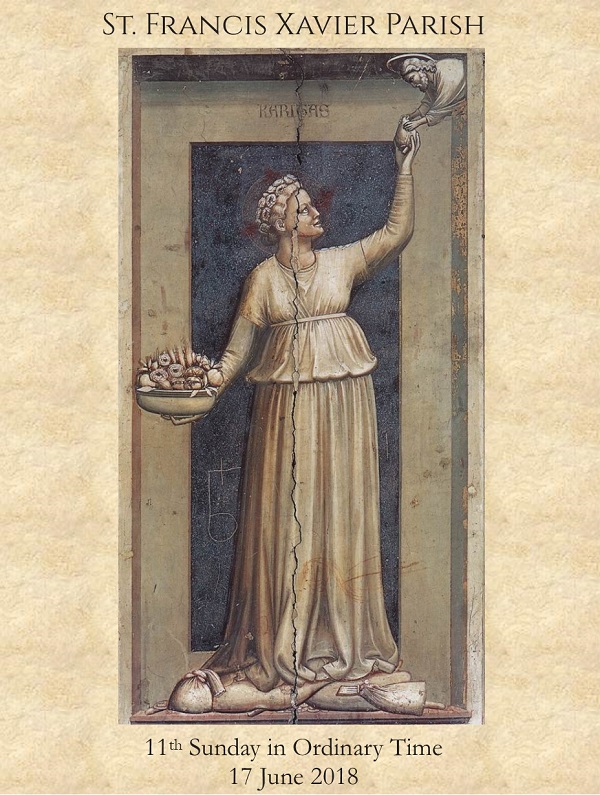
In order to better grasp this notion, we have placed on our bulletin cover another painting by the Florentine, Giotto, entitled simply Charity (1306). Here we see the image of a woman as an allegory of charity. She is not charitable on her own power, but through the gift of faith, as she now reaches out to God for supernatural virtue. In fact, the abounding fruitfulness seen in her right hand has its source in what she receives from Christ Jesus in her left hand. Giotto has purposely shown this blessed movement of grace by painting an inferred diagonal – drawing our eye from Christ to the plentiful bowl. Further, God’s grace is so fertile that even the little that is given by Jesus results in so much bounty that it fills to overflow the bowl of Lady Charity – even accumulating a surplus that must be stored at her feet.
In order to gain the requisite charity needed to merit a good judgment before God, we must live a life of grace. Without grace, human activity is fruitless before God’s throne. God showers everyone with active grace to get us moving, but we need sacramental grace for sanctification. Baptism, Confession, Confirmation, and especially the Holy Eucharist – the sacrament of love – all strengthen our faith and our desire to perform those good works which are pleasing to God and efficacious toward salvation.
-Steve Guillotte, Director of Pastoral Services
by SFXparish | Jun 8, 2018 | BLOG
Summoning them, he began to speak to them in parables, “How can Satan drive out Satan? If a kingdom is divided against itself, that kingdom cannot stand. And if a house is divided against itself, that house will not be able to stand. (Mk 3:23-25)
Discord and division, if not remedied, will be the diminution or death of any institution. Business partnerships, friendships, and as Jesus points out, even kingdoms, will not thrive or survive if they are deeply divided. The same can be said about democracies whose political parties come to mutual hate, and whose owners and workers come to mutual mistrust. This is an important fact about human nature and the world, but we must acknowledge here that Jesus was speaking a parable.
The parables of Jesus used mundane images to explain spiritual realities. In particular, in the quotation above from the Gospel reading for this 10th Sunday in Ordinary Time Jesus was responding to an accusation by the Jewish scribes that He was possessed by the supreme demon (i.e. Beelzebub) which therefore enabled Him to expel other demons. Sadly, while these Jewish scholars were citing popular belief in a demonic hierarchy, they were undermining their own Messianic prophecy just to discredit the good and gracious works of Jesus.
By doing so they risked committing what Jesus described as the unforgivable sin (Mk 3:29). By describing the activity of Jesus, i.e. the activity of the Holy Spirit, as the activity of the devil, the scribes were committing the one sin which cannot be forgiven if not repented – the sin against the Holy Spirit. In this sin, the person believes deliberatively that a good work of God is a work of evil. Anchored in such belief, the person has set himself against God as anti-Christ. This point cannot be overstated because so many in our present age disfigure the creation of God and see the good works of the Church, for example the defense of marriage and the unborn, as discriminatory, oppressive, and evil. Those who believe this reject the fertile Spirit and flirt dangerously with the unforgiveable sin.
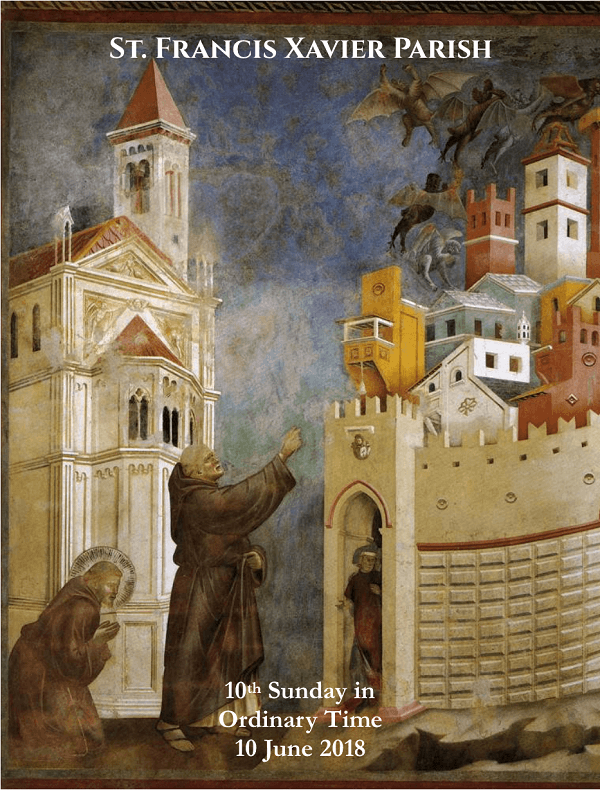
In order to shed light on our selected passage from Sacred Scripture we have placed on our bulletin cover a painting from the St. Francis of Assisi Series of the late-medieval Florentine painter Giotto di Bondone, entitled Exorcism of the Demons at Arezzo (1299). Pictured in this fresco is St. Sylvester, sent to Arezzo by St. Francis who saw demons in the city during a time of civil disorder. Brother Sylvester (standing) performs the sacred ritual while Francis kneels and prays. The scene is split into Church (left background) and State. In front of the city walls is a large fissure in the ground symbolic of the realm of demons and the place they will return after the exorcism. The demons are pictured above the city as they are expelled, while the citizens (seen at the gates) can now return to peaceful activity. All the while the church bell rings in victory.
In this depiction civil unrest or division has been instigated by evil powers. Since Adam this has always been the case. Let us see to it that we do not prefer this urging: to call what is good “evil” and what is evil “good”.
–Steve Guillotte, Director of Pastoral Services