by SFXparish | May 19, 2018 | BLOG
Jesus came and stood in their midst… he showed them his hands and his side. Jesus said to them… As the Father has sent me, so I send you.” And when he had said this, he breathed on them and said to them, “Receive the Holy Spirit. (Jn 20:19-22)
For our reflection on sacred scripture this Pentecost we have chosen a segmented quotation from the Gospel reading for Sunday Mass. Here we meet Jesus visiting his Apostles on the evening of the same day He rose from the dead. St. John the Apostle and Evangelist tells us of how Jesus came and stood in their midst even though the Apostles had locked themselves away for fear of those who crucified Jesus.
First, Jesus greets His Apostles with “Peace” (Jn 20:19) in order to console and convince them that this appearance is not false or sinister. Next he shows them His hands and feet and side to reveal that He is tangible and not some ominous apparition. Then He reminds them of the mission He has from his Father: a theme quite familiar to them. Hence, in this progressive way Jesus leads them to trust again in His real presence. Once this trust is reestablished, Jesus is able to “send” them. He sent them out before, granting them authority over unclean spirits (Mk 6:7). Now he breathes on them the cleansing Spirit, granting them authority to forgive sins.
This first, post-Resurrection gift of the Holy Spirit to the Apostles is an intimate prelude to Pentecost. It occurs without any overt manifestations: no rushing wind, no tongues of flame, no speaking in tongues; no dashing out into the public square (Acts 2:2-4). Still, the Holy Spirit is given. The Spirit is not given with signs and epiphanies; not given as a public wonder, but as a private ministry to certain men whose duty it would now be to bring forgiveness to all who would repent and believe in the Gospel.
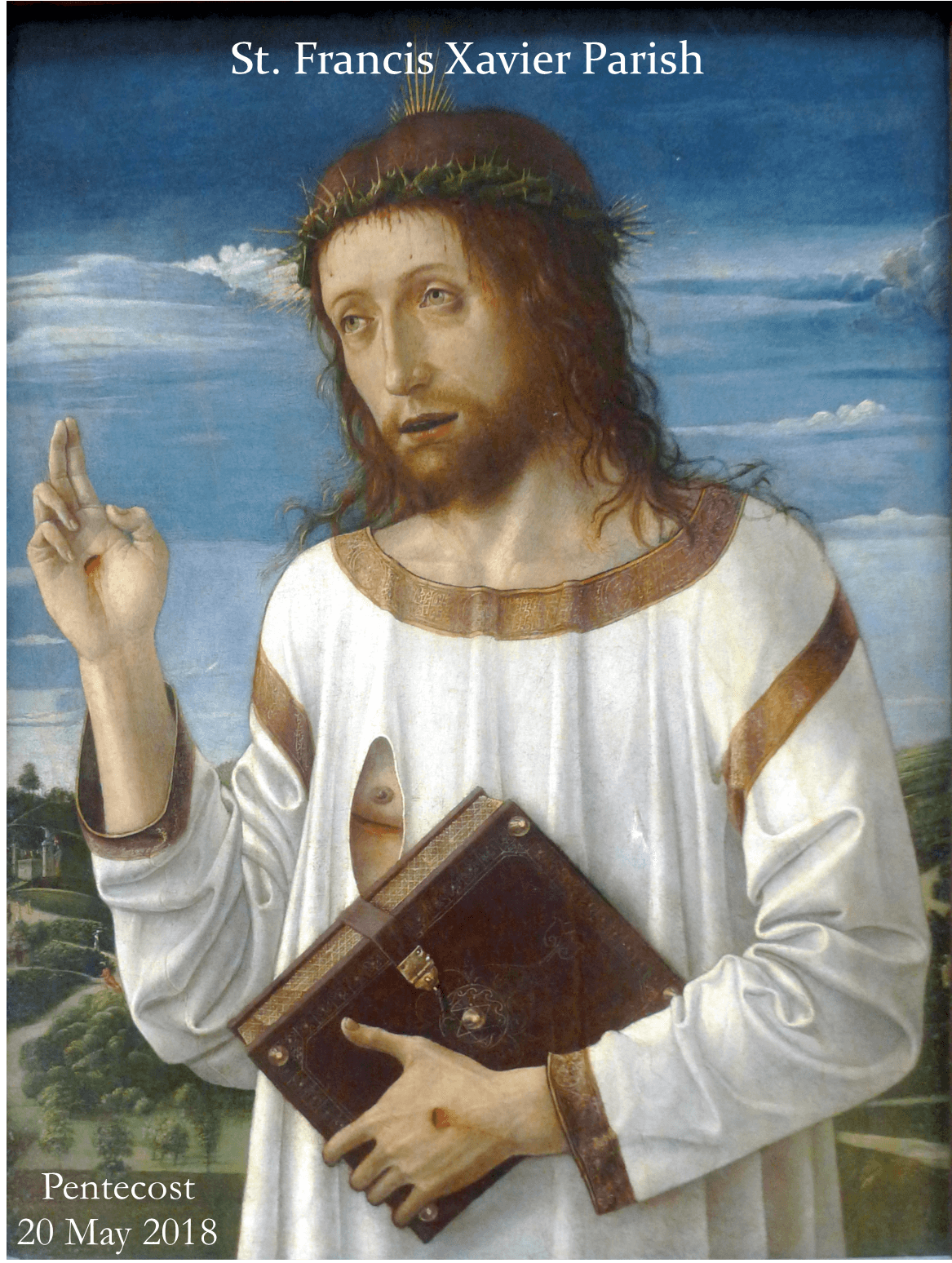
To aid our Gospel reflection we have placed on our bulletin cover for Pentecost a work by the Early Renaissance, Venetian artist: Giovanni Bellini, entitled simply, Christ Blessing (1460). This is not the iconic figure of Christ we encountered from El Greco last Sunday. Bellini has Jesus on the move as seen by the Jerusalem landscape behind Him. Bellini paints Jesus offering a blessing, with the express purpose of showing us the pierced hands of Jesus. Bellini also makes a slit in Jesus’ garment so we can see the spear thrust that Jesus showed to His Apostles just before He breathed on them the Holy Spirit. Further, Bellini cleverly shows Jesus holding a book – not the customary prop symbolizing Jesus as the Word of God – but a book with lock or seal.
Jesus is the Lamb of God, the Lion of Judah who can open the seal (Rev 5:2-5). That which he holds, that which is sealed, is the Book of Life or for our purpose on this day of Pentecost – the Book of the Spirit of Life. Without Pentecost and the Spirit of Pentecost poured out upon the world, there would be no life, because there would be no grace. Through the grace of the Holy Spirit, Jesus unlocks the supernatural life necessary for our salvation and the glory of the children of God.
-Steve Guillotte, Director of Pastoral Services
by SFXparish | May 12, 2018 | BLOG
I gave them your word, and the world hated them, because they do not belong to the world any more than I belong to the world. I do not ask that you take them out of the world but that you keep them from the evil one. They do not belong to the world any more than I belong to the world. (Jn 17:14-16)
In our Gospel reading for this 7th Sunday in Easter, Jesus declares that the word of God makes its disciples strangers to the world. Jesus does not mince words. He does not say that his followers “seem” to not belong to the world (i.e. because they are misunderstood). Jesus declares plainly, “They do not belong”. They are outsiders because of His word. And the world hates them.
Yet, Jesus does not pray to his Father that the world come to love (or even like) his disciples. Jesus knows that this is not possible since the hatred he speaks of is sown by the evil one who has only hatred for Jesus and his word (Mt 21:37-39). As we know well from the teaching of Jesus, the devil is always trying to snatch away the word from those who receive it (Mt 13:19). Therefore, the greatest threat to the disciples of Jesus is not human trial at the hands of the world, but instigation of the evil one and the loss of grace. Grace does not belong to the world; the word of God does not belong to the world. Neither do the disciples of word and grace.
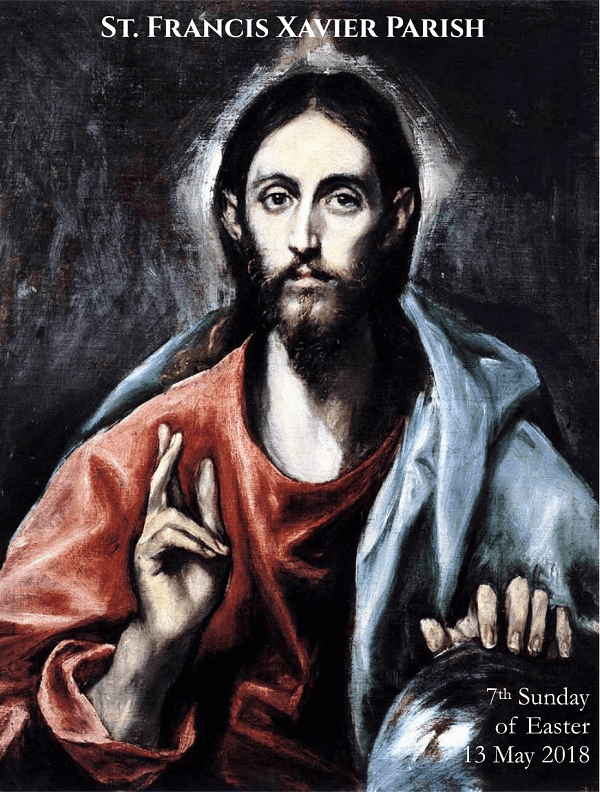
In order to illustrate the meaning of this Sunday’s scriptural passage we place on our bulletin cover a work by the great Mannerist painter El Greco, entitled Christ Blessing (The Savior of the World – 1600). Domenikos Theotokopoulos was born and trained on the island of Crete where he mastered the 16th century Byzantine iconography. His study in Venice led to his encounter with Titian from whom he learned the contrast of light and dark; and Tintoretto by whom he gained his elongated form and canvas. His complete style was of course gilded in Spain where he became a spiritual painter of the Counter Reformation. It is in Toledo, Spain that he was given the name El Greco (“the Greek”).
In this masterful depiction of Jesus Christ we can see the admixture of all of El Greco’s experiences: the Pantocrator posture of iconography, the brilliant color of Titian, the elevated sense of Tintoretto, and the spiritual sense of the Spanish Catholic renewal. Jesus raises his right hand in a posture of blessing (and instruction) while he gently places the fingers of his left hand on a globe symbolic of the world He Himself created. Jesus is shown here as a friend and guardian of the world, a world that hated him and cast him out, yet which He still redeemed for the sake of all those who would not be its possession.
This spiritual image of Christ is a fitting reflection in our approach to Pentecost next Sunday. Here Jesus seems to say, “[You] do not belong to the world any more than I belong to the world. Yet, for now I leave you in the world so that through My Spirit you may renew it.”
–Steve Guillotte, Director of Pastoral Services
by SFXparish | May 3, 2018 | BLOG
You are my friends if you do what I command you. I no longer call you slaves, because a slave does not know what his master is doing. I have called you friends, because I have told you everything I have heard from my Father. (Jn 15:14-15)
How many friends do you think you would keep if you told them today that they could be your friends under the condition that they do what you command? Probably not many which is a shame, because friendship is based on trust, and so the best friend is the one you can command and who can command you.
We have a difficult time understanding this notion in our present “personal relationships” with each other; which is why we need to do better than “personal relationship” when we encounter God. Our goal should be the noble union of friendship. Yet to achieve this end we need to set aside our feeble understanding of friendship in favor of God’s understanding.
In today’s Gospel reading for this 6th Sunday in Easter, we are given a wonderful insight into the just and proper union with God. When Jesus meets his Apostles as the Incarnate Word of God, He is Master; and his Apostles are servants. The Apostles are not privy to the activities and especially not to the motivations and purposes of God. However, over time Jesus reveals to the Twelve the mind and intention of his Father; “everything” as Jesus Himself puts it. Jesus gains intimacy with his Apostles and they become his friends. However, Jesus still commands them.
Here we are reminded of an ancient story of three Greek friends, one who in dying caused the other two to read his will. The will bequeathed to his two friends not a obvious benefit, but a responsibility: to care for his widow and daughter. One of these two friends also died not long after, leaving the remaining friend to see to the care of a widow and the dowry of a young bride (which he saw to with joy). Thus, the first friend left as his legacy – a command – and his friends were glad to receive it as benefit.
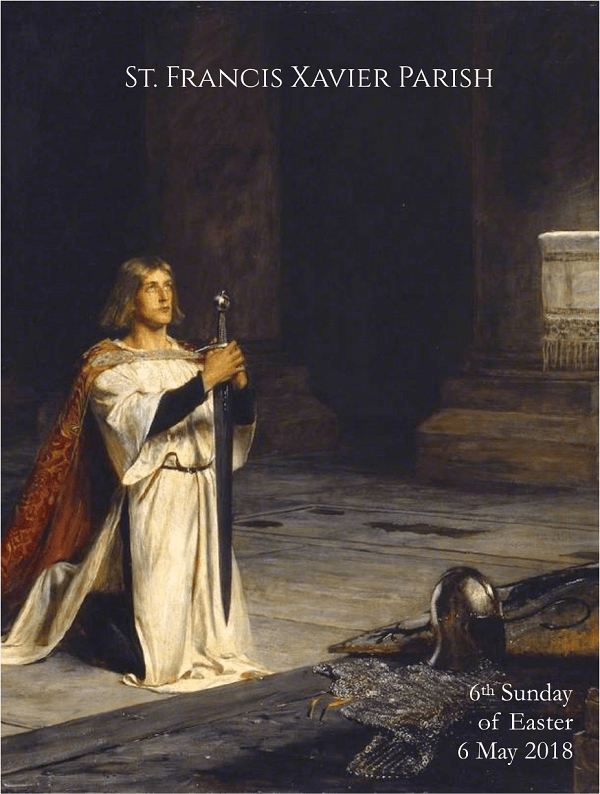
In order to better grasp our call to friendship with God, we place on our bulletin cover a work by the Scottish Romantic painter, John Pettie, entitled The Vigil (1884). This painting (especially the shadow of the sword on the knight’s surplice) is said to have influenced the creation of the spire for the Church Army Chapel in London.
In this work we see a young man keeping vigil before the Eucharistic altar as part of his knighting ceremony. All night he has been facing “ad orientem” as we now finally see his figure light up at the rising of the sun. He keeps vigil, not seeking a personal relationship but a friendship with God, that is, trusting and gracious service (Mt 23:10-11), as he prays, “Command me, O’ Lord”. For the purpose of our spiritual meditation, our knight has before him the “armor of God”: the mail of righteousness, the shield of faith, the helm of salvation, and the sword of the Spirit (Eph 6:13-17). He desires to be the comrade and friend of God; and so he appears to understand full well what this means – obedience to all God’s commands.
–Steve Guillotte, Director of Pastoral Services
by SFXparish | Apr 26, 2018 | BLOG
The church throughout all Judea, Galilee, and Samaria was at peace. It was being built up and walked in the fear of the Lord, and with the consolation of the Holy Spirit it grew in numbers. (Acts 9:31)
What Catholic today does not desire a united and peaceful Church? If he does not desire it, he should. After all, Jesus desired it (Jn 14:27 & Jn 17:22-23). In today’s first reading for this 5th Sunday in Easter we get a true sense of the peace and unity of the early Church; for it “was at peace”, “built up in the fear of the Lord”, and consoled by the Holy Spirit. Yet, how can peace arise from fear and result in consolation?
First of all peace is most basically the tranquility of order. If we are speaking of a church, then peace is manifested as the tranquility of a well-ordered assembly. If we are speaking of a person, then peace arises as the tranquility of a well-ordered soul. In the early Church “throughout all Judea, Galilee, and Samaria” the new Christians were united in thought, will, and prayer and were being well-ordered by common belief and trustworthy leadership. They were at peace.
Further, the earliest Christians were built up into a body or a legion walking side-by-side in the fear of the Lord. That is, they preferred to adhere to the teachings of the Apostles (Acts 2:42) fearing to offend the loving hand of God, rather than binding themselves to the world in order to avoid suffering the brutal hand of man. The first Christians no longer sought consolation in the world, but in the Spirit of God. They pursued the approval of God, not the approval of the state or the prevailing culture (Acts 5:29) – and they “grew in numbers”.
This leads us to the question: when will we, as Church, learn that it is only by aligning ourselves with God, rather than with earthly powers, that we will grow, if not in numbers, at least in faith, unity, and peace?
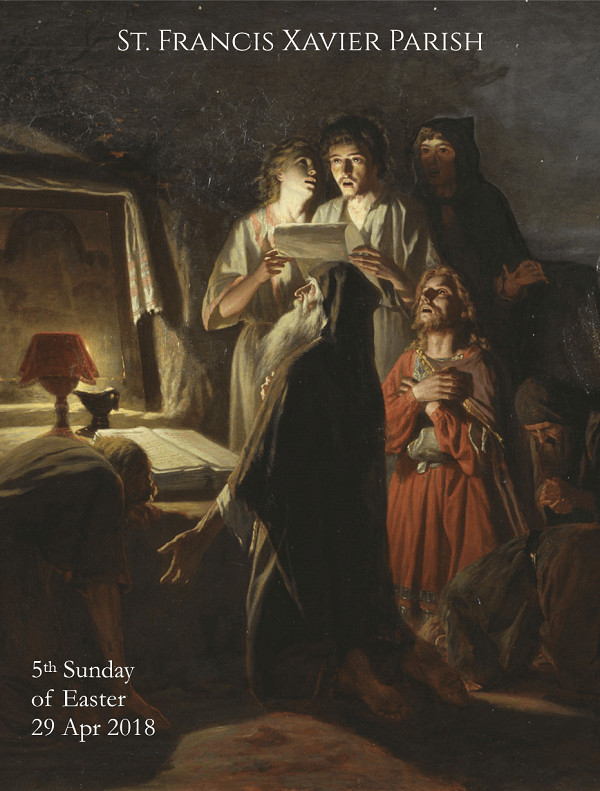
In order to assist us to answer this question we have placed on our bulletin cover a work by the Russian Realist, Vasily Perov, entitled, First Christians in Kiev (1880). Perov was a successful Academic painter until he joined a group of painters which resisted the Imperial Academy and its neoclassical constraint (e.g. against painting the gritty aspects of peasant life).
Like the early Christian community in Judea, the early church in Kiev was planted amidst a hostile pagan state. Thus, in Perov’s painting we see prayers, probably Holy Mass, being celebrated in stealth at night. The priest on his knees appears to be celebrating the liturgy while young worshipers sing hymns of praise. Not seen in our representation is a praying warrior dressed in chainmail indicating a church in which all stations of life are united in peace. The full view of this work shows these first Rus Christians huddled into a cave. There is something attractive in this isolation that gathers them together in faith. No doubt, the Spirit will move them to go out into the world to evangelize. However the Spirit will also urge them back to their spiritual shelter where their common faith and unity must not be overcome by the encroaching wiles of a wayward world.
-Steve Guillotte, Director of Pastoral Services
by SFXparish | Apr 24, 2018 | NEWS
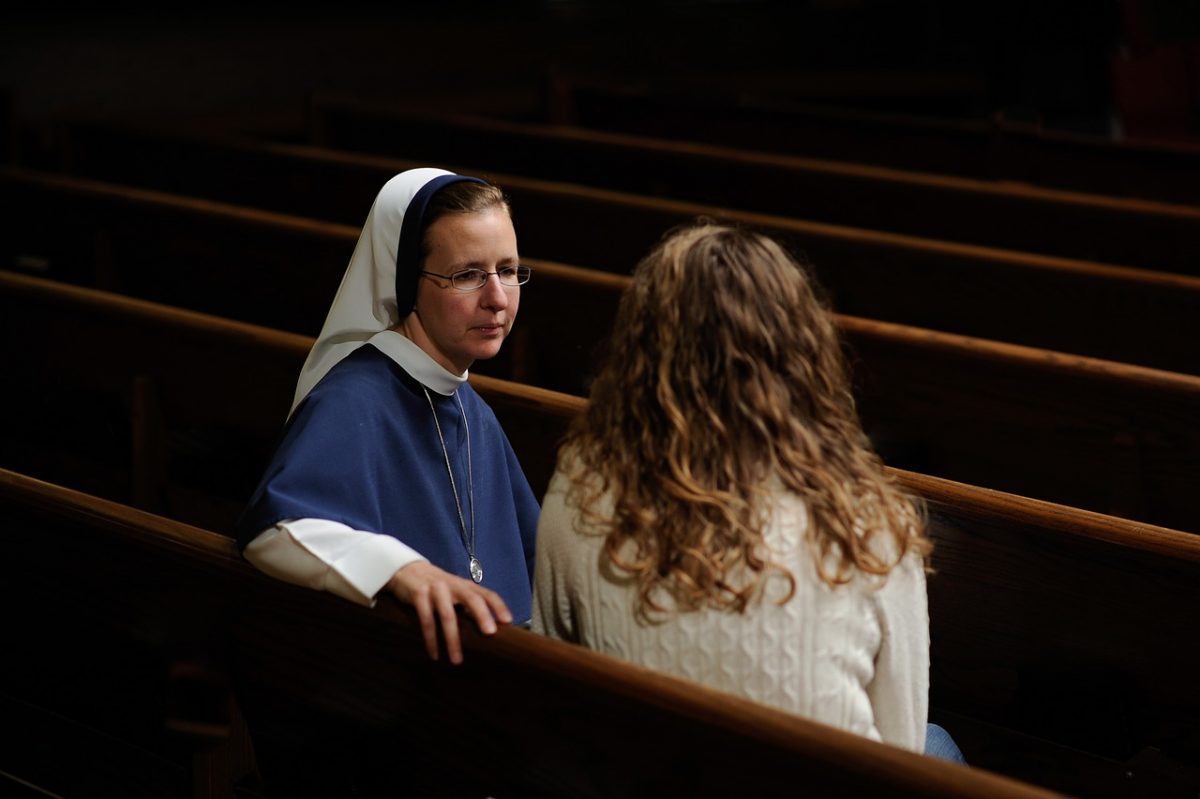
Vocations are a top priority here at St. Francis Xavier Parish and so we are particularly excited about the prospect of a new female religious vocation in our 3rd Grade school teacher Haley Ketchske. In order to support Haley, our Women of Grace apostolate is sponsoring a night at the Knights of Columbus Hall (57 Fairhaven Road in Mattapoisett) on Friday, 11, May at 6pm. All women of the parish are invited to attend and to bring their post-First Communion daughters with them for an evening of fellowship and fundraising for Haley (free will donations will be accepted on Haley’s behalf). We will have a guest speaker on women vocations. Please sign up after the weekend Masses or call Janine at 508 995-7600 for more information.