by SFXparish | May 10, 2019 | BLOG
“My sheep hear my voice, and I know them, and they follow me, and I give them eternal life and they shall never perish, and no one shall snatch them out of my hand. ” (Jn 10:27-28)
A close examination of our quotation from Sacred Scripture (above) seems to indicate a shifting metaphor. For if the sheep “follow” the shepherd it means that they walk on their own and are not carried. Thus, the entire quotation would be more consistent if it concluded with “and no one shall lead them astray” rather than “and no one shall snatch them out of my hand” (since, as noted, the sheep follow and are not carried).
However, since the Bible is a spiritual work we need to seek a spiritual meaning whenever we spot a grammatical inconsistency, which, if we are patient, will engender our gratitude rather than our criticism, since what first seems a difficult passage will often reveal a profound lesson.
In the book of Deuteronomy we read the expression “there is none that can deliver out of my hand” (Dt 32:39). In its context it means that God is all-powerful and all-knowing, and that no one can turn or malign his divine plan. In the Book of the Prophet Isaiah, we find a similar expression: “there is none who can deliver from my hand” (Is 43:13). Here the phrase once again means that no one can hinder the work or providence of God. Hence, when Jesus makes a parallel statement in our quotation He is saying that He is God and that no one can defy his will which is to lead his flock into eternal and imperishable life. Further, when we, the flock, follow Jesus we need not fear of falling behind, for if we do we can be assured that He will lift us up, carry us, and protect us.
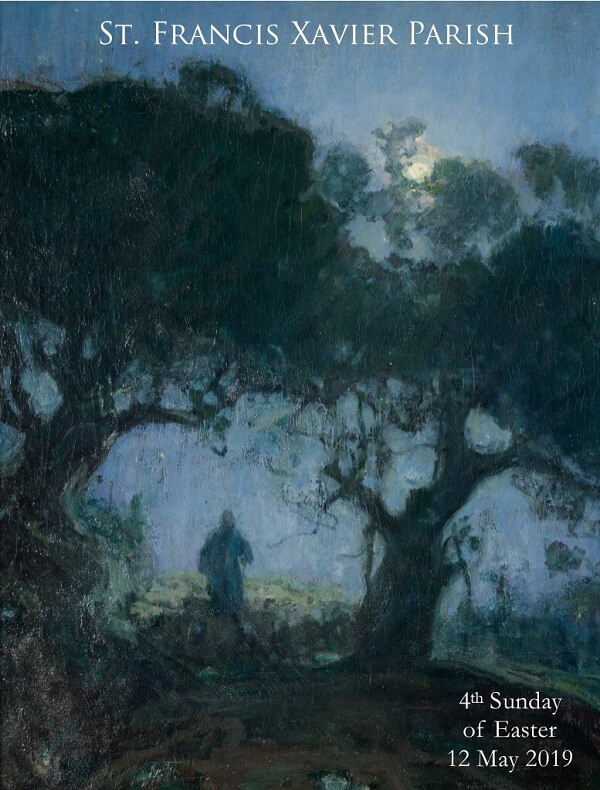
Thus, we place on our bulletin cover for this 4th Sunday in Easter a work by the American artist Henry Tanner entitled The Good Shepherd (1903). There are very few allegories as straightforwardly portrayed in art than the image of Jesus as the Good Shepherd. However, we have chosen a work of Impressionism, an unusual and opaque visual medium for this ordinarily simple theme.
Tanner presents an enigmatic Good Shepherd who before making his flock “to lie down in verdant pastures” (Ps 23:2), must lead it through the “valley of the shadow of death” (Ps 23:4) so represented here by the dark trees and cumbersome hills. In Impressionistic fashion it is the light that is painted; not sunlight in this case, but moonlight which imbues the flock with brilliance as it follows its obscure shepherd over arduous terrain. The flock may not look obviously like a flock because of its lack of linear form; however it is a flock, a unity of form in reflected light moving as one body: behind, below, and around its leader. Neither sheep nor shepherd appears to have legs. They proceed as a singularity of Spirit, the Head and Body of Christ capable of striving forward freely as a distinct and graceful force through the eerie shadow of sin and death.
“ … At the sight of you the mountains writhed… The sun forgot to rise; the moon left its lofty station… You came forth to save your people.” (Hab 3:10, 11, 13)
–Steve Guillotte, Director of Pastoral Services
by SFXparish | May 2, 2019 | BLOG
“… The high priest questioned them, “We gave you strict orders, did we not, to stop teaching in that name….” But Peter and the apostles said in reply, “We must obey God rather than men.” (Acts 5:27-29)
St. Luke tells us in his chronicle of the missionary activity of the Apostles, that the party of the Sadducees had St. Peter and his companions locked up out of “jealousy”. The Apostles had been very successful in the Spirit winning over new disciples for the ascended Jesus through convincing preaching and miraculous healings. The Jewish authorities judged preaching in the name of Jesus to be a heresy that offended the Lord, the God of Moses. Even the sincere and pious Jew likely believed that the name of the one LORD was threatened by the name of Jesus. Such a one failed to understand his Messianic faith.
Yet, the most reasonable Jew in authority should never have set out to mistreat a fellow Jew who followed this new way. In fact it was a Pharisee of the Sanhedrin (which interrogated the Apostles) who suggested that the authorities let the Apostles be (Acts 5:38). He surmised this new teaching would either self-destruct or prove the will of God. This Pharisee, Gamaliel, “a teacher of the law” likely saw Peter as a devout Jew who, misguided or not, taught the spirit of the Mosaic Law. Gamaliel knew of other (false) Messiahs, and that the true Messiah could not be gainsaid in life or death (and certainly not in resurrection). Gamaliel proposed a policy of watch-and-see: would Peter “peter-out”?
If only our own authorities would take his advice. Our civil authority often refuses to watch for the benefits to society of the full Gospel message. The state would rather command this message suborning the Gospel to its own purpose. Even some in Church authority have become accustomed to presenting a pre-packaged Gospel, judged suitable for the world, while they stow away faithful traditions and true teachings. However, any institution, civil or religious, that refuses to acknowledge an obvious benefit of a tradition in favor of a blind obligation to an innovation, will find itself in a perpetual state of loss and frustration.
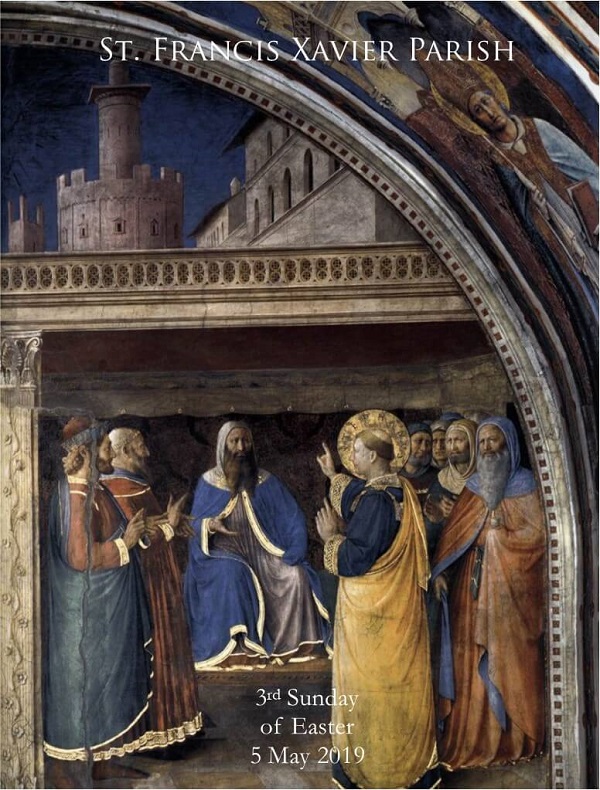
Now we could not find a proper image of Peter standing before the Sanhedrin, so instead we are placing on our bulletin cover for this 3rd Sunday in Easter a work by the great Florentine, Dominican-religious painter, Fra Angelico, which depicts St. Stephen in his interrogation before the Sanhedrin. It is entitled, Dispute before Sanhedrin (1449). We can easily imagine St. Peter fixed in Stephen’s place, brought before the authorities for preaching about the life of Jesus after being charged not to (Acts 5:28).
This beautiful fresco in the Niccoline Chapel in the Vatican Palace is a wonderful example of an Early Renaissance work which makes its point with the multiple gestures of its figures. Stephen expresses the same hope Peter would have shown in the life of Jesus Christ, even in the face of great threat by an authority seeking to crush it. We too are called to go out and profess our faith in Christ and His Church even as we face ever-new threats and suppressions to the love and truth of God.
–Steve Guillotte, Director of Pastoral Services
by SFXparish | Apr 26, 2019 | BLOG
Thus they even carried the sick out into the streets and laid them on cots and mats so that when Peter came by, at least his shadow might fall on one or another of them. (Is 50:6:7)
There are two kinds of shadow. The first gives respite from the hot sun. This is what we simply refer to as “shade” and Jonah, while in Nineveh, was very glad for its presence and angry at its loss (Jon 4:6; 8-9). The other type of shade is metaphorical as in J.R.R Tolkien’s The Lord of the Rings, where the preservation of light (goodness) was threatened to be overcome by the shadow of darkness (evil). Hence, trees cast shadows providing relief from the heat; but the devil also casts his shadow upon a world that should quake in fear if not for the redemptive act of Jesus Christ.
The psalmist also presents this dichotomy of shadow. In Psalm 23 he speaks of the “valley of the shadow of death” which the psalmist would rightly fear if God was not with him with his rod and staff of comfort (Ps 23:4). Psalm 23 offered the Israelites a glimpse of hope, a prophetic consolation until the coming of the Christ.
Yet, the psalmist also speaks of a shadow of blessing in Psalm 17. Here God Himself is our pleasing shade, our “refuge from… foes” (Ps17:7). The psalmist is overjoyed for this kind of shade as he asks God to hide him “in the shadow of [his] wings” (Ps 17:8). The psalmist finds in this shade protection from his enemies.
We Christians know that the greatest and last enemy is death (1 Cor 15:26). Fortunately we have the soothing message of St. Paul that Christ comes to destroy the shadow of death. (Still, it is good that we remember that this shadow remains for those who utterly reject God’s divine mercy and show no mercy themselves – Mt 18:30-35).
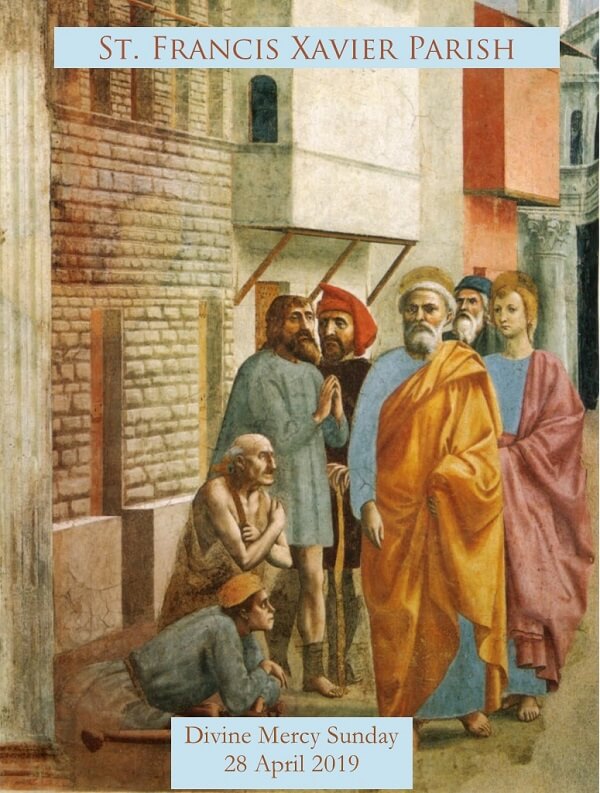
Thus, on this Divine Mercy Sunday we have placed on our bulletin cover a work by the great Quattrocento, Florentine painter Masaccio entitled St. Peter Healing the Sick with His Shadow. Masaccio ushered in the Early Renaissance and like Giotto is another example of how the medieval gothic style transitioned organically into the renaissance through artistic progression (not through radical reformation as some would claim) especially shown in Masaccio whose early works were Gothic triptychs and sacred icons. Masaccio was one of the first Italian painters to master light and perspective; and emotion through posture and expression.
In our art piece taken from today’s first reading, Peter appears almost cold and uncaring in appearance as he passes the on-looking sick and immobile. But we must recall the transitional art of Masaccio and that he was painting in two styles. If you cut out the image of St. Peter and set it alone it would appear statuesque. This is the sacredness of the Gothic. Next we have attentive figures who await Peter’s healing. This is the naturalism of the Renaissance. These latter figures are active venerators of Peter’s shadow which is cast as God’s grace on the lame man sitting on the ground. No doubt this fresco inspired young artists with hope in the novel style. Yet, it also inspired eager Christians with hope for a glorious healing.
-Steve Guillotte, Director of Pastoral Services
by SFXparish | Apr 19, 2019 | BLOG
They found the stone rolled away from the tomb… While they were puzzling over this, behold, two men in dazzling garments appeared to them… They said to them, “Why do you seek the living one among the dead? He is not here, but he has been raised. (Lk 24:2, 4, 5-6)
St. Paul declared consistently that death befell mankind as an effect of sin. In his letter to the Colossians, Paul states that we were all once “dead in our transgressions” (Col 2:13) and in his epistle to the Ephesians Paul states much the same, adding that we were brought to life only through Christ (Eph 2: 1, 5). Thus when we read the above quotation about the angels speaking to the women who came to visit the tomb of the crucified Jesus on the first Easter morning, we must consider that “among the dead” relates not only to those who have physically died. In the spiritual sense, “living… among the dead” means living a life of sin without the rectification of grace offered by Jesus Christ – the Son of God who became man, suffered, died, and rose from the dead, and who is most alive because he never sinned.
On Easter morning Jesus not only broke from His own tomb; He smashed all our tombs as well. He set man free (Jn 8:36) so we might arise from our spiritual death in sin and so approach the waters of the baptism unto new life (Rom 6:3-4). Easter and baptism are intimately connected which is why the Church baptizes its new, adult Catholics at the Easter Vigil Mass and why those of us already baptized renew our promises at Easter. As St. Paul writes in his Letter to the Romans, our bloodless baptism makes us die and rise with Christ.
This is very important because we must renew our commitment to evangelize the truth about the necessity of baptism for salvation. Easter Sunday is a good day to begin. Now it is true that the Catechism of the Catholic Church teaches “a baptism of desire” unto salvation for those ignorant of the Gospel message. However, we must be honest and admit that self-satisfied, post-modern man is becoming ever less likely to seek the truth and do the will of God (CCCC 1260) without intervention from an Easter person. To be an “Easter People” means not only that we are saved, but that we work to save others through baptism and by calling people back to their baptismal roots.
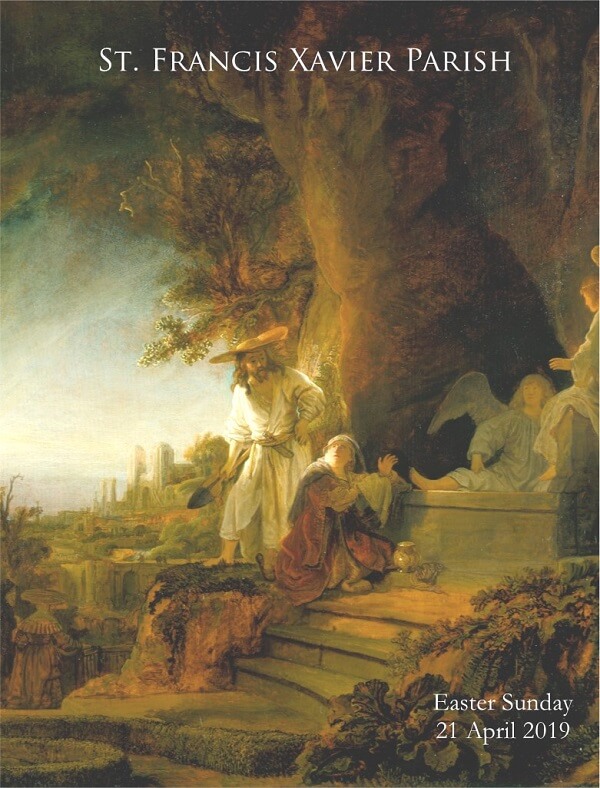
We place on our bulletin cover for this Easter Sunday a painting by the Dutch master, Rembrandt, entitled Christ and St. Mary Magdalene at the Tomb (1638). Here we see Christ the Creator at a distance from Jerusalem establishing his new creation represented as a well-kept garden. We see angels leisurely guarding the empty tomb; we see Jesus in the attire of a gardener. The figure of Mary Magdalene is a hinge between the angels and Jesus.
In the lower left we see two people walking away uninterested; they represent the world. Yet Mary who once anointed Jesus in Bethany (Jn 12:3) and comes again Easter morning to do the same, is full of interest. She will be glad to be anointed herself in the cleansing of baptism still to come (Mt 28:19).
–Steve Guillotte, Director of Pastoral Services
by SFXparish | Apr 13, 2019 | BLOG
I gave my back to those who beat me, my cheeks to those who plucked my beard; my face I did not shield from buffets and spitting. The LORD GOD is my help, therefore I am not disgraced… (Is 50:6:7)
The farsighted utterances of the prophet Isaiah generally known as the Suffering Servant Prophecies (which include the quotation above) are written in the past tense. This should amaze not only Christians, but every person with an open mind toward religion. This is because if, for instance, we heard a man saying: “I went to the grocery store and picked up some fruits and vegetables”, we must assume that this man already completed the task. Such would also be the case if we overheard the man say, “I gave my back to those who beat me…” In this case we would surmise that the man was captured by an enemy and mistreated in the past. Yet, this same sentence was written by Isaiah some seven centuries before the action ever came true. For some reason, the Spirit of God wished to describe a future event using the past tense. This is not a case of “going back to the future”, but rather of going forward to the past!
Why didn’t Isaiah write instead, “I will give my back to those who will beat me…” like when he wrote, “a virgin will conceive a son and will call him Immanuel? Why is the Incarnation in the future tense for Isaiah, but the Passion in the past tense? One spiritual explanation is that since the future tense of a verb gives the sense of something that still has to be proven, the past tense gives the sense of it being proved. Hence, while the Spirit wanted the Incarnation to require our verification, the Spirit desired that the Passion be already verified. In spiritual terms this means that we are to await the joy, having acknowledged the sacrifice.
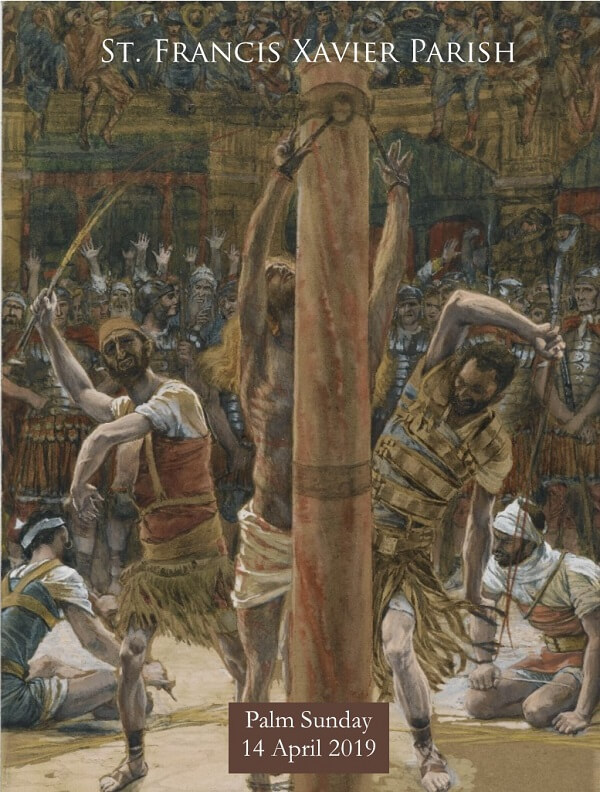
To commemorate the sacrifice of our Lord Jesus Christ on this Palm or Passion Sunday, we have placed on our bulletin cover another work of James Tissot entitled The Scourging on the Back (1894 – courtesy of the Brooklyn Museum). Here we see the sad but glorious fulfillment of the quotation of Isaiah. We say “here” because even though the Passion is in the past we explore its science and its art in the present during every season of Lent. Whether in the Stations of the Cross or the reading of the Passion or the meditation on the Crucifix or in the present suffering of ourselves or of those we love, we attempt to experience and understand the loving and redeeming sacrifice of Jesus Christ.
Many other denominations of Christians would desire that Catholics just get over it; that we take Jesus off our crosses and move on to the Resurrection. Well, we do get there eventually, as we will next Sunday. But first we prefer to be faithfully biblical and revel with Isaiah in the past and future tenses. We also revel with the Psalmist in the present tense as when he proclaims of Our Lord’s sacrifice, “My heart is ready O’ God; my heart is ready!” (Ps 108:1)
–Steve Guillotte, Director of Pastoral Services