by SFXparish | Apr 5, 2019 | BLOG
Jesus bent down and began to write on the ground with his finger. But when they continued asking him, he straightened up and said to them, “Let the one among you who is without sin be the first to throw a stone at her.” (Jn: 8:6-7)
The biblical narrative of the adulteress who was brought by the scribes and Pharisees before Jesus for judgment is (in the gospel of John) a brief but profound story. St. John related this story not only to instruct his readers about how Jesus was tested and pursued by the Jewish leadership, but also as a lesson about divine absolution. It is true that the Pharisees had earlier sent some officials to arrest Jesus (Jn 7:32). It is also true that the Pharisees even imputed one of their own, Nicodemus, for listening to Jesus (Jn 7:52). These are important points as John prepares to relate the Passion of Christ. However, this story is not only about the growing conspiracy against Jesus; it is also about the developing science of sacramental forgiveness.
Notice that the story does not follow the normal sacramental order of Confession: examination of conscience, firm purpose of amendment, confession, penance, and absolution. Yet, all parts of the confessional experience are present. First, the woman was caught in adultery and so the confession comes rather as an accusation. This is how we should all approach confession – as if caught in the act and exposed to accusation before God. Next comes the demanded penance which Jesus forgoes for now in place of the examination of conscience – not only for the adulteress, but also for her accusers (the practice of which thankfully curtails their own sin of murder). Finally, Jesus forgives the adulteress by way of His divine omniscience; for he graciously perceives her sorrow and her intent to amend her life. Lastly, underlying this science of reconciliation is its unspoken vital principle for all absolution: that in order to be forgiven, one must be willing to forgive others (Mt 18:33-34).
To recall this wonderful narrative of divine forgiveness on this 5th Sunday in Lent, we place on our bulletin cover a work by the Venetian Rococo painter Giovanni Battista Tiepolo entitled, Woman Taken in Adultery (courtesy of the Smithsonian American Art Museum). Rococo was a highly decorative style expanded from the Baroque, and Tiepolo was one of its masters who painted ceilings and other frescos with ornate religious, classical, and allegorical themes.
We are only able to show the central portion of the painting. We see a Pharisee standing behind the woman with his hand up as if to hail Jesus’ authority when in truth he has come to undermine it. Tiepolo creates an invisible diagonal, an interlocking “look” between Jesus and the Pharisee which visually goes through the woman. Absent is the force of any stone throwers while Jesus Himself is presented forward-kneeling on left leg as one able and ready to pounce forward in defense of the lady. This may also be why the Pharisee appears with docile bow, hiding behind the woman from the strong justice of Our Lord.
Now our adulteress may not be the guiltless Susanna protected by Daniel (Dn 13:48), however she has, as every repentant sinner does, the merciful protection of Jesus Christ.
–Steve Guillotte, Director of Pastoral Services
by SFXparish | Mar 29, 2019 | BLOG
On the day after the Passover, they ate of the produce of the land… On that same day after the Passover, on which they ate of the produce of the land, the manna ceased;… the Israelites … ate of the yield of the land of Canaan. (Jos 5:11-12)
Canaan was an ancient land of the Near East most immediately east of the Mediterranean Sea. It is the land promised by God to Abraham and his descendants (Gn 15:18-21). For forty years the Israelites journeyed toward this country, wandering in the wilderness while being led by Moses until his aide Joshua finally crossed the Jordan River (Jos 3:17) and brought the Israelites into this Promised Land. During their forty year sojourn in the desert the Israelites gathered up and ate manna, food which appeared miraculously each morning on the floor of the wilderness. Moses and Joshua had led the sons or tribes of Israel out of Egyptian bondage; a bondage that had begun only after the pharaohs had forgotten the good deeds and blessings brought upon Egypt by God through Joseph (Ex 1:8-10), the son of Israel and Rachel.
Once the Israelites crossed the Jordan River by the power of God, they began to eat of the fruit of their new land. This was a sign not only of the completion of their journey but also of the completion of their fast and abstinence in the desert, a forty year penance brought on by their own disobedience (Num 14:34). With the manna, God sustained the ancient nation of Israel throughout its moral and spiritual rectification. The manna was not only physical nutrition, but also salvific representation: a sign that God would sustain them and forge them into a unified nation in the midst of many trials. Further, that the manna ceased to appear in proximity to the first Passover feast celebrated in the Promised Land, indicates that it was the Passover, not the manna, which would be the future glory of Israel.
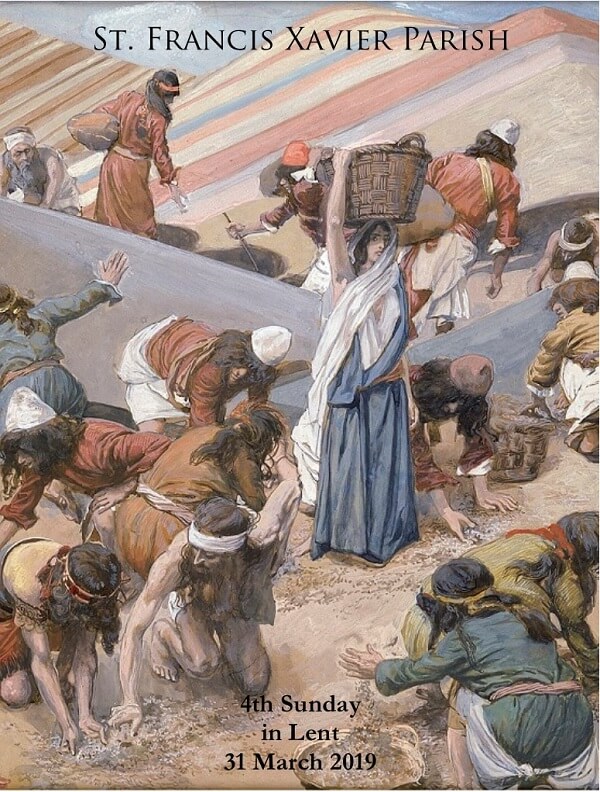
To better explain this notion we have placed on our bulletin cover another work by James Tissot for this 4th Sunday in Lent. This work, painted on wood board in gouache or opaque watercolor, is entitled, Gathering of the Manna (1896). The water base paint creates an image which close up looks more like an illustration for an action comic book; and this image is full of action: bodies leaning and twisting this way and that way, while the segmented dunes produce a deepening and distant artistic perspective.
Whether intended or not, this work is symbolic. The multiple colored striping of the dunes reminds us of God’s rainbow (or rather God’s promise) to Noah; but more suitably it recalls the “many colored coat” made by Jacob for his son Joseph (Gn 37:3). Proceeding visually from the banded background, we can see the Israelites moving away from the Josephic Egypt into the Mosaic Law (foreground) symbolized by (and allied to) the descendant manna. Yet in the middle of this scene stands a woman looking solemnly toward the future. She looks to the Passover still-to-come in Jesus Christ, the Bread from Heaven. She stands as a pillar of revelation, a sacred caryatid; a majestic or even Marian monstrance upholding the basket of the Bread of Life, our Most Beloved and Holy Eucharist.
–Steve Guillotte, Director of Pastoral Services
by SFXparish | Mar 22, 2019 | BLOG
‘For three years now I have come in search of fruit on this fig tree but have found none. So cut it down. Why should it exhaust the soil?‘ (Lk: 13:7)
It must be allowed that fig trees may not bear fruit until the age of four, so the tree in our story must be about seven years old. Figs need not be grown in an orchard; they are self-fruitful. They do require much sun and the right amount of fertilizer – too much feeding however can cause the fruit to fall immature and then result in a long recovery period. This is not the case of the fig tree in our parable. It has been underfed.
In this parable, the gardener responds to the owner of the tree: ‘Sir, leave it for this year also, and I shall cultivate the ground around it and fertilize it; it may bear fruit in the future. If not you can cut it down.’” (Lk: 13:8-9). In spiritual terms, fertilizer is symbolic of nutrition (i.e. grace) while the soil in which the tree is planted on earth is the ecosystem of grace, that is, the Church, which itself needs regular tilling.
In this parable the fig tree is the human soul. Souls in the state of grace produce good fruit. It is the soul that is not in the state of grace, but which lives in grave sin, which is fruitless. The fig tree in our story is the soul that stubbornly refuses the grace and mercy offered by God. The story is meant to show us that God the Father is very patient by offering active grace and interior sanctity. Yet in the end, the soul that proves itself willfully fruitless will be cut down, fully cut off from grace and uprooted from the mystical Church, the Body of Christ, which malicious souls “exhaust”.
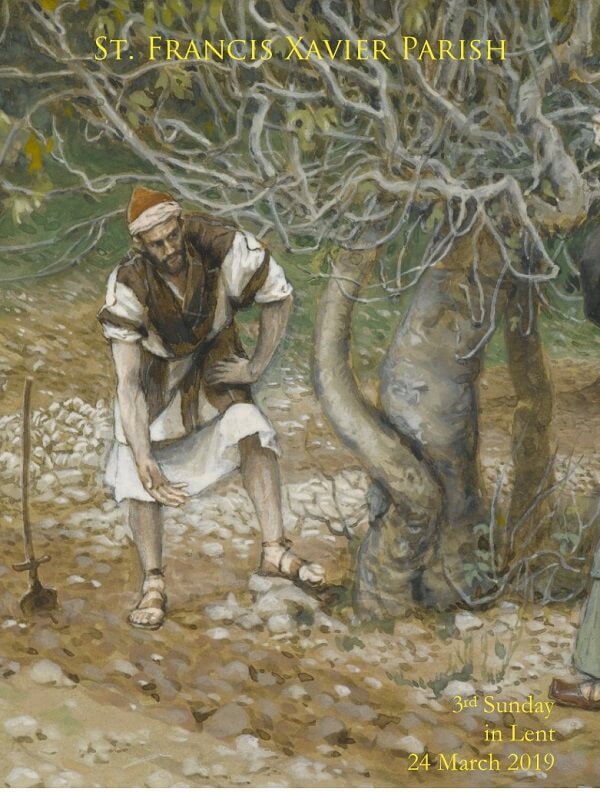
On this 3rd Sunday in Lent we place on our bulletin cover a work by religious genre painter James Tissot, entitled The Vine Dresser and the Fig Tree. This “event” is presented (as with many of Tissot’s works) with scenery requiring a landscape rather than a portrait viewing. Hence, we are unable to include on our bulletin cover the full image of the owner of the tree; we show only his foot in the lower right hand corner of our bulletin image to acknowledge his presence.
Here we see the fig tree sporting very few leaves so that its capacity to receive light has been compromised. It is not prosperous (Ps 1:3). Its defoliation has come about through its failure to take in the proper nutrition (grace). In the parable, the tree is given more time to allow for “soil improvement” so that it may be saved (i.e. be fruit-bearing in the future). The vine dresser is Jesus Christ; but so are his vicars, the stewards of the Church which stand in for Him on earth. If they fail to feed the fig trees by properly fostering the soil – the Church – then they too will be held to account to the owner (God) for their time and produce. In our illustration then, it is not only the fig tree, but also the stewards, who, especially at present, are in a place of spiritual probation.
–Steve Guillotte, Director of Pastoral Services

by SFXparish | Mar 14, 2019 | BLOG
The Lord God took Abram outside and said, “Look up at the sky and count the stars, if you can. Just so,” he added, “shall your descendants be.” Abram put his faith in the LORD, who credited it to him as an act of righteousness. (Gn: 15:5-6)
When God spoke with Abram and promised him a great reward, Abram responded that a reward or gift would be pointless since he had no children on whom to bestow it; and Abram was already aged. God responded that the gift he would give to Abram was in fact an abundance of children down to many generations. Abram (eventually named Abraham by God) thus becomes (through his wife Sarah) the father of Isaac, who becomes the father of Jacob, who becomes the father of the nation of Israel. But this is not all that God intended.\
St. Paul elucidates God’s promise to Abraham not in terms of offspring, but in terms of faith. He recalls God’s other promise to Abraham – to make him the “father of many nations” (Gn 17:5) which at the time the promise was sealed was the exact moment God first called the once pagan Abram, “Abraham”. Paul explains that Abraham becomes a father through faith (Rom 4:16) and thus the “father of us all” who come to God through faith. The essential promise that God made to Abraham was to create the Church: the People of God, through Abraham’s example of faith.
We might wonder why God did not become angry with Abraham when he questioned the efficacy of God’s gift. It is because it was an entirely unselfish inquiry. A “reward” appeared meaningless to Abraham without its perpetuity; without it being able to be shared with those who would come after him. Abraham could have bequeathed God’s gift to those outside his family – to a servant not of his household (Gn 15:2) – but symbolically and mystically this gift would not have led to the spiritual household God intended: the household of the faithful which would adhere to the commands and love of the Son of God (Rom 4:24).
In order to commemorate the meeting between God and Abram, we place on our bulletin cover for this 2nd Sunday in Lent a painting by the German landscape painter Caspar David Friedrich, entitled Two Men Contemplating the Moonlight (1830). Friedrich painted in the Romantic style which reacted against the classical method. The Romantics believed the classical style to be too preoccupied with convention which could not properly and profoundly allow man’s free reflection upon nature. We, however, use this piece by Friedrich to create a visual allegory, not for a scrutiny of the natural, but of the supernatural: the spiritual contemplation of that intimate covenantal moment between God and Abraham.
Here God is represented in angelic dialogue as he leans slightly bent upon Abram’s shoulder. He is bent to show that God is of-old and wise beyond all ages; even his creation, the trees and rocks, bend in honor of his eternal presence. Abram however is represented rather straight and still as one held back in stasis until the future of faith comes to life fully in the Holy Spirit. God shows Abraham his future – which is us: we who believe in Jesus Christ.
-Steve Guillotte, Director of Pastoral Services
by SFXparish | Mar 7, 2019 | BLOG
“If you are the Son of God, throw yourself down from here… Jesus said to him in reply, “It also says, You shall not put the Lord, your God, to the test.” (Lk: 4:9;12)
If you are a parent, then it is very likely you have had recourse to the phrase, “You are testing my patience”. It is very unlikely though that you ever said, either as a parent or otherwise, “You are testing my humanity”. This is unfortunate because our human nature is tested regularly by our present culture to become less human. We are tested over life in the womb, gender in the body, sex outside of marriage, and the practice of religion in society. We are asked to “choose” about intrinsic values which in nature invite little or no choice. In effect, our humanity is tested by a rebellious power each and every time we are challenged to give up our inherent human freedom for a licentious inhuman freedom.
No doubt God could be heard (if we listen close enough in prayer) saying often to us, “You are testing my patience”. We are most fortunate that God is patient; patient with a purpose. For as St. Peter tells us: “The Lord does not delay his promise, as some regard “delay,” but he is patient with you, not wishing that any should perish but that all should come to repentance” (2 Pt 3:9). God knows that we will test his patience, and he is forbearing so that we will come to be sorry for our sins – sorry that we have tested his patience.
The devil is another matter altogether. Long ago God’s patience ran out with the devil (Is 14:12) who being of the angelic order has a will most deliberate and fixed. Lucifer was never satisfied just to test God’s patience. He set out to test God’s divinity. We see this in today’s gospel reading where he challenges Jesus to throw himself from the parapet of the Temple so that God the Father might have to act to save Him. He wanted Jesus to test God as God, and thus to tear at the very fabric of divine trust within the Holy Trinity. However, Jesus would not test the Lord God, His beloved Father.
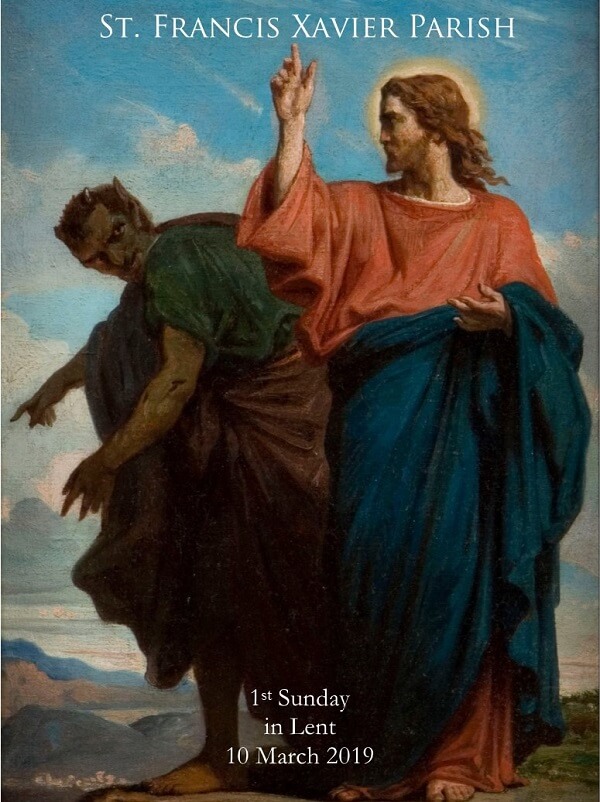
In order to encapsulate this event, we have placed on our bulletin cover for this 1st Sunday in Lent a painting by the French Academist, Felix Joseph Barrias entitled, The Temptation of Christ by the Devil (1860). Barrias was a historical classicist who also painted ancient religious scenes in the classical style. In this oil on canvas Jesus is actually on the mountain top in the moment of being tempted by the devil to take rule over the world (Lk 4:6). Yet we can also surmise here Satan inviting Christ to throw himself downward so that His Father’s angelic host would lift him up and carry him to safety (Lk 4:10-11). Jesus instead points upward indicating that He is always obedient to his Father’s will and that the rule of His kingdom is in heaven.
Barrias paints the devil in all his disfigurement; for when the devil challenged God’s divinity he forfeited the angelic beauty graced to him by the Lord (Gn 3:1). In defying the mastery of God, the devil sought self-mastery. All he gained was self-defacement, as do his followers today.
-Steve Guillotte, Director of Pastoral Services