by SFXparish | Jun 13, 2019 | BLOG
“[The Spirit] will glorify me, because he will take from what is mine and declare it to you. Everything that the Father has is mine…” (Jn 16:14-15)
In the political state known as “communism” everything allegedly belongs to “the people” because the people make up the state and the state owns all. In this theory what is considered “mine” is lent me from the state which gets what it has from the people. In effect, communism is a dictatorial trinity of individual, state, and people.
It is certainly not a Holy Trinity. The Holy Trinity is spiritual. Communism on the other hand is thoroughly material; and all that is “mine” through the state and all that the state can give me is material and economic. Even the national “spirit” of a communist state is materialistic and atheistic making it “anti-Trinity”.
According to theoretic communism what belongs to individuals was never theirs to begin with. In order to consolidate all and give everything over to the state, the people first have to take all that is mine and yours – your private property and your freedom. Then once the people have confiscated all and converted all into state property, state authority can regurgitate to its individuals some of what it had earlier swallowed up, keeping most for itself. Communism operates through distribution, but it has no love.
The Holy Trinity is a communion. It is the very opposite of communism. It is a union of divine love. In the Father exists all that there is and he shares this willingly and lovingly with the Son who accepts it thankfully and graciously. Jesus says of the Holy Spirit that the Spirit “will take from what is mine”. The Spirit does this joyfully; and for Jesus it is a joy to give it.
Now one might say that communion is easy for God because unlike the earth with its limited resources God can give all away and still have all. This may be true and it may be what is needed for a perfect communion. However, God showed that he is quite ready to give all from what he has, even his only beloved Son, for the sake of his love. That is real communion.
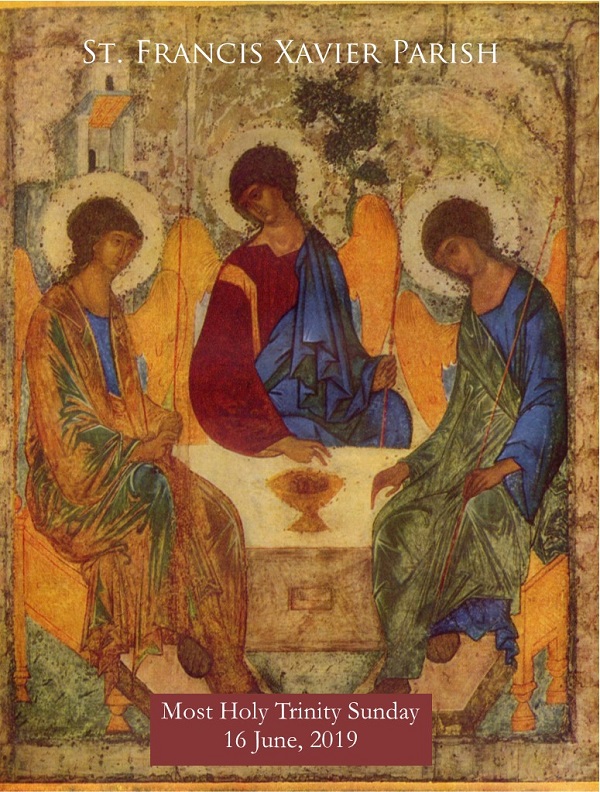
For this Most Holy Trinity Sunday, we place on our bulletin cover the famous iconic work of the Russian painter Andrei Rublev, entitled The Trinity (1427). It is painted in the tradition of the biblical narrative of the Hospitality of Abraham, yet for the purpose of man’s adoration of God Rublev removes the human actors (Abraham & Sarah) and transforms the three angelic visitors into a symbol of the Most Holy Trinity.
There are many and sundry interpretations of this work. For our purpose we will keep it simple. The angelic figure on the left appears to be the Father to which the other two figures focus all their attentiveness. The cup (certainly representative of the Eucharist) is a symbol of what is shared and what is received; for all that the Father has is Christ’s and all that is in Christ is there for the Holy Spirit to take. What the Spirit takes he distributes to man in grace, word, and sacrament; and always with an abundance of truth and love so that we who receive it may be in full communion with God and with each other.
–Steve Guillotte, Director of Pastoral Services

by SFXparish | Jun 6, 2019 | BLOG
“In the same way, the Spirit too comes to the aid of our weakness; for we do not know how to pray as we ought, but the Spirit himself intercedes with inexpressible groanings.” (Rom 8:26)
Prayer is not as easy a thing as one might think. Some say that it is only a “conversation with God” but it is very unlike the face-to-face (or Facebook to Facebook) conversations we are accustomed to these days. In fact the Latin root of the word conversation has as its meaning, “intimacy”, “familiarity” and the notion of “living among” others. To converse well with God, one must live among him (and his household).
Now anyone can speak to God, and if you do not now, you are encouraged to begin at any and all times in any way you can. However, to gain intimacy with God you must let Him do the speaking; you must sit quietly and listen as he tells you about his life, especially through his word and sacraments. Even so-called “passive” prayer requires effort, just as listening to anyone requires attentiveness. In order to listen well, a person needs patience and needs to put away his pride. This also takes effort.
Hence, we are most fortunate to learn today from St. Paul that the Holy Spirit intercedes for us in the matter of our weakness in prayer; the Spirit teaches us how to pray. If however you listen to some Christian’s today, including some Catholics, they will tell you that the only way to pray in-the-Spirit is the “charismatic” way. Thus, some take the phrase in our quotation above, “inexpressible groanings” to mean speaking in tongues. Yet how can this be since tongues are expressed quite emphatically whereas the groanings Paul speaks of here are “inexpressible”. Even the word “groaning” sounds not very salutary in that it can mean “creaking” of “grunting”. What is meant here is that the person who in prayer joins his interior sighs to the sighs of the Holy Spirit will enter into this Spirit through a mutual, loving yearning. That is, just as the creature yearns for the Creator, so the Creator yearns for his created.
In order to celebrate this Pentecost Sunday, we place on our bulletin cover a work by the Dutch Renaissance painter, Jan Joest, entitled simply, Pentecost. In particular the Dutch Renaissance is called the Northern Renaissance to distinguish it from that other work particularly in Venice, Florence, and Rome. Like so many northern masters Joest gives particular detail to each of his figures so that the distinctness of their features seems to tell a story about each of them. In Pentecost, we see young, middle aged and elder men; elder men with full heads of hair, younger men who are balding, and men without hair; bearded and fully shaven faces; men who are elated or somber; yet all prayerful as the Holy Spirit comes to each of them offering them what they need to pray in their diverse weaknesses. In the center of the scene is Mary, focusing us (the observers) on the Word of God, her beloved Son.
Notice that the pages of the book Mary is holding appear to turn on their own – in the breath of the descending Spirit. It could be said, that once again, Our Lord Jesus has come to do the breathing (Jn 20:22).
–Steve Guillotte, Director of Pastoral Services

by SFXparish | Jun 3, 2019 | BLOG
“And I have given them the glory you gave me, so that they may be one, as we are one, I in them and you in me; that they may be brought to perfection as one…” (Jn 17:22-23)
Some pagan philosophies, including Plato’s, have put forward a didactic legend that the human race began as one soul which was broken apart. Plato posited that since the One has become many (Plato didn’t like the many) man is trying desperately to get back to the One. Plato explains that war is one way man unknowingly fights and claws his way back to the One. This is interesting as an ancient myth, but as a serious religious belief it will not do.
We know that only God is One, and that he has created many things and beings other than himself; and that he has called these “good” (Gen 1:10,18 etc.). We also know that war offers no promise, poetic or otherwise, toward unity. We know that war is the ultimate human disunity and that peace (e.g. which may sometimes come only after war) is what brings about unity.
We also know that the human race is not united. This is not to suggest that the world should have one government for all people; this would never accommodate the varied and diverse free peoples. The Church is certainly a sign of unity on earth, and it is more diverse and varied in peoples than anything the secular agenda could ever manage to construct artificially. The Church is of course the Body of Christ. Its unity relies upon the grace of God. It requires that the Father be in the Son and the Son in the Father and that this divinity be in us through the Holy Spirit. Charity and justice is one of the main unifiers of the Church. However, the Church would run amiss in its universality if it were to neglect its primary unifier, its common liturgy which must be wholesome, beautiful, and worshipful so as to preserve its dignified unity.
In order to capture this notion we have placed on our bulletin cover for this 7th Sunday in Easter a work by the minor Spanish Baroque painter Juan Carreno de Miranda, entitled Mass of St. John Matha (1666). Miranda was a court portrait painter who also had the Church as one of his patrons. St. John Matha was the founder of the Trinitarian order of priests whose original charism was to ransom back captive Christians from Muslim pirates.
Here we see the Holy Mass in its triumphant reality: a holy sacrifice offered by the priest, prayed for by the laity, witnessed by the saints, gathered in by the angels, and deposited at the throne of the Blessed Trinity – all through the vessel of the holy altar on earth. Unifying earth and heaven is also the prayer of the Blessed Mother, the Virgin Mary, seen standing in visionary form upon the tabernacle.
In this image the entire earthly attendance is focused on the consecration of the Holy Eucharist, while Miranda gives us also a vision of the invisible heavenly attendance which joyously receives this offering. In this great prayer, “the source and summit of the Christian life”, is the hope of all our unity, and the unity of all our hope.
–Steve Guillotte, Director of Pastoral Services
by SFXparish | May 23, 2019 | BLOG
‘I am going away and I will come back to you.’ If you loved me, you would rejoice that I am going to the Father… And now I have told you this before it happens, so that when it happens you may believe.” (Rev 21:3, 5)
We are never inclined to rejoice when someone that we love departs from us. If we dearly love that person, then departure, even for a little while, feels a great loss; thus we are much less likely to rejoice when that person goes away and cannot be seen or reached again, as say in death. We grieve and mourn for the person’s absence, their powerlessness to return, and our powerlessness to call them back. This may even lead some Christians to falter, put aside their faith for a time, and seek solace in secret and false knowledge, psychic mediums and other forms of esoteric spiritualism practiced by the wayward, the pagan, and the charlatan.
Jesus predicted that He would go away and leave the disciples who loved Him dearly. Rather than accepting the bemoaning of His parting, He cautioned them that if they loved Him they would rejoice at His leaving the world. Jesus required that they prove their love for Him by being joyous that He, the Son of God, would be reunited in heaven with His Father. He also wanted them to rejoice because it would be proof that they believed that He would return to them in the Holy Spirit and eventually in glory to restore creation to its intended fulfilment (Rom 8:21). Jesus tells His disciples that he will return through a Paraclete, a helper, an Advocate, Thus, Jesus leaves his dear ones behind not as a lessening of His love but as an increase of it through the promise of a greater mystical union (Jn 14:20-21).
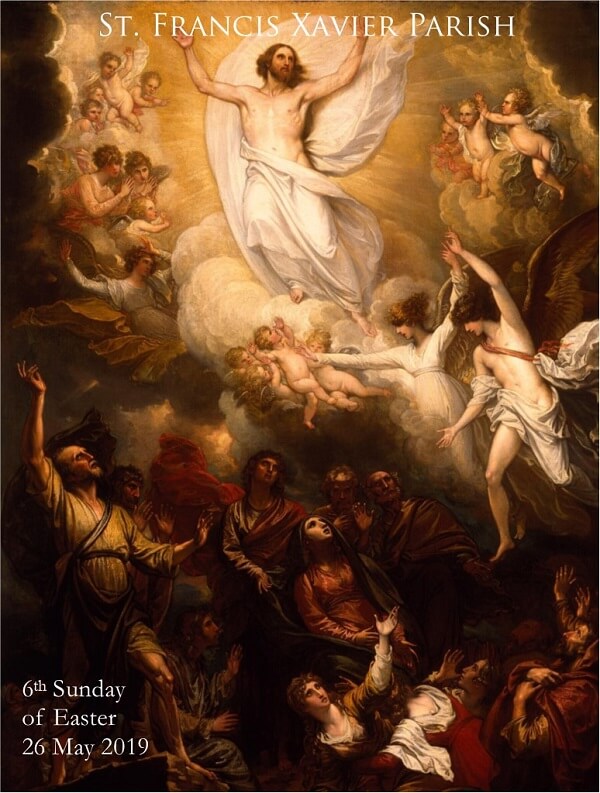
This is a special liturgical week because our celebration of Easter and Ascension converge on this 6th Sunday in Easter. We are not quite at the Ascension, but the Gospel reading gives us a foretaste through a divine assurance. Hence, we place on our bulletin cover a work by American and British painter, Benjamin West, which anticipates Ascension Thursday, entitled The Ascension (1801). West was born in Pennsylvania, was friend of Benjamin Franklin, and eventually visitor to England, which became his permanent residence. He was famous for contemporary war scenes and images of classical Roman history and mythology. He once made a tour of Italy and later in life took to religious painting.
This glorious scene of the Ascension seems influenced by his Italian study. It reminds us of the color, contrast, and vertical style of the Venetian master Tintoretto. However, the brightness of the scene and its liturgical unity is indicative of Neoclassicism and not the Mannerism of Tintoretto with its painted figures moving hither and thither. We see here both earth and heaven united in one offering of praise shown by raised arms and upward observance.
In fact, the larger angels (middle right) raise and lower their arms bridging earth and heaven as they say to the Apostles – once Jesus had left their sight -“Why are you standing there looking at the sky”?
Our savior will come again (Acts 1:11), first in spirit (Acts 2:3), then in flesh and glory (Rev 1:7).
–Steve Guillotte, Director of Pastoral Services
by SFXparish | May 17, 2019 | BLOG
“Behold, God’s dwelling is with the human race. He will dwell with them and they will be his people… The One who sat on the throne said, “Behold, I make all things new.” (Rev 21:3, 5)
The Holy Trinity is a thoroughly self-sustaining communion of three divine persons. To say this is of course true and not true. It is true in that we may firmly believe that the one and only Godhead of Father, Son, and Holy Spirit needs nothing outside itself to fulfill itself: its Nature, that is, its Divine Nature is thoroughly accomplished and fully content. Our opening sentence is also not wholly true in that all human descriptions of the Blessed Trinity fall short of its complete beauty and majesty. Even the great St. Thomas Aquinas, who once received a personal revelation that he had written well of God, received another more beautiful and majestic vision which left him saying (in comparison) that all he had written was “straw”.
God did not need to create us or the world; neither we nor the world sustain him (Is 40:15-16). Yet, as we say and believe, “He created us because he loves us”. This is a mysterious saying since how can one love someone before that person exists? Yet for God, whose essence is existence, even this is possible. For since God is outside of time, He sees all in the present, so that the past and the future converge in the “now”.
We do not write these words so as to cause confusion. We write them to rejoice that the Lord is so mysterious and so far above us that even the word “far” cannot suffice to describe the distance. Yet, in his love God has forever bridged this distance by incarnating his divine Son with a human nature (i.e. in human flesh). The Incarnation, not some esoteric dream, but that particular act of Jesus being conceived in the womb of Mary, brought God to not only dwell on the earth, but to dwell among man forever. This is a blessing beyond all human comprehension in that it was achieved to save us from our corruption. All that we can do in its wake is to bow low and humbly before the divine favor.
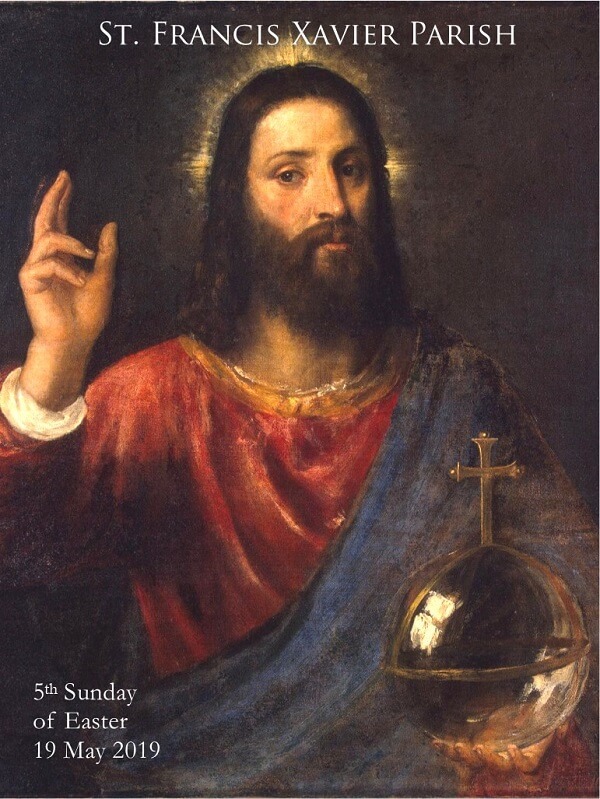
In order to encapsulate this glorious thought for this 5th Sunday in Easter, we place on our bulletin cover a work by the great Venetian master, Titian, entitled Salvator Mundi (1570). The English translation of this title is “Savior of the World”, and its simple imagery is packed with profound symbolism. First, God can now be portrayed in human form because He has become man. Next, the world is made anew by the Holy Cross which is shown rising above the earth toward heaven. Third, Christ is shown blessing the world by the second of God’s divine blessings. The first blessing is creation which was corrupted by the sin of man; the second now comes as salvation, the making of “all things new” in the sinless and obedient human nature of Jesus Christ, the Son of God.
We should think of this painting as an earlier instinctive rendering of the Divine Mercy long before the gracious depiction of Jesus, received and presented by St. Faustina; for salvation comes to the world as the merciful blessing of God.
–Steve Guillotte, Director of Pastoral Services