
by SFXparish | Nov 6, 2019 | NEWS
Please join us on Saturday 16 November from 5 to 8 pm for a parish Family Fued event to raise funds to send Rwandan children to high school in their own country. We have a special association through Father Leonard Kayondo of Rwanda to ensure that 10 children are provided for their full high school years through this raising of $5000. Tickets for this event are $15 for adults and $5 for children, 12 and over. Please call 508 995-7600 for more information. (This event takes place at the parish school).
by SFXparish | Nov 4, 2019 | NEWS
Introducing our new Parish Podcasts!
“Kindling Our Zeal” is the name of our new parish podcast series. These podcasts were recorded during our recent Adult Education Series, which is part of our Faith Formation Program here at St. Francis Xavier. Currently you will find recordings regarding the Gospel writers, as well as the Letters of St. Paul. Please check back as we will add more podcasts throughout the year.
We hope that through these talks and reflections, your faith may grow and your hearts burn with zeal for the faith like that of our patron saint.
Go to Parish Podcasts Page
by SFXparish | Oct 31, 2019 | BLOG
“For you love all things that are and loathe nothing that you have made; for what you hated, you would not have fashioned.” (Wis 11:24)
You have often heard it mentioned from the parish pulpit, and these bulletin pages, that the three transcendental properties that subsist in all created things are beauty, truth, and goodness. All created things have these inherent properties as they reflect the Creator, who when beheld, is all Beautiful, True and Good. Today, with the prompting of our quotation above taken from this Sunday’s first reading, we will focus on goodness.
The notion of goodness eludes the modern world. This is because it has limited the idea of the good to only one of its aspects: that which benefits the individual person or subject. Now there is some truth to the subjectivity of the good as it applies to the physical world, since what is materially good for one person may not be good for another person (e.g. medicine). However, when we consider another aspect of the good – morality or virtue – we see that there are some actions which are always good (i.e. objectively good or good for everyone).
Objective goodness rests in God. God is the “omega” (Rev: 22:13), that ultimate good which all objects and subjects tend toward or desire. The wing blowing, the deer leaping, and the man formulating each achieve actions particular to their respective species through the joyful will of God. We call such actions “perfections” since by the acting out of powers proper to them, things, animals, or persons actually achieve their divine purpose. We call the function and fulfilment of all these natural powers “the natural law” believing that God is the origin of this “law” which flows through the veins of his creation.
Sadly, the devil has sown into our earthly condition an “unnatural” or unintended purpose to disrupt the perfections which God created and desires for his creatures. Humanity now challenges the natural law by prompting each person to say “I am the decider of good” in many areas established by God: life and death, morality and sexuality; gender and personal identity. So let us pause and remember.
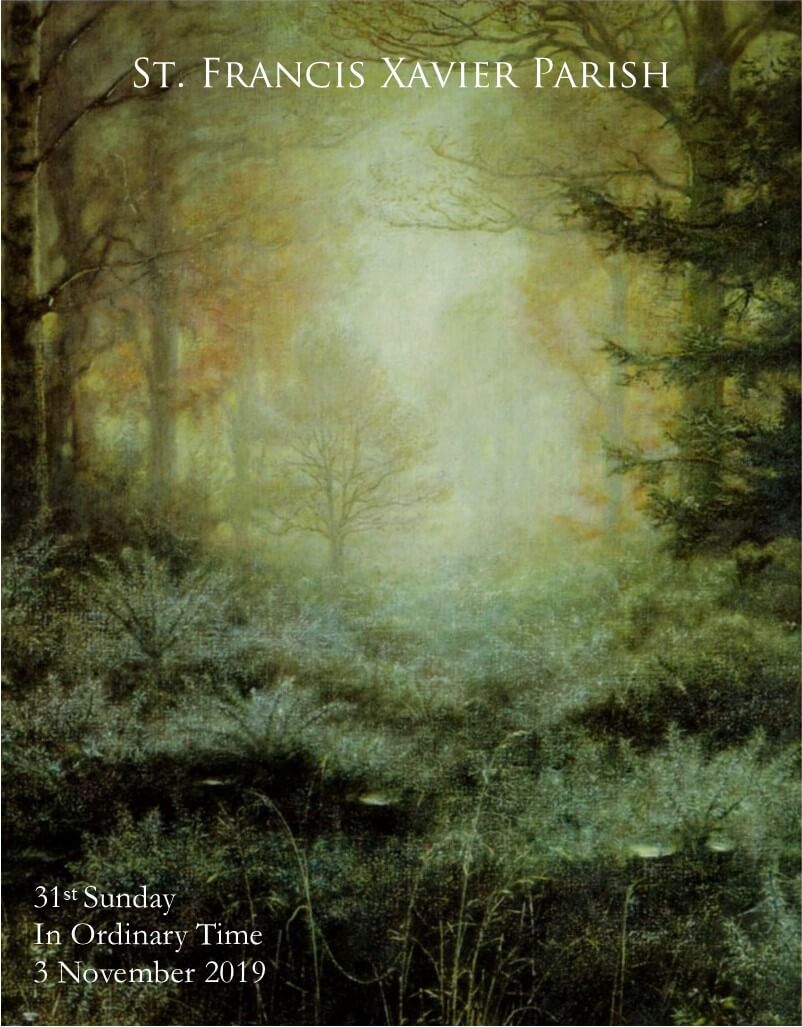
On this 31st Sunday in Ordinary Time, we place on our bulletin cover a work by painter John Everett Millais entitled Dew Drenched Furze (1890). Here we find Millais fully wrought in his landscape phase having reached his goal of serene naturalism just six years before his death.
Furze grows in Ireland, England and Scotland and as a young plant has succulent leaves like young hemlock but which become spiny in older age. Because the plants on Millais’ forest floor are drenched in dew it cannot be known if the furze is young or old. Yet, Millais purposely leaves out the plant’s bright yellow flowers to give his observer a strong sense of the primordial world full of the original purpose of God.
Perhaps it is well to recall some words of Hamlet to his beloved Ophelia: “God has given you one face, and you make yourself another”. This we do each time we seek our human happiness and identity outside of the natural law. God gives us the natural because he desires our good, so that our lives will be serene. Instead, we have chosen agitation, confusion, and havoc.
-Steve Guillotte, Director of Pastoral Services
by SFXparish | Oct 25, 2019 | BLOG
Beloved: I am already being poured out like a libation, and the time of my departure is at hand. I have competed well; I have finished the race; I have kept the faith. (2 Tim 4:6-7)
It is quite fortuitous (and fortunate) that just as we received last week the final instruction in our adult education series on St. Paul by examining his 2nd Letter to Timothy, we read from this same letter this Sunday at Holy Mass. It is also fitting to read from this letter just before Advent which is the opening of a new liturgical year. For us, Paul’s anticipation of his own death in this letter to Timothy feels like the closing of the apostolic age and the ushering in of a new but challenging age since with Jesus ascended and the apostles gone, all who come after them who have never met Jesus must move forward with Jesus through a life of unseen grace. This is the age we still live in today, a time in which we must put on hope and offer witness to Christ because we are those who remain; those who “have not seen but have believed”. (Jn 20:29).
In our quotation above taken from today’s second reading, Paul is writing to Timothy to inform him that he is prepared to make a final sacrifice of his life in imitation of Christ. Paul is like Ulysses, that fateful Greek mariner in the poem of the same name by Alfred Lord Tennyson, who speaks the words, “I will drink life to the lees”. Ulysses will not waste even the last drop of wine from his bottle. Similarly, Paul’s earthly life is now finally flowing out from him. He will pour out the last drop on an altar of sacrifice for the Lord. His “departure is at hand”. He wants to give all that he has left to God; for Paul has “competed well”, “finished the race”, and “kept the faith” through trials and tribulations so as to win the crown of victory.
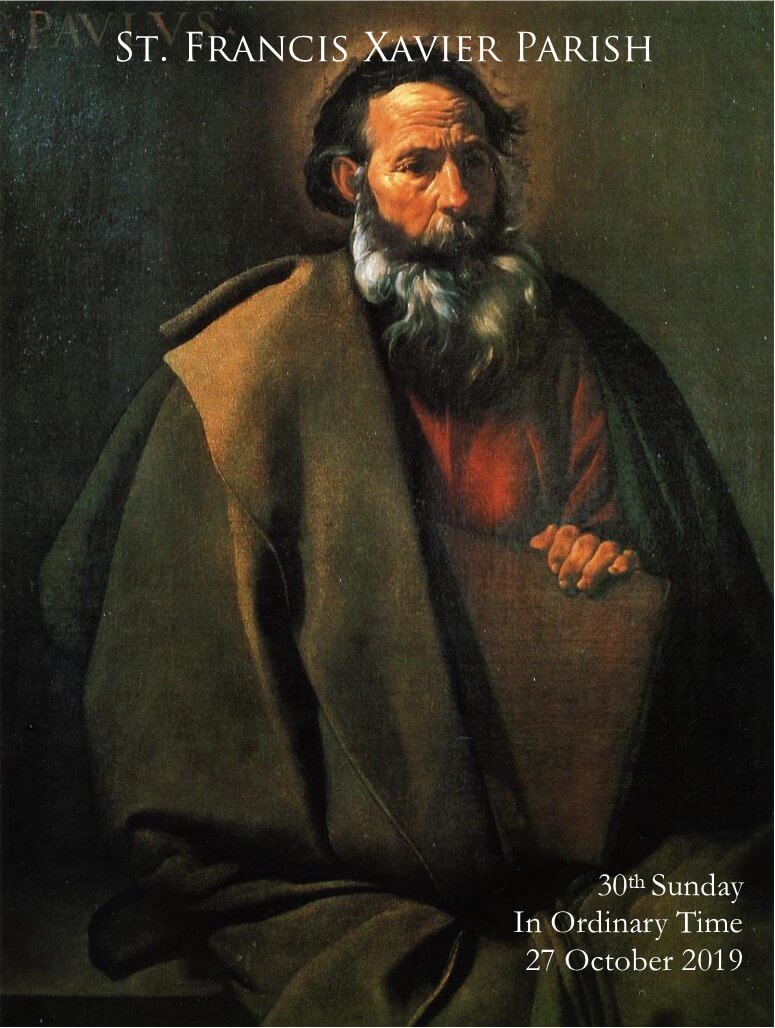
Now we thought of using as an image of Paul’s spiritual accomplishment a painting depicting Pheidippides – that famed Greek runner who ran from Marathon to Athens only to collapse in death upon announcing victory. However no such work would have done metaphorical justice to Paul’s race. Hence we place on our bulletin cover for this 30th Sunday in Ordinary Time a work by the Spanish master Diego Velzquez, simply entitled, St. Paul (1620). Velazquez painted in the Tenebrist style. Yet even though St. Paul is one of his earlier works, Velazquez anticipates the broader brushstrokes of his later period.
Velazquez accomplishes a scene of St. Paul sitting on a bench, perhaps in his own prison cell awaiting his sentence of death: reflective and stoic, but possibly sad, not for his own demise but for the many souls he has labored and worried over. He holds in his hands as his last possession a single portfolio symbolic of all the writings to his flock which when read show that he is not antagonistic toward state authority; only solicitous for God’s authority. He holds these works as he intends to present these to the Lord, his judge, as proof of the good works he has done on earth, while “in the body” (2 Cor 5:10).
-Steve Guillotte, Director of Pastoral Services
by SFXparish | Oct 17, 2019 | BLOG
As long as Moses kept his hands raised up, Israel had the better of the fight, but when he let his hands rest, Amalek had the better of the fight. Moses’ hands, however, grew tired; so Aaron and Hur supported his hands… so that his hands remained steady till sunset.” (Ex 17:11-12)
Which one of us even at a young age could all the day long keep his hands raised above his head? God certainly gave Moses divine authority to secure victory over Amalek; however Moses still needed to rely on his natural strength to keep his hands raised during the entire battle. Each time he lowered his arms from exhaustion he had to know that some of his men were being wounded and killed. Just knowing this must have added anguish to the task and anxiety to his weariness.
Fortunately, Moses had Aaron and Hur to hold his arms up. More to the point, the task which now requires three persons, takes on spiritual meaning: the prefigurement of the Holy Trinity. This is not to take the comparison too far and suggest that Moses’ weariness shows that one divine person is weak without the others. It is simply an Old Testament foretokening of the revelation of the tri-fold Godhead, the eternal communion of truth and love.
Moses also serves as a foreshadowing of Jesus. This task of Moses is a window into the Passion of Christ who in His own battle against the enemy keeps His own hands above His head. The hands of Jesus were held aloft by nails so that He could not lower them. In fact, the lowering of His hands would mean coming down from the cross – and risking the loss of souls. Moses held on “until sunset” when the battle finally ended. Jesus held off until sunrise when on Easter morning he burst forth from His tomb bringing victory over sin and death.
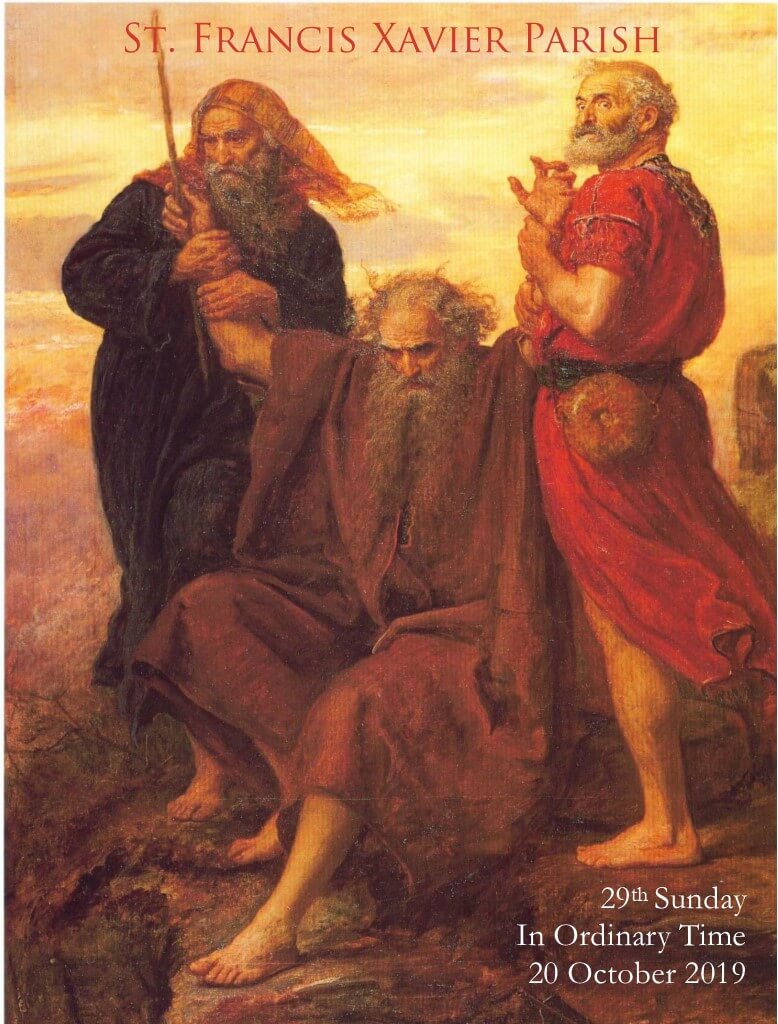
To bring the image of Moses from the Book of Exodus alive on this 29th Sunday in Ordinary Time, we place on our bulletin cover a work by Pre-Raphaelite painter John Everett Millais entitled Victory O Lord (1871). Although this work is thoroughly Pre-Raphaelite in its naturalistic and spiritual mood, it also indicates the movement of Millais into his landscape period when scenery gains more emphasis. Although Aaron (in red) and Hur are present to give relief to the weary Moses, Millais paints Moses as one who appears eager and tireless. The observer of the painting gets the sense that Moses is being held back from throwing himself forward into the battle. (The battle is only indicated by a single broken spear head in the lower right corner of the image). The face of Moses is determined and intent on the event below, while above and behind him the sun begins to set as the day closes and victory draws near.
Staff in hand, this image of Moses flanked on high by two companions could depict the scene of Creation. In that case Moses would be the Father shown unwearied by his task yet still held back by the Spirit and the Son for a “day of rest” as the new world dawns for man.
–Steve Guillotte, Director of Pastoral Services