by SFXparish | Dec 6, 2019 | BLOG
John the Baptist appeared, preaching in the desert of Judea and saying, “Repent, for the kingdom of heaven is at hand”… At that time Jerusalem, all Judea, and the whole region… were being baptized by him in the Jordan River as they acknowledged their sins. (Mt 3:1-2; 5-6)
We cannot say with certainty that there are no famous artistic images of John the Baptist baptizing the people of Judea who came to him acknowledging their sins; yet if there are such works, they are hard to find. There are many other masterfully painted images of John: sitting or standing alone, playing as an infant, spending time with the Holy Family, venerating the Blessed Mother, preaching, and even being beheaded, yet few to none of John baptizing the repentant sinners. This is most probably because the primary focus of the many images of John baptizing are of him baptizing Jesus. The image of the “Baptism of Jesus by John” has a preeminent place in Christian art.
Perhaps it is only natural to not portray in Christian art the early penitential baptisms of John since these anointings were not in their own right supernatural (Mt 3:11). However, John’s most important role in salvation history – after being the prophetic voice announcing the coming of the Lord – is preparing the peoples for repentance. This repentance is necessary for sustaining a life of grace (Lk 13:3). Two-thousand years later, John’s ministry still plays a vital role in our liturgy reminding us of the call to repentance during the season of Advent.
John’s call is the call to conscience. It is a call to the self-examination of one’s soul. We all need to do this examination with regularity. Deep in our hearts there is a desire to do this since the soul unceasingly desires to be close to God under the divine’s sincere and intimate counsel. In accord with this, the heart yearns for forgiveness and peace. However, John can only take the human heart so far. He must eventually hand it over to Jesus (Jn 3:30).
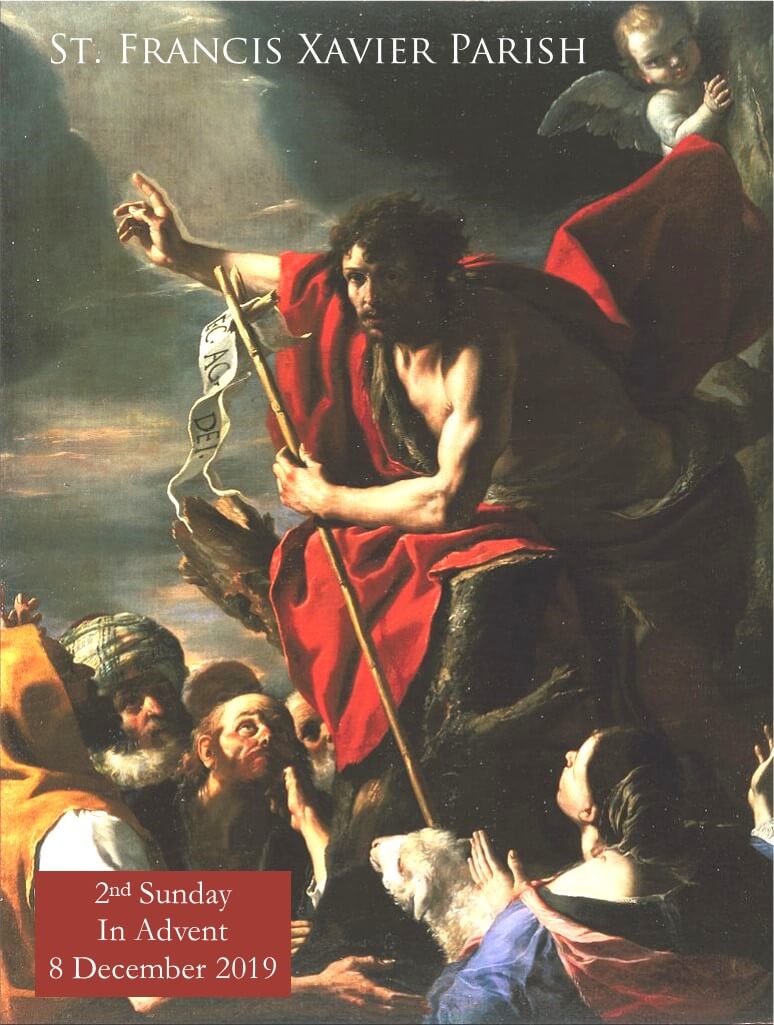
On this 2nd Sunday in Advent we place on our bulletin cover a baroque work, John the Baptist Peaching (1665), by the Italian Mattia Preti which may have been painted in Malta after Preti was made a Knight of Malta. Preti was very much influenced by the Tenebrism of Caravaggio. Tenebrism comes from the Italian “tenebroso” (dark or gloomy) and this style is a baroque technique that mysteriously delivers salvific light into the seeming bondage of a looming darkness.
The most illuminating aspect of this work is the opening of the sky in the upper left part of the frame (which John points out). This aperture sends light through the receptacle of John’s staff which bears the Latin phrase, Behold the Lamb of God, while the banner itself reaches out and clings to the fractured stump of Jesse (Is 11:1). John’s staff acts a pointer, touching the lamb at the bottom of the scene representative of Christ. The people standing about are in postures of praise while John looks outward beyond the scene toward us, reminding us to “repent, for the kingdom of God is at hand” (Mt 3:2).
John points to Jesus Christ during Advent; for Jesus alone carries our hearts from repentance to forgiveness to peace.
-Steve Guillotte, Director of Pastoral Services
by SFXparish | Nov 29, 2019 | BLOG
In days to come… many peoples shall come and say: “Come, let us climb the LORD’s mountain, to the house of the God of Jacob, that he may instruct us in his ways, and we may walk in his paths.” (Is 2:2-3)
As we begin a new Advent season we do so in the midst of our parish’s year-long reflection on grace. Advent itself is a season of grace, a liturgical urging to renew our life in God as shown clearly and distinctly by the quotation above from the Church’s very first reading in Advent.
The literal meaning of this passage concerning the Lord’s mountain is a prophecy that a Messianic-restored Temple in Jerusalem will serve as a destination of “many peoples” or nations which will stream there for instruction and salvation. Christians further see in this passage an anagogical meaning (i.e. how it relates to heaven) considering it to be a proclamation of the glory of the New Jerusalem still to come. However, for our present purpose as we begin Advent, we will focus on the quotation’s spiritual meaning: how does it relate to the life of grace?
The mountain climb itself is the life of grace which begins with Jesus Christ. In Psalm 24 the Lord’s mountain is called a “holy place” and the question is put to us, “who may go up the mountain of the Lord?” (Ps 24:3). The answer to this question is he who is “clean of hand and pure of heart” (Ps 24:4). Now we would be wrong if we thought that the answer to this question relates directly to us, for none of us (on our own) is clean and pure. The only one that can ascend the Lord’s mountain is Christ. He is the clean and pure one, and it is only through the Ascension of Jesus that a life of grace becomes possible (Jn 16:7). Jesus climbs the mount of God so he may draw us up with him through His gift of grace.
According to Isaiah, the Spirit of grace “instruct[s] us in His way” so that we may “walk in His paths”. Through grace, the Lord Jesus teaches us the virtues of faith, hope and love. However before we can enter into the tutelage of grace we must first admit that we have followed the wrong way: that we have walked on errant paths; that we have sinned. Without this realization and admission, especially in Confession, we will not be able to say with commitment, “Come let us climb!”
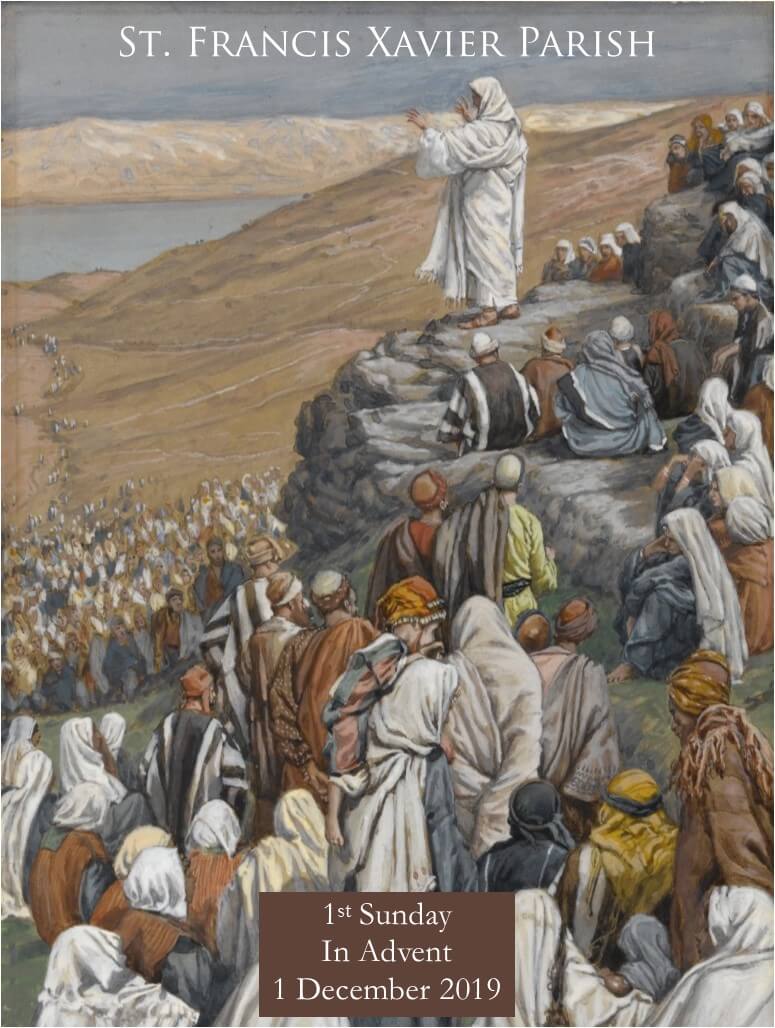
And so we return now to the literal sense of sacred scripture on this 1st Sunday in Advent by placing on our bulletin cover a painting by James Tissot entitled The Sermon on the Mount (1896 – courtesy Brooklyn Museum). Here we see Jesus standing on the Mount as many people come from a distance to hear and to follow His instructions (Mt 5:1ff).
This work of Tissot is listed by some as being in the style of Symbolism which would place it in the category of the Pre-Raphaelites and William Blake. However if the work is symbolic, it is also realistic, relating a reality originating in a true witness account. In Advent we recall the gospel testimony of Our Lord’s first revelation on earth, while faithfully awaiting His glorious finale.
-Steve Guillotte, Director of Pastoral Services
by SFXparish | Nov 22, 2019 | BLOG
And the LORD said to you, “You shall shepherd my people Israel and shall be commander of Israel.” When all the elders of Israel came to David in Hebron… they anointed him king of Israel. (2 Sam 5:2-3)
Many years after Moses and Joshua died (and not long after Samuel went into semi-retirement – 1 Sam 8:1) the Israelites begged the Lord to place a king over them even though God counseled them through Samuel that they would pay dearly for being ruled (1 Sam 8:11-13). The Lord appeared slighted by their request for an earthly king, not because it took away his sovereignty over the earth, but because it was a sign that Israel was beginning to stray and follow the pagan way. Yet, God honored Israel’s request and lifted up Saul as their first king.
God never does anything grudgingly, but only willingly. Thus it became God’s will that through the vehicle of earthly kingship, the Lord would save mankind by sending his only divine Son, Jesus Christ as everlasting king in the line of the Davidic household (2 Sam 7:11-12). Thus when Jesus descended to earth it was necessary that He teach about the true nature of kingship: “The kings of the Gentiles lord it over them …but among you it shall not be so. Rather, let the greatest among you be… as the servant” (Lk 22:25-26).
King David in his second psalm explains the malicious activity of these “kings of the gentiles”: “The kings of the earth set themselves, and the rulers take counsel together, against the Lord and his anointed, saying, ‘Let us burst their bonds asunder and cast their cords from us’” (Ps 2:2-3). The heathen kings were an affront to God not only because they ruled harshly over their people but because they conspired against the Lord.
Now we being a free people have a natural umbrage for kings though we should never be wary in principal of a good king (St. Thomas Aquinas was himself fond of the constitutional monarchy!) We should also contemplate the full spiritual meaning of David’s second psalm which applies not only to monarchs but to all men, male and female; for the “kings” described here are not just the world’s sovereigns, but you and I who have traded in just, communal dominion over the earth (Gn 1:26) for unjust personal domination. The bonds that we burst and the cords that we cast away are marriage, family, friendship, and all the moral virtues which unite us in the image of God.
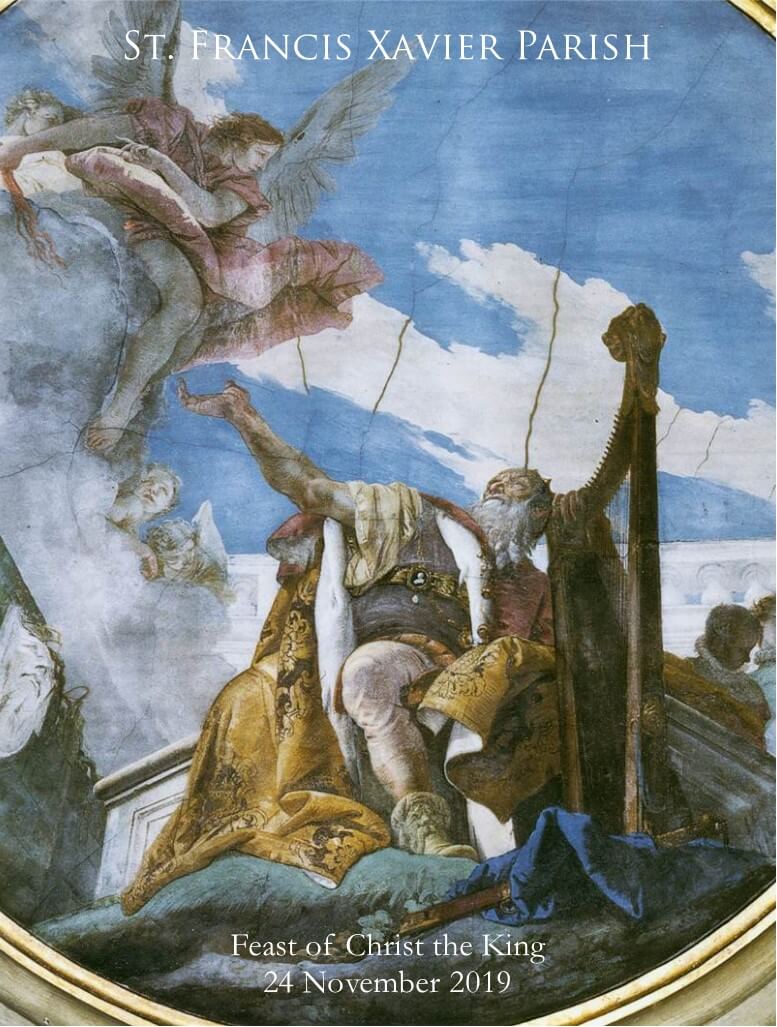
We place on our bulletin cover for this Feast of Christ the King a fresco by the Venetian master Giovanni Battista Tiepolo entitled King David Playing the Harp (1739). Here we see David in all his stately regalia not as a conqueror of men but as a servant of God offering his service to the angelic messenger above him. David has set at his feet the sword of Goliath which began his princely career. Tiepolo has painted David as a sage, a poet, and a leader through prayer. The harp that David plucks is itself is an indication of the king at prayer since many of the Psalms were composed for this musical instrument. Artistically, we no longer have the contrast of heaven and earth as in Mannerism, but their union in the Rococo style.
Whether we be kings over the earth or only kings of our own castles, we must faithfully serve others through the preservation of all our natural and gracious bonds to God the Father and his anointed Son, Jesus Christ.
-Steve Guillotte, Director of Pastoral Services
by SFXparish | Nov 14, 2019 | BLOG
“Lo, the day is coming, blazing like an oven, when all the proud and all evildoers will be stubble… But for you who fear my name, there will arise the sun of justice with its healing rays.” (Mal 3:19-20a)
Advent arrives just two Sundays from today. While it is still too soon to display images of the Nativity of Jesus, it is not too soon to begin anticipating our display. In fact our liturgical anticipation of the arrival of Christ goes into high gear during these last few Sundays before Advent. For instance, our scriptural quotation taken from today’s first reading is from the very last book of the Old Testament; just before we turn the page to the New. Malachi is the prophet of great expectation. He says, “Lo, the day is coming”. In fact, the day is approaching, “blazing like an oven” for the rebellious. The day is also coming when “the sun of justice” will arise and bring healing to the meek and faithful. The source of radiance to both the evil and the good is the same – the Lord God – the one, single flame which roasts all evil deeds and evildoers while also rehabilitating all gracious deeds and humble worshipers.
In Chapter three of his book, Malachi compares “stubble”, people who refuse to repent of sin, to “silver”, those refined through repentance (Mal 3:3). For the Lord “will draw near to you for judgment” and “will be swift to bear witness” against all deadly sins (Mal 3:5). Then in verse six of chapter three God exclaims through Malachi that the Divine Being does not change. The judgment of God, that is, the holy presence of God, is one and same eternal flame which will burn up the proud and defiant stubble, yet will purify and sanctify the tarnished silver.
Whence does the bright “sun of justice” arise? What is this fire that is coming for us all? It is the “dawn from on high”, Jesus Christ, who “… shall… shine on those who dwell in darkness and the shadow of death… to guide our feet into the way of peace” (Lk 1:78-79).
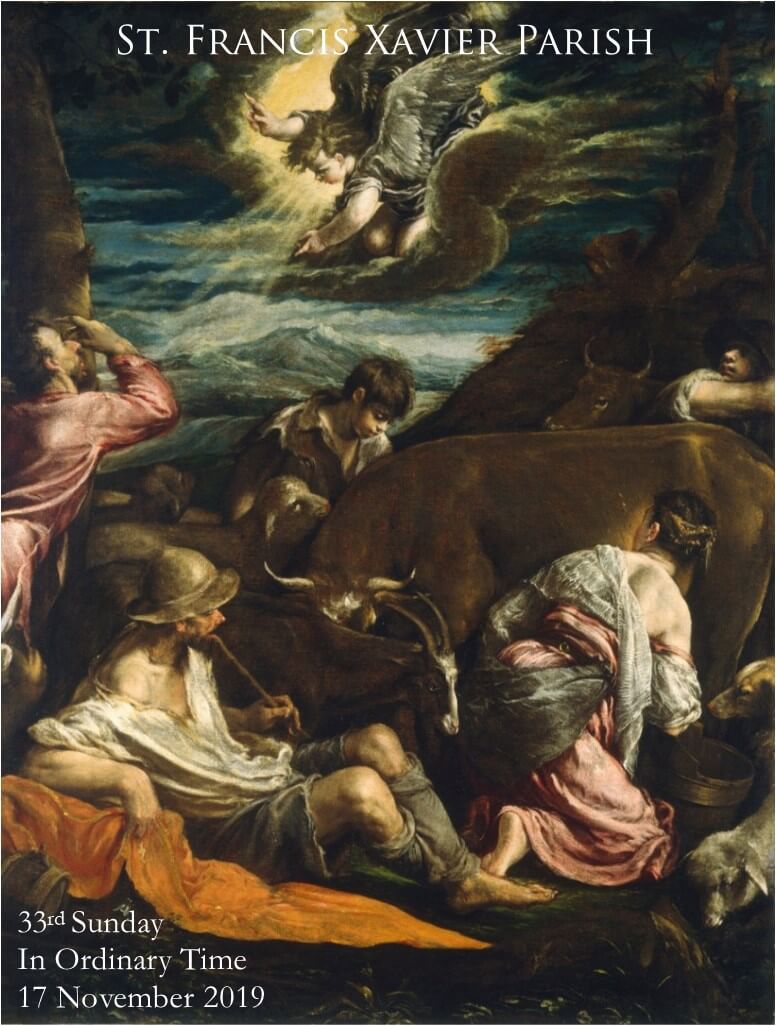
Thus for this pre-Advent reflection on the coming judgment of God for this 33rd Sunday in Ordinary Time, we have placed on our bulletin cover a work by the Venetian master Jacopo Bassano entitled The Annunciation to the Shepherds (1560). This work bespeaks that nocturnal style of Tintoretto in which light emerges from and into darkness. Here Bassano has heaven open into a pastoral scene, a meeting of the supernatural with the natural. This style known as Mannerism abandoned the classical reserve of the Renaissance and created a bridge for the increasingly mystical and active Baroque.
Mannerism is controlled pandemonium as we see here in this packed scene with heads turning this way and that way. This claustrophobic shepherd’s camp immersed in twilight is a plethora of postures; even the animals point in all directions. Yet from both corners of the image forming an implied arrow with the appearing angel above, we the observers are able to look into heaven where the radiance of the divine fire pours forth upon the earth.
This angel could well be exclaiming, “Lo, the day is finally here”. We too must, like the shepherds, leave our packed and harried cubicles to follow the Son of Justice.
-Steve Guillotte, Director of Pastoral Services
by SFXparish | Nov 7, 2019 | BLOG
Finally, brothers and sisters, pray for us, so that the word of the Lord may speed forward and be glorified, as it did among you, and that we may be delivered from perverse and wicked people, for not all have faith. (2 Thes 3:1-2)
The New Evangelization is risky business. We the Church living in modern times are asked to bring modern man into the Church by engaging modernity. Direct engagement by the Church is nothing new. It has been the evangelical approach of the Church ever since the missionary activities of Ss. Peter and Paul. The peril of engagement however has always been (since apostolic times) how to “disengage” when one draws too close to the world and to its spiritually-diminishing influence.
We read in the Old Testament how Israel entered the promised land of Canaan under the instruction of God. The Israelites were directed to destroy all remnants of the pagan faith in order to avoid coming under their influence. Modern sensibilities may find such violence disturbing; however we should understand that the land of Canaan had been irreparably desecrated through idolatry. Israel was sent into Canaan to be an instrument of justice in the same way the staff of Moses treated the heathen pride of Egypt. Israel was forged in the desert of Sinai with God’s law so that it might bring spiritual purity into an land thoroughly obdurate in rebellious impurity.
Upon escaping from Egypt, the children of Jacob formed a covenant with God so that upon entering Canaan they would make it into and keep it as a holy land. Through the sincere practice of the Ten Commandments the Israelites were to purify not only the land they beheld, but the earth itself by becoming a light to the nations (Is 42:6). However, not long after Joshua died the Israelites began to lose their way (Judg 2:1-2). Even their wisest king, Solomon, fell under idol worship (1 Kg 11:1-6). Sadly, the ancestors of the Israelites escaped the bondage of Egyptian paganism only to have their descendants return to it whole heartedly through Canaanite heathenism.
In today’s reading, just as Paul prays for the evangelization of the Word, he also prays that he and his flock may escape the idolatry of the world. Paul makes it clear that those who do not have faith are always at risk of falling into perversity and wickedness. Not only this, but Paul asks for prayers so that he might be delivered from the wicked.
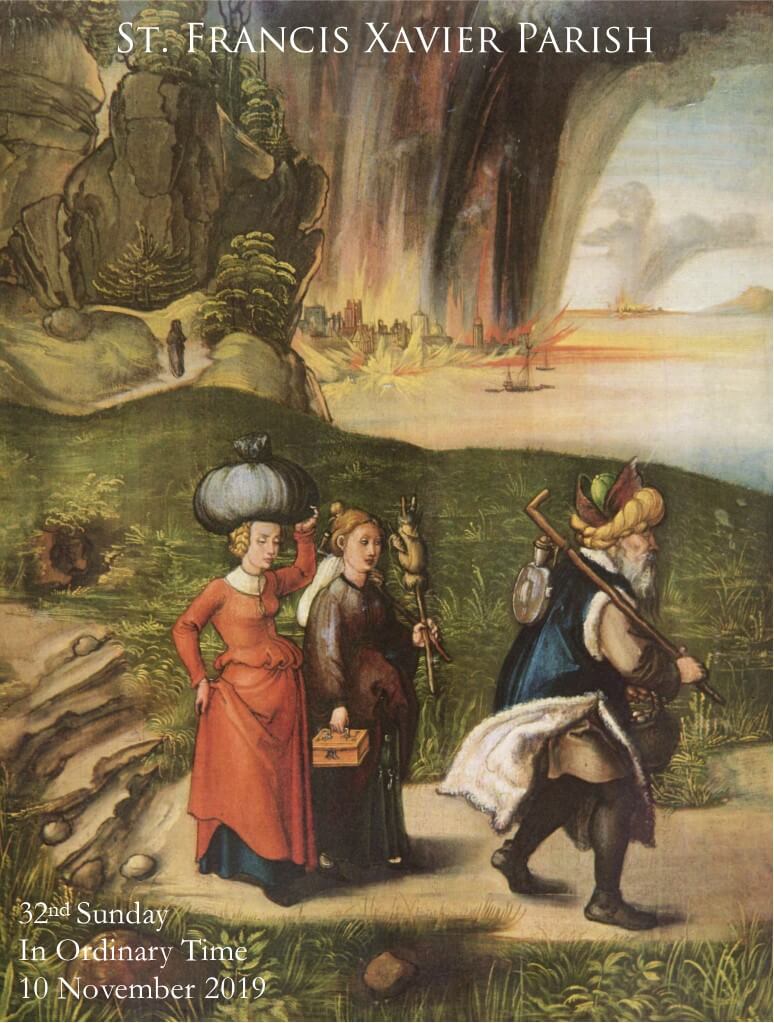
Thus, in accord with our quotation above taken from today’s second reading, we place on our bulletin cover for this 32nd Sunday in Ordinary Time a work by the Dutch Master, Albrecht Durer, entitled Lot’s Escape (1496). This work leaps forward out of the somber Northern Renaissance and into the glow of fantasy literature with its mellifluous colors and its fantastic imagery. It as if Durer has painted a fable for us. This is not far from the truth as he uses the historical event of the escape of Lot from Sodom as a lesson of encouragement to all Christians to abandon lifestyles of sin and friendships that trap one in sin.
As we go forward to evangelize the world we must often move among an irrational and faithless people. Therefore, just as Jesus told his apostles to move on and shake the dust from their feet, so too must we never settle down by pitching our tents in sloth among the wayward (2 Cor 5:1-4).
-Steve Guillotte, Director of Pastoral Services