In a recent article in The Atlantic on-line magazine (March 11) writer Yascha Mounk provided commentary on guidelines published by the Italian College of Anesthesia, Analgesia, Resuscitation and Intensive Care (SIAARTI). Mounk explains that this document likens “the moral choices Italian doctors may face [concerning the COVID-19 virus epidemic] to the forms of wartime triage”. Mounk describes how the document recommends the utilization of “distributive justice” and “the appropriate allocation of limited health resources.”
Mounk declares that the methodology of justice applied by the college is “utilitarian”. This is the idea that the morally right action is the one which produces the most good. He quotes the college’s position on distributive justice to be: “those patients with the highest chance of therapeutic success will retain access to intensive care.”
Now if you are of a suspicious nature and the hair stands up on the back your neck when national doctors’ groups proclaim themselves ethicists, then you may have already guessed correctly what comes next: “It may become necessary to establish an age limit for access to intensive care.” Just in case the physician group’s statement remains unclear here is Mr. Mounk’s full translation of it: “Those who are too old… or who have too low a number of ‘life-years’… would be left to die”. Mounk informs us further that not only age but “comorbidity” – the presence of more than one illness occurring at the same time in the same person – will also be “carefully evaluated” by the doctor to determine who might be more likely to die. However, when the decision is made as to who lives or dies based on available resources, those who “require a greater share of scarce resources” i.e. “older or more fragile patients”, would be on the top of that list.
Mr. Mounk then proceeds to make his case in support of the doctors’ college. He does so by posing his argument in the form of question: “If you are an overworked nurse battling a novel disease under the most desperate circumstances, and you simply cannot treat everyone, however hard you try, whose life should you save?
This would seem a mind-bending question if it did not open with an entirely false assumption: that nurses, overworked or not, ought to be calculating who lives and who dies. The problem with Mr. Mounk’s thesis is that it presupposes that doctors and nurses have, by virtue of their profession, a right to decide who to save and who not to save. They don’t.
Let us begin with triage. Triage is not for deciding who lives or who dies. Triage is primarily for assessing the wounded, a lot of wounded, for the purpose of deciding the order of treatment, not the order of dying.
As for “utility” and “distributive justice” the college’s use of these terms is distortive. First of all, distributive justice is not solely about the distribution of resources to individuals based on someone’s determination, but about a guarantee to the individual that the privileges of society will be equitable and unbiased and that everyone in society will share not only in the common benefits but also in the common burdens. Further, the “utilitarian” concept is not only concerned with the greatest good for a society; it is also concerned with the impartial good of everyone. This is how the Stanford Encyclopedia of Philosophy explains utility: “Everyone’s happiness counts the same”.
Should there be an age limit on access to intensive care? Is this the way it really works in wartime? Are the older, wounded officers put at the bottom of the list for emergency surgery because they are older? Do the doctors stand around and say, “Well, this fifty-year old major is a chain-smoker with severe hypertension. Leave him to die and bring in the private first class”!
Is the doctors’ recommendation of screening-out who lives by age and pre-existing condition so preferable to “first come – first serve” as they claim? When an eighty-two year old man with diabetes presents with COPD needing a ventilator and three devices are still available, do you refuse him one because you are expecting a few younger COVID-19 patients to come through the door? Their “utilitarian” approach would say so.
We readily grant that doctors and nurses have an agonizing job in times of disaster and limited resources. I believe that in such circumstances they do their best to treat everyone. However, as healers they should not be strategizing beforehand about who lives and who dies over resources, especially as this strategy does not even mesh with the ideas of utility and distributive justice that make up their strategy. Doctors must decide in times of crisis. We want to trust their decisions. Yet they appear lest trustworthy when they are wont to withhold care based on a predetermination against age and fragility.
More than one week after reading Mounk’s commentary, I watched a video of intensivist doctors and nurses working in the busiest hospital in Bergamo, the Italian province hardest hit by COVID-19. I was impressed by the dedication of these caring professionals to treat every patient that comes to them. They may have been forced to turn their ER into an ICU, but they have not been moved to follow the guidelines of the SIAARTI.
If this Italian college of doctors is truly concerned about justice, it should rewrite its proposal and begin with communitive justice. This form of justice regulates the rights between one person and another. As a virtue it is most suited to the patient/doctor relationship: two human beings, meeting face-to-face, not hiding behind policy. Hence, through an honest, compassionate conversation about his terminal condition the critical care patient (or he holding proxy) may even decide to give up his just claim to a ventilator for the patient next to him, in exchange for the doctor’s pledge to try to keep him comfortable. Then, medicine will not only be about justice and utility, but about love and fidelity.
Live as children of light, for light produces every kind of goodness… Take no part in the fruitless works of darkness;for it is shameful even to mention the things done by them in secret… Awake O Sleeper”!(Eph 5:8-9; 11-12; 14)
In one of our recent weekly parish instructions on The Sacraments narrated by Father Matthew Kauth (St. Benedict Press), we cited a point from the teaching of St. Thomas Aquinas, the Angelic Doctor. In his teaching on sin, St. Thomas points out that the gravest effect of sin is the darkening of the sinner’s intellect. This is to say that the person engaged in serious sin may no longer recognize his sin, as sin. Such a person will even come to favor dark and shadowy things, just as the truth and the light of God will grow to dismay and frustrate him. If this person be of a weak nature, he will simply hide from the light. However, if he be strong, he will try to defeat the light and all those who bear it.
During Lent, in the Daily Office of the Church, we pray these words of Psalm 36: “Sin speaks to the sinner in the depths of his heart; there is no fear of God before his eyes. He so flatters himself in his mind that he knows not his guilt… All wisdom is gone”. The psalmist continues: “[The sinner] plots the defeat of goodness as he lies on his bed”. What this means by way of examples is that the one who covets his neighbor’s wife plots the defeat of marriage; the one who plans an abortion plots the defeat of creation; while the one who rises early to purchase all the toilet paper in the store plots the defeat of justice!
Now the remedy for the ignorance and forgetfulness brought on by our sins is found in Psalm 51: “… in the secret of my heart teach me wisdom”. However, it seems impossible that the one who knows not his sin will pray this without an acknowledgment of his sin! So we must pray for him even if he be our enemy (Mt 5:44), believing that nothing will be impossible for God (Lk 1:37).
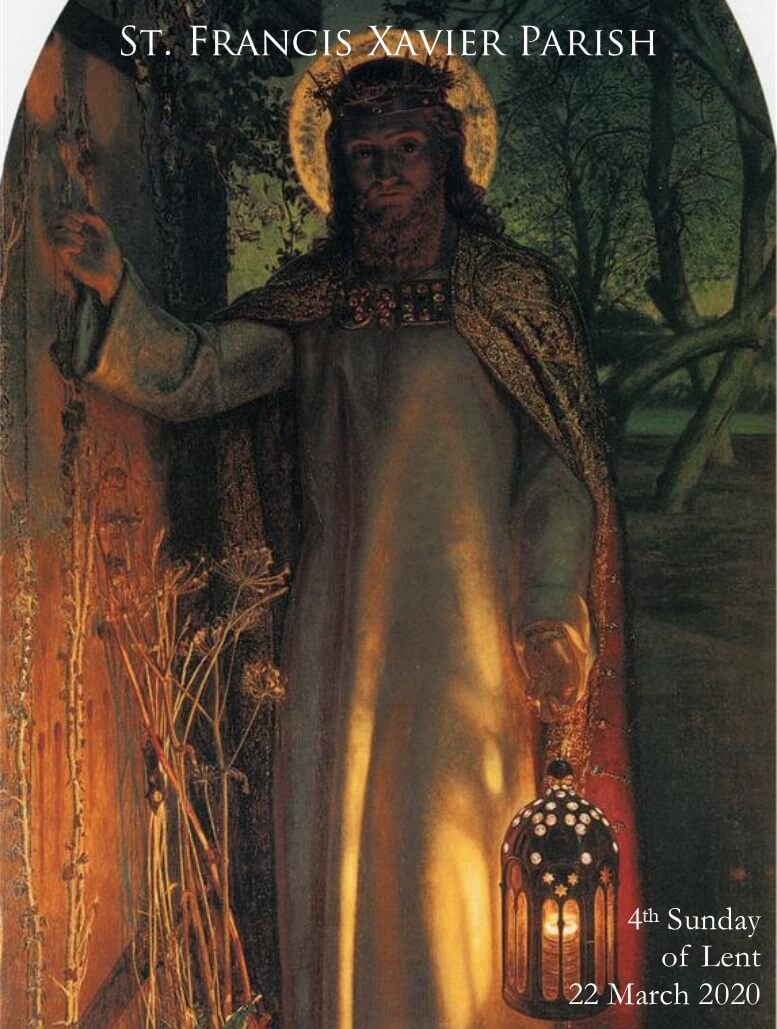
We place on our bulletin cover for this 4th Sunday in Lent an image painted by William Holman Hunt, entitled The Light of the World (1851). Hunt was a British painter of the Pre-Raphaelite Brotherhood whose Romantic works were chock-full of religious symbolism.
Here we see Christ bringing light to the sinner’s soul. He comes at night indicated by the stars dotted above and behind him. On the ground near his feet are apples fallen from the tree, a sign that this soul has not been vigilant in keeping up with the spiritual harvest. Even the door that the Lord knocks upon has the growth and stubble of spent flowers blocking its entrance. Unkempt vines descend from the roof over the domicile. Thankfully, Jesus, whose halo appears as a harvest moon, has come knocking at this soul looking to enter with his golden lamp of salvific light. He peers out at us as if to say, “Awake O Sleeper”… put away at last your fruitless works of darkness which you keep and store away in the unlit closet of your mind and heart.
Jesus came to a town of Samaria called Sychar… Jacob’s well was there. Jesus, tired from his journey, sat down there at the well… A woman of Samaria came to draw water. Jesus said to her, “Give me a drink.” (Jn 4:5-7)
There are some conversations in the biblical narrative that will strike us as strange or humorous. For instance, in St. John’s Gospel presentation of the Multiplication of the Loaves after Jesus inquires quite wittily as to how with little funds and in a remote place they are to buy enough food to feed five thousand people, Andrew responds: “There is a boy here who has five barley loaves and two fish; but what good are these for so many?” (Jn 6:9). First of all, why would one boy have five loaves and two fish and no one else there have even the equivalent of an ancient middle-eastern granola bar? Second, why would Andrew even bring this up as relevant since he clearly believes it provides no solution? More is at play here. We cannot put it past Our Lord to have prompted a boy to show up with loaves and fishes on that day just as on another day he prompts “bystanders” to lend Him a colt for trotting into Jerusalem (Mk 11:4-6).
Today we hear from St. John how the Samaritan woman says to Jesus who has just offered her “living water”, “Sir, you do not even have a bucket and the cistern is deep; where then can you get this living water? (Jn 4:11) Now bible scholars claim that the Samaritan woman interprets the phrase “living water” as “flowing water”. Fair enough, but if the cistern offers only stagnant water, i.e. non-flowing water, then why does the Samaritan woman mention the cistern at all? The logical response would have been, “where then can you get this living water because you cannot draw it out of this well!”
It is fair to say that anyone of us, in the presence of Jesus, would speak like a simpleton. Even that worldly master of men, Pontius Pilate, was stymied by Our Lord’s wisdom and divine persona. We cannot blame the Samaritan woman for being confused and tongue-tied when her creator stood before her asking, “Give me a drink”.
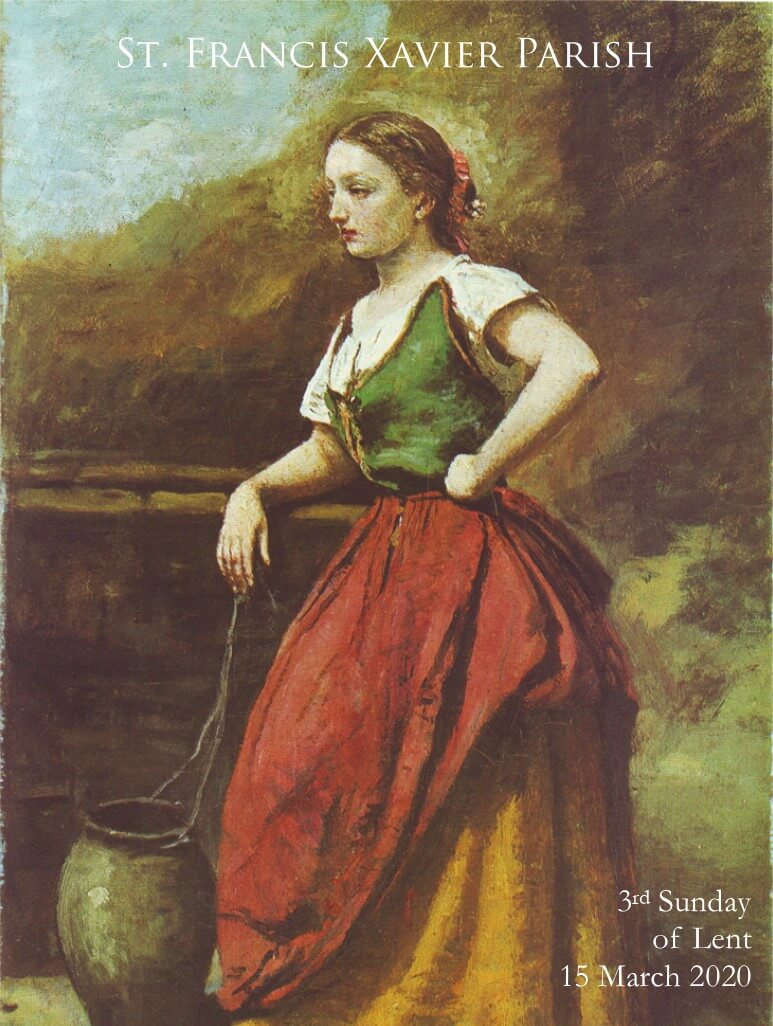
For this 3rd Sunday of Lent we place on our bulletin cover a work by the French Romantic painter Camille Corot entitled Young Woman at the Well (1870). Corot was most famous for his pre-impressionist landscapes, yet his female portraits still leave observers wondering about the interior thoughts of these women figures.
Here we see a young woman standing near a well. She waits and looks. Let us say that Jesus is approaching her. Her right arm leaning on the well says that she is casual in her lifestyle; her left hand on her hip says that she is stubborn in her casualness. Her expression is not rude but cautious, after all she has had five husbands and lives now with a man who is not her husband (Jn 4:16-18). However, a few moments in the company of Jesus and she is changed; her soul has found its true love. She runs off to her village proclaiming Him to be the Messiah.
Besides this, this woman of Samaria has done the world another service. For we know now that if Our Lord ever asks us for a drink, we are to say simply, “Lord give us the living water that flows from your side.”
The LORD said to Abram: “Go forth from the land of your kinsfolk and from your father’s house to a land that I will show you… Abram went as the LORD directed him. (Gen 12:1; 4)
Faith is trusting in what another person tells you is true, because that person is trustworthy. Every fruitful act of faith requires at least one person who is trusting and another person who is trustworthy.
However, faith is not solely reliant upon trust. Faith requires some prior knowledge. For example, when a man from out-of-town whose car is running near empty asks you where the nearest gas station is, the only way the man will be able get to the gas station (imagine for now his smart phone has no signal) is by trusting you whom he believes to be trustworthy. However, for you to be trustworthy you must know exactly where the nearest gas station is. Without that knowledge you could not be considered
a trustworthy reference for those urgently needing to fuel up.
Thankfully, God knows all and can be completely trusted. Abram understood this about God in his meeting with God. Perhaps it is also the case that Abram was selected out of all the people on earth by God because Abram was the most trusting person on earth: the most discerning and the most guileless; the most believing and the most hopeful.
Now Abram didn’t need to stop and ask and trust someone as to where to find water for his nearly exhausted camel. Abram was already in the “land of his kinfolk”. Abram appears to have had a call to trust, a desire to trust already planted in his heart. This “vocation” was just waiting to be called out by God. When God did call, “Abram went as the Lord directed him.”
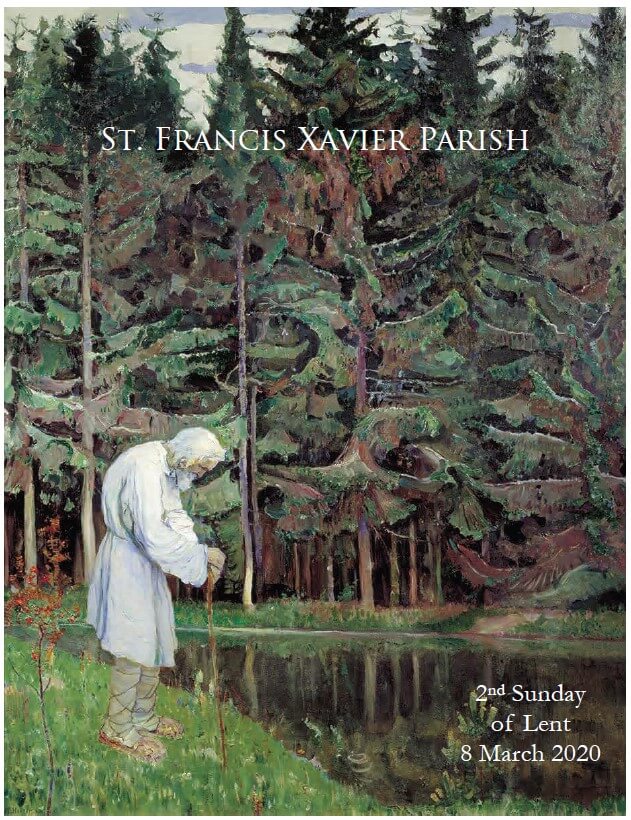
On this 2nd Sunday in Lent we place on our bulletin cover a work by Russian Symbolist painter, Mikhail
Nesterov entitled Elder or Abraham, Servant of God. Nesterov was an artist but not untouched by politics. He painted many religious works throughout his career, but under the new Communism he was no longer allowed to publicly paint religious works.
In the work we examine today we see a familiar theme of Nesterov: a wise elderly man standing by a scenic river in deep meditation. Nesterov’s first famous work, The Hermit (1889), is also a river scene (possibly the Volga), as is his painting of Leo Tolstoy. Here we see Abram leaning on a staff. Is he bent over by age or by prayer or both? Is
he on the bank of the Euphrates after his call by God to leave the land of Ur or is he on Jordan’s bank before he separates from his nephew Lot? In either case he is certainly in the presence of the unseen God.
Abram is painted here in white as one who has been in the presence of God. In Symbolist fashion the water of the river means more than water. It serves as the threshold dividing the figure of Abram from the thick Impressionistic forest of the unknown land that Abram is about to
embark towards. On the other side of the bank we spy a path. It is the way that God has made for Abram.
God also has made a path for each of us. Will we listen; will we trust; will we “go forth”?