by SFXparish | Apr 15, 2020 | BLOG
As the Father has sent me, so I send you.” And when he had said this, he breathed on them and said to them, “Receive the Holy Spirit. Whose sins you forgive are forgiven them, and whose sins you retain are retained.” (Jn 20:21-23)
All Christians should be amazed that on the evening of the same day that He rose from the dead, Jesus visited the Apostles and gave them the express authority to forgive sins through His gift of the Holy Spirit. Jesus had already appeared to Mary Magdalene in the morning (Jn 20:13-15). Later in the day he met two disciples leaving Jerusalem whose distraught hearts He resuscitated (Lk 24:32). In his meetings with Mary and these disciples He initially kept his true identity hidden. However, when he comes upon the Apostles on that first Easter evening, Jesus spares no time showing Himself to them. He has come on business, the business of the His Father’s divine mercy; for just as the Father has sent Him, so he is sending out his new overseers of justice and mercy.
The Church considers this visitation to the Apostles to be the institution of the Sacrament of Penance. The Apostles had already been chosen for the priesthood at the Last Supper. Now they are to be the keepers of the episcopal office or bishops of the Church binding and loosening through the grace and power of Jesus Christ. Yet one of their number was not there.
The Apostle Thomas was not there. Thus he did not receive the breath of the Holy Spirit on Easter Evening. When Jesus appears again a week later, Thomas is now present. Jesus addresses Thomas immediately, inviting him to probe the wounds of His Crucifixion. The purpose of this is not only that Thomas will believe, but that he will also be able to forgive sins. For how could Thomas, if he doubted the risen power of Jesus, ever be able to forgive sins in the name of Jesus? Jesus is being merciful to the doubt of Thomas, yet He also means to be merciful to the entire world through Thomas.
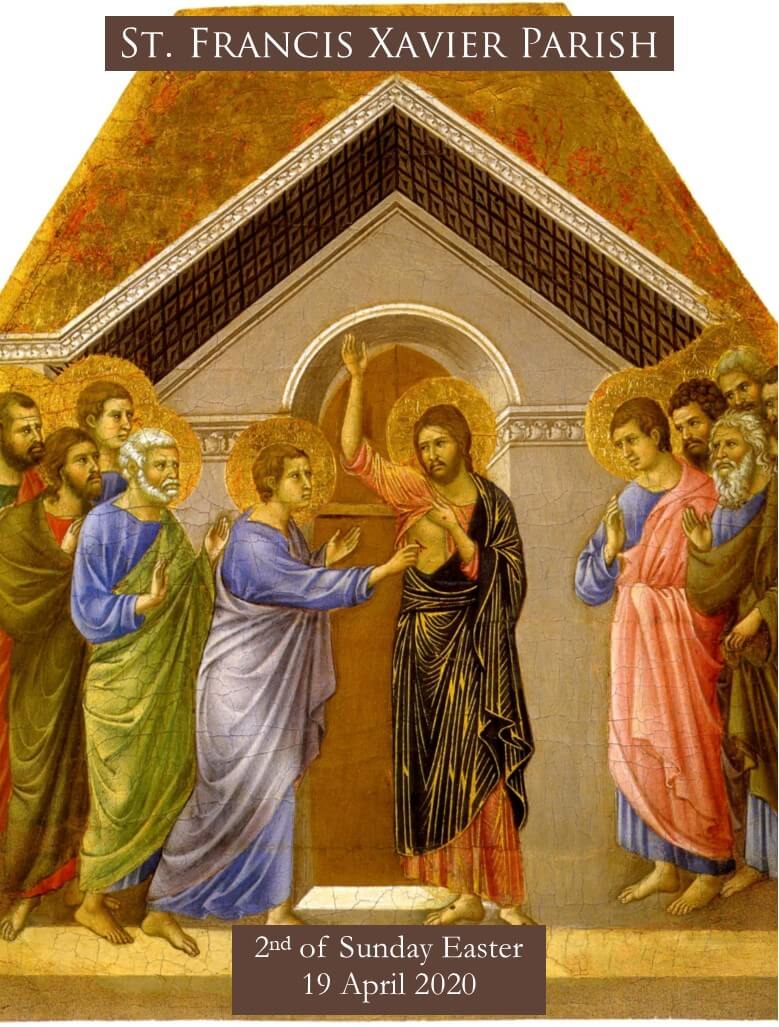
For this Second Sunday of Easter, often captioned “Divine Mercy Sunday”, we place on our bulletin cover a work by the famous medieval Sienese painter Duccio entitled Doubting Thomas painted as part of his Maesta or Majesty Altarpiece for the Cathedral of Sienna (1311). Duccio painted in a style inherited by Byzantium but with a fresh religious fervor obvious in the gestures of his figures.
Here in beautiful medieval color Duccio places the risen Christ in between two groups of Apostles. Christ lifts his arm so that the wound of this side might be revealed (and as a sign of blessing). This is not the presentation of Caravaggio or later painters which show Jesus guiding the hand of Thomas into the wound. Thomas is eager to reach out and touch the Lord Jesus as seen by his forward leaning. Even the disciples behind Thomas press upon each other in this “still-life” to rush upon their Lord. Duccio paints Jesus afore the Jewish Temple to make the point that our new temple is the Sacred Body which has now become our focus of worship.
In true Sienese artistic style, this sacred work is meant to instill in us a desire to rush toward the Divine Mercy of God!
-Steve Guillotte, Director of Pastoral Services
by SFXparish | Apr 9, 2020 | BLOG
Brothers and sisters: If then you were raised with Christ, seek what is above, where Christ is seated at the right hand of God. Think of what is above, not of what is on earth.
(Col 3:1-2)
On this Easter Sunday let us be raised with Christ toward the hope of heaven and all its glorious expectations and joys. We should follow today the good and faithful counsel of Saint Paul in his Letter to the Colossians, “Think of what is above, not of what is on earth”.
We should acknowledge that when we read from Sacred Scripture in the holy liturgy, it is the Holy Spirit in the Church speaking to us. Those human beings who have selected the readings for the Mass, those who are given this task by the Church, do so through the inspiration of the Holy Spirit. Thus what we read and hear at Holy Mass is not coincidental.
Today the Church tells us not only to think of what is above, but to seek it. In order to better frame this instruction the Church also tells us through St. Paul what we should not think of or seek: that which is on earth. This is not to say that we are to forget to eat, drink, sleep and change our clothes and instead enter into some transcendental meditative state. It is also not to say that we should ignore the world and others in the world or that we should not try to better the world which Our Lord created. It means that we are to make the eternal truths and virtues our primary reflection and activity. It means that we are not to dwell on the fleeting thoughts and desires and achievements of the world which may take us as far as a comfortable retirement but not beyond. It means that we are to fill the temporal world with eternal things, especially faith, hope and love.
Today we are to consider those words of Jesus, “…seek first the kingdom of God and his righteousness, and all these things will be given you besides” (Mt:6:33). These consoling words are most significant for Easter morn as we consider them coming directly from God himself… today, now, and always!
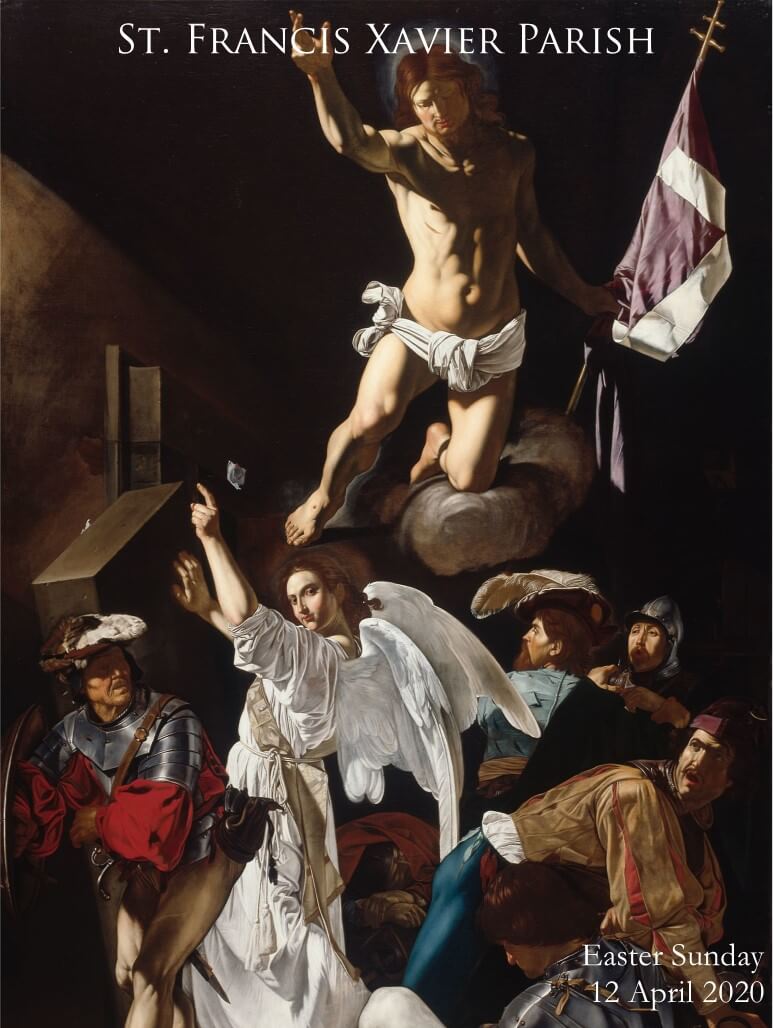
On this Easter Sunday we place on our bulletin cover a work by Francesco Buoneri entitled The Resurrection (Art Institute of Chicago). Little is known of Buoneri and many have speculated as to his relationship with the master painter Caravaggio because of a few general footnotes in history. We can say with confidence only that he was a Caravaggisti, a 16th century painter dedicated to the baroque, tenebrist style of Caravaggio.
This painting lifts our minds and hearts away from the things of earth to the things of heaven. Because it is literally an uplifting work (for being oblong) we cannot show the entire figure of the sleeping soldier (bottom right). The risen Jesus takes one knee on a cloud illustrative of heaven as He holds His Cross now become a banner of victory. The soldiers do not look to heaven. They look about seeking some earthly explanation for the disappearance of Jesus. They are answered by the angel who looks beyond them to us encouraging that we look and seek what is above.
See also how the Lord Jesus looks down upon the world to bless it. In turn we must look up at Him to seek His will, “on earth as it is in heaven”, to fully capture His gracious benediction.
-Steve Guillotte, Director of Pastoral Services
by SFXparish | Apr 1, 2020 | BLOG
The Lord GOD is my help, therefore I am not disgraced; I have set my face like flint, knowing that I shall not be put to shame. (Is 50:7)
“Death, comes for us all, even for kings he comes”. These are the words of St. Thomas More in Robert Bolt’s screenplay, A Man for All Seasons. More speaks these words as he is tried for high treason in July of 1535 for refusing to take the Oath of Supremacy which for one thing bound its takers to recognize the king as overseer of the church in England.
Thomas More was once Lord Chancellor of England, highest law official in the realm, until he fell into social disgrace for refusing to agree to Henry VIII’s divorce and remarriage. However, St. Thomas did not behave in a disgraced manner before his accusers and condemners. Instead, in the words of Bolt, he “clamored liked a champion” for Christ; for the Lord was his help and his shield. When St. Thomas More arrived at the chopping block, he forgave his executioner “right readily” and before his soul was detached from its head, More stated, “I am His Majesty’s good servant, but God’s first”. Thomas More was brought low, losing his title and office and his life, brought seemingly to a place of shame; yet he could not truly be put to shame for his imitation of Christ.
Christ predicted that his followers would stand before worldly authorities and face unjust condemnations (Lk 21:12). Jesus stood up first and faced this evil fate. He came to His Passion through His Father’s constant protection. Our Lord Jesus might have been killed well before His trial. He could have been taken by the mob (Lk 4:29) or by the religious authorities (Mt 12:14). Yet it was His destiny as judge of the world to be judged by the world for the sake of those who would believe in Him (Jn 3:16). Jesus did this to overcome the world (Jn 16:33) and Satan who had once mastered it (Jn 14:29). Jesus also did what He did to set us an example so that we too might, in flesh and in spirit, overcome the evil authorities of the world.
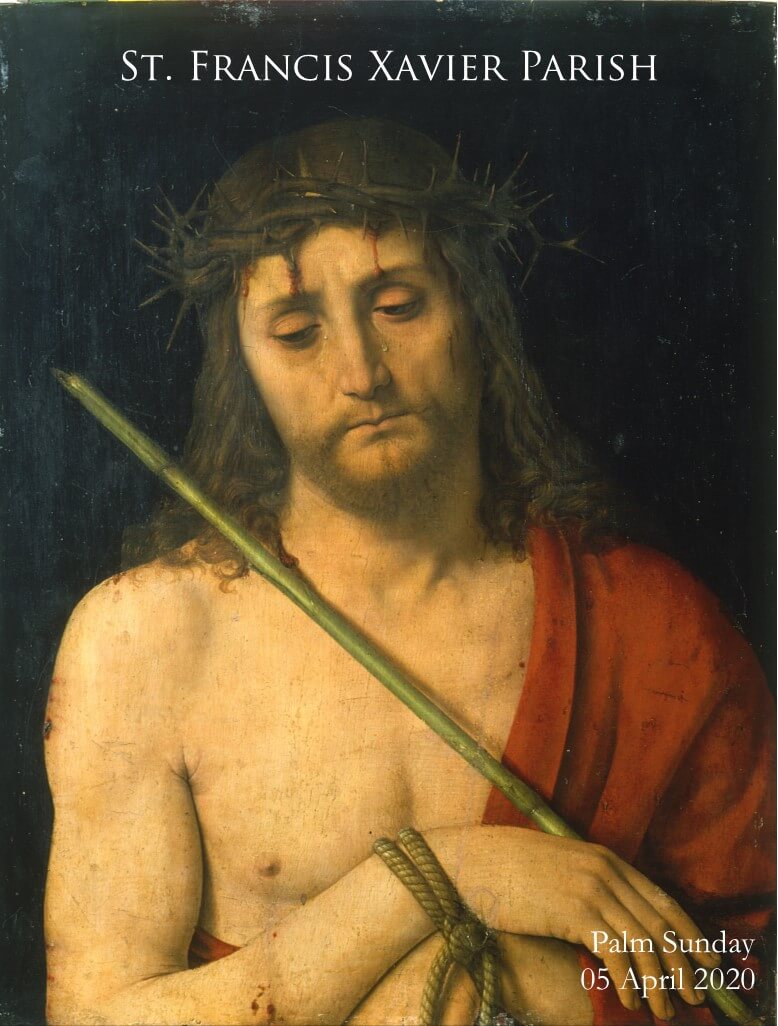
For this Passion and Palm Sunday, we place on our bulletin cover a work by the Milanese Renaissance painter Andrea Solario entitled Ecce Homo. Milan was uplifted in art in the 15th century through the long stays there of Leonardo da Vinci. Solario became one of his most avid followers.
“Ecce homo” are the Latin words “Behold the man!” spoken by Pontius Pilate to the crowd after he had Jesus scourged and the Roman soldiers handed Our Lord a reed scepter and placed a crown of thorns upon His head (Jn 19:5). Close examination of Solario’s painting reveals the thorns penetrating Our Lord’s forehead, blood dripping down just before they mingle with tears. Solario lifts the hands of Jesus into this Passion portrait so we can see the bindings about his wrist. Jesus barely touches the reed, refusing this sign of a weak kingdom easily snapped. Most striking in this visage are the dejection and the shame stressed by the tilted Sacred Head. Yet, Christ is not put to shame. His human nature has not an iota of shame for never having done anything shameful. It is our shame he bears. He brings our shame to the Holy Cross. By Thy Holy Cross, O Lord, Thou hast redeemed the world.
-Steve Guillotte, Director of Pastoral Services
by SFXparish | Apr 1, 2020 | EDITORIAL
It is now about two weeks since our Commonwealth has been operating solely on “essential services”. This unprecedented and resolute reduction in economic and personal activity for the purpose of “social distancing” was of course implemented to stop the spread of a novel strain of Corona virus.
To effect this change, a nine page COVID-19 list of essential services was promulgated by Governor Baker. Each service on the list is considered to be indispensable to the lives and functions of citizens during this pandemic. It is a comprehensive list which provides all observers of the human condition with an interesting perspective not only on the government’s priorities but on its notion of man.
Interestingly, our governor does indicate (on his order dated March 23rd) that “workers at places of worship” do provide an essential service. They can be found under the rather dull and disorderly title of “Other Community-Based Essential Functions and Government Operations”. Other essential roles deemed similar enough to be in this category with church workers are: election personnel, weather forecasters, hotel workers and laundry services. This would actually be humorous except that “workers at places of worship” is the last item noted in this jostling jumble of jobs. It is at the very bottom of the list.
Now something is seriously amiss in the deliberations of any government-of-the-people when it is unable to think of even one essential service to place under a heading titled “Religion”, especially when, as is the case with our state leadership, it is quite able to come up with three services under the heading “Hazardous Materials”. Yet truly, what should we expect from a state government that excludes the Church from the role of adoption provider for deeming male and female parents as “essential” to the raising of children.
Now state and church both exist for man. The former is natural to man; the latter supernatural. Yet both are providential in the will of God. Each has its source in God. As such, both are meant to agree on the essentials for man. In times when reason and faith are both held high and in accord with each other, state and church will agree on what is essential to man. Sadly, this is not the case in our times.
In fact, any statist government that sees religion as a solely private affair meriting no say in civil matters has already failed to grasp the essential nature of man. Mundane man (male and female), man who has one ear planted on the earth and the other ear blocked to heaven, is not complete man and therefore will know and understand only some of his own needs. He will follow mostly his inferior needs thinking these to be essential.
This is the situation we find ourselves in now, since for example while religion has become barely essential to the public welfare, abortion has become one of its bare essentials. Andrew Beckworth, President of Massachusetts Family Institute. recently informed its supporters in an email of how the Department of Public Health in Massachusetts exempted abortion from its list of non-essential elective surgeries during this pandemic, therefore (essentially) declaring abortion to be an essential service. Considering former moral decisions and acts of our governorship and the department of public health, Massachusetts citizens should not find this surprising. However, if we are to be thoughtful citizens and grasp what is going on we must put on our thinking caps and consider the very meaning of the term “essential”.
“Essential” comes from the Latin essentia, meaning “in the highest degree”. Essentia (English “essence”) has deeper roots in the Latin term esse meaning “to be”. Thus, when we speak of essentials we are speaking of those things that we need because they fulfill our human nature, that is, those things or activities or powers that make us what we are.
This is why it is all the more disturbing that states such as Colorado, Massachusetts and Washington, which have stopped all elective surgeries to conserve their in-state medical protective equipment, have at the same time exempted abortion from their stop order. Yet our purpose here is not to examine the political debate over these decisions but rather to examine the philosophical undertones and fallout over, for instance, the National Abortion Rights Action League’s (NARAL) colluding position that surgical abortions, including all elective surgical abortions, ought to always be considered “essential”.
NARAL, Planned Parenthood and various other feminist organizations have consistently taken the public position that abortion is an essential service to women’s health. However, they cannot call abortion “essential” without exposing their foul presumption that abortion goes to the very essence of womanhood! When we say that food, shelter, clothing, freedom of movement, social association, and religious worship are all essential to man, we are saying that that these things are necessary for man to be man. By comparison when the feminist and her feminist allies say that abortion is essential to women, they are saying that abortion is necessary for women to be women! They are saying that women need abortion “to be” what they are, i.e. to fulfill their gender.
Back in October 2015, in a piece for The Nation, feminist writer Katha Pollitt penned an essay entitled “Gender Equality Is Not Possible without Abortion”. Now we have neither the space nor the time to debate that obfuscating term “gender equality”. Suffice it to say that to make the claim that abortion is essential for female equality is to make the claim that abortion is essential for the female to be who she is meant to be; to achieve her essence.
Some feminists might shiver at the claim that women cannot be women without the right to destroy their own child in the womb (however most are stone cold believers of this)! This is the principle they stand for and act upon: abortion as equalizer, as fundamental right, as essential need; abortion atrociously authenticating the very essence of womanhood.
-Steve Guillotte, Director of Pastoral Services
by SFXparish | Mar 26, 2020 | BLOG
He cried out in a loud voice, “Lazarus, come out!” The dead man came out, tied hand and foot with burial bands, and his face was wrapped in a cloth. So Jesus said to them, “Untie him and let him go. (Jn 11:43-44)
Once again this Sunday we have a very interesting scriptural quotation to examine that leaves us with many questions. First, when Jesus calls Lazarus out from his tomb, did Lazarus walk out of the tomb? Jesus does not command Lazarus to “walk out” but to “come out” or “come forth”. The Catholic Revised Standard and New American versions and the King James translation do not read that Lazarus “walked out” but that he “came out” or “came forth”. In fact, how could he have walked out if his feet were tied? Further, the first two respective translations record that “the dead man came out”. Was Lazarus still dead when he came out? The King James translation refers to Lazarus a bit differently: “he that was dead”. Does this mean that at this point Lazarus was now alive even though his face was still bound? And if he was alive, how still could he come out since his feet were still bound which we know to be the case since they needed to be unbound.
There is no mention in St. John’s gospel narrative that Lazarus struggled to loosen his own bonds. This may be because Lazarus did not struggle (or because this is not the detailed Gospel of St. Mark)! Did Lazarus not struggle because he was still dead at his coming out? Did Lazarus levitate from his tomb? Did he come to life only after he was untied and let go, such that Christ wanted those who participated in the untying to experience the palpable return of the breath of human life to this one who had been entombed for four days? We can only respond to these questions by saying that the event itself was certainly more amazing than the amazing narration of it; for all who were present were in the presence of the “resurrection and the life” (Jn 11:25).
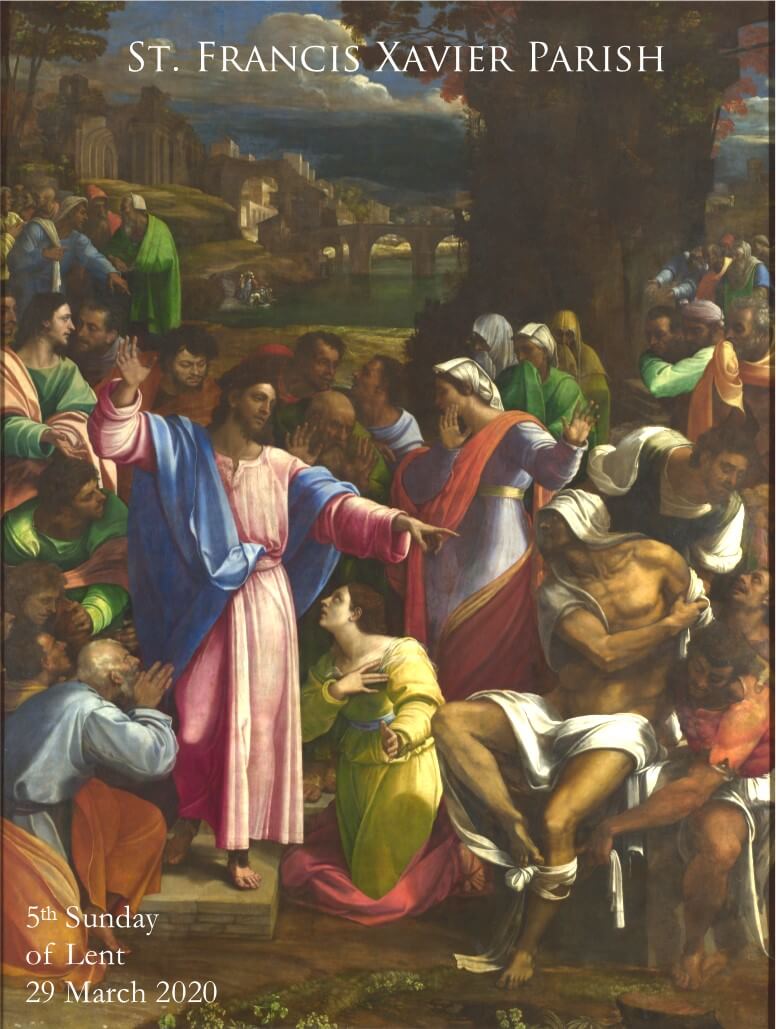
For this 5th Sunday in Lent we have placed on our parish bulletin cover a work by the late Renaissance painter Sebastiano del Piombo entitled The Raising of Lazarus (1519 – National Gallery, London). Del Piombo was a Venetian who after studying under Bellini travelled to Rome to study the works of Raphael and Michelangelo. This painting of del Piombo once hung side by side in the Vatican with Raphael’s Transfiguration (1520).
Here we see all the early Mannerist reactions to the miraculous raising: a man and woman kneeling in adoration, a man and woman (above Christ’s left arm) in fear and astonishment, three woman above them preparing for the stench of the dead body, two men to the left of them embracing in joy that the Messiah has come! Of course there is Lazarus being unbound and full of new life. Beyond the conversing crowd which flanks Christ, we see a deep, beautiful landscape with hill and lawn, bridge and water, painted in Venetian brilliance.
We might ask ourselves what our reaction would have been at the raising of Lazarus. Would we have adored, turned away, covered our noses, embraced in celebration; or would we have heard the command of Jesus and ran toward the “dead man” releasing him from his bonds of death.
-Steve Guillotte, Director of Pastoral Services