by SFXparish | Feb 27, 2020 | BLOG
Then the devil took him up to a very high mountain, and showed him all the kingdoms of the world in their magnificence, and he said to him, “All these I shall give to you, if you will prostrate yourself and worship me.” At this, Jesus said to him, “Get away, Satan! (Mt 4:8-10)
Every mountain high or low, every valley shallow or deep, every water narrow or broad belongs to the Lord God who created them all and keeps them. Nations encompass mountains and valleys, hills and flatlands, lakes and rivers and in their sovereignty claim these as their own. This is not a bad thing as national sovereignty maintains the diversity and unity of peoples and provides security against evil tyrants (unless such tyrants claim their own unjust sovereignty).
The devil is an unjust tyrant. In the myth behind The Lord of the Rings, J.R.R. Tolkien proposes that the leading angel who rebelled against God wanted to make his own creations and to be called “Lord”. Melkor, meaning “mighty-rising”, was the name of this preternatural spirit. He might have also been called “pride-rising” for as majestic as Melkor was he could not temper his desire for power; a power that wished to contend with and overthrow the One and only Lord God.
As we begin the season of Lent we enter into a season of anti-pride, a season of humility and contrition. We strip away all our self-given titles of honor especially those that set our will against what is good and graceful in the Lord. We examine our consciences, the evil things we have done in the past, and strive to enter the future with humility, temperance, gentleness and charity. We pray, we repent, and we give; all with the express purpose to put off the pride that brought us to death and to put on the faith and hope that brings us to new life.
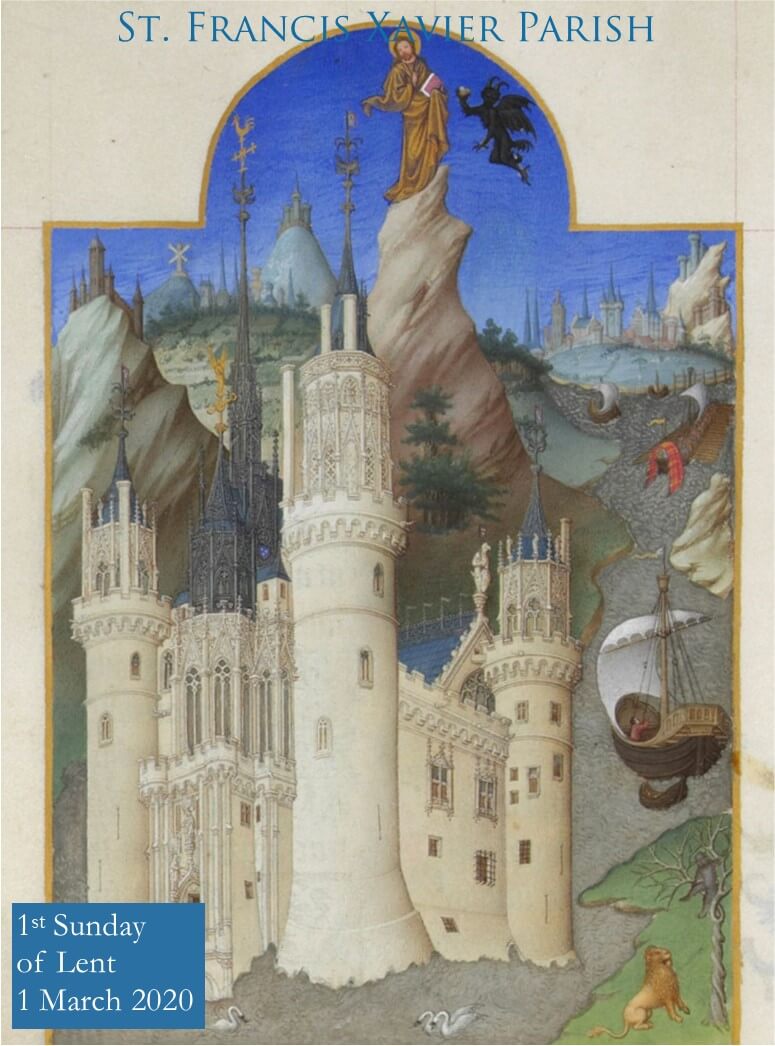
As we celebrate our 1st Sunday in Lent we place on our bulletin cover an illustrated work by the Limbourg Brothers entitled The Temptation of Christ (late 14th Century). The Limbourg Brothers painted in a style known as “International Gothic” because it is said to have spread throughout Western Europe; or “Late Gothic” since it flourished before the Early Renaissance. The important thing to note is that it was a transitional style just as the Gothic period was an advancing period. Thus we see in these illuminated manuscripts (and in statuary of that time) the breakout of emotion, postures that step out toward the observer, and expansive landscapes, all features to be carried over to the proto-renaissance.
On our cover we see the beautiful colors of medieval illumination presenting a landscape that will release the deepening perspective of the Renaissance. There stands Jesus atop His creation tempted by Satan who has presumed lordship over the earth. On the weathervane to Jesus’ left is a rooster indicating the denial of Christ and the penance needed to overcome this. Swimming in the moat are swans, symbols of God’s grace. In the bottom right Jesus is the Lion of Judah chasing the Beast up the Tree of Knowledge.
All temptation is a solicitation to sin. We would have no Lent leading to Easter if the devil had convinced Jesus to sin only once. Jesus triumphed and so the redemption of man was established on earth and still carries on today.
-Steve Guillotte, Director of Pastoral Services
by SFXparish | Feb 20, 2020 | BLOG
But I say to you, love your enemies and pray for those who persecute you… if you love those who love you, what recompense will you have? Do not the pagans do the same? So be perfect, just as your heavenly Father is perfect.” (Mt 5:44, 46, 47-48)
One of the most disconcerting instructions given to us by Jesus is to love our enemies. It is difficult just to begin to understand this command because the words “enemies” and “love” are terms which need unpacking. Let us begin with “love”.
When we think of love we may immediately think of the emotion of love or of someone that we love and so we cannot envision loving our enemies in this way. However, love in its spiritual context means “to will the good of another.” To love someone does not mean simply to feel good about another person or to “wish” another person well. To will someone’s good means that we are willing to actually do something for that person’s welfare. Because we are Christians, the good we want for everyone is heaven; therefore it is not so far-fetched for us to love an enemy, since as Christians we are already working for everyone’s eternal salvation.
Further, Jesus told us to love our enemies. He did not tell us to become friends with our enemies (or they would no longer be enemies). Jesus does not require us to trust our enemies, that is, to trust those who are untrustworthy; nor does He ask us to align with those who would have us compromise our belief. This is important because an enemy is someone who is not only hostile to your plans but to God’s plans too, so that befriending an enemy is perilous to you and to the Church. Jesus told us “to pray for” our enemies; prayer is the very first thing we should do if we are ever to begin willing their good. Further, we are asked to “turn the other cheek” not as a sign of friendship with a person of evil intent, but as a witness to God’s goodness.
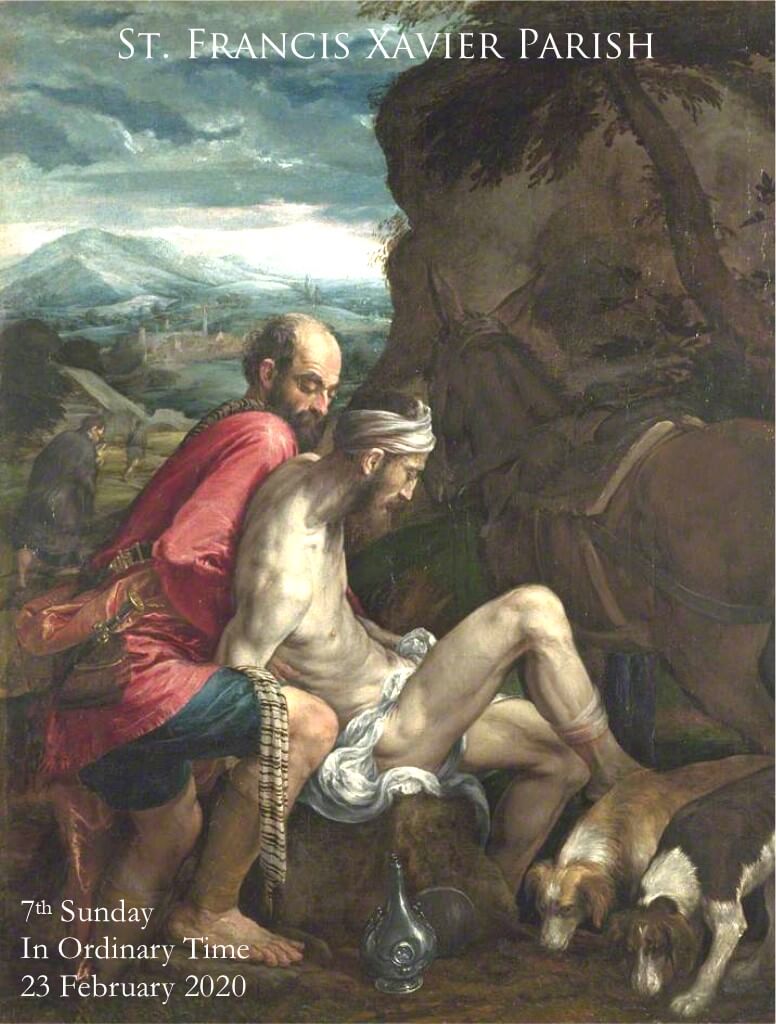
For this 7th Sunday in Ordinary Time we place on our bulletin cover a work by the Venetian master Jacopo Bassano entitled The Good Samaritan (1563). Bassano’s career began with the use of bright colors in imitation of Titian but he turned to Mannerism through his observation of the likes of Raphael and Tintoretto. Bassano also moved away from the classical backdrops of his Renaissance contemporaries to deep, dark landscapes with an ambiance of twilight or the impending storm. This is one significant way that his depiction of the Parable of the Good Samaritan differed from, say, that of Rembrandt.
In our image, we see the Samaritan hoisting the injured man onto his horse. In the forefront is the flask from which he poured the wine over the poor man’s wounds. We see the head and right leg of the man already bandaged by the Samaritan. In the middle-left of the scene are the priest and a Levite who walk past their fellow Jew without providing care. It was the Samaritan, accounted an enemy or non-friend of Jews, who acted to save the beaten man. Thus, Bassano’s foreboding sky foretells a time when the follower of Christ would serve all mankind, even his enemies.
-Steve Guillotte, Director of Pastoral Services
by SFXparish | Feb 12, 2020 | BLOG
“If you choose, you can keep the commandments & they will save you; if you trust in God, you too shall live; … Before man are life and death, good and evil, whichever he chooses shall be given him.” (Sir 15:15; 17)
God made man free. This means God gave man the power to act of his own accord. Man has the power to act or not to act – and if he chooses to act – the power to act one way or another. Man can choose his own way and he can do so deliberately taking into consideration what is good or bad and what is right or wrong. Thus God gave man not only the power of freedom but the proclivity for prudence which allows man to seek after what is beneficial and honorable and to avoid what is detrimental and dishonorable.
Freedom does not happen without responsibility. The misuse of freedom results in injury to one’s self or injury to others (often resulting in punishment to one’s self). This is the rule of life and the rule of law. It is also the law of God. Being made in the image of God we understand the cooperating principles of freedom and responsibility: that overreaches in freedom result in pain and in penalty. Or do we understand this any longer?
So many people today appear to be frustrated and angry because they cannot grasp that their errant moral behavior is the cause of their frustration and anger. They suffer personally and spiritually because they cannot distinguish between what is actually good and what only appears to be good (yet is actually bad). A person who is unable to discern between the good and the bad has little chance of knowing the right from the wrong. His corrupted conscience will continue to stray from the path of happiness.
It is for this reason that knowledge and practice of God’s commandments are so needed today. Our quotation above from the Book of Sirach reveals an ancient wisdom: each person chooses the good or evil he or she ends up with. God lures no one to Hell; God lays out before man life and death. Man chooses his own way. God wants to lead man to Heaven, but each man can refuse God’s truth and grace in his own unrepentant free will.
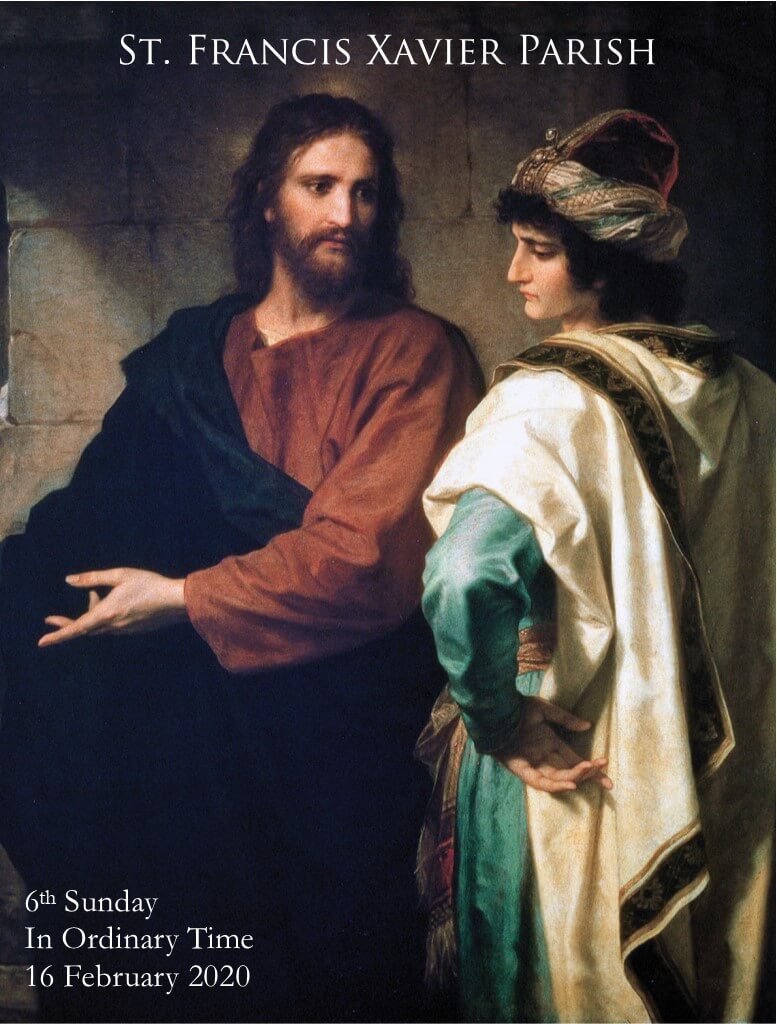
For this 6th Sunday in Ordinary Time we have placed on our bulletin cover a work by Heinrich Hofmann entitled Christ and the Rich Young Ruler (1889). Hofmann was a German Academic painter heavily influenced by the Italian masters of antiquity. Hofmann dedicated himself to images portraying the life and activities of Jesus.
Here we see Jesus offering the young man a choice: to continue his rich worldly lifestyle or to follow Him to the riches of God’s kingdom. Unseen on our bulletin cover (due to the width of the painting) is a frail, ill man cared for by a woman who resembles the Blessed Mother. Hofmann paints Jesus asking the young man to use his riches to serve others rather than only himself. The young man looks away in obstinacy. We know he goes away sad (Mt 19:22).
The young man need not gone away. He could have stayed with Jesus selling all he had for the “pearl of great price” (Mt 13:45-46). He could have prudently chosen, at that moment, everlasting happiness.
-Steve Guillotte, Director of Pastoral Services
by SFXparish | Feb 6, 2020 | BLOG
“You are the light of the world… Just so, your light must shine before others, that they may see your good deeds and glorify your heavenly Father.” (Mt 5:14; 16)
In our regular reading of Sacred Scripture we will come across some passages which appear to contradict each other. For example, today Jesus tells his disciples to show their good deeds to others, while at another time He commanded them to “take care not to perform righteous deeds in order that people may see them” (Mt 6:1). On the surface it appears that Jesus is instructing His disciples to do two opposite things. However Jesus never does anything only on the surface. His meaning always delves deeper.
The teachings of Jesus are not for the superficial or slothful but for those who through grace seek His greater understanding. Surface contradictions in Sacred Scripture should never pose any threat to the believer. In this case the Christian will come to see these passages from Matthew as two pieces clinging together in the same complete puzzle.
The teaching of Our Lord is always spiritual. In this case the two sayings each encourage us to have a proper spiritual intention. Thus, when we perform an act of charity do we intend that people see us or see God? Do we desire, even a little, to be in the spotlight or is our intent to shine the light upon God? Do we seek (even a little) to glorify ourselves or do we seek entirely to glorify God?
The answers to these questions are very important because what Jesus wants is not that we should hide our good deeds but that we should not perform them with the purpose of making ourselves look good to others. For instance, when a Christian posts a picture of himself on social media performing some charitable act does he do so for the purpose of making himself look good to others or for the exclusive purpose of glorifying God? Because this is a spiritual matter, this is an interior question which each Christian must answer within his own conscience. The answer to this question and the intention of the believer will determine if the Christian is walking on the path of Christ.
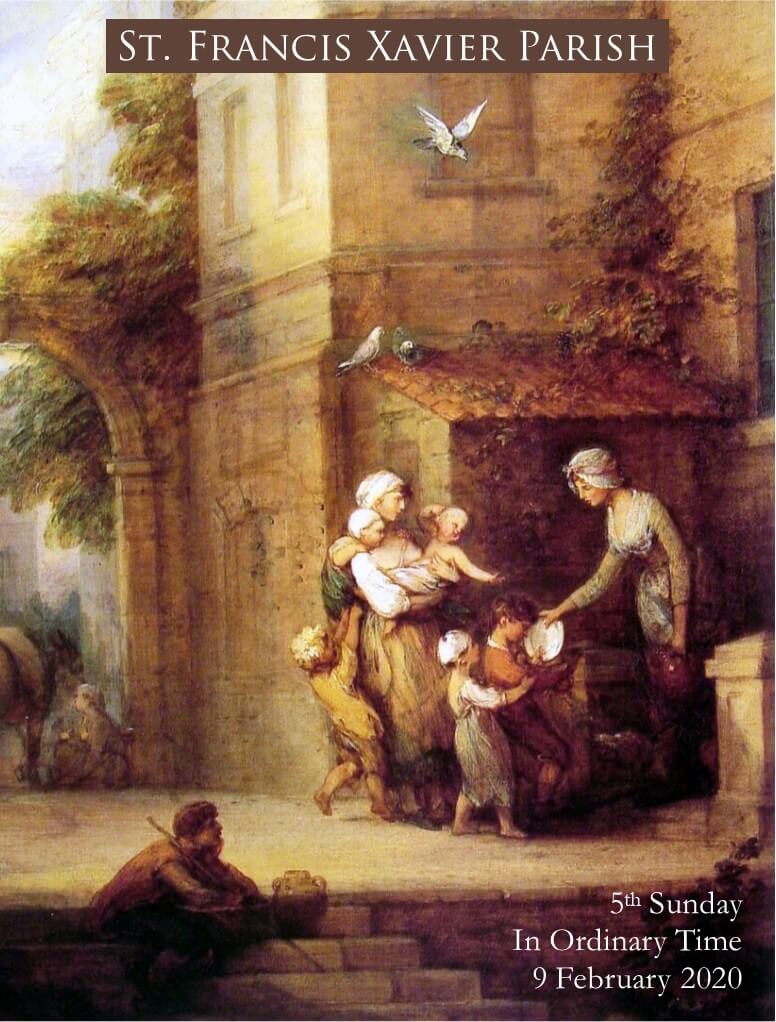
For this 5th Sunday in Ordinary Time we place on our parish bulletin cover a work by the 18th century English painter Thomas Gainsborough entitled, Charity Relieving Distress. Gainsborough painted in the Rococo and Academic styles progressing from portraits to landscape-portraits to far reaching country landscapes. The work we examine today is actually a bit of an oddity for its use of classical features and its classical appearance, uncharacteristic of the artist.
The importance of this work to us is the unassuming appearance of the woman offering charity to the poor. She is wholly engaged in the task, seemingly thinking nothing of herself. Gainsborough has even cornered her in by his architecture so that her charity is blocked from view on most sides. Only the man sitting on the steps who appears not poor (he has both basket and jug) can directly see her good deeds. This man peers at the woman without her knowing it as he is moved to admiration and contemplation over her humble and loving concern.
Let us perform charitable acts inspired by prayer and grace, and let us think only of glorifying God.
-Steve Guillotte, Director of Pastoral Services

by SFXparish | Feb 5, 2020 | NEWS
Do you desire a stronger and more fulfilling marriage for you and your spouse? Join other couples on this Day of Reflection for Married Couples on Sunday, 29 March 2020 from 11:30 am -5 pm at the parish school. This event will help you to reflect on the great value of your matrimonial vows and the graces that the sacrament gives you to fully live out this vocation. The day will include talks discussing the following topics: “The Ideal Marriage: What We Want”; “The Promise to Love: Why the Vows Matter”; “Forgiveness: the Will to Love”. There will also be the opportunity for Eucharistic Adoration & Sacrament of Confession. Free child care will be provided. The lunch provided is $20.00 per husband/wife; child meals can be reserved for $6.00. The presenter will be Father Nicholas Fleming who has a license in Marriage & Family Studies from the John Paul II Institute in Rome. Please pick up your registration form in the church entrance or in the parish office.