by SFXparish | Nov 22, 2019 | BLOG
And the LORD said to you, “You shall shepherd my people Israel and shall be commander of Israel.” When all the elders of Israel came to David in Hebron… they anointed him king of Israel. (2 Sam 5:2-3)
Many years after Moses and Joshua died (and not long after Samuel went into semi-retirement – 1 Sam 8:1) the Israelites begged the Lord to place a king over them even though God counseled them through Samuel that they would pay dearly for being ruled (1 Sam 8:11-13). The Lord appeared slighted by their request for an earthly king, not because it took away his sovereignty over the earth, but because it was a sign that Israel was beginning to stray and follow the pagan way. Yet, God honored Israel’s request and lifted up Saul as their first king.
God never does anything grudgingly, but only willingly. Thus it became God’s will that through the vehicle of earthly kingship, the Lord would save mankind by sending his only divine Son, Jesus Christ as everlasting king in the line of the Davidic household (2 Sam 7:11-12). Thus when Jesus descended to earth it was necessary that He teach about the true nature of kingship: “The kings of the Gentiles lord it over them …but among you it shall not be so. Rather, let the greatest among you be… as the servant” (Lk 22:25-26).
King David in his second psalm explains the malicious activity of these “kings of the gentiles”: “The kings of the earth set themselves, and the rulers take counsel together, against the Lord and his anointed, saying, ‘Let us burst their bonds asunder and cast their cords from us’” (Ps 2:2-3). The heathen kings were an affront to God not only because they ruled harshly over their people but because they conspired against the Lord.
Now we being a free people have a natural umbrage for kings though we should never be wary in principal of a good king (St. Thomas Aquinas was himself fond of the constitutional monarchy!) We should also contemplate the full spiritual meaning of David’s second psalm which applies not only to monarchs but to all men, male and female; for the “kings” described here are not just the world’s sovereigns, but you and I who have traded in just, communal dominion over the earth (Gn 1:26) for unjust personal domination. The bonds that we burst and the cords that we cast away are marriage, family, friendship, and all the moral virtues which unite us in the image of God.
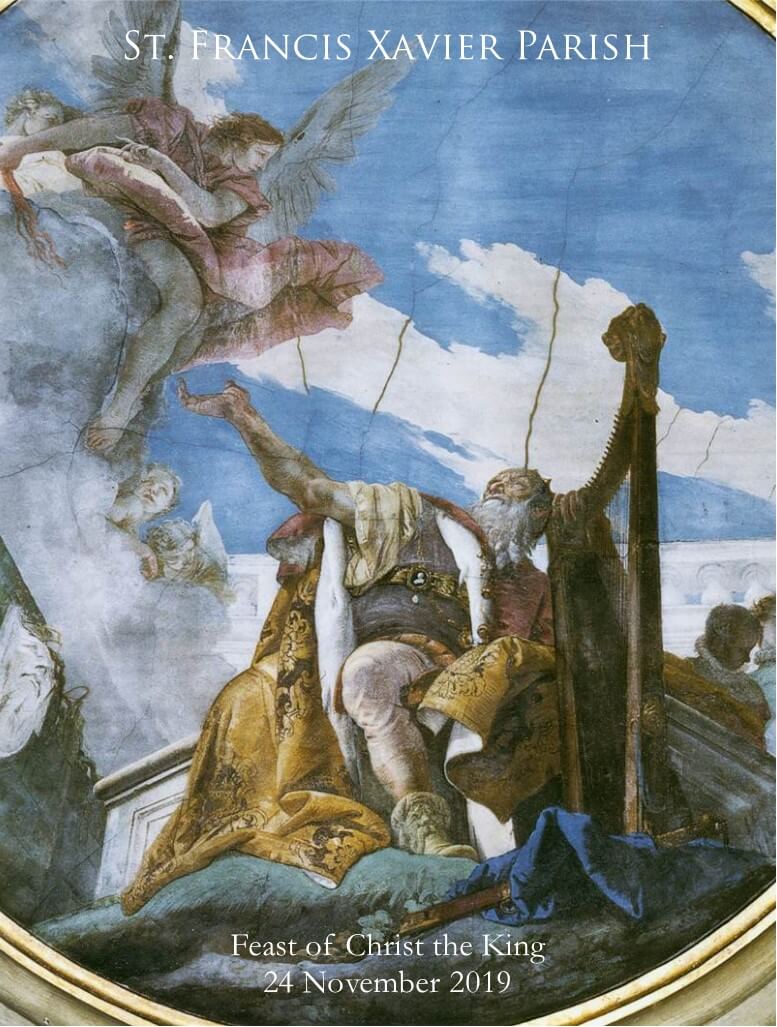
We place on our bulletin cover for this Feast of Christ the King a fresco by the Venetian master Giovanni Battista Tiepolo entitled King David Playing the Harp (1739). Here we see David in all his stately regalia not as a conqueror of men but as a servant of God offering his service to the angelic messenger above him. David has set at his feet the sword of Goliath which began his princely career. Tiepolo has painted David as a sage, a poet, and a leader through prayer. The harp that David plucks is itself is an indication of the king at prayer since many of the Psalms were composed for this musical instrument. Artistically, we no longer have the contrast of heaven and earth as in Mannerism, but their union in the Rococo style.
Whether we be kings over the earth or only kings of our own castles, we must faithfully serve others through the preservation of all our natural and gracious bonds to God the Father and his anointed Son, Jesus Christ.
-Steve Guillotte, Director of Pastoral Services
by SFXparish | Nov 14, 2019 | BLOG
“Lo, the day is coming, blazing like an oven, when all the proud and all evildoers will be stubble… But for you who fear my name, there will arise the sun of justice with its healing rays.” (Mal 3:19-20a)
Advent arrives just two Sundays from today. While it is still too soon to display images of the Nativity of Jesus, it is not too soon to begin anticipating our display. In fact our liturgical anticipation of the arrival of Christ goes into high gear during these last few Sundays before Advent. For instance, our scriptural quotation taken from today’s first reading is from the very last book of the Old Testament; just before we turn the page to the New. Malachi is the prophet of great expectation. He says, “Lo, the day is coming”. In fact, the day is approaching, “blazing like an oven” for the rebellious. The day is also coming when “the sun of justice” will arise and bring healing to the meek and faithful. The source of radiance to both the evil and the good is the same – the Lord God – the one, single flame which roasts all evil deeds and evildoers while also rehabilitating all gracious deeds and humble worshipers.
In Chapter three of his book, Malachi compares “stubble”, people who refuse to repent of sin, to “silver”, those refined through repentance (Mal 3:3). For the Lord “will draw near to you for judgment” and “will be swift to bear witness” against all deadly sins (Mal 3:5). Then in verse six of chapter three God exclaims through Malachi that the Divine Being does not change. The judgment of God, that is, the holy presence of God, is one and same eternal flame which will burn up the proud and defiant stubble, yet will purify and sanctify the tarnished silver.
Whence does the bright “sun of justice” arise? What is this fire that is coming for us all? It is the “dawn from on high”, Jesus Christ, who “… shall… shine on those who dwell in darkness and the shadow of death… to guide our feet into the way of peace” (Lk 1:78-79).
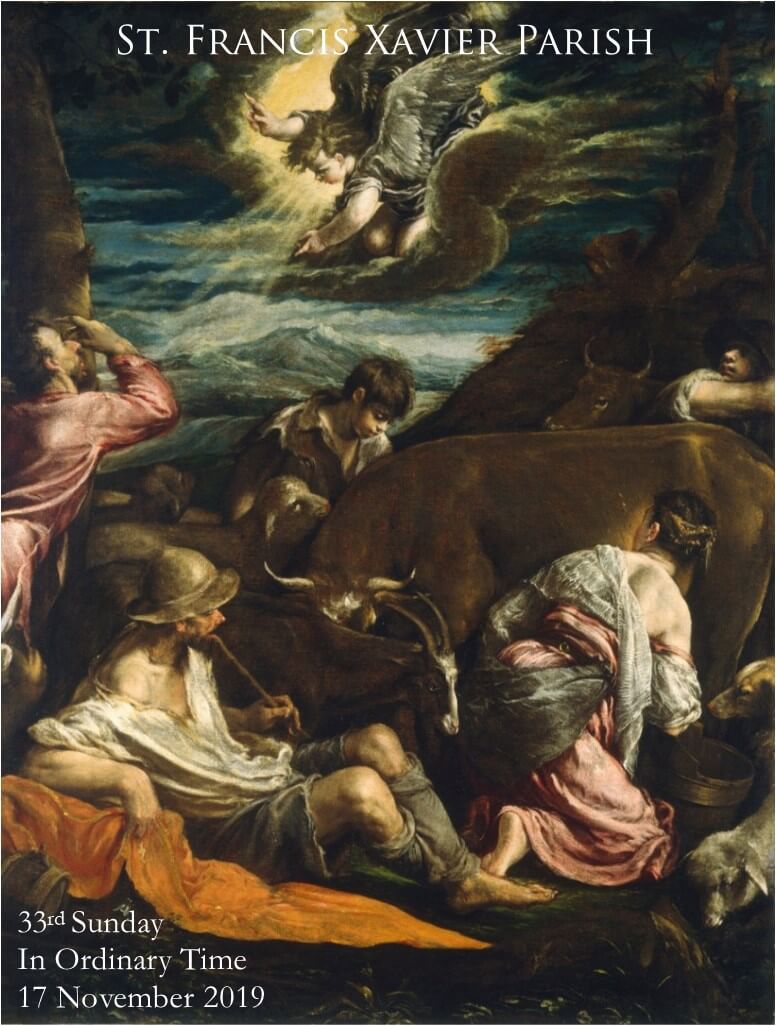
Thus for this pre-Advent reflection on the coming judgment of God for this 33rd Sunday in Ordinary Time, we have placed on our bulletin cover a work by the Venetian master Jacopo Bassano entitled The Annunciation to the Shepherds (1560). This work bespeaks that nocturnal style of Tintoretto in which light emerges from and into darkness. Here Bassano has heaven open into a pastoral scene, a meeting of the supernatural with the natural. This style known as Mannerism abandoned the classical reserve of the Renaissance and created a bridge for the increasingly mystical and active Baroque.
Mannerism is controlled pandemonium as we see here in this packed scene with heads turning this way and that way. This claustrophobic shepherd’s camp immersed in twilight is a plethora of postures; even the animals point in all directions. Yet from both corners of the image forming an implied arrow with the appearing angel above, we the observers are able to look into heaven where the radiance of the divine fire pours forth upon the earth.
This angel could well be exclaiming, “Lo, the day is finally here”. We too must, like the shepherds, leave our packed and harried cubicles to follow the Son of Justice.
-Steve Guillotte, Director of Pastoral Services
by SFXparish | Nov 7, 2019 | BLOG
Finally, brothers and sisters, pray for us, so that the word of the Lord may speed forward and be glorified, as it did among you, and that we may be delivered from perverse and wicked people, for not all have faith. (2 Thes 3:1-2)
The New Evangelization is risky business. We the Church living in modern times are asked to bring modern man into the Church by engaging modernity. Direct engagement by the Church is nothing new. It has been the evangelical approach of the Church ever since the missionary activities of Ss. Peter and Paul. The peril of engagement however has always been (since apostolic times) how to “disengage” when one draws too close to the world and to its spiritually-diminishing influence.
We read in the Old Testament how Israel entered the promised land of Canaan under the instruction of God. The Israelites were directed to destroy all remnants of the pagan faith in order to avoid coming under their influence. Modern sensibilities may find such violence disturbing; however we should understand that the land of Canaan had been irreparably desecrated through idolatry. Israel was sent into Canaan to be an instrument of justice in the same way the staff of Moses treated the heathen pride of Egypt. Israel was forged in the desert of Sinai with God’s law so that it might bring spiritual purity into an land thoroughly obdurate in rebellious impurity.
Upon escaping from Egypt, the children of Jacob formed a covenant with God so that upon entering Canaan they would make it into and keep it as a holy land. Through the sincere practice of the Ten Commandments the Israelites were to purify not only the land they beheld, but the earth itself by becoming a light to the nations (Is 42:6). However, not long after Joshua died the Israelites began to lose their way (Judg 2:1-2). Even their wisest king, Solomon, fell under idol worship (1 Kg 11:1-6). Sadly, the ancestors of the Israelites escaped the bondage of Egyptian paganism only to have their descendants return to it whole heartedly through Canaanite heathenism.
In today’s reading, just as Paul prays for the evangelization of the Word, he also prays that he and his flock may escape the idolatry of the world. Paul makes it clear that those who do not have faith are always at risk of falling into perversity and wickedness. Not only this, but Paul asks for prayers so that he might be delivered from the wicked.
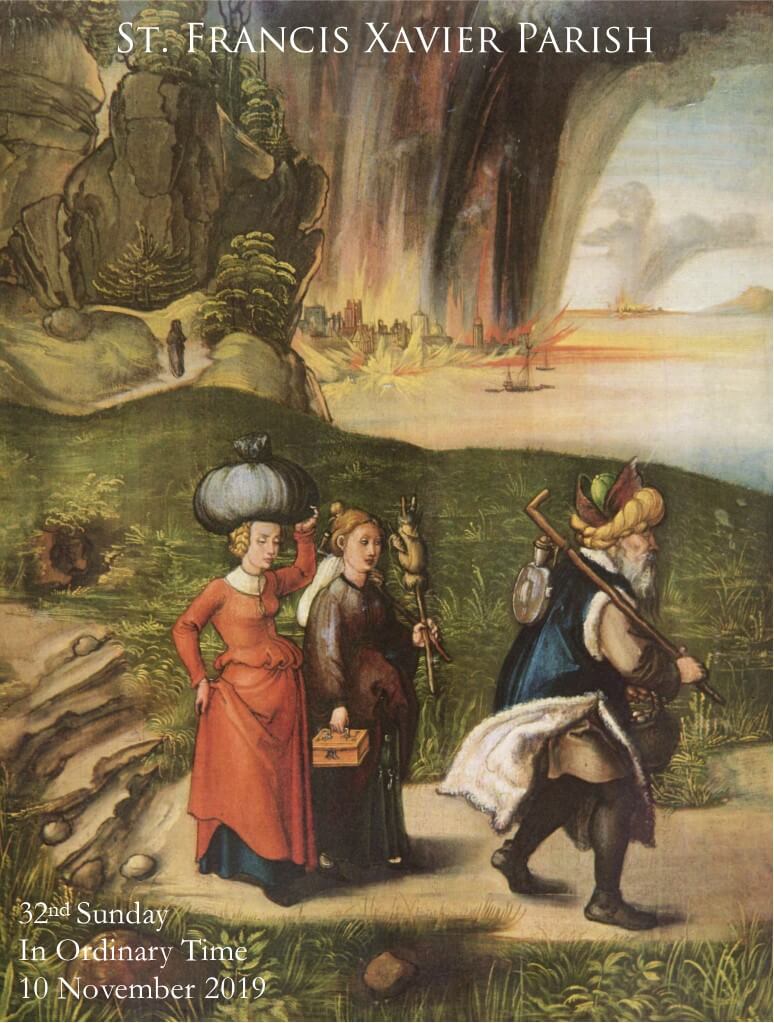
Thus, in accord with our quotation above taken from today’s second reading, we place on our bulletin cover for this 32nd Sunday in Ordinary Time a work by the Dutch Master, Albrecht Durer, entitled Lot’s Escape (1496). This work leaps forward out of the somber Northern Renaissance and into the glow of fantasy literature with its mellifluous colors and its fantastic imagery. It as if Durer has painted a fable for us. This is not far from the truth as he uses the historical event of the escape of Lot from Sodom as a lesson of encouragement to all Christians to abandon lifestyles of sin and friendships that trap one in sin.
As we go forward to evangelize the world we must often move among an irrational and faithless people. Therefore, just as Jesus told his apostles to move on and shake the dust from their feet, so too must we never settle down by pitching our tents in sloth among the wayward (2 Cor 5:1-4).
-Steve Guillotte, Director of Pastoral Services
by SFXparish | Oct 31, 2019 | BLOG
“For you love all things that are and loathe nothing that you have made; for what you hated, you would not have fashioned.” (Wis 11:24)
You have often heard it mentioned from the parish pulpit, and these bulletin pages, that the three transcendental properties that subsist in all created things are beauty, truth, and goodness. All created things have these inherent properties as they reflect the Creator, who when beheld, is all Beautiful, True and Good. Today, with the prompting of our quotation above taken from this Sunday’s first reading, we will focus on goodness.
The notion of goodness eludes the modern world. This is because it has limited the idea of the good to only one of its aspects: that which benefits the individual person or subject. Now there is some truth to the subjectivity of the good as it applies to the physical world, since what is materially good for one person may not be good for another person (e.g. medicine). However, when we consider another aspect of the good – morality or virtue – we see that there are some actions which are always good (i.e. objectively good or good for everyone).
Objective goodness rests in God. God is the “omega” (Rev: 22:13), that ultimate good which all objects and subjects tend toward or desire. The wing blowing, the deer leaping, and the man formulating each achieve actions particular to their respective species through the joyful will of God. We call such actions “perfections” since by the acting out of powers proper to them, things, animals, or persons actually achieve their divine purpose. We call the function and fulfilment of all these natural powers “the natural law” believing that God is the origin of this “law” which flows through the veins of his creation.
Sadly, the devil has sown into our earthly condition an “unnatural” or unintended purpose to disrupt the perfections which God created and desires for his creatures. Humanity now challenges the natural law by prompting each person to say “I am the decider of good” in many areas established by God: life and death, morality and sexuality; gender and personal identity. So let us pause and remember.
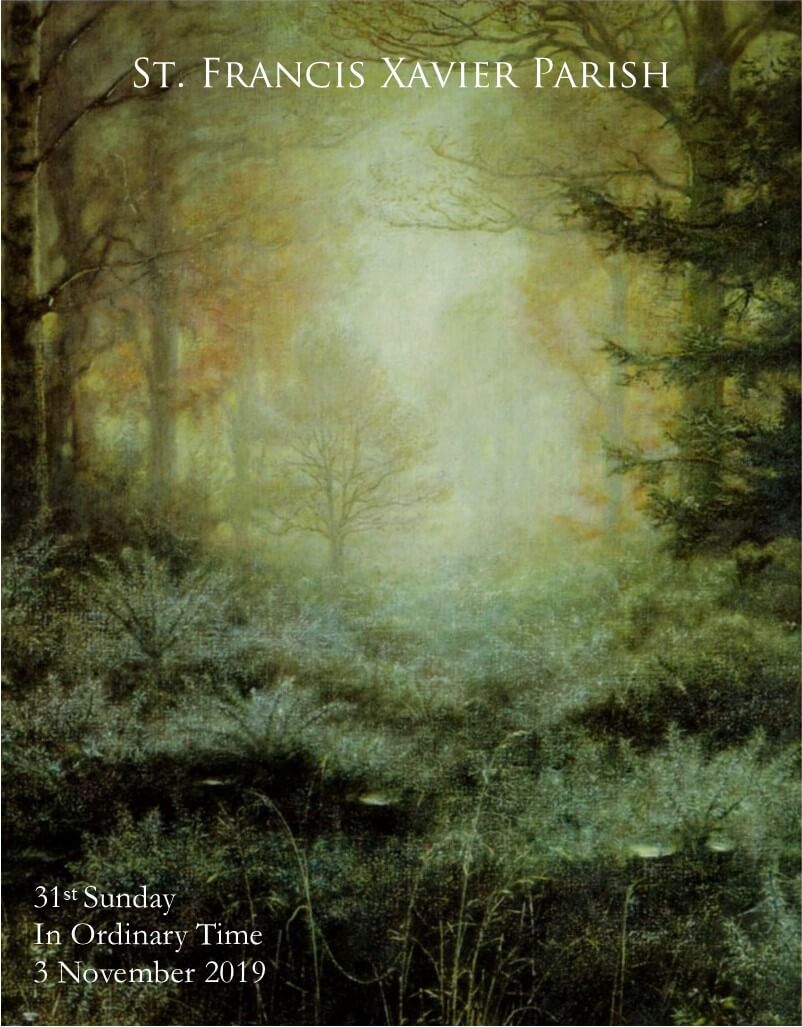
On this 31st Sunday in Ordinary Time, we place on our bulletin cover a work by painter John Everett Millais entitled Dew Drenched Furze (1890). Here we find Millais fully wrought in his landscape phase having reached his goal of serene naturalism just six years before his death.
Furze grows in Ireland, England and Scotland and as a young plant has succulent leaves like young hemlock but which become spiny in older age. Because the plants on Millais’ forest floor are drenched in dew it cannot be known if the furze is young or old. Yet, Millais purposely leaves out the plant’s bright yellow flowers to give his observer a strong sense of the primordial world full of the original purpose of God.
Perhaps it is well to recall some words of Hamlet to his beloved Ophelia: “God has given you one face, and you make yourself another”. This we do each time we seek our human happiness and identity outside of the natural law. God gives us the natural because he desires our good, so that our lives will be serene. Instead, we have chosen agitation, confusion, and havoc.
-Steve Guillotte, Director of Pastoral Services
by SFXparish | Oct 25, 2019 | BLOG
Beloved: I am already being poured out like a libation, and the time of my departure is at hand. I have competed well; I have finished the race; I have kept the faith. (2 Tim 4:6-7)
It is quite fortuitous (and fortunate) that just as we received last week the final instruction in our adult education series on St. Paul by examining his 2nd Letter to Timothy, we read from this same letter this Sunday at Holy Mass. It is also fitting to read from this letter just before Advent which is the opening of a new liturgical year. For us, Paul’s anticipation of his own death in this letter to Timothy feels like the closing of the apostolic age and the ushering in of a new but challenging age since with Jesus ascended and the apostles gone, all who come after them who have never met Jesus must move forward with Jesus through a life of unseen grace. This is the age we still live in today, a time in which we must put on hope and offer witness to Christ because we are those who remain; those who “have not seen but have believed”. (Jn 20:29).
In our quotation above taken from today’s second reading, Paul is writing to Timothy to inform him that he is prepared to make a final sacrifice of his life in imitation of Christ. Paul is like Ulysses, that fateful Greek mariner in the poem of the same name by Alfred Lord Tennyson, who speaks the words, “I will drink life to the lees”. Ulysses will not waste even the last drop of wine from his bottle. Similarly, Paul’s earthly life is now finally flowing out from him. He will pour out the last drop on an altar of sacrifice for the Lord. His “departure is at hand”. He wants to give all that he has left to God; for Paul has “competed well”, “finished the race”, and “kept the faith” through trials and tribulations so as to win the crown of victory.
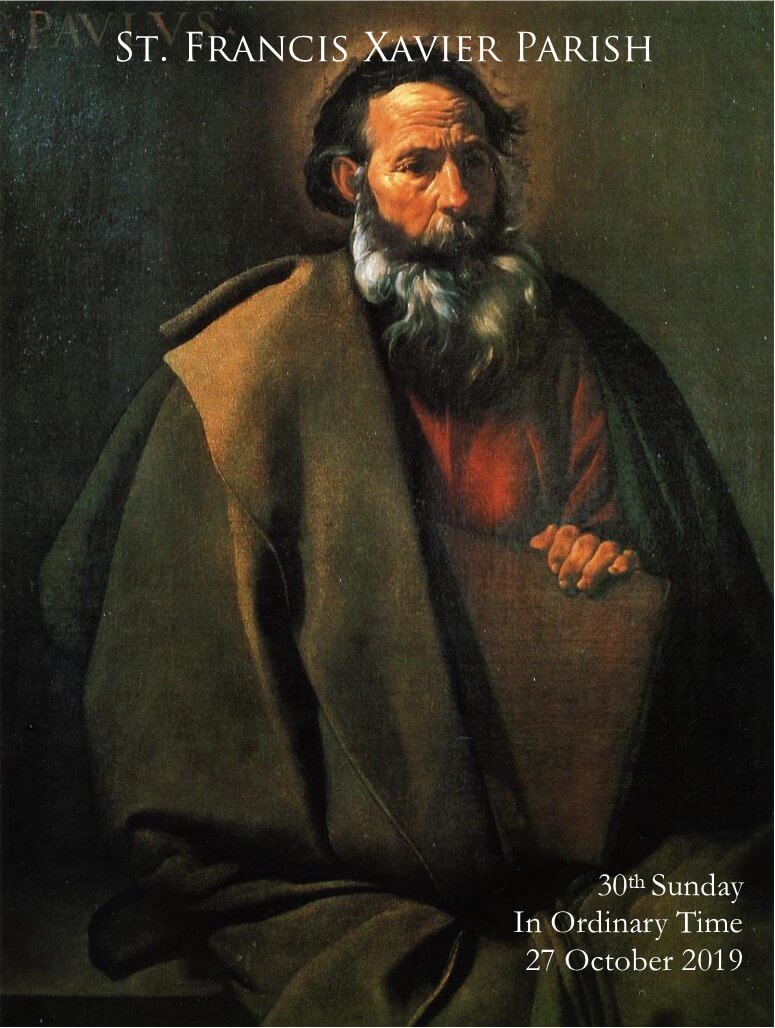
Now we thought of using as an image of Paul’s spiritual accomplishment a painting depicting Pheidippides – that famed Greek runner who ran from Marathon to Athens only to collapse in death upon announcing victory. However no such work would have done metaphorical justice to Paul’s race. Hence we place on our bulletin cover for this 30th Sunday in Ordinary Time a work by the Spanish master Diego Velzquez, simply entitled, St. Paul (1620). Velazquez painted in the Tenebrist style. Yet even though St. Paul is one of his earlier works, Velazquez anticipates the broader brushstrokes of his later period.
Velazquez accomplishes a scene of St. Paul sitting on a bench, perhaps in his own prison cell awaiting his sentence of death: reflective and stoic, but possibly sad, not for his own demise but for the many souls he has labored and worried over. He holds in his hands as his last possession a single portfolio symbolic of all the writings to his flock which when read show that he is not antagonistic toward state authority; only solicitous for God’s authority. He holds these works as he intends to present these to the Lord, his judge, as proof of the good works he has done on earth, while “in the body” (2 Cor 5:10).
-Steve Guillotte, Director of Pastoral Services
by SFXparish | Oct 17, 2019 | BLOG
As long as Moses kept his hands raised up, Israel had the better of the fight, but when he let his hands rest, Amalek had the better of the fight. Moses’ hands, however, grew tired; so Aaron and Hur supported his hands… so that his hands remained steady till sunset.” (Ex 17:11-12)
Which one of us even at a young age could all the day long keep his hands raised above his head? God certainly gave Moses divine authority to secure victory over Amalek; however Moses still needed to rely on his natural strength to keep his hands raised during the entire battle. Each time he lowered his arms from exhaustion he had to know that some of his men were being wounded and killed. Just knowing this must have added anguish to the task and anxiety to his weariness.
Fortunately, Moses had Aaron and Hur to hold his arms up. More to the point, the task which now requires three persons, takes on spiritual meaning: the prefigurement of the Holy Trinity. This is not to take the comparison too far and suggest that Moses’ weariness shows that one divine person is weak without the others. It is simply an Old Testament foretokening of the revelation of the tri-fold Godhead, the eternal communion of truth and love.
Moses also serves as a foreshadowing of Jesus. This task of Moses is a window into the Passion of Christ who in His own battle against the enemy keeps His own hands above His head. The hands of Jesus were held aloft by nails so that He could not lower them. In fact, the lowering of His hands would mean coming down from the cross – and risking the loss of souls. Moses held on “until sunset” when the battle finally ended. Jesus held off until sunrise when on Easter morning he burst forth from His tomb bringing victory over sin and death.
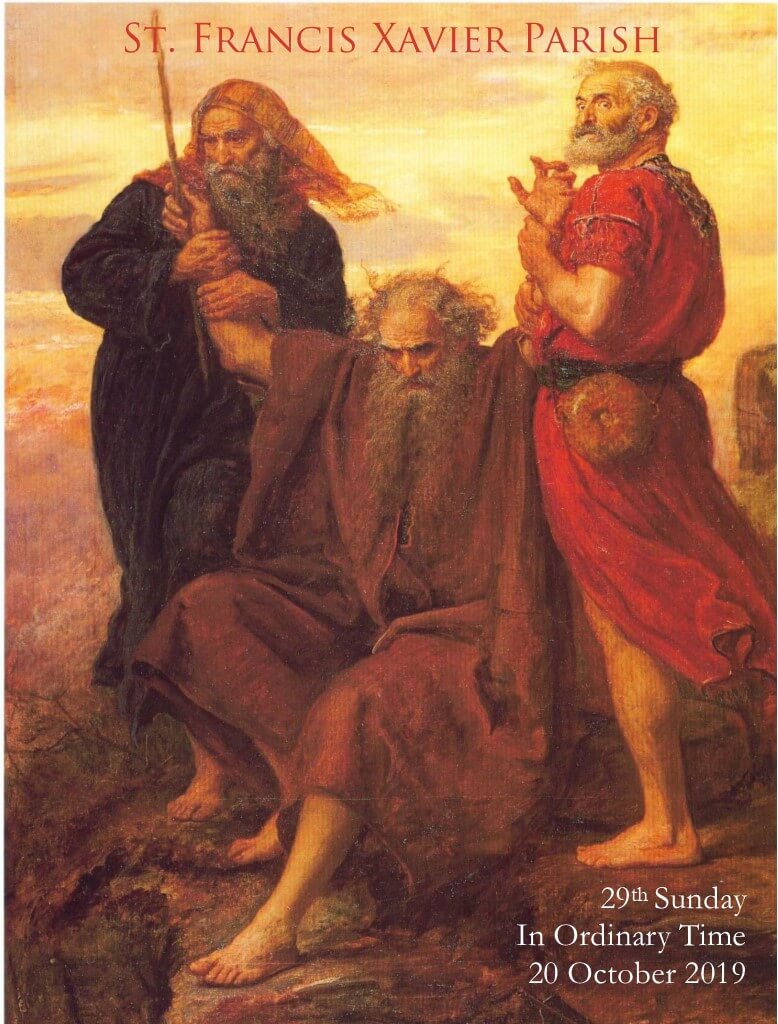
To bring the image of Moses from the Book of Exodus alive on this 29th Sunday in Ordinary Time, we place on our bulletin cover a work by Pre-Raphaelite painter John Everett Millais entitled Victory O Lord (1871). Although this work is thoroughly Pre-Raphaelite in its naturalistic and spiritual mood, it also indicates the movement of Millais into his landscape period when scenery gains more emphasis. Although Aaron (in red) and Hur are present to give relief to the weary Moses, Millais paints Moses as one who appears eager and tireless. The observer of the painting gets the sense that Moses is being held back from throwing himself forward into the battle. (The battle is only indicated by a single broken spear head in the lower right corner of the image). The face of Moses is determined and intent on the event below, while above and behind him the sun begins to set as the day closes and victory draws near.
Staff in hand, this image of Moses flanked on high by two companions could depict the scene of Creation. In that case Moses would be the Father shown unwearied by his task yet still held back by the Spirit and the Son for a “day of rest” as the new world dawns for man.
–Steve Guillotte, Director of Pastoral Services