by SFXparish | Oct 10, 2019 | BLOG
Jesus said in reply, “Ten were cleansed, were they not? Where are the other nine? Has none but this foreigner returned to give thanks to God?” Then he said to him, “Stand up and go; your faith has saved you.” (Luke 17: 17-19)
In today’s gospel reading Jesus descends from Capernaum toward Jerusalem traveling south through Galilee and Samaria. Jesus is called upon from a distance by ten people with leprosy asking Him to pity them. Jesus does not call back saying to them that they will be healed; He says only “Go show yourselves to the priests”. Mosaic Law required that those with a lesion should go and show their ailment to the Levite priest. Depending on the specific condition of the skin, the priest declared the person “clean” or “unclean”. If sanctioned “unclean”, the person was separated from the encampment (Lv 13: 1-4).
What we don’t know about the ten lepers that encountered Jesus is if they ever fulfilled their initial duty to report to the priest. It appears that most of these lepers were Jewish since Jesus commands them to present themselves. It also seems that they never fulfilled their original duty to the law because they began immediately on their way to find the priests (Lk 17:14). The men with leprosy may have thought that Jesus caught them in the dereliction of their duty to fulfill the law and that in order for Jesus to heal them He was requiring them to fulfil the discipline of the law for lesions. Yet, they were healed on their way.
According to the Mosaic Law even if an Israelite was healed of his lesion, he still could not enter the encampment until an examination by the priest cleared him. So it may be that what the lepers thought would be their first visit to the priest was in fact to Our Lord’s mind their final visit for approval. Yet, since the lepers were healed on the way, they may not have even gone to the priest; they may have dispersed in celebratory joy. Interestingly, the Samaritan who was healed may not even have known how to follow the command of Jesus to go to the priest since as a Samaritan he was already isolated from the Jewish faith. However, when he was healed he knew exactly where to go: back to Jesus to thank God for his full recovery.
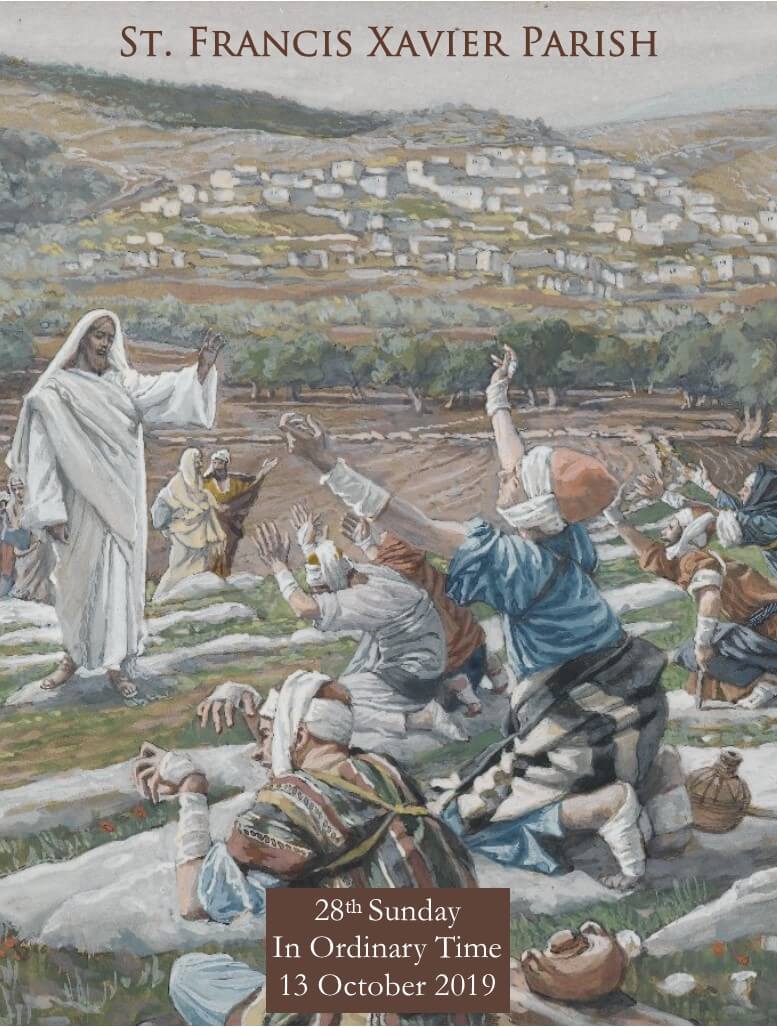
To give vision to this event we have placed on our bulletin cover for this 28th Sunday in Ordinary Time a watercolor work by James Tissot entitled The Healing of Ten Lepers (1894). This work is part of an extensive series entitled “The Life of Christ”.
Here can be seen the men with leprosy calling out to Jesus during his travel toward Jerusalem. Some of the men show the debilitation of their illness, all are bandaged; all are in postures of humility which betoken souls which have been completed brought low and are on the edge of utter despair and hopelessness. We should not mistake their poses for that of praise. Their bearing is of great lamentation.
They must have lamented on their way to the priests, but only for a short time; for when they were healed they were surely amazed. Yet, only one returned to offer thanks. He surpassed all duty to the “law” and was freed by faith!
–Steve Guillotte, Director of Pastoral Services
by SFXparish | Oct 3, 2019 | BLOG
The apostles said to the Lord, “Increase our faith.” The Lord replied… “When you have done all you have been commanded, say, ‘We are unprofitable servants; we have done what we were obliged to do.’” (Luke 17: 5-6; 10)
A servant in ancient times owned no property and was not free in the way we understand freedom today. The servant attached to an estate or household was wholly dependent upon his master who owned property. In the evolving feudal system property was paramount; it was the large country estate that fed the economic system. Before the factory worker, there was the servant who was tied to the land and beholden to the master of the estate.
Understanding this master & servant relationship is necessary for evaluating the quotation above taken from one of Jesus’ parables in today’s gospel reading at Holy Mass. The obligation of the servant to his or her master was not solely one of labor contracted and duty performed; it was also one of gratitude owed. Before the world advanced on the notions of universal freedom and private property there were masters who possessed and retained, and servants who relied and obeyed.
In our time it is difficult to grasp these types of relationships – the patrician and plebe or the nobleman and commoner – which was as cultural as it was economic. The ancient and medieval master/servant relationship usually existed for defense and in the absence of central government. At its finest the good master commanded respect yet also cultivated the well-being of his tenants who came to trust his direction and virtue. Noblesse oblige was once a way of life in which those privileged to have wealth were expected to act with generosity and care to those without privilege. However, it was not a system based on our notions of freedom, education, and occupational mobility, nor did it fail in becoming oppressive, but at its best it rested upon authority and gratitude forming bonds of trust. Thus to follow the instruction of Jesus and say that we are “unprofitable servants” under obligation means to say that we are grateful to build up the divine estate from which we receive its fruits. The request of the Apostles – “increase our faith” – is thus our common hope of being bound to God to gain all his graces.
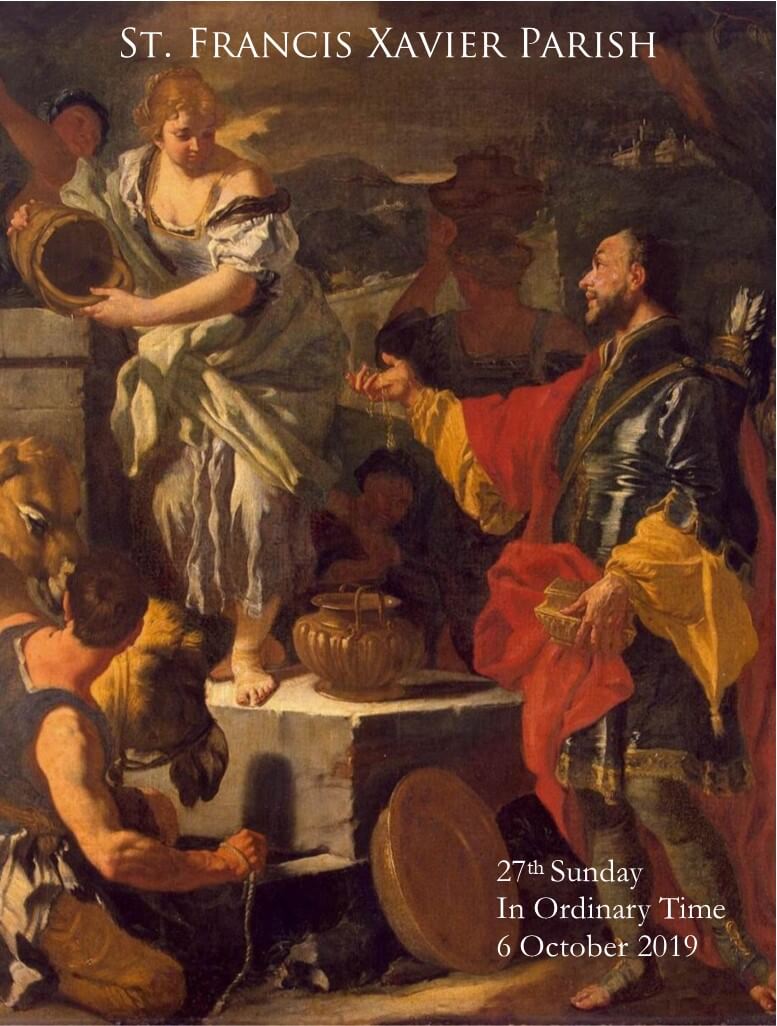
For this 27th Sunday in Ordinary Time we have placed on our bulletin cover a work by the Neapolitan master Franceso Solimena entitled Rebecca and the Servant of Abraham (1710). Solimena was a well-established baroque master in Naples (Italy) where he relied and built upon the baroque of Rome.
In this painting we catch the servant as he approaches Rebecca to become the wife to Isaac, Abraham’s son. We see the servant as the true representative of his master dressed in the fruits of his master’s prosperity. He carries gold in his left hand and offers a bracelet to Rebecca with his right so as to tie this around her wrist and bind her in betrothal to Isaac.
This servant is not oppressed and weak. He is himself noble and he holds in his hands great wealth. But as these are symbols of grace he claims these not for himself but as the possession of his master. He has great trust in his master; he loves Abraham just as we should love God for all his mighty and gracious gifts.
–Steve Guillotte, Director of Pastoral Services
by SFXparish | Sep 26, 2019 | BLOG
Thus says the LORD the God of hosts: Woe to the complacent in Zion! Lying upon beds of ivory, stretched comfortably on their couches (Amos 6:1; 4)
With Mass attendance suffering, parishes closing, and Catholic belief in doctrine such as the Real Presence of Jesus in the Holy Eucharist dropping off, we must admit that besides a damaging wave of secularism there has been a red tide of complacency in the Church that has brought us to this state. True, we face challenges as great as in any pagan era; however we also bear the blame of being too slow to respond to these challenges and perhaps even too polite in our approach to an aggressive culture intent on stamping out Christ in the world.
This is not to suggest that the Church should become a counter-puncher or a bellicose adversary. It should simply begin to do what it does best when it is at its best: proclaim the word of God clearly and distinctly, without reservations or hesitations, in love, but in perfect truth, without fear or doubt.
Doubt about speaking the truth will always leave a Churchman resting on a couch of complacency. First he avoids speaking the truths of the faith because he does not want to offend or to appear negative or “mean”. He may even come to fear to speak the truth. By avoiding church teaching on “controversial” subjects he may become more accepted by society. This comforts him. He finally rests in this comfort without realizing the he has put the Church and himself in danger; for in the end religious complacency is false consolation, a lack of awareness that the peril one avoids continues to grow in the absence of diligence and true devotion.
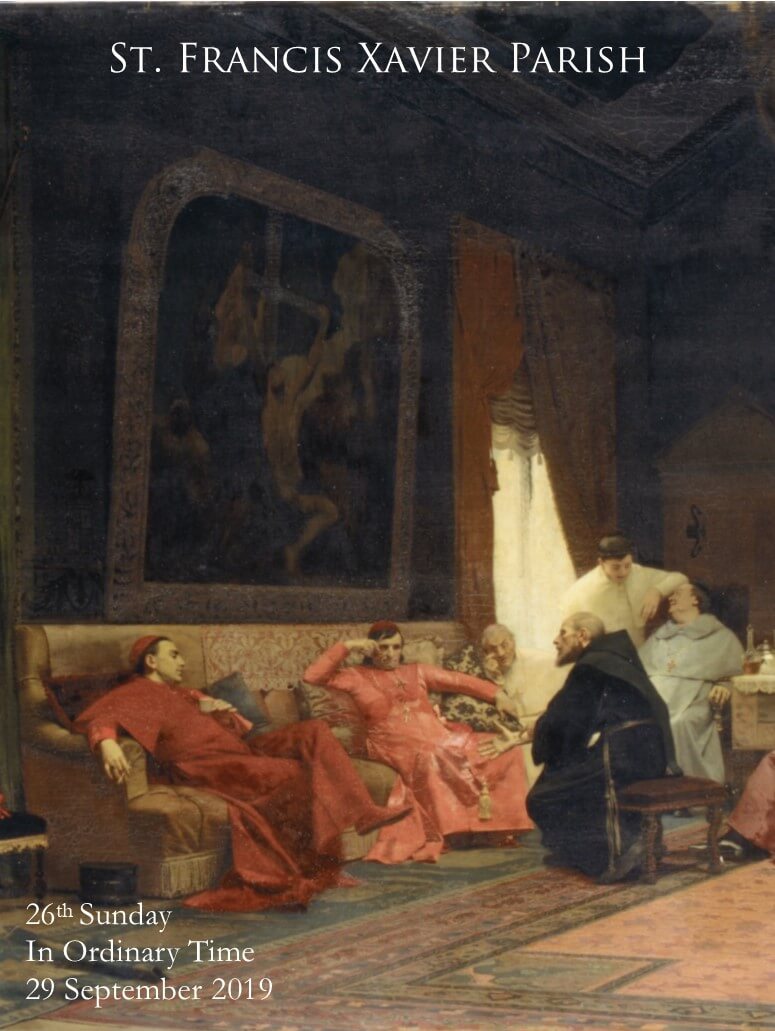
To further make this point, our bulletin cover for this 26th Sunday in Ordinary Time dons the image entitled The Missionary’s Adventures painted in 1883 by the French Academician, Jehan Georges Vibert.
The subject of this painting is both obvious and chock-full of allegory. Here we see a missionary just returned from spreading the gospel abroad. He leans forward on the edge of his seat balancing on the tips of his toes, pointing to a wound he received; mouth open, eyes and head forward, all indicative of one who is steadfast in the faith and spirited in evangelism. He has an audience of three. On the far left is a cardinal holding a cigarette and a cup of tea leaning back with legs crossed and apparently now asleep. To his left (our right) is another prelate sitting in a casual posture also resting on pillows with a look of skepticism or disapproval. The third person, an elderly priest or religious, wipes his eyes literally bored to tears (or is he wiping a tear in memory of his own missionary days, before he too became comfortable)? Allegorically, this work should stir the conscience of every Catholic.
Now not every Catholic is called to be a missionary or evangelist; these are special gifts. Yet all are called to be disciples, that is, to be pupils and followers of Christ. The priests and the missionary which are here portrayed in Vibert’s incisive painting offer an opportunity for each of us to examine two sides of ourselves: the side that uses the gifts of God for personal gain and the side that uses these gifts for God’s kingdom.
Vibert prompts the disciple inside of you to favor the latter and so he “hangs” above his comfy couch Ribera’s Martyrdom of St. Bartholomew. This painting-within-a-painting is literally the crux of the matter; for the Church cannot witness successfully in nicety and comfort, but only through the loving zeal of the cross of Jesus Christ.
–Steve Guillotte, Director of Pastoral Services
by SFXparish | Sep 19, 2019 | BLOG
“Beloved… I ask that supplications, prayers, petitions, and thanksgivings be offered for everyone, for kings and for all in authority, that we may lead a quiet and tranquil life in all devotion and dignity.” (1 Tim 2:1-2)
It is not possible live heaven on earth. There are too many solicitors to sin such as the devil, our flesh, and of course the world itself. When the devil isn’t sowing sin in the heart and strife in society and our flesh isn’t leading us toward fear and doubt, the world is busy prodding us to takes sides against each other. Sinister snares, frightful worries and selfish desires all prevent man from being able to replicate the paradisal kingdom.
This does not mean that we should not raise up heaven as a model for life on earth. Citizens of heaven would lift the word of God as a hedge against the devil; would build up the Spirit as a bulwark against the fears of the flesh, and would elevate the virtues of truth and charity against the vices of avarice and jealousy. Most of all as citizens of the eternal kingdom we would be humble in the knowledge that we cannot find perfection and lasting joy on this earth which is still groaning to become a new creation (Rom 8:22). We would recognize suffering as a mystery, alleviate suffering as an evil, and endure suffering as in imitation of Christ.
And we would pray – constantly. This means that our lives would be a continuous response to an awareness of God’s everlasting presence. Every person would work to heighten their wakefulness to the Holy Trinity though the grace of our Lord Jesus Christ. Our first prayer, being always acknowledgment and praise of the Lord, would spill out into prayerful petition for our needs and the needs of others; and in thanksgiving for what we have received and in contrition for having failed to honor our God-given freedom. We would pray particularly for all in authority either placed there by God or by our common decision; and we would expect our leaders to uphold devotion to the good, the right, and the beautiful so that human dignity would be respected at all stages of life and that peace and tranquility would thrive upon the earth.
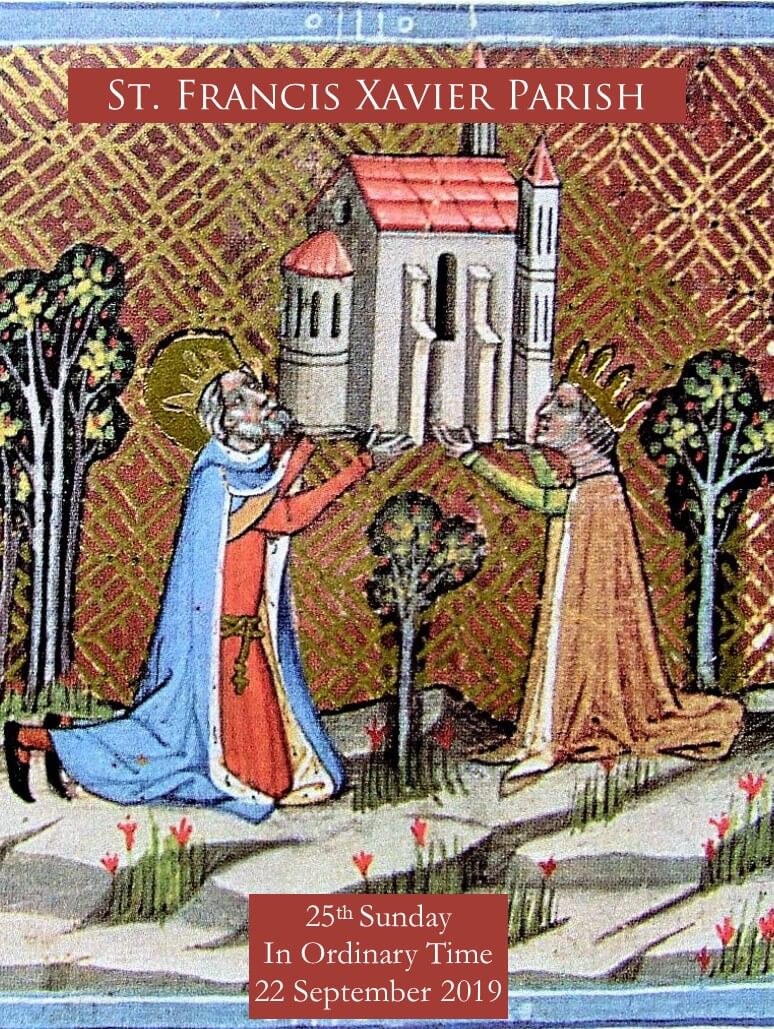
In consideration of this we place on our bulletin cover for this 25th Sunday in Ordinary Time an image depicting St. Stephen of Hungary and Queen Gisela founding a church at Obuda, which now forms part of Budapest. This work is a colorful illumination contained in the Chronicon Pictum which was completed about 1373 AD, some three hundred and fifty years after the death of Stephen.
Here we see Stephen who united the ancient Magyars into the Hungarian Christian nation, with his Bavarian wife. Both king and queen elevate the church while they themselves are firmly fixed on the earth. They are on their knees, not laying the foundation of the edifice, but presenting an offering to God. As the highest authority of the state Stephen and Gisela are humbling themselves before the authority of heaven. They pray for strength to lead, wisdom to rule, and just judgment to benefit their people. Would that all our earthly leaders learn and practice this same devotion, so we might enjoy a bit of heaven on earth.
–Steve Guillotte, Director of Pastoral Services
by SFXparish | Sep 12, 2019 | BLOG
“Beloved: I am grateful to him who has strengthened me, Christ Jesus our Lord, because he considered me trustworthy in appointing me to the ministry. I was once a blasphemer and a persecutor and arrogant, but I have been mercifully treated…” (1 Tim 1:12-13)
In the month of October our parish will present a Pauline study on grace. This will coincide with the introduction of the theme for our year of faithful inquiry entitled “Your Grace is Enough for Me, O Lord” which is a paraphrase taken from 2 Corinthians 12:9.
Even before this formal announcement, this theme had already made itself known to us over the last few Sundays in our Gospel readings. Two weeks ago Jesus instructed us to conduct our lives with humility. He gave us the parable of the man who takes a lower place on earth so that he may be raised to a higher place in heaven. This raising up only occurs through grace. Last Sunday Christ asked us to renounce all that we have so that we might be his disciples. Yet why do we give these things up except so we might gain a greater portion of grace? And what discipleship do we seek if not the discipleship of grace? All Christian roads start from and lead back to grace; every destination of the Christian spiritual life finds its starting point in baptism. “Your Grace is Enough for Me, O Lord” is not simply a clever theme, it is our wake-up call, a trumpet blast in the ears of those slumbering through the walk of life, lazily following or avariciously chasing after the things of the world which lead the soul away from God and lessen its desire for a life of grace.
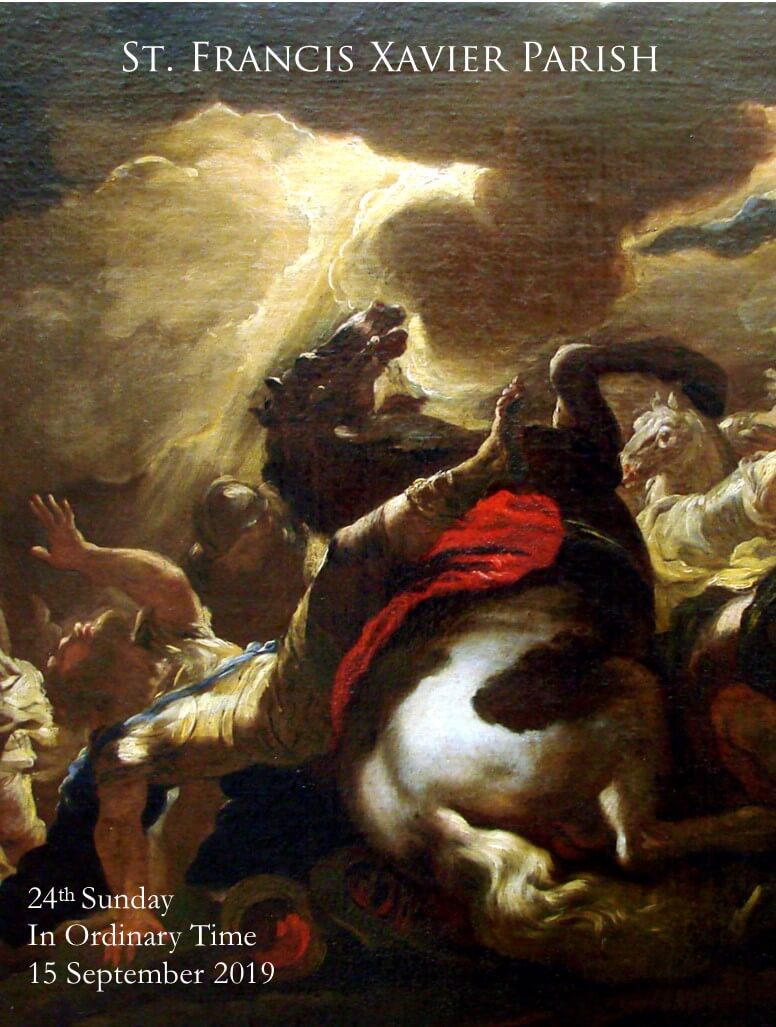
To help us get ready for our examination of the life and essential teachings of St. Paul, we place on our bulletin cover for this 24th Sunday in Ordinary Time a work by the Italian Baroque master, Luca Giordano, entitled The Conversion of St. Paul (1690). Giordano was a painter-artisan; he mastered the epic of Tintoretto and the illumination of Caravaggio, all while his mature baroque anticipated the ethereal tones of the Rococo. His painting was majestic and fast making him the perfect artist for painting spaces of worship: walls and domes in lively fresco.
In the full image (not seen here) of the Conversion, Paul seems as an Alexander the Great amidst a battle scene with twisting figures, human and equine, falling here and their collapsing upon each other, while tack and garments are tossed about as flags in a mighty wind. A great storm from above falls upon the mass of bodies and the light of heaven emerges through dark clouds throwing all into disarray and blinding the zealous Pharisee named Saul. While many of the figures cover their faces from the light, the man to be called “Paul” puts out one hand to break his fall while the other hand reaches out to heaven as his eyes look directly into the divine light above him. Giordano shows Paul accepting his ministry with immediacy, turning his usual zealousness without hesitation in the sole direction of Christ.
–Steve Guillotte, Director of Pastoral Services
by SFXparish | Sep 5, 2019 | BLOG
‘… After laying the foundation and finding himself unable to finish the work the onlookers should laugh at him and say, ‘This one began to build but did not have the resources to finish.’ (Lk 14:29-30)
Our present age has increasingly little interest or regard for the resources of the past. Modern eras tend to be that way. We care about the next smart phone, the next e-book, the next technological breakthrough more than we seem to care about an in-person conversation, a classic tale, or knitting. Secularism, materialism and consumerism all contribute to this departure from the past and tradition.
Even the Church has had a hand in this. For instance, the recent LCWR Conference of women religious spoke much about “making meaning” but little to nothing of “making it” with the stuff of our rich ecclesial past. Many others in the Church today can’t say the word “tradition” without wincing. To still others the Latin Mass for example is the “old Mass”; old, of course, being a bad thing. What these individuals have yet come to understand is that without a high regard for the ancient and historical Mass, there comes about eventually little interest in the Mass itself. A family, a country, a Church without its past is as St. James says – like a man who sees his own face in the mirror and after walking away promptly forgets what he looks like (Ja 1:23).
Here at St. Francis Xavier Parish we try very hard not to forget. The use of relics makes us remember the saints, incense makes us remember the Holy of Holies, male altar servers makes us remember the Last Supper; Eucharistic Adoration makes us remember the Real Presence of Jesus. We believe that we have a duty to remember; a piety for fully living out our belief or else what is this Gift of Holy Spirit for? If we don’t recall our heritage day after day, who else will encourage us to do so?
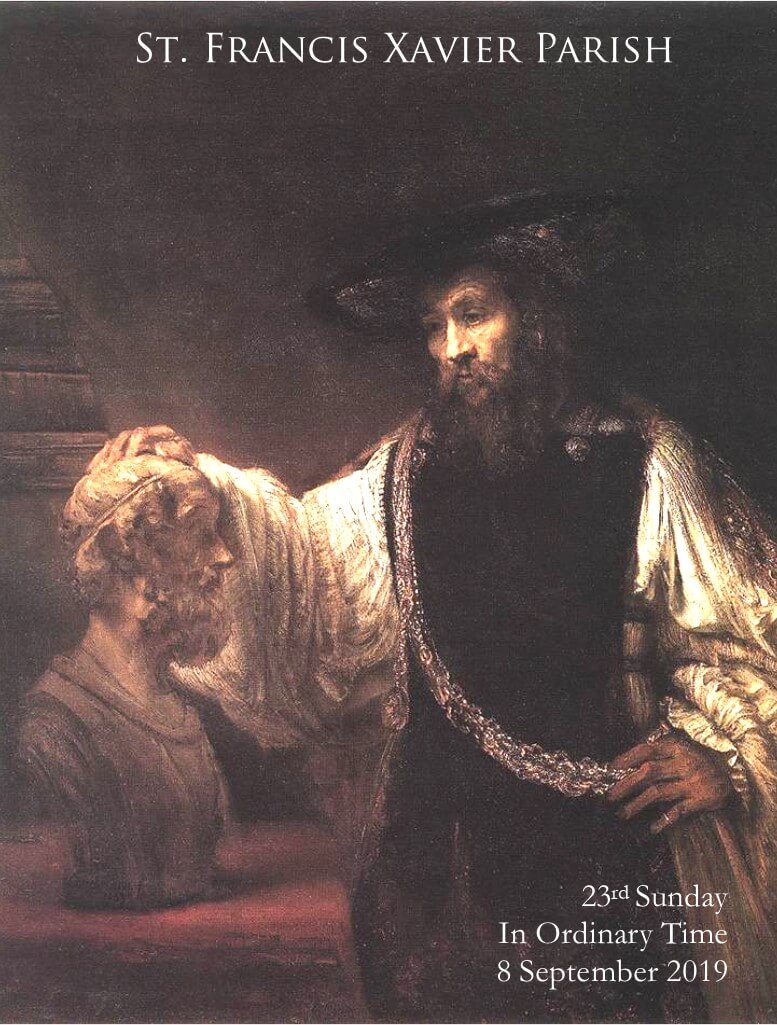
Hence we have deposited on our bulletin cover for this 23rd Sunday in Ordinary Time a work by the Dutch master, Rembrandt, entitled Aristotle with a Bust of Homer (1653). The Dutch Baroque was subdued compared to its Italian and the Spanish expression, but its magnificent use of light emerging from darkness offers a wonderful contemplative experience.
Here is the great Greek philosopher Aristotle presented as a Dutch noble with his hand resting on the head of the Greek epic poet Homer. Aristotle looks back at least three centuries into his past and recalls the literary heritage which raised and educated him. He honors it with his entire posture in quiet reflection. If we can imagine Aristotle just a moment before, with both hands on his hips before he reaches out to touch the bust, it would bespeak a bearing of surprise such as “Well, what do we have here!” Homer was blind, but Aristotle gives him sight; for the past is blind without those in the present to give it vision.
What we see in this image is a discovery of the past. So then, what of us? Was not the rediscovery of our most vital resources the best, intended purpose of Vatican II – a rediscovery of the Church Fathers and the original meaning of our faith and liturgy? Why then do we insist today on looking past our blessed past?
–Steve Guillotte, Director of Pastoral Services