by SFXparish | May 7, 2020 | BLOG
So the Twelve called together the community of the disciples and said, “It is not right for us to neglect the word of God to serve at table. Brothers, select from among you seven reputable men, filled with the Spirit and wisdom, whom we shall appoint to this task…” (Acts 6:2-3)
In reading our scriptural quotation above from Sunday Mass one might think that the Apostles had forgotten Christ’s command at the Last Supper to serve humbly (Jn 13:14); for when approached by their flock to settle a dispute over the distribution of charity to widows, the Twelve seem to shun the task and instead create other “servants” (in Greek diakonia) to manage such affairs. Now it is a justifiable question to ask why the Apostles did this especially since only two chapters earlier in Acts, the Apostles were receiving money directly from believers for distribution to the people (Acts 4:35).
A few points are necessary to understand their actions. First, today’s reading begins with the phrase “the number of disciples continues to grow”. This means that there was an ever greater need of laborers for the harvest (Lk 10:2) and the Apostles were needed afield. Next, the Apostles’ pulling back from daily decisions was in keeping with Jewish tradition: this is exactly what Moses did in taking the advice of Jethro to assign minor judges to the flock (Ex 18:21-23); Jethro called the delegation of such duties a “command of God”. Lastly, the creation of deacons was perfectly in accord with the Holy Spirit which had already begun forming such men toward ordination (Acts 6:3).
So today we celebrate our deacons, our priest’s assistants by appointment and sacrament. We also come to see that their assignment was not just to “serve at table”, which in truth is only a pithy expression for “serving the people directly”. St. Luke wrote the Acts of Apostles, and immediately after announcing the institution of diakonia he showed how Stephen the Deacon not only proclaimed the word of God but died for it (Acts 7). Later on in Acts 8, Philip the Deacon is found preaching and working wonders in Samaria and baptizing in Gaza. Thus, in the kingdom of heaven even the “waiters at table” are called to proclaim Christ!
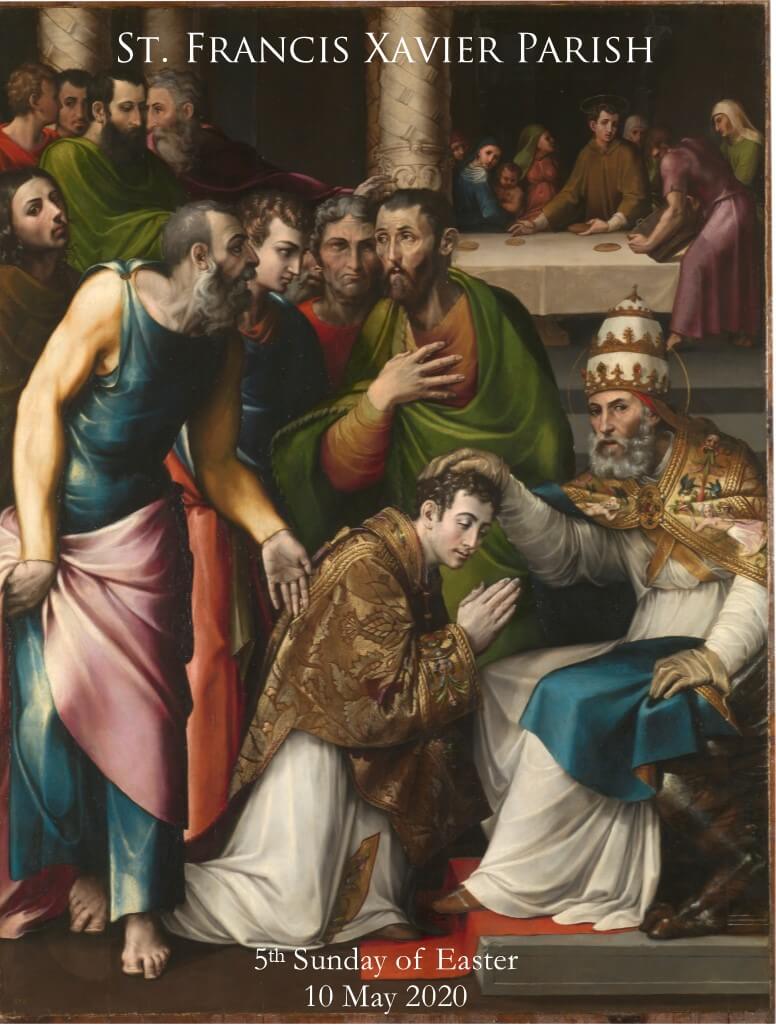
For this 5th Sunday of Easter, we place on our bulletin cover a work by an obscure Spanish painter, Onofre Falco, entitled St. Stephen Ordained as Deacon (1555). Falco was prominent in the Valencian School and was friend to the high master of the style, Juan de Juanes. Sixteenth century Valencia art was influenced by Italy in color and light, but by the Counter-Reformation in spirit and piety. Comparatively it is not a magnificent style, but its devotional character is strong. Many of its artists never painted a worldly subject.
Here we see St. Peter and St. Stephen in full liturgical dress. Interestingly, in the 16th century the deacon was not a stopping point for ordination, but always the next step to becoming a priest. Thus, the gaze of Peter outward may have moved many men to discern the priesthood. Flanking the kneeling Stephen are either Apostles deliberating over this innovative call to the diaconate or possibly candidates for this new vocation. In the upper right Falco has set a table for Stephen to serve at, placing him directly with the people and the poor. Stephen will serve them well, and Christ too, as he kneels on the color of martyrdom that would be his destiny.
-Steve Guillotte, Director of Pastoral Services
by SFXparish | Apr 30, 2020 | BLOG
When he was insulted, he returned no insult; when he suffered, he did not threaten; instead, he handed himself over to the one who judges justly. (1 Pt 2:23)
Today’s first reading presents an extremely profound statement that would be quite at home in any book of proverbs: If you are patient when you suffer for doing what is good, this is a grace before God.
First of all, this sentence is a conditional. St. Peter is telling us that it is only a grace before God if or under the strict condition that one suffers patiently for doing what is good. Sadly, many people suffer patiently for doing what is bad. There is no grace there.
Only when one suffers for something good and virtuous and pleasing to God does it conform to grace. Not only this but every act of Christian patience has its source in God. Since through our baptism we are inalterably joined to the vine of grace, any patience that we practice as believers originates as a gift from the Holy Spirit (Jn 15:5). As taught in the Parable of the Talents all grace begins with the Father and returns to him with interest (Mt 25:27). Yet, for grace to run its full circuit it must have our eager cooperation.
St. Peter tells us in today’s holy liturgy that Christ is our perfect example of patience. Jesus returned no threat when He might have used His divine authority to exact justice against his persecutors. In fact, Jesus sought no justice from man, but only from his Father, the one and true just judge! Not only did Jesus not curse his enemies, he blessed them with “Father, forgive them; they know not what they do” (Lk 23:34).
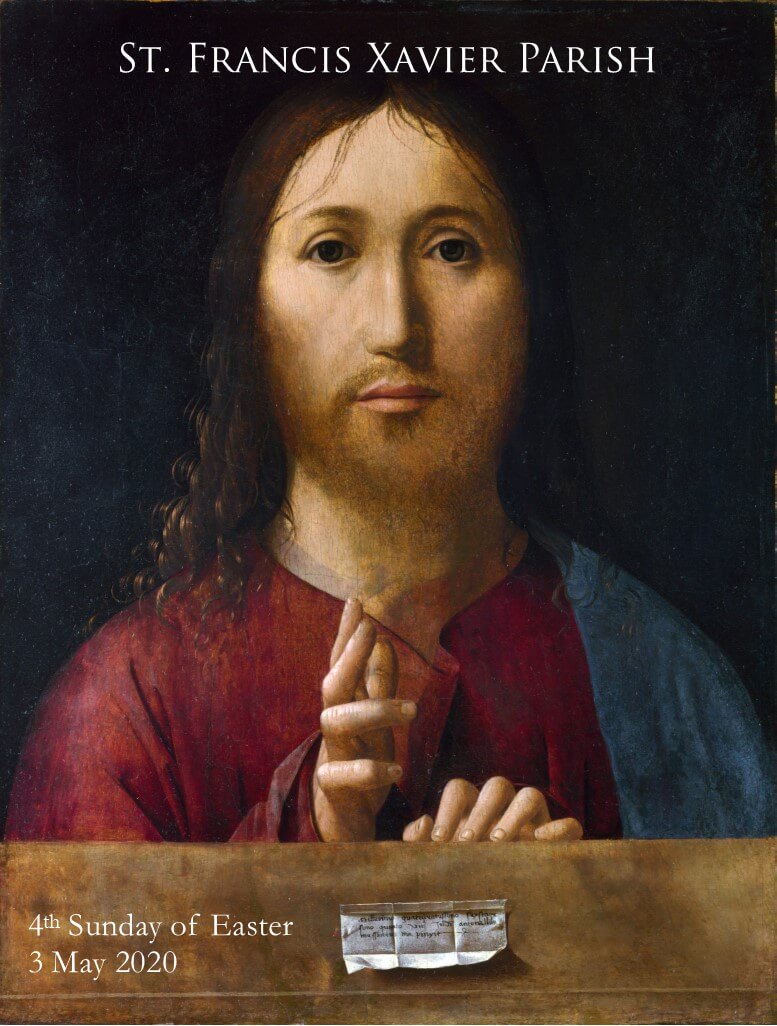
Hence, we place on our parish bulletin cover for this 4th Sunday of Easter a work by the Early Renaissance master Antonello de Messina entitled Christ Blessing (1465). Antonello was named “de Messina” for having been born in the Sicilian city of the same name. Messina was first an ancient Greek colony. It was a vital seaport across from the toe of the Italian peninsula. Antonello eventually traveled to Naples, another coastal city in Italy, where he was exposed to Netherlandish painting which was prevalent there. It is said by some that he introduced oil painting to Italy (source: Wikipedia).
This work of oil on wood is a fine example of quattrocento portraiture (i.e. the Italian 15th century). The figure of Christ is still traditionally statuesque, yet the expression is a snapshot of vibrant activity. The eyes of Christ are clear and piercing, penetrating the soul of the observer with gentleness and love. De Messina has found a way to impart compassion from a face with closed lips. The hands of Christ are most interesting since they appear as a separate feature! With most of the humerus muscle, all of the elbow and most of the forearm unseen, Christ’s hands are not clearly joined to His body. This allows Messina to create a distinct artistic space to present Our Lord’s hands with the delicate fingers of a child. This is not to portray unmanliness, but to emphasize the peaceful nature of Christ’s merciful blessing.
This image calls us to the same peacefulness asking us to avoid using threats or insults on the part of Christ. Instead we are to act as Christ, offering judicious blessings that will move the wayward and the vicious to a conversion of heart.
The title “Mother of the Church” was first used by Pope St. Paul VI at the Second Vatican Council. It reflects the two ways in which the Blessed Virgin Mary is our Mother: not only is she the mother of Christ, the head of the Church of which we are part, but also as a fellow disciple who prays for us, that we may be faithful just as she is.
The Blessed Virgin Mary is the mother of our Redeemer, and therefore the mother of our Salvation. Jesus Christ is the one mediator between God and humanity (1 Tim. 2:5), yet He has also allowed Mary to participate in a special way in His plan of salvation. To honor the Blessed Virgin Mary is to honor the God Who did such great things through her, while also to recognize that her cooperation with God’s plan is the perfect model of our free will cooperating with grace. In this she is not only a model for all believers, but also the mother of all believers and the mother of the Church.
The great theologian Fr. Henri de Lubac once reflected how, when Jesus was dying on Calvary, Mary’s faith was the faith of the Church – in that she was the only believer whose faith was not at least shaken by what she was seeing. In these troubling times, may her prayers help us to be faithful to God, just as she is!
-Steve Guillotte, Director of Pastoral Services
by SFXparish | Apr 22, 2020 | BLOG
“Jesus the Nazarene was a man commended to you by God with mighty deeds, wonders, and signs… as you yourselves know. This man, delivered up by the set plan and foreknowledge of God, you killed, using lawless men to crucify him”. (Acts 2:22-23)
Today our first reading at Holy Mass comes from St. Peter’s proclamation to the Jews following the graceful event of Pentecost. Peter had just received the grace of fortitude and so he boldly asserts in public for the first time that Jesus is the Savior of the world.
One can only wonder what Peter was thinking when he uttered the words “delivered up by the set plan of God” especially as he had played a role in that plan by falling asleep at Gethsemane when Jesus had asked him to pray with Him (Mt 26:40). Of course, Peter tried to prevent the arrest of Jesus by taking up the sword to save Him (Jn 18: 10-11). However, later he denied even knowing Jesus (Mt 26:75). Did Peter ever recall his failings while he was preaching about the capture and detention of Jesus. Would Peter wince, as say Frodo did, with remembrances of his dark moments? Probably not.
We can surmise that Frodo was healed when he travelled to the undying land. Peter, in his turn, was blessed for being in the presence of the Resurrected Lord who forgave him his weakness and chose Peter to lead His apostolic mission (Jn 21:15-19). The Peter who speaks confidently at Pentecost is the repentant Peter who has humbly accepted his failings and now his appointed role strengthened by the Holy Spirit. Now as the forgiven Peter, he can never be gainsaid, because his Lord Jesus Christ would never permit it!
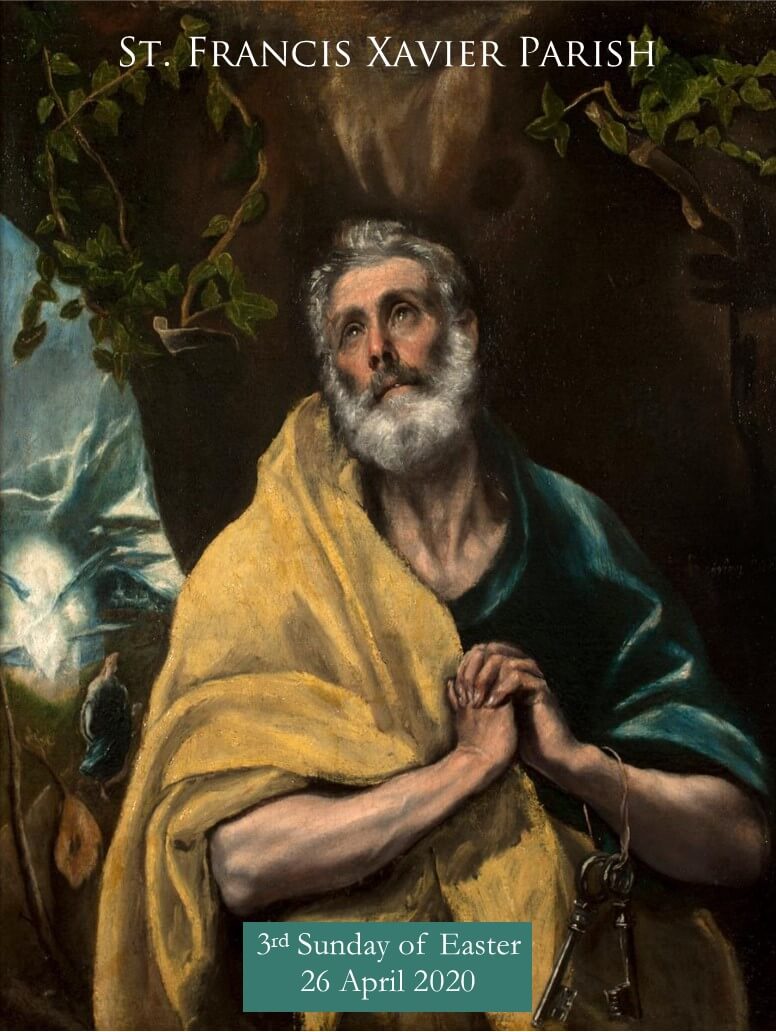
For this 3rd Sunday of Easter, we place on our bulletin cover a mystical work by El Greco entitled The Repentant Peter (1600). El Greco was a Greek who painted in Spain during the Counter-Reformation. Raised in Crete, he became a local master of the Post-Byzantine style. Working in Venice he encountered the Mannerism of Tintoretto. One might say that El Greco’s work was an amalgamation of the Cretan and Venetian styles with a splash of Rome. Yet, even this could not sufficiently describe the expressive style of this artist who seems his own species.
Here we see St. Peter in dutiful repentance, just as he is dutiful to the infant Church whose keys to the kingdom hang upon his wrist. A tree stands behind him reminding us of Gethsemane. To our left we see Mary Magdalene already on foot, leaving the empty tomb, rushing to Peter as seen by the waving hem of her garment. Behind her is the tomb magnified by angelic glory. The sky above the tomb appears as a waterfall of light; this glimmering light also fills the cape, tunic, and face of Peter.
Some say that El Greco abandoned all form for light. However, line and form still exist with El Greco. It is just that he has filled these with bright color and light; perhaps “colored light” is an apt description. A much better description would be “spiritual light” and it is interesting the God gave El Greco and St. John of the Cross to the Spanish church as contemporaries in the resurgence of the faith.
In our meditation of this work we can think on the repentant Peter as ourselves: forgiven, still perhaps wincing over past sins, yet moving forward confidently in God.
-Steve Guillotte, Director of Pastoral Services
by SFXparish | Apr 15, 2020 | BLOG
As the Father has sent me, so I send you.” And when he had said this, he breathed on them and said to them, “Receive the Holy Spirit. Whose sins you forgive are forgiven them, and whose sins you retain are retained.” (Jn 20:21-23)
All Christians should be amazed that on the evening of the same day that He rose from the dead, Jesus visited the Apostles and gave them the express authority to forgive sins through His gift of the Holy Spirit. Jesus had already appeared to Mary Magdalene in the morning (Jn 20:13-15). Later in the day he met two disciples leaving Jerusalem whose distraught hearts He resuscitated (Lk 24:32). In his meetings with Mary and these disciples He initially kept his true identity hidden. However, when he comes upon the Apostles on that first Easter evening, Jesus spares no time showing Himself to them. He has come on business, the business of the His Father’s divine mercy; for just as the Father has sent Him, so he is sending out his new overseers of justice and mercy.
The Church considers this visitation to the Apostles to be the institution of the Sacrament of Penance. The Apostles had already been chosen for the priesthood at the Last Supper. Now they are to be the keepers of the episcopal office or bishops of the Church binding and loosening through the grace and power of Jesus Christ. Yet one of their number was not there.
The Apostle Thomas was not there. Thus he did not receive the breath of the Holy Spirit on Easter Evening. When Jesus appears again a week later, Thomas is now present. Jesus addresses Thomas immediately, inviting him to probe the wounds of His Crucifixion. The purpose of this is not only that Thomas will believe, but that he will also be able to forgive sins. For how could Thomas, if he doubted the risen power of Jesus, ever be able to forgive sins in the name of Jesus? Jesus is being merciful to the doubt of Thomas, yet He also means to be merciful to the entire world through Thomas.
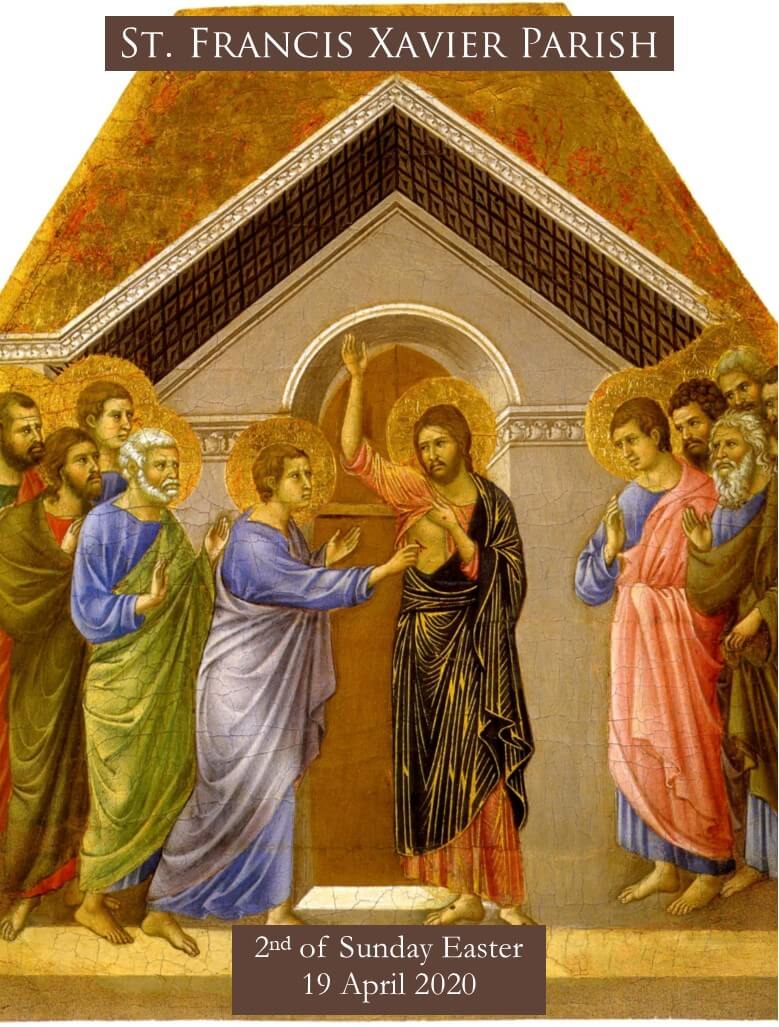
For this Second Sunday of Easter, often captioned “Divine Mercy Sunday”, we place on our bulletin cover a work by the famous medieval Sienese painter Duccio entitled Doubting Thomas painted as part of his Maesta or Majesty Altarpiece for the Cathedral of Sienna (1311). Duccio painted in a style inherited by Byzantium but with a fresh religious fervor obvious in the gestures of his figures.
Here in beautiful medieval color Duccio places the risen Christ in between two groups of Apostles. Christ lifts his arm so that the wound of this side might be revealed (and as a sign of blessing). This is not the presentation of Caravaggio or later painters which show Jesus guiding the hand of Thomas into the wound. Thomas is eager to reach out and touch the Lord Jesus as seen by his forward leaning. Even the disciples behind Thomas press upon each other in this “still-life” to rush upon their Lord. Duccio paints Jesus afore the Jewish Temple to make the point that our new temple is the Sacred Body which has now become our focus of worship.
In true Sienese artistic style, this sacred work is meant to instill in us a desire to rush toward the Divine Mercy of God!
-Steve Guillotte, Director of Pastoral Services
by SFXparish | Apr 9, 2020 | BLOG
Brothers and sisters: If then you were raised with Christ, seek what is above, where Christ is seated at the right hand of God. Think of what is above, not of what is on earth.
(Col 3:1-2)
On this Easter Sunday let us be raised with Christ toward the hope of heaven and all its glorious expectations and joys. We should follow today the good and faithful counsel of Saint Paul in his Letter to the Colossians, “Think of what is above, not of what is on earth”.
We should acknowledge that when we read from Sacred Scripture in the holy liturgy, it is the Holy Spirit in the Church speaking to us. Those human beings who have selected the readings for the Mass, those who are given this task by the Church, do so through the inspiration of the Holy Spirit. Thus what we read and hear at Holy Mass is not coincidental.
Today the Church tells us not only to think of what is above, but to seek it. In order to better frame this instruction the Church also tells us through St. Paul what we should not think of or seek: that which is on earth. This is not to say that we are to forget to eat, drink, sleep and change our clothes and instead enter into some transcendental meditative state. It is also not to say that we should ignore the world and others in the world or that we should not try to better the world which Our Lord created. It means that we are to make the eternal truths and virtues our primary reflection and activity. It means that we are not to dwell on the fleeting thoughts and desires and achievements of the world which may take us as far as a comfortable retirement but not beyond. It means that we are to fill the temporal world with eternal things, especially faith, hope and love.
Today we are to consider those words of Jesus, “…seek first the kingdom of God and his righteousness, and all these things will be given you besides” (Mt:6:33). These consoling words are most significant for Easter morn as we consider them coming directly from God himself… today, now, and always!
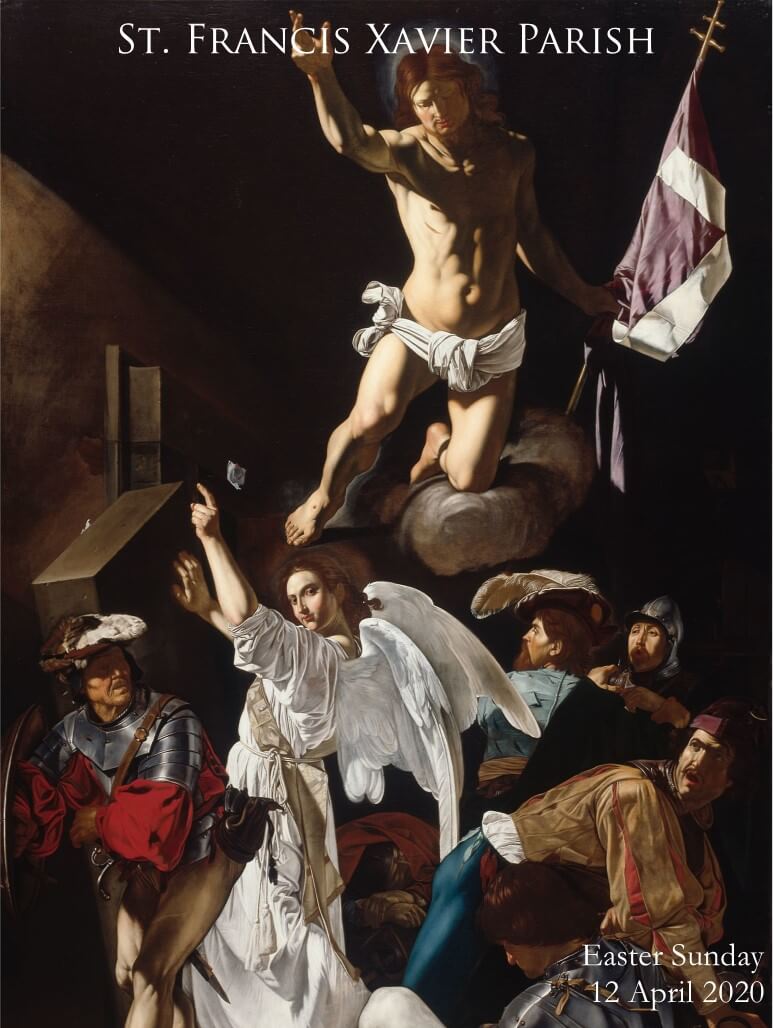
On this Easter Sunday we place on our bulletin cover a work by Francesco Buoneri entitled The Resurrection (Art Institute of Chicago). Little is known of Buoneri and many have speculated as to his relationship with the master painter Caravaggio because of a few general footnotes in history. We can say with confidence only that he was a Caravaggisti, a 16th century painter dedicated to the baroque, tenebrist style of Caravaggio.
This painting lifts our minds and hearts away from the things of earth to the things of heaven. Because it is literally an uplifting work (for being oblong) we cannot show the entire figure of the sleeping soldier (bottom right). The risen Jesus takes one knee on a cloud illustrative of heaven as He holds His Cross now become a banner of victory. The soldiers do not look to heaven. They look about seeking some earthly explanation for the disappearance of Jesus. They are answered by the angel who looks beyond them to us encouraging that we look and seek what is above.
See also how the Lord Jesus looks down upon the world to bless it. In turn we must look up at Him to seek His will, “on earth as it is in heaven”, to fully capture His gracious benediction.
-Steve Guillotte, Director of Pastoral Services
by SFXparish | Apr 1, 2020 | BLOG
The Lord GOD is my help, therefore I am not disgraced; I have set my face like flint, knowing that I shall not be put to shame. (Is 50:7)
“Death, comes for us all, even for kings he comes”. These are the words of St. Thomas More in Robert Bolt’s screenplay, A Man for All Seasons. More speaks these words as he is tried for high treason in July of 1535 for refusing to take the Oath of Supremacy which for one thing bound its takers to recognize the king as overseer of the church in England.
Thomas More was once Lord Chancellor of England, highest law official in the realm, until he fell into social disgrace for refusing to agree to Henry VIII’s divorce and remarriage. However, St. Thomas did not behave in a disgraced manner before his accusers and condemners. Instead, in the words of Bolt, he “clamored liked a champion” for Christ; for the Lord was his help and his shield. When St. Thomas More arrived at the chopping block, he forgave his executioner “right readily” and before his soul was detached from its head, More stated, “I am His Majesty’s good servant, but God’s first”. Thomas More was brought low, losing his title and office and his life, brought seemingly to a place of shame; yet he could not truly be put to shame for his imitation of Christ.
Christ predicted that his followers would stand before worldly authorities and face unjust condemnations (Lk 21:12). Jesus stood up first and faced this evil fate. He came to His Passion through His Father’s constant protection. Our Lord Jesus might have been killed well before His trial. He could have been taken by the mob (Lk 4:29) or by the religious authorities (Mt 12:14). Yet it was His destiny as judge of the world to be judged by the world for the sake of those who would believe in Him (Jn 3:16). Jesus did this to overcome the world (Jn 16:33) and Satan who had once mastered it (Jn 14:29). Jesus also did what He did to set us an example so that we too might, in flesh and in spirit, overcome the evil authorities of the world.
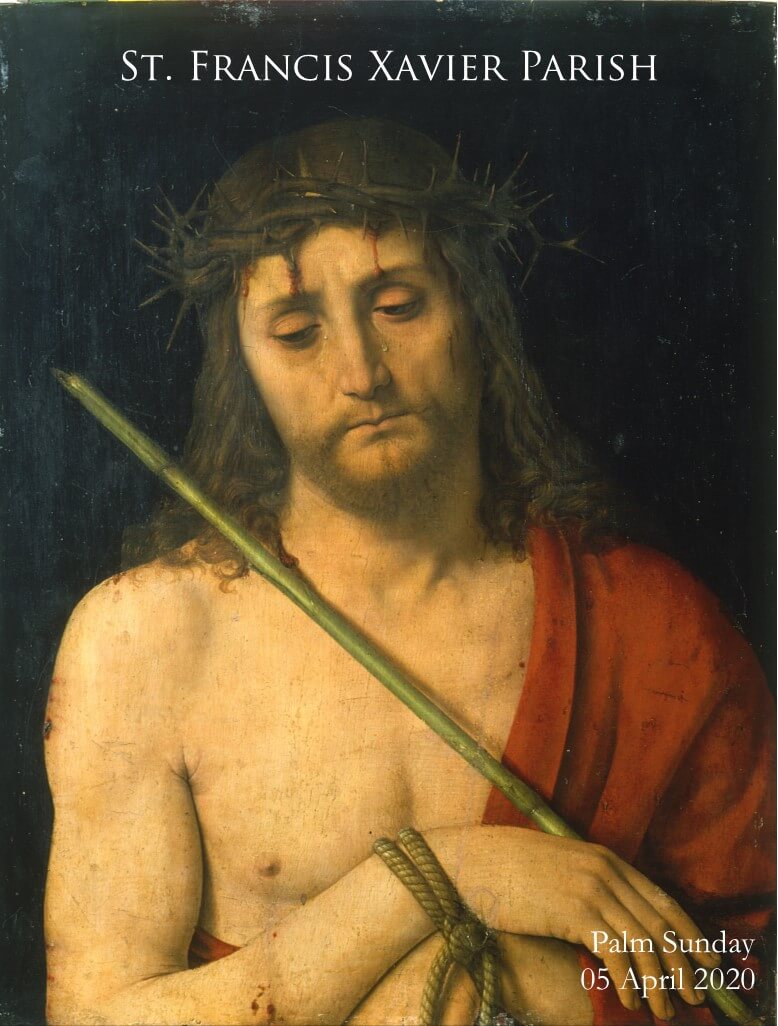
For this Passion and Palm Sunday, we place on our bulletin cover a work by the Milanese Renaissance painter Andrea Solario entitled Ecce Homo. Milan was uplifted in art in the 15th century through the long stays there of Leonardo da Vinci. Solario became one of his most avid followers.
“Ecce homo” are the Latin words “Behold the man!” spoken by Pontius Pilate to the crowd after he had Jesus scourged and the Roman soldiers handed Our Lord a reed scepter and placed a crown of thorns upon His head (Jn 19:5). Close examination of Solario’s painting reveals the thorns penetrating Our Lord’s forehead, blood dripping down just before they mingle with tears. Solario lifts the hands of Jesus into this Passion portrait so we can see the bindings about his wrist. Jesus barely touches the reed, refusing this sign of a weak kingdom easily snapped. Most striking in this visage are the dejection and the shame stressed by the tilted Sacred Head. Yet, Christ is not put to shame. His human nature has not an iota of shame for never having done anything shameful. It is our shame he bears. He brings our shame to the Holy Cross. By Thy Holy Cross, O Lord, Thou hast redeemed the world.
-Steve Guillotte, Director of Pastoral Services