by SFXparish | Aug 31, 2019 | BLOG
Rather, when you hold a banquet, invite the poor, the crippled, the lame, the blind; blessed indeed will you be because of their inability to repay you. (Lk: 14:13-14)
Jesus gives us a new beatitude in today’s gospel reading: Blessed are those who give and are not repaid. This appears a peculiar teaching since in the Parable of the Talents Jesus indicates that even his Father in heaven expects a return on his investment (Mt 25:26-27).
Yet, we know that the Father has all and needs nothing. Humanity can give nothing to God that would increase his household. God gives grace to all men and he gives more grace to those who use it to do his will (Mt 25:28-20). The return that God expects for his gift of grace is not for the benefit of his own increase, but for our benefit. His repayment is our rise in virtue; his recompense is the happiness we gain in becoming like him. God’s joyful compensation is sharing all that he has with his children who are overjoyed at receiving it.
Thus, the meaning of today’s gospel quotation is that God wants us to be like him who gives and cannot be repaid. The Father desires that we find intrinsic value in giving. This giving does not always have to be monetary. Even if it is monetary, it must first and foremost be spiritual. In a sense our Christian giving is always a passing on of grace and we should always recall that all that we give, be it material, physical, or spiritual, is originally quarried from the mountain of God so that none of us can say definitively “this is mine”. Even our charity finds its source in God since what we give is not ours and what we are repaid returns to its source.
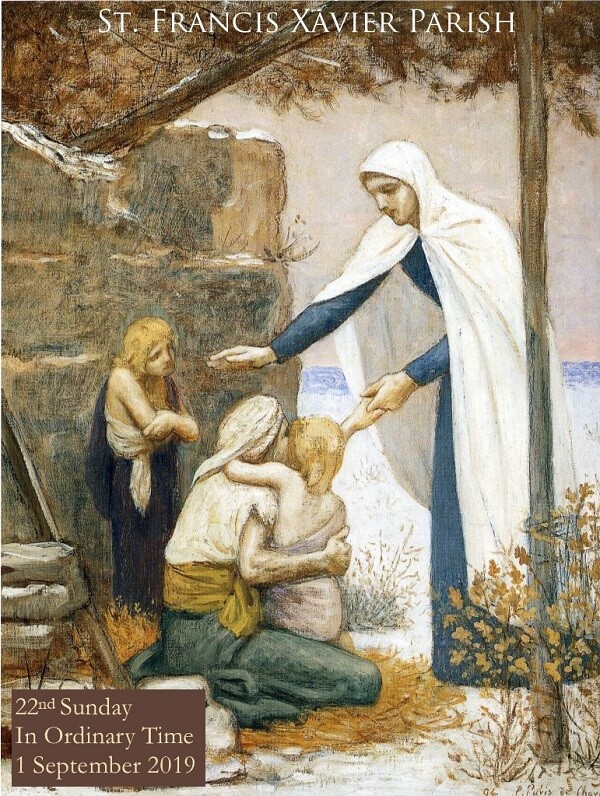
Thus we place on our bulletin cover for this 22nd Sunday in Ordinary Time a painting by the Romantic and Symbolist painter, Pierre Puvis de Chavannes, entitled Charity (19th Century). Its imagery and temper is reminiscent of the Pre-Raphaelites yet it is a purely symbolic work. However, the symbolism of de Chavannes is not that of, say, William Blake. De Chavannes is more reserved in his allegory and his symbolic craft does not lead into fantasy but is rooted solidly in a “romantic-realism” if we may be permitted the expression.
Here we see Lady Charity using her left hand to assist to their feet a mother and daughter while offering with her right hand a sign of blessing. The Lady has come to rescue this poor family from insecure and desperate lodging. The family has been sheltering against the elements in what does not even amount to a lean-to. Their backs are to a wall and they have only one post and one beam with some dead tree branches to shed the elements. The girl standing appears quite chilled. The family has huddled on a bed of straw surrounded by what appears as snow.
Lady Charity might be for us the Blessed Virgin Mary on one of her visitations. In any event she has come to rescue and give comfort to those who cannot repay her. Hence, this Lady is truly blessed.
–Steve Guillotte, Director of Pastoral Services
by SFXparish | Aug 22, 2019 | BLOG
I will set a sign among them; from them I will send fugitives to the nations… to the distant coastlands that have never heard of my fame, or seen my glory; and they shall proclaim my glory among the nations. (Is: 66:51-53)
In today’s first reading from the Book of Isaiah, God declares that he will send “fugitives” to call back the nations to faithfulness. Now “fugitive” seems a strange term to use to describe a messenger of God. Is this just a poor translation of a biblical expression?
In another bible translation the word used is “survivors” and in still another (King James) an entire phrase is used – “those who have escaped from them” – an expression more literal than lovely. This last expression however explains quite ably why the translators of our lectionary carefully selected fugitive as the apt term. So what is God is telling us here about the qualifications of the carriers of his word?
Throughout history, but more specifically in ancient times, the Jews were displaced from their ancestral home and taken into captivity or made to flee to far off lands. Even those who remained behind lived under foreign occupation. Yet, in many books of the Old Testament such as the Books of Daniel and Tobit, we read how many Jews remained faithful to the One God while living among their idolatrous conquerors. Even the Psalmist recalls how the Jews hung up their harps on the poplar trees by the rivers of Babylon; for they would not pluck their strings while they yearned for Jerusalem (Ps 137:1-2). Faithful Jews remained attached to God and detached from the pagan culture.
Thus the spiritual meaning of the term “fugitives” means that those who are sent out into the world to preach the Holy Name of Jesus Christ must be detached from the world and from its many profane principles. They must “escape” the trappings of the earth and “survive” the trials of temptation that solicit each of us to favor the things of earth over the things of heaven. The messengers must be fugitive to vain and worthless things (Ps 24:3) if they are to lead others to heavenly things.
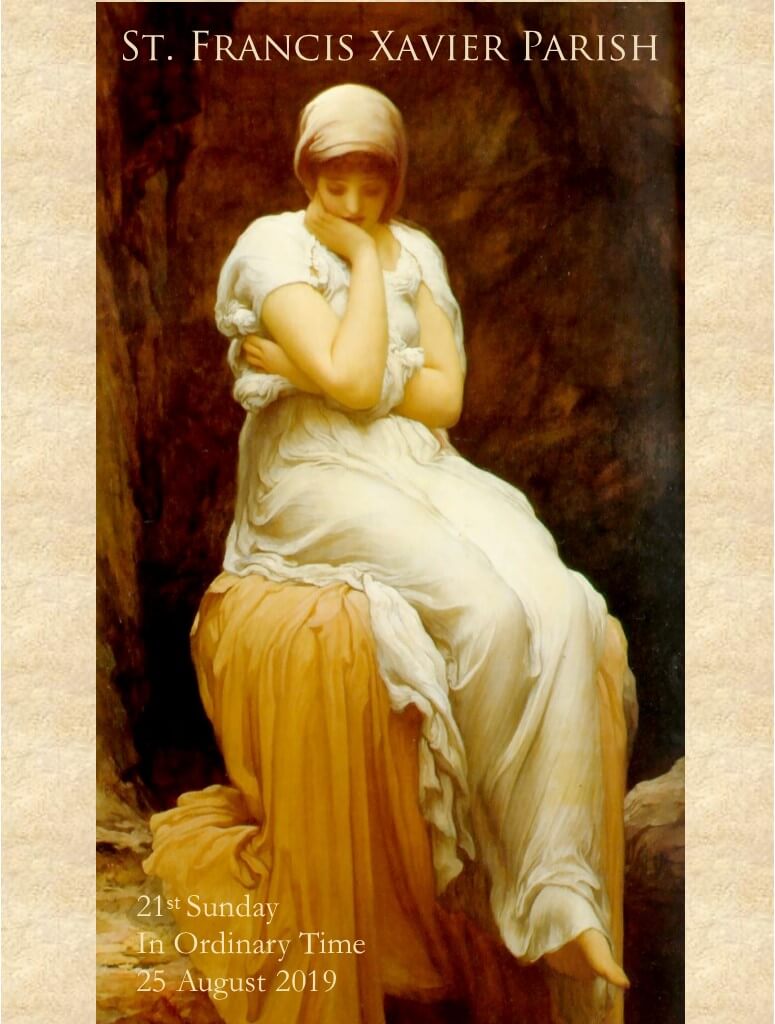
For this 21st Sunday in Ordinary Time we propose the need for such detachment. We place on our bulletin cover a work by the British sculptor and painter and Pre-Raphaelite sympathizer, Frederic Leighton, entitled Solitude (1890). We use this work merely as an allegory for Christian detachment.
The woman in the image sits thoughtfully and beautifully upon a shrouded stone as it were the world draped in her solitude. She sits in a dark cave yet she has been preserved in white. The setting is dim however she is bathed in light as if from an illumination above. She has escaped the world; she is for us a fugitive of thought and prayer as she looks down compassionately past her own feet into the murky and mundane pool below. Still her expression might be described as “pensive” as Lady Detachment knows she cannot remain there; for just as in Plato’s myth of the cave she too must return to the world to bring it truth and good counsel, leading others to God.
–Steve Guillotte, Director of Pastoral Services
by SFXparish | Aug 16, 2019 | BLOG
“Do you think that I have come to establish peace on the earth? No, I tell you, but rather division. From now on a household will be divided… a father… against his son and a son against his father…“ (Lk: 12:51-53)
Peace is the tranquility of order. A well-ordered state is peaceful and so is a well-ordered soul. A state whose civil laws are unenforced or unjust and whose citizens do not obey the natural law is not well-ordered. A soul which is in turmoil intellectually, morally, and emotionally is not well-ordered. Further, a state whose citizens are divided against each other and a soul divided in conscience will have little peace.
So why would Jesus who once said, “Peace I leave with you; my peace I give to you…” (Jn 14:27) on another occasion say that He has come to the earth to sow division? When Jesus speaks about giving his disciples peace, He of course means the peace of the Holy Spirit (Jn 14:26). Hence as He states, “…not as the world gives do I give [peace] to you…”
First of all Jesus did not come into the world to become a king over nations. Worldly kings bring about peace through war and stately power, but Jesus is a heavenly king not an earthly king (Jn 18:36). Second, when Jesus speaks of division He is not focused on physical or territorial division as are the nations which sometimes justly and other times unjustly make claim to the lands. Lastly, what Jesus means is that He has come to stake out a “”spiritual division” amongst men even in the most united of all societal bonds – the family – so that each person, be they father, mother, son, or daughter, will either choose for God or against God.
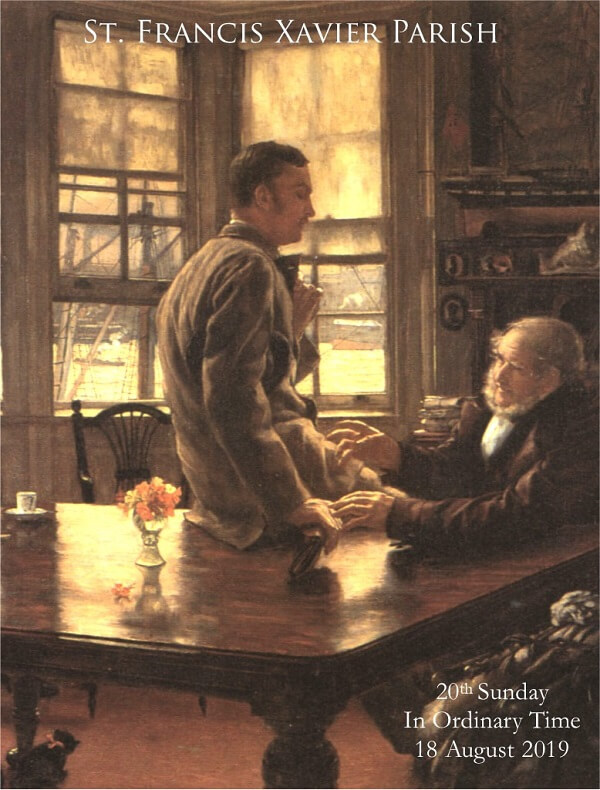
In order to drive home this point on this 20th Sunday in Ordinary Time we place on our bulletin cover a detail of an oil-on-canvas by James Tissot. This work is titled The Departure (1880) and it is part of a series called The Prodigal Son in Modern Life. Tissot’s purpose was to take the various parts of the parable of Jesus and to present these as contemporary, visual reflections to the late 19th century observer.
Here we see the son intent on departing, looking down upon his father in unmerited superiority. He has fully withdrawn his left hand from his father’s grasp while his right hand clutches the purse of money he has just received from his father. The father looks at the son imploring him to reconsider as he makes one last effort to touch his son before he departs. Not shown in this image is the older son who looks out a window as if to foretell his brother’s future, as he appears to care little about it. Also unseen here is a sister similarly apathetic sitting close to her tray of fine china and precious silver. Tissot paints a family already divided over an immanent inheritance.
This painting represents for us the division that Jesus desires: one inspired by the Holy Spirit which forces a deliberate choice – to stay with the Father or to leave him. Thankfully though, we have a Father who takes us back when we repent of our sinful decisions.
-Steve Guillotte, Director of Pastoral Services
by SFXparish | Aug 10, 2019 | BLOG
The night of the Passover was known beforehand to our fathers… For in secret the holy children of the good were offering sacrifice and putting into effect with one accord the divine institution. (Wis: 18:6;9)
The Sacred Liturgy of the Church is not man-made. It is not as in some ancient pagan religions the coordinated effort of an elite priestly class organizing myth to subjugate the people and enrich its own situation. Judeo-Christian religious practice, especially its public worship, was inaugurated by the Lord in real time, during adversity, and under the threat of enemies.
All Catholics should know that when Jesus celebrated His Last Supper, He was celebrating the Passover meal. This sacred meal was first eaten during the final plague which God let loose upon Egypt for stubbornly refusing to acknowledge his divinity. The Jews ate this meal of unleavened bread, lamb, and bitter herbs while standing with staff in hand to signify their immanent deliverance from captivity and servitude. The Jews were still living under the suppression of their enemy when their liturgy was founded.
Likewise, the Christian liturgy, the Holy Mass, was instituted by Jesus Christ under the threat of His foes which came out to arrest Him on the same evening. The Last Supper, the institution of the Holy Eucharist, occurred on the eve of Our Lord’s crucifixion. Thus, Jesus initiated the “source and summit” of the Christian life, the central act of the Church’s liturgy just as His Body was being taken by his earthly enemies and as it was being vanquished by the Enemy of the world.
We must never forget this truth: the liturgy is not only a memorial of our salvation but the actual moment of salvation. The momentous event of human salvation is uniquely and thoroughly liturgical. Because of this, the liturgy of the Catholic Church is meant to be a solemn and reverent reoccurrence of the salvific act. It is never to be celebrated as some mere human event with a permissible amount of entertainment value.
On this 19th Sunday in Ordinary Time, we acknowledge through today’s first reading that the unseen grace of God is at the foundation of the Church’s liturgy and that through this liturgy God institutes his divine plan upon the earth. Nowadays so many Catholics look for signs, new devotions, and novel prophecies. Yet many do not realize that these things exist only as guideposts to send them back to the sacramental life of the Church where the crucial activity of salvation still occurs on earth.
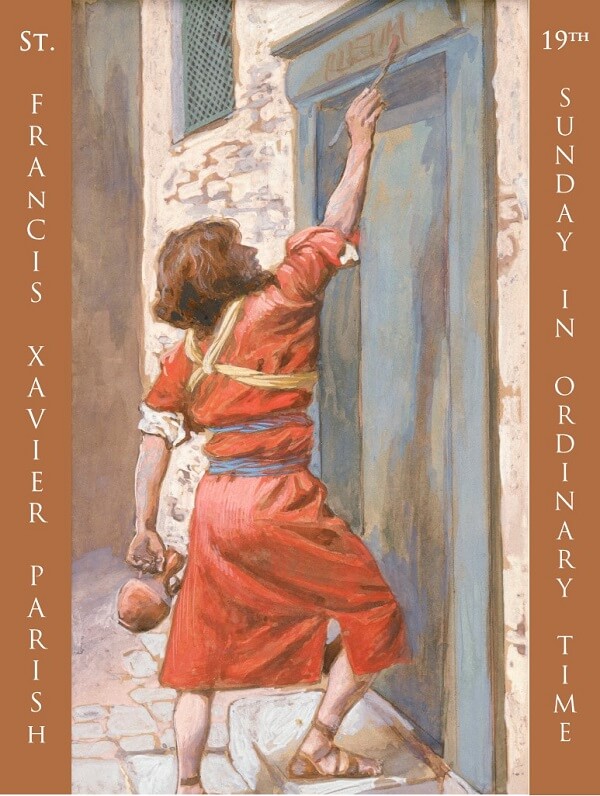
Thus we place on our bulletin cover a work by James Tissot entitled The Signs on the Door. Here we see Tissot’s representation of the Jew’s application of the blood of the Passover lamb to the lintel and doorposts so that the plague of death of the first born would pass them by. The liturgical blood served as an outward sign of a salvific action.
As our quotation above indicates, the sacramental life goes on in mystery while the earthly society moves forward at unawares. It is this: our sincere, daily, liturgical worship operating behind Church doors and on consecrated altars which puts into effect the divine achievement upholding and purifying an unsuspecting world.
–Steve Guillotte, Director of Pastoral Services
by SFXparish | Aug 3, 2019 | BLOG
“There was a rich man… [who] said… I shall store all my grain and other goods and I shall say to myself, “Now … rest, eat, drink; be merry!”’ But God said to him, ‘You fool, this night your life will be demanded of you…’ (Lk: 12:16;18;19;20)
Pride is the first of the seven deadly sins. As a vice pride also contributes mightily to the motivation of the other six deadly sins.
Take for example the activity of the rich man in today’s gospel reading whose pride misguides him to other grave sins. First, improper pride leads the rich man to a foolish reliance upon himself: he believes that he can preserve his own life by storing up goods on earth. Next, this hubris becomes the basis of avarice in that the only purposes the rich man can see for his goods are his own security and his own pleasure – in the latter case physical pleasure associated with gluttony. Lastly, the selfish pursuit of his “rest” along with his excessive esteem for his own needs will only result in sloth or lethargy of soul thereby further diminishing his charity toward others.
Vanity of vanities, all things are vanity! Pride is vanity. Yet to be clear, we do not mean here by “vanity” the inordinate self-esteem that desires the attention and praise of others, which is of course one description of vanity. When the first reading for this Sunday speaks of vanity it means “futility”. It carries the meaning of the parable in the gospel reading which instructs that all the labor spent storing up treasure for oneself on earth is pointless; for when God demands your life the realization comes that it would have been better if you had stored up treasure in heaven (Mt 6:19-20).
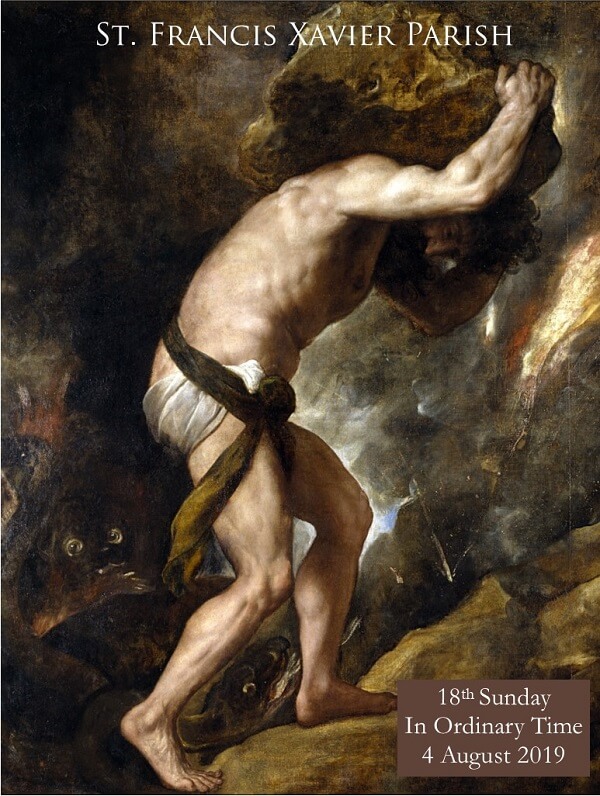
For this 18th Sunday in Ordinary Time we place on our bulletin cover an image showing another exercise in futility. It is a work by the great Venetian master Titian entitled Sisyphus (1549). In Greek mythology Sisyphus was the founder and first king of what was to become Corinth. He was sly in his actions and even once chained Thanatos, the personification of Death who had come to chain him. Thus for a time no one on earth would die. Since Sisyphus was also a murderous and avaricious king who had more regard for his own pride than that of the gods, he was punished in the underworld by Zeus by being assigned the task of pushing a massive rock up a hill which would then slip from his grasp each time just before he reached the top of the hill, thus forcing him to do this over and over for all eternity. Sisyphus is for us this Sunday a symbol of the effort of futile labor.
All honest work is of course a virtue. However, our labor should always be turned toward our spiritual life. When God gave Adam the command to “fill the earth and subdue it” (Gn 1:28) God did not mean for each person to hoard, but for each person to hallow. It will always be the case that those who labor without the Spirit, labor in vain (Ps 127: 1-2).
-Steve Guillotte, Director of Pastoral Services
by SFXparish | Jul 26, 2019 | BLOG
“I tell you, if he does not get up to give the visitor the loaves because of their friendship, he will get up to give him whatever he needs because of his persistence…”; “…to the one who knocks, the door will be opened.” (Lk: 11:8;10)
When we speak of Christian spirituality we use terms like endurance and perseverance. Less often do we speak of “persistence”. Most likely the reason for our reticence in talking about persistence is that it has the connotation of vice not virtue: individuals who “persist” can be rather annoying at times. Hence, it would seem improper to be persistent with God. However, His beloved Son Jesus gives us explicit permission to be just that in our approach to His Father in heaven.
Even the parable of Jesus which we read about today in Mass does not at first glance portray an admirable picture of human persistence. Jesus presents a man who wakes up his friend in the middle of the night for loaves of bread. Not even the town baker (who probably gets up before the town rooster) is awake yet! Still, the man lodging the unexpected visitor shows up pleading for and expecting bread from his friend at a most unexpected hour.
If we compare the man in this parable to the bridesmaids or virgins in another parable, shouldn’t the man in this parable also be chided for being unprepared (Mt 25:9) i.e. without bread in his home? Should not the man, like the virgins, find the door locked due to his lack of preparedness (Mt 25:10-12)? In truth he should not; for the man did not expect his guest and his persistence was for the good of another, while the foolish bridesmaids knew that the bridegroom was arriving yet still they went out to meet him carelessly without extra oil for their lamps.
In the spiritual life we need not worry much about erring through persistence (as long as we are not stubbornly self-entitled in our petitions). This is because we do not go about disturbing a human person who is sleeping but rather a divine person who is waiting. God desires our persistence, especially when it comes as endurance of faith and perseverance in prayer.
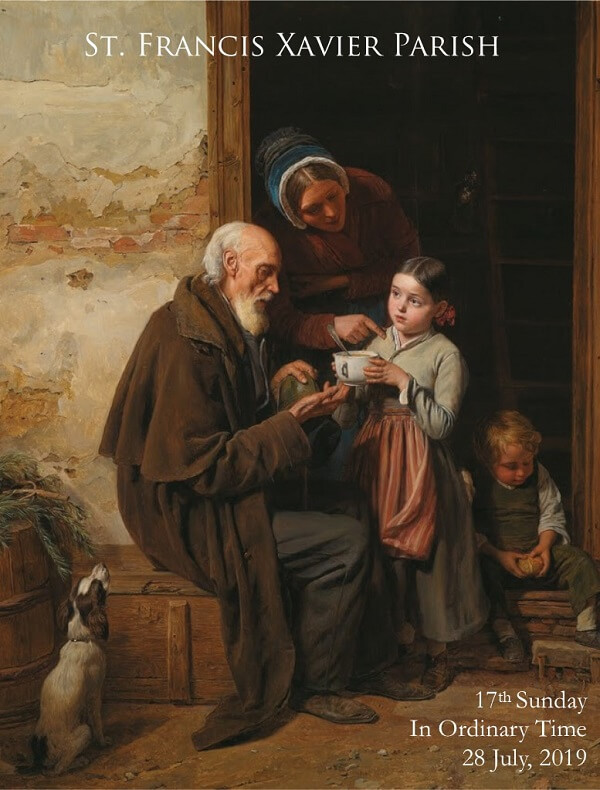
For this 17th Sunday in Ordinary Time we place on our bulletin cover a painting by the 19th century Austrian Romantic artist Ferdinand Georg Waldmuller entitled, The Charity (1865). Like many romantics. Waldmuller painted images of societal traditions and sought to portray optimism concerning the human condition. He was the primary mover of the Biedermeier style which sought to exhibit the beauty of nature and the piety of pastoral life.
Our own instructional use of this work is focused here on the old beggar. His shoes are worn out through persistence. He has endured much and persevered through many trials. His age is only important to us a symbol of his diligence and devotion: “to knocking on the door” again and again to gain entry. His persistence has paid off in peace. He is now able to sit, rest, and receive. He does so gently, by thankfully accepting; not by greedily taking. His eyes are lowered and his hat is off in noble reverence; for the door has finally been opened to him. He receives his bowl as it were the cup of salvation.
– Steve Guillotte, Director of Pastoral Services