by SFXparish | Jul 19, 2019 | BLOG
Martha, burdened with much serving… said, “Lord, do you not care that my sister has left me by myself to do the serving? Tell her to help me.” The Lord said to her … There is need of only one thing. Mary has chosen the better part and it will not be taken from her.” (Lk 10:11-14)
St. Luke offers to the readers of his Gospel many intimate moments with Jesus. In chapter nine, Luke describes Jesus summoning his twelve Apostles, Peter professing his faith, and Jesus transfiguring in glory with only Peter, James, and John in attendance. Intermixed with these occasions, are less private events such as the feeding of five thousand, the healing of a boy amidst a great crowd, and Jesus’ entrance into a Samaritan village. In chapter ten, the center of this Sunday’s Gospel reading, we also see Jesus engaged in more focused activities such as the sending out of seventy-two disciples, an interaction with a scholar of the Law, and His entrance into the home of Martha and Mary.
Now not all of these events occur in remote or private settings. For example, there seems to have been many people around when Jesus addressed the scholar of the law (Mt 22:34). However, Luke makes a point to transform this and other active scenes with Jesus into short but intimate dialogue.
Another such exchange was the one that concerns us today with Martha and Mary. It is likely that the discussion between Martha and Jesus occurred in the midst of a larger event, for it is doubtful that Martha, surely a strong and resolute Jewish woman, would have been “burdened” with serving only Martha and Jesus. The fact that Mary sat at the feet of Jesus gives us a sense that she was willing to give up her seat to others to be close to the Lord, while St. John in his Gospel appears to have at least Lazarus and the Apostles also being waited upon by Martha (Jn 12: 2ff). Yet Luke offers within this busy setting an intimate portrayal of Christ teaching, not from a lectern or a hilltop, but during an everyday situation.
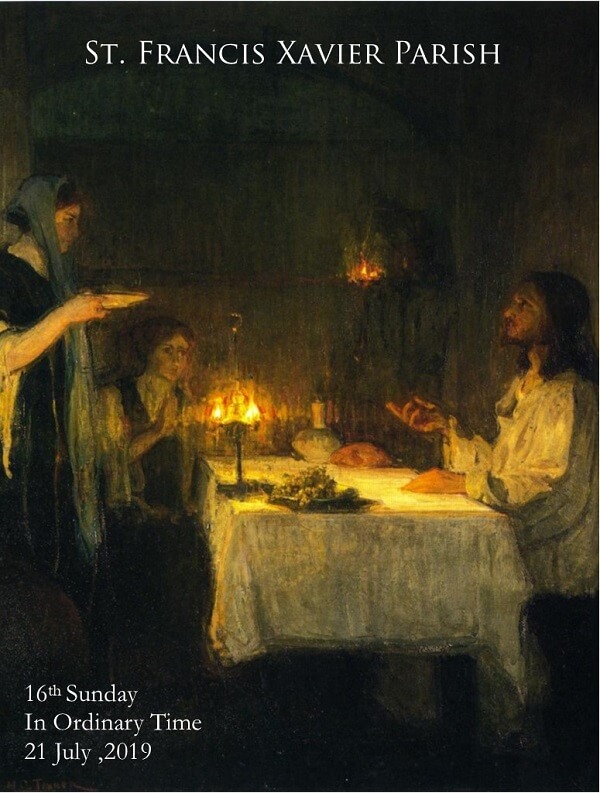
Thus for this 16th Sunday in Ordinary Time we place on our bulletin cover a work by the 20th century African-American painter, Henry Ossawa Tanner, entitled Christ at the Home of Mary and Martha (1905). Tanner is described as an American realist, however his loose brush strokes reveal a realistic Impressionism; the dispersion and absorption of light lending to a somber ambiance. Yet this light is not the hidden, often secretive light of the Dutch Tenebrists; it is a real light, seen in a real room.
Here we see painted the comparison between the active and contemplative life: Mary with hands folded in prayer and Martha presenting a dish of food. Jesus extends his hand in instruction. The spiritual meaning here is that all our service must have its source in prayer.
Yet, Tanner also presents a pastoral meaning in the tradition of Luke, which is that we too are called to give intimate Christian instruction in the midst of daily situations. In the crowded darkness of our world we are called to be the everyday light of the realism of God.
–Steve Guillotte, Director of Pastoral Services
by SFXparish | Jul 12, 2019 | BLOG
“For this command… is not too mysterious and remote for you. It is not up in the sky… Nor is it across the sea, No, it is something very near to you, already in your mouths and in your hearts; you have only to carry it out.” (Dt 30:11-14)
Last week our scriptural reflection emphasized the need for our parishes and our Church to follow in the footsteps of St. Benedict by gathering to ourselves all sacred knowledge for our own sake and the sake of a bewildered world. This knowledge is not of themes unfamiliar to us, nor is it a collection of esoteric sayings and enigmatic secrets. It is the knowledge of the life and teachings of Jesus Christ and our advocate, the Holy Spirit.
Ours is not merely a natural religion. We do not believe in God based solely on our observation and reasoning about the world. Instead, we are children of revealed religion and without the precious revelation of Jesus Christ we too would be bewildered. Therefore, while many of the commands of God approach us from on high and are mysterious (Col 1:26), Deuteronomy tells us that these are “not too mysterious” so as to be incomprehensible to our rational minds made in the image of God. Hence, Catholics do not need to seek truth “up in the sky”, “across the sea” or in any other secret or far off place since they have the word of God and the teachings of the Church which are “very near” to them. As Sacred Scripture indicates, “you have only to carry it out”.
Yet what may appear clear to the human mind through the Spirit of God (for it is only through grace that we grasp and believe these holy mysteries), the knowledge of God and his ways become impenetrable to stubborn hearts which refuse to admit the pious obligations which bind them in this knowledge. Such obligations (God’s expectations) are not meant to overburden us (Mt 11:28-30), but to free us from the bondage of sin and sorrow, while the stubbornness of pride remains one of the greatest obstacles to this freedom.
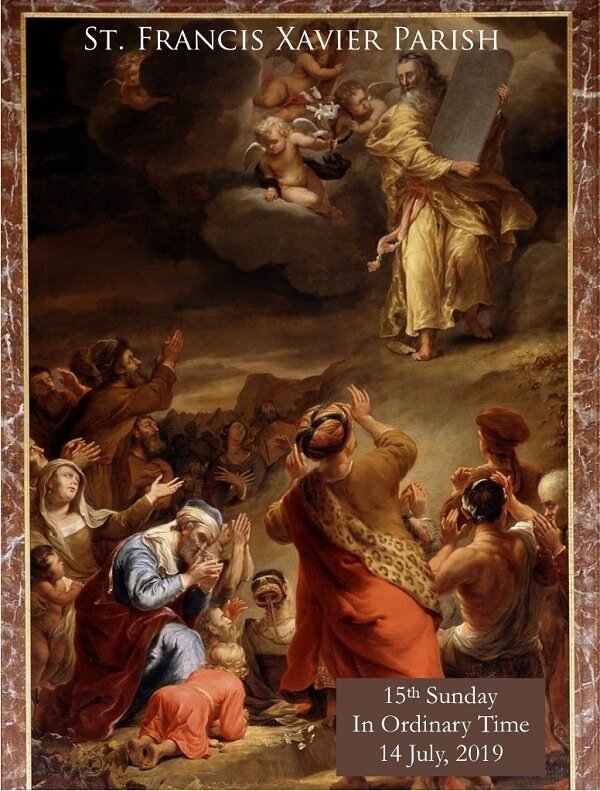
Thus we place on our bulletin cover for this 15th Sunday in Ordinary Time a work by the Dutch Baroque master, Ferdinand Bol, entitled Moses Descends from the Mountain with the Ten Commandments (1662). These commandments of God were not only the first down payment of revealed religion, but the key to unlocking the mystery of the mind and will of God.
In our painting we see in the upper middle of the image, two angels, one holding the fasces (axe and wood bundle) symbolizing the authority of God, and the other holding a lily representing God’s purity and holiness. (The lily is also symbolic in Christian art of the Annunciation and Resurrection). Thus Bol shows us, respectively, the initiation and fulfillment of divine revelation. Moses is seen taking the commands “from the sky”, but his own feet are shown on solid ground as he brings God’s teaching to earth. We should be as those in this painting who wait upon Moses: reverent and prayerful and joyful and praiseful in carrying out all these wonderful and not-too-mysterious commands.
–Steve Guillotte, Director of Pastoral Services
by SFXparish | Jul 5, 2019 | BLOG
For thus says the LORD: Lo, I will spread prosperity over Jerusalem like a river, and the wealth of the nations like an overflowing torrent. As nurslings, you shall be carried in her arms… (Is 66:12)
We all love idyllic and fruitful scenes of nature. We all love images of prosperous and restful places. Since our hearts are made in the image of God, our hearts hearken back to Eden and beyond to heaven. Following the example of his Creator, man goes about organizing nature making chaotic spaces more beautiful: the public park and the monastery are two examples of this.
This week we will celebrate the memorial of St. Benedict. Benedict was the founder of Western monasticism. He and his monks established many monasteries through- out Europe since the early sixth century. These sacred places served as centers of culture, education, and agriculture which helped to renew both the landscape and the civilization of Europe. The monasteries were locales of prayer and prosperity which breathed the same into the lungs of Europe reviving the continent.
While we began our weekly reflection on the themes of place and prosperity we expand our thoughts now with an- other quotation from today’s Gospel reading, “The harvest is abundant but the laborers are few; so ask the master of the harvest to send out laborers for his harvest…” (Lk 10:2). That is to say, when prosperity comes, there must be workers to gather in the fruitfulness.
Now Jesus was always speaking about spiritual matters and while it may seem that these days there is less to harvest in the world because of the lack of interest in God and religion, there is still a bountiful amount of grace being offered by God. Our fields may be filled with many sickly plants, but the medicine to heal these souls still comes in abundance. Fewer monasteries exist; so too will fewer par- ishes. Yet, we can never give up on the hope of making our parishes prosperous again through truth and prayer. The Benedictines were the main movers in the renovation of culture mostly because they were the keepers of truth and knowledge; and when civilization fell apart they were there to pick things up and piece society back together in the fidelity of Christ.
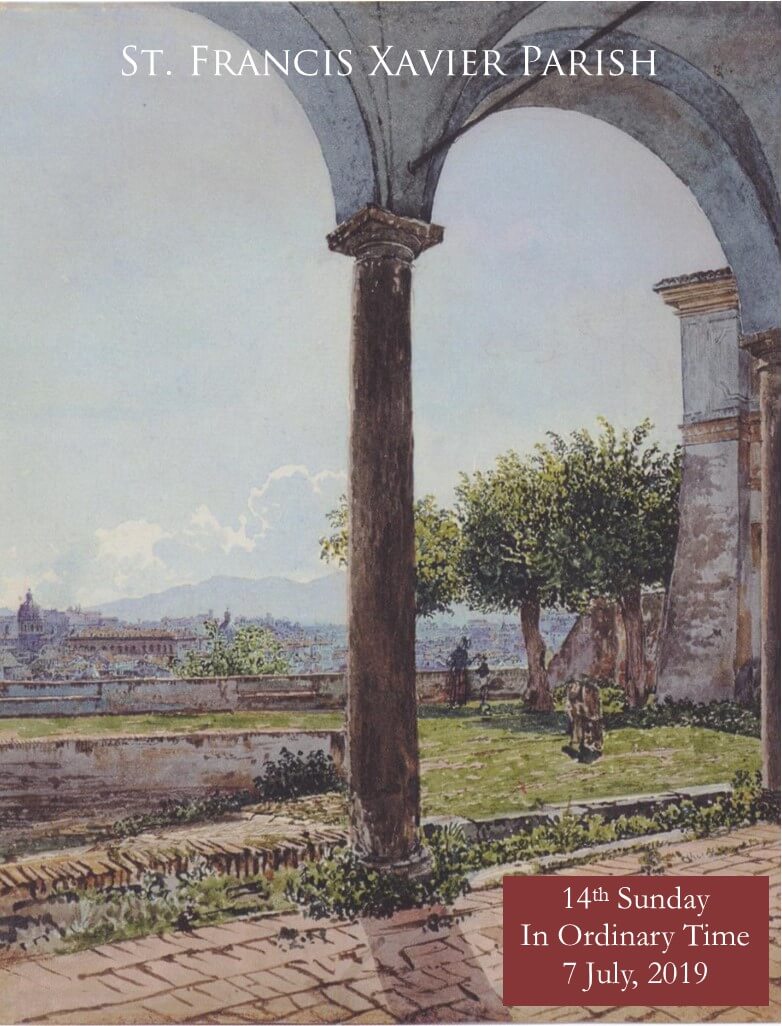
Thus on this 14th Sunday in Ordinary Time we place on our bulletin cover a work by the Romantic Austrian architectural and landscape painter Rudolf von Alt, entitled View from the Monastery of Sant ‘Onofrio in Rome (1835). This is the second watercolor on paper we have used in two Sundays. Here we see a view as from a person looking out from an pillared ambulatory onto a bright landscape. Above the observer is a simple but pleasingly optical groin vault ceiling. Off the path is green grass and groundcover and possibly fruit or olive trees. However, the pillars need support from metal extensions, the brick pathway is beginning to rise, and the building walls need repainting.
Here we have an image, even an allegory, for today’s Catholic parish: a fruitful setting in need of spiritual and material upkeep; a river wanting to overflow with grace and charity into the valley below but which first needs its own revitalization through a sincere and reverent worship of God.
–Steve Guillotte, Director of Pastoral Services
by SFXparish | Jun 29, 2019 | BLOG
As they were proceeding on their journey someone said to him “I will follow you wherever you go.” Jesus answered him, “Foxes have dens and birds of the sky have nests, but the Son of Man has nowhere to rest his head.” (Lk 9:57-58)
Jesus was always on the go. Not long after He was conceived in the womb of His mother Mary, He was carried off “in haste” to the hill country of Judah (Lk 1:39). Later on in Mary’s pregnancy Joseph took Mary and the prenatal Jesus from Galilee to Bethlehem (Lk 2:4) where Jesus was born. Soon after, he was taken to Jerusalem to be presented in the Temple; after an undetermined time, and still an infant, Jesus was marshaled away to Egypt to avoid the murderous wrath of King Herod (Mt 2:13).
The hectic and well-traveled infant narrative of Jesus Christ is a true narrative and was presented by the Gospel writers as historical truth. Yet is also serves the hermeneutical purpose of explaining that Jesus was not of this earth and therefore the earth did not prepare for him a place of rest. No doubt Jesus had temporary places of rest as he grew and lived with his parents and later on in places like Capernaum during his public ministry, but Jesus was not of this world (Jn 8:23) and He did not come here for vacation or respite, but for mission and redemption.
While Jesus wandered the earth (or a particular region of the earth) as He lived among us, He did wander with a purpose. Jesus went here and there but He was always fulfilling prophecy, escaping capture, or preaching the Gospel. Even when Jesus was carried away by his persecutors, He knew exactly where He was going and He went to Jerusalem with the express purpose of fulfilling His destiny on the Cross.
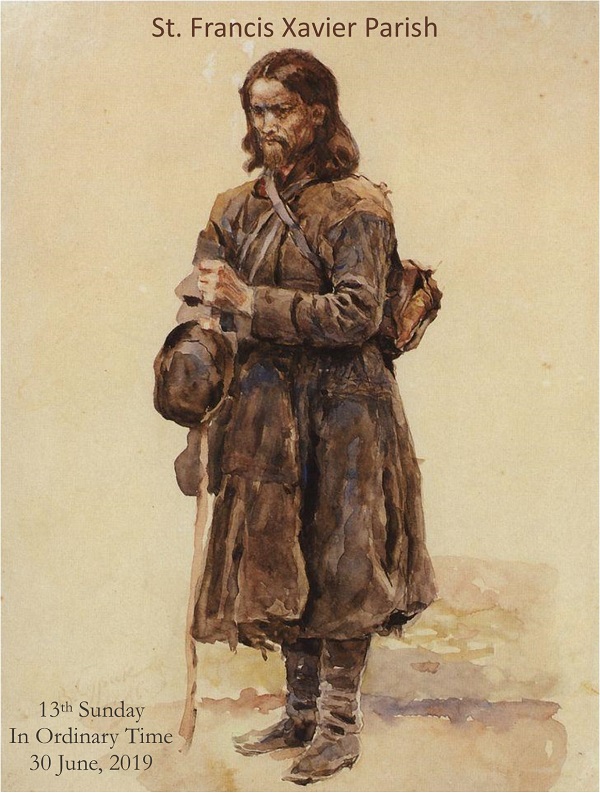
On this “13th Sunday” we pick up again the season of Ordinary Time, which is hardly ordinary as evidenced by today’s Gospel reading. We place on our bulletin cover a work by the Russian Realist Vasily Surikov entitled, Wanderer (1886). This is not an oil painting on canvas but a watercolor completed on paper. Surikov actually drew this image or parts of this image (such as the face) over a two year period. He was mostly a painter of Russian history and his images were very active and always bringing about some great change in the world. Yet, this is not the case with this image.
This wanderer is not like many other figures in the peasant genre which often appear old and tired and bent. Surikov’s wanderer is straight and stalwart, keen-eyed and grasping his staff with strength and determination. Surikov sheds an absorbing light on his figure so it is difficult to determine if his earth-tone clothes wear the light in impressionistic fashion or if the garb is truly tattered from age. In any case, this wanderer is not aged; he appears as Tolkien’s Aragorn, timeless, a wanderer with a purpose.
We too are called through our baptism to be as exiles on the earth, pilgrims and journeyers in grace. In our wandering in the Spirit there is no danger of our being lost. The only danger for us is in being so firmly fixed upon the earth that we prefer it to heaven.
–Steve Guillotte, Director of Pastoral Services
by SFXparish | Jun 21, 2019 | BLOG
I received from the Lord what I also handed on to you, that the Lord Jesus, on the night he was handed over, took bread, and, after he had given thanks, broke it and said, “This is my body that is for you. Do this in remembrance of me.” (1 Cor 11:23-24)
In the above quotation of Jesus Christ from the Last Supper confirmed by St. Paul in his First Letter to the Corinthians we recall the earliest of our sacred traditions: that Jesus commanded His disciples to perform the Eucharistic blessing “in remembrance” of Him. Some, especially Protestant believers, have proposed that this means that the Eucharistic celebration is a memorial, that is, a ritual or drama to be performed in memory of the words and actions of Jesus during His last Passover meal with his Apostles. Interestingly, many Protestant communities no longer perform the blessing of bread and wine in their services. It would appear that once a community sees the Eucharistic sacrifice only as a memorial, the community forgets about it altogether.
Catholics see the command of Jesus quite differently. Remembrance to the Church means never forgetting that when the bread and wine are consecrated they become the Most Holy Body and Blood of Christ. We believe that the directive of Jesus to remember “this is my Body” was proposed not only as a memorial but as a perpetual remembrance that the Eucharist is the Real Presence of Jesus Christ.
The best way to fulfill the remembrance that Jesus desires is Eucharistic Adoration. Holy Mass is the source of the Eucharist; it gives us the supernatural and sacrificial means to bring about the transformation of bread and wine to Body and Blood. However, it is Eucharistic Adoration, done in supplementation and in cooperation with Holy Mass that gives us remembrance: the reflective time to cherish what we have been given.
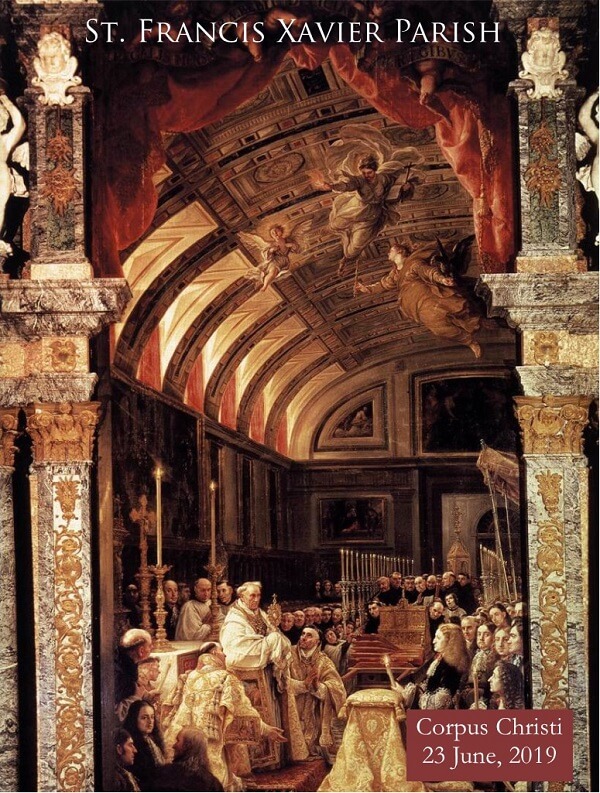
For this great day of the Feast of Corpus Christi, we place on our bulletin cover a work by one of the last great Spanish Baroque painters, Claudio Coello, entitled Adoration of the Miraculous Host (1685).
During the Eighty Years War, Dutch Calvinists invaded Gorkum, a city in western Netherlands and they took over the Cathedral. These “Sea Beggars” seized the Host in the monstrance and trampled Our Lord breaking the Host into three pieces from which the Blood began to drip. The painting by Coello commemorates the dedication of a new tabernacle commissioned by King Carlos II to hold the Eucharistic Relic, since earlier in 1594 the relic came to Spain through King Phillip II. Then and now it is kept in the Monastery of San Lorenzo in El Escorial.
During the invasion at Gorkum, the Sea Beggars also took four parish priests and fifteen religious priests and brothers captive bringing them to Brielle for trial or rather for renunciation of their faith. When the nineteen men refused to renounce the Pope and the Real Presence of Jesus in the Blessed Sacrament they were cruelly put to death.
Each year the Eucharistic Relic is processed in Spain from the monastery in El Escorial. On this Feast of Corpus Christi we will process the Holy Eucharist in the city of New Bedford reminding all that see, that this is truly the Body of Christ.
–Steve Guillotte, Director of Pastoral Services
by SFXparish | Jun 13, 2019 | BLOG
“[The Spirit] will glorify me, because he will take from what is mine and declare it to you. Everything that the Father has is mine…” (Jn 16:14-15)
In the political state known as “communism” everything allegedly belongs to “the people” because the people make up the state and the state owns all. In this theory what is considered “mine” is lent me from the state which gets what it has from the people. In effect, communism is a dictatorial trinity of individual, state, and people.
It is certainly not a Holy Trinity. The Holy Trinity is spiritual. Communism on the other hand is thoroughly material; and all that is “mine” through the state and all that the state can give me is material and economic. Even the national “spirit” of a communist state is materialistic and atheistic making it “anti-Trinity”.
According to theoretic communism what belongs to individuals was never theirs to begin with. In order to consolidate all and give everything over to the state, the people first have to take all that is mine and yours – your private property and your freedom. Then once the people have confiscated all and converted all into state property, state authority can regurgitate to its individuals some of what it had earlier swallowed up, keeping most for itself. Communism operates through distribution, but it has no love.
The Holy Trinity is a communion. It is the very opposite of communism. It is a union of divine love. In the Father exists all that there is and he shares this willingly and lovingly with the Son who accepts it thankfully and graciously. Jesus says of the Holy Spirit that the Spirit “will take from what is mine”. The Spirit does this joyfully; and for Jesus it is a joy to give it.
Now one might say that communion is easy for God because unlike the earth with its limited resources God can give all away and still have all. This may be true and it may be what is needed for a perfect communion. However, God showed that he is quite ready to give all from what he has, even his only beloved Son, for the sake of his love. That is real communion.
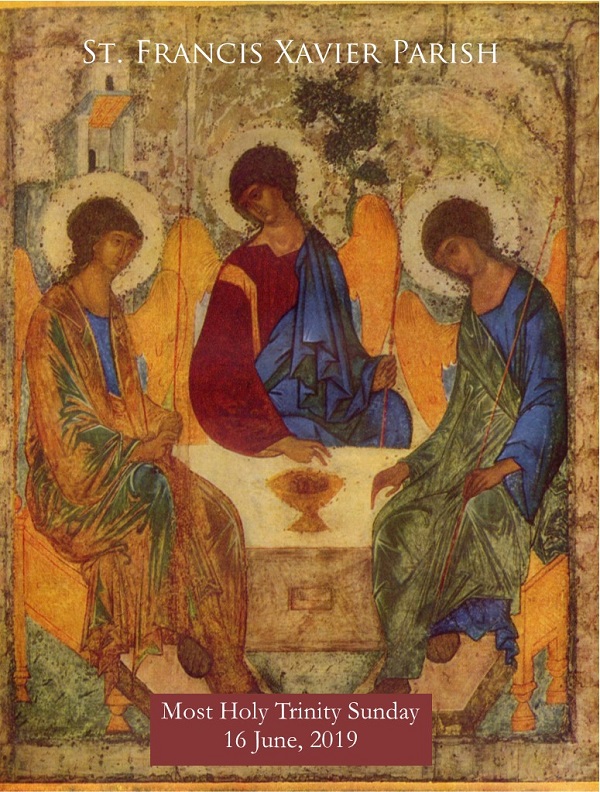
For this Most Holy Trinity Sunday, we place on our bulletin cover the famous iconic work of the Russian painter Andrei Rublev, entitled The Trinity (1427). It is painted in the tradition of the biblical narrative of the Hospitality of Abraham, yet for the purpose of man’s adoration of God Rublev removes the human actors (Abraham & Sarah) and transforms the three angelic visitors into a symbol of the Most Holy Trinity.
There are many and sundry interpretations of this work. For our purpose we will keep it simple. The angelic figure on the left appears to be the Father to which the other two figures focus all their attentiveness. The cup (certainly representative of the Eucharist) is a symbol of what is shared and what is received; for all that the Father has is Christ’s and all that is in Christ is there for the Holy Spirit to take. What the Spirit takes he distributes to man in grace, word, and sacrament; and always with an abundance of truth and love so that we who receive it may be in full communion with God and with each other.
–Steve Guillotte, Director of Pastoral Services