
Blood Drive Results
Thanks to all parishioners and others who offered to give blood on Sunday, 22 April. We had 25 people come forward to donate and 21 units collected. Once again, thank you for supporting LIFE!

Thanks to all parishioners and others who offered to give blood on Sunday, 22 April. We had 25 people come forward to donate and 21 units collected. Once again, thank you for supporting LIFE!
Beloved, we are God’s children now; what we shall be has not yet been revealed. We do know that when it is revealed we shall be like him, for we shall see him as he is. (1 Jn 3:2)
God reveals himself through mighty blessings. The first blessing is creation and St. Paul teaches that no one who sincerely observes the intricacies of the world can be ignorant of God (Rom 1:20). The second blessing God gives us is salvation. The Father does this by way of the forgiveness of sins to those who repent and believe in the Gospel (Mk 1:15); these God claims as his own through a spirit of adoption (Rom 8:15). The Church calls this second blessing divine filiation in that the ones redeemed become sons and daughters of God (2 Cor 6:18).
In our second reading today for this 4th Sunday in Easter, St. John gives us a hint as to the third and final blessing to be revealed at the end of time: man shall become like God (2 Cor 3:18). This is an astounding revelation only communicated because Jesus ascends to heaven and sends the Holy Spirit to achieve even greater things for us (Jn 14:12). Becoming like God is the holy, graceful, transformation into glory of both body and soul known in Church theology as divinization. This theology does not teach that man will become God, that is, man will not expand the Holy Trinity; but God will complete His sanctification of those who love Him with a share of His divinity. What this will make us has yet to be revealed, but it will be revealed because we shall finally see God as he is! This is the Gospel; this is our faith; this is our enduring hope against all the travails of the world.
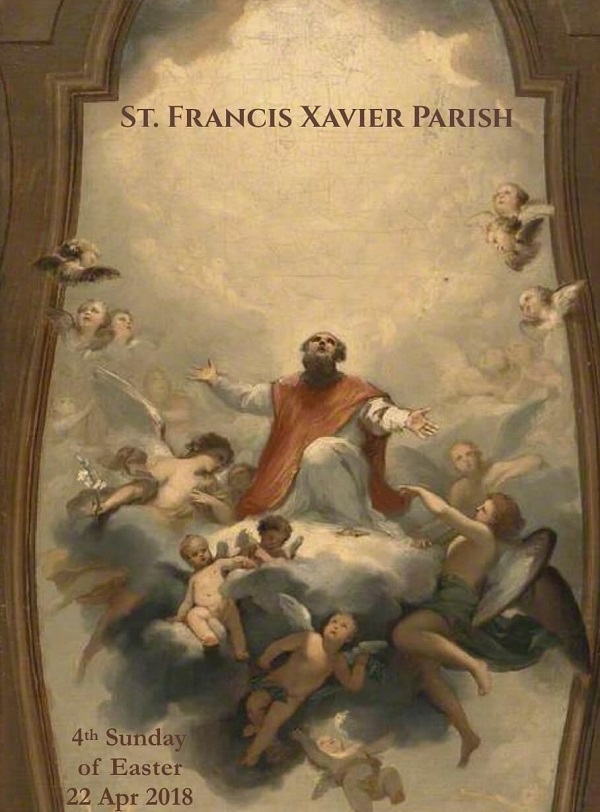
Divinization is impossible to display in art. The most any artist can do is instill in the observer a religious emotion proximate to glory. Hence we place on our bulletin cover a work by (German) Bohemian artist Anton Raphael Mengs entitled St. Eusebius Carried to Heaven (1757).
Mengs is considered a Neoclassical painter and many of his works are based on the 18th century conception hailing Greek and Roman art. However, Mengs was also on the cusp of the closing out the Baroque and this work is more Rococo than Roman. In fact the category into which this work falls is quadratura. In quadratura, the artist would paint a frame that looks like part of the architecture, of say a church ceiling. Within this frame are painted figures appearing statue-like (i.e. three dimensional) within the illusory depth of the feigned architecture. Thus, here we see the sky open up above Eusebius while the cloud he ascends protrudes beyond the architectural frame. Even some of the winged angels appear to escape beyond the painted heavenly border into the earthly realm.
Divinization, or the notion that we will become like unto God at the end of time, is a mystery beyond our present comprehension. Thus, while we have a word for what is to be revealed in us, we have no word for what we will become. For now let us be content to be called God’s children – and to act like it.
–Steve Guillotte, Director of Pastoral Services
The two disciples recounted what had taken place on the way, and how Jesus was made known to them in the breaking of bread. (Lk 24:35)
Today’s Gospel reading opens with the conclusion of the narrative known in Christian art and lore as the “Road to Emmaus”. This narrative speaks of how Cleopas and another unnamed disciple of Jesus left Jerusalem and walked about seven miles when they encountered the risen Lord. Yet, they knew Him not by sight. Jesus spoke of Sacred Scripture, interpreting it for them – and their hearts burned within them (Lk 24:32). Yet, they knew him not by word. Jesus accepted their invitation to stay with them. Yet, they knew him not by hospitality. Only in the breaking and the blessing of the bread did they come to know him.
These disciples of Jesus left Jerusalem because they thought that their discipleship was at an end. This realization was more disconcerting than we can imagine because, as these followers stated, they had been “hoping he would be the one to redeem Israel” (Lk 24:21). And since Jesus had been in life to them a “prophet mighty in deed and word before God and all people” (Lk 24:19), their disappointment at the death of Jesus was indeed staggering!
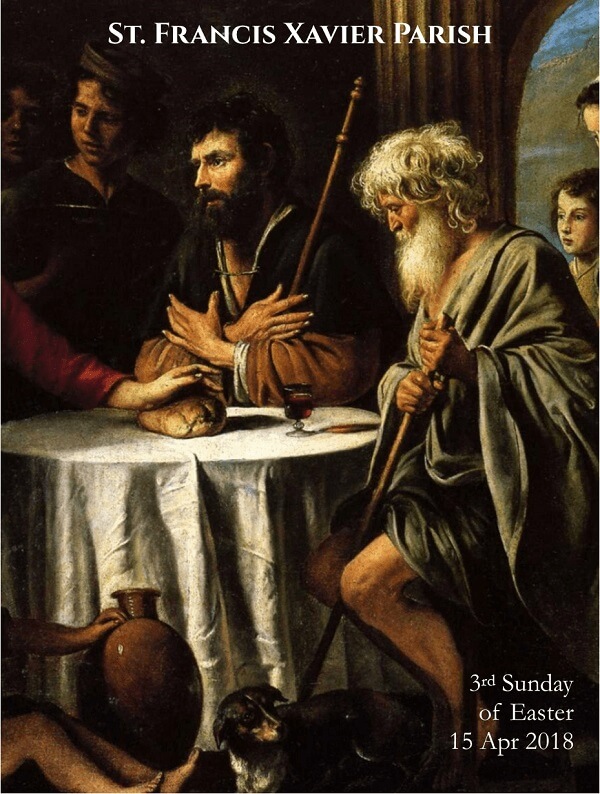
To aid us in today’s examination of Sacred Scripture on this 3rd Sunday in Easter, we place on our bulletin cover a painting attributed to the Le Nain Brothers, entitled The Supper at Emmaus (1645). The brother Parisian artists did not paint with the subtle mastery of others who portrayed this biblical theme: Caravaggio, Titian, Tintoretto, Rubens, Rembrandt, or even Velazquez. The baroque of the Le Nain brothers was not the vigorous baroque of Peter Paul Rubens. Still, they were talented French guild painters whose craft depicted peasants in a sober and dignified manner (unlike Dutch genre works): the still, human figures of this and their other works express a precious and solemn piety.
We present here only a detail of the entire work. The work itself is too wide to be fully viewed in portraiture. Also, we purposely left out the full image of Jesus so as to simulate his vanishing from sight at the breaking of the bread. Instead, we present the bread and the wine as the central focus, or rather the Body and Blood of Christ once blessed and consecrated.
In our image we see the venerable hand of Jesus in blessing posture just as it is about to release its touch and disappear from his disciple’s sight. The younger bearded man places his hands across his heart as he finally recognizes Jesus before He vanishes. However, the older bearded man has captured the wisdom of this transforming event as he sits Moses-like at Passover (Ex 12:11) with staff in hand gazing upon both species of the Holy Eucharist. This elderly man also serves to remind us of the ancient priesthood of Melchizedek which once brought forth bread and wine (Gn 14:18) as a foreshadowing of the Blessed Sacrament.
In truth, Cleopas and the other disciple never lost sight of Jesus. Even after his mysterious disappearance, Jesus was truly present to them in what still appeared to be bread – but which had become the Body of Christ.
– Steve Guillotte, Director of Pastoral Services
“Receive the Holy Spirit. Whose sins you forgive are forgiven them, and whose sins you retain are retained.” (Jn 20:22-23)
“Blessed are those who have not seen and have believed.” (Jn 20:29)
A Sunday catechist, teaching his class how on Easter evening Jesus appeared to his Apostles granting them the power to forgive sins, would probably not incorporate into his lesson the story of the Doubting Thomas. The incredulity of the Apostle Thomas is of course an excellent subject for catechesis; however the subject would not typically arise in a religious instruction about the forgiveness of sins and the institution of the Sacrament of Confession – although it should. It should, because according to St. John and the Church, it does.
St. John was not just a chronicler of the Good News; he was its first mystic. That is to say, more than the writers of the Synoptic Gospels, John related not only the activities and lessons of Jesus, but also the deep “spiritual sense” of those activities and lessons.
St. John utilizes the disbelief of Thomas to explain the apostolic authority of the forgiveness of sins in this way: Jesus mysteriously appears to his Apostles on the evening of his Resurrection. Jesus endows them with the ministry to forgive sins. The absent Thomas rejects the appearance. Therefore Thomas also rejects the ministry. Jesus appears again, welcoming Thomas to investigate the wounds of His crucifixion. Once Thomas believes in the appearance of Jesus, Thomas can believe in the ministry of the forgiveness of sins. The lesson here is this: blessed are those who have not seen and have believed – in the Resurrection and the forgiveness of sins!
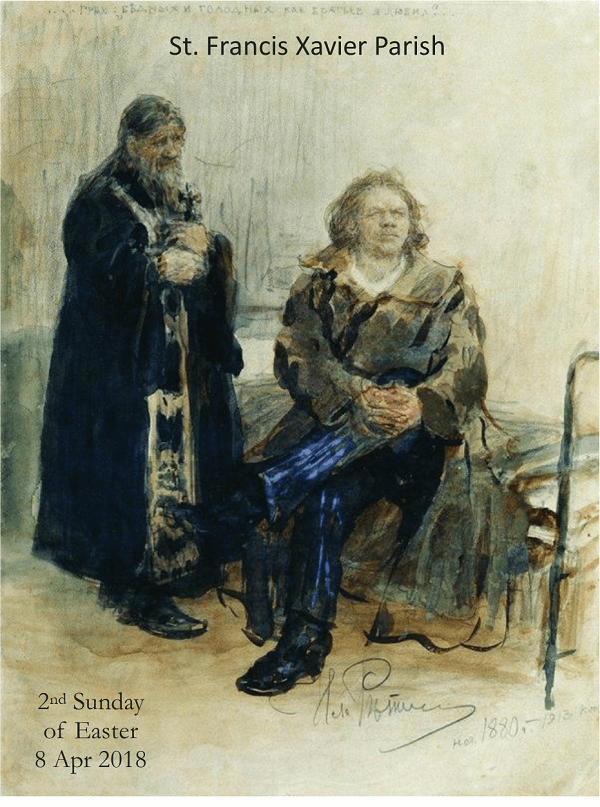
To assist us in our Sacred Scripture meditation for the 2nd Sunday in Easter (or Divine Mercy Sunday) we have placed on our bulletin cover an image by the Russian realist painter Ilya Repin, Refusal of Confession. It is said that Repin was the first Russian artist to popularize Russian painting in Europe. Repin had a peasant upbringing and this endeared to him the common laborer who was often the subject of his painting. His direct and gritty understanding of “lower class” existence enabled him to produce realistic and endearing portraitures of everyday life and labor.
In Refusal of Confession, a man sits on his bed in stubborn posture – legs crossed, and hands folded over knee, looking away and repositioning himself away from a visiting priest. In truth, he has turned away from redemption symbolized by the Crucifix held delicately before him by the caring priest who, dressed in stole and offering confession, appears sad at the refusal.
This would have been the final confession: the man, fully dressed in boots and coat, sits on his prison bed awaiting execution. He is like the impenitent thief who also refused forgiveness before he died (Lk 23: 39-40).This work of Repin is unlike many of his other paintings of indoor images – which are full of walls and windows and curtains and accessories. This is so we may understand that the man has nothing left but his conscience and his pride and the offer of repentance and the forgiveness of sins. Unlike the Apostles, he has not seen. However, with grace, he might still believe.
-Steve Guillotte, Director of Pastoral Services
When the Sabbath was over, Mary Magdalene, Mary, the mother of James, and Salome bought spices so that they might go and anoint him. On entering the tomb they saw a young man sitting on the right side, clothed in a white robe, and they were utterly amazed. He said to them, “Do not be amazed! You seek Jesus of Nazareth, the crucified. He has been raised; he is not here. (Mk 16:1; 5-6)
The Sabbath rest had ended which meant that Jewish law now permitted the disciples of Jesus to attend properly and reverently to his dead body which was laid in the tomb just two days before on Friday. The three women brought fragrant oil to anoint him (Jn 12:7). They came to do their pious duty to bury the dead (Tob 1:17) as this was thought to be contributory to the general resurrection. They had not yet any sense of an individual resurrection – of one man rising from the dead on his own power. If Mary Magdalene and Martha’s sister Mary are the same person (as held by the Latin Fathers) then at least one Mary arriving at the tomb of Jesus would have seen Lazarus rise. Yet, Lazarus did not raise himself.
The women found the tomb empty and were “amazed”. No doubt they were amazed at the angelic messenger whose task it was to say nothing more of his Lord’s whereabouts than, “he is not here”. Further, who would not be amazed upon finding the tomb of a loved one open and empty? The Gospel of John tells us that Magdalene reported the event to Peter and John whom she accompanied back to the tomb; and after they departed, “Mary stayed outside the tomb weeping” (Jn 20:11). She could not help fearing that someone had taken the body of Jesus (Jn 20:13). Sadly, Mary Magdalene was not uplifted from the angel’s message that Jesus had been raised. She only knew that He was “not here”, and she desired so dearly to be near Him.
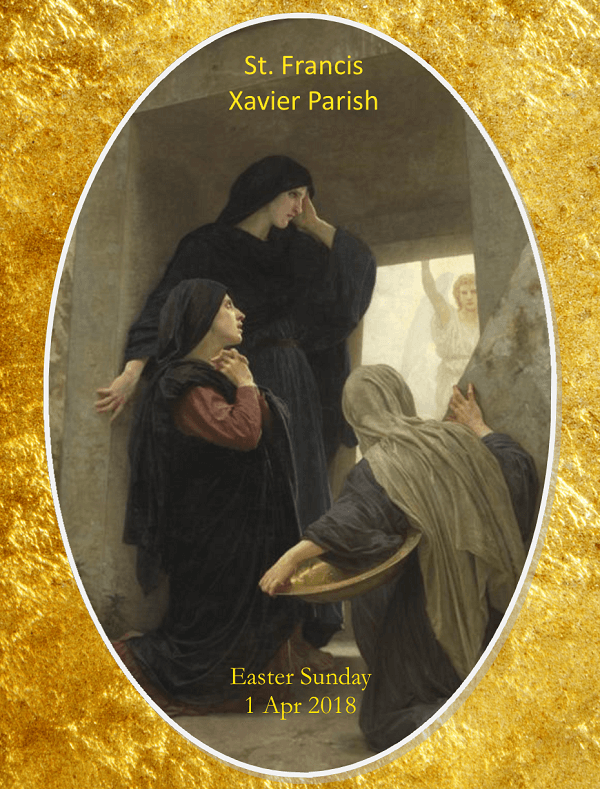
To assist us in our Sacred Scripture meditation on this glorious Easter Sunday, we have placed on our bulletin cover an image of a work by William Bouguereau entitled The Holy Women at the Tomb (19th Century). Here we see the two Marys and Salome “utterly amazed”. The woman standing needs to brace herself against the tomb wall, while the woman with her back to us peeks into the tomb with fear and hesitation. Yet, the woman in the middle who we may assume is Mary Magdalene is in full adoration posture with eyes attentive, mouth open ready to praise God, and hands folded in prayer. Through the opening of the tomb we see the preternatural herald of God, no doubt the primary source of amazement.
In this Neoclassical work, with its well squared and marbled architecture, Bouguereau creates a contrast between the ladies in mournful black and the interior of the tomb filled with smoky light as when bright rays illuminate an incensed sanctuary – most symbolic of the presence of God.
“Do not be amazed! You seek Jesus of Nazareth, the crucified. He has been raised; he is not here.” (Mk 16:1; 5-6)
–Steve Guillotte, Director of Pastoral Services