by SFXparish | Aug 22, 2018 | BLOG
Many of Jesus’ disciples who were listening said, “This saying is hard; who can accept it?” … As a result of this, many of his disciples returned to their former way of life and no longer accompanied him. (Jn 6:60; 66)
Jesus had to know that he would lose many disciples. After all, in His Parable of the Seed (or Sower) three quarters of the soil that receives the word of God bears no fruit; only the rich soil which nourishes the seed yields an abundant harvest (Mk 4:3-8). Thus Jesus predicted that many people who first accepted His Word would fall away for at least three reasons: diabolic temptation, Church scandal or persecution, and worldly distraction (Mk 4:13-20).
It was probably the first of these three that caused the disciples of Jesus to leave him (as described in today’s Gospel Reading for this 21st Sunday in Ordinary Time). Jesus had just told them that “unless you eat the flesh of the Son of Man and drink his blood, you do not have life within you” (Jn 6:53). Some of his disciples found this scandalous, but there was no real scandal here. Neither was what Jesus said a worldly distraction. It was a divine revelation; and as we well know it is for the demise of revelation that the devil is eager to bring deceit and disruption.
A particular point for our meditation on this Sunday’s Sacred Scripture is the phrase “many of his disciples returned to their former way of life”. There is a tendency here to think that those who left Jesus went back to spiritual truancy or dissolute living. This may be the case. However, some of the disciples who departed may have been pious Jews. Their “former way of life” may have been the noble Law of Moses. Hence, our claim that they left Jesus at the temptation of the devil does not mean to suggest that they necessarily returned to a life of sin, but that by falling away from the Word and the Messiah they in fact forfeited the fulfillment of the Law (Mt 5:17).
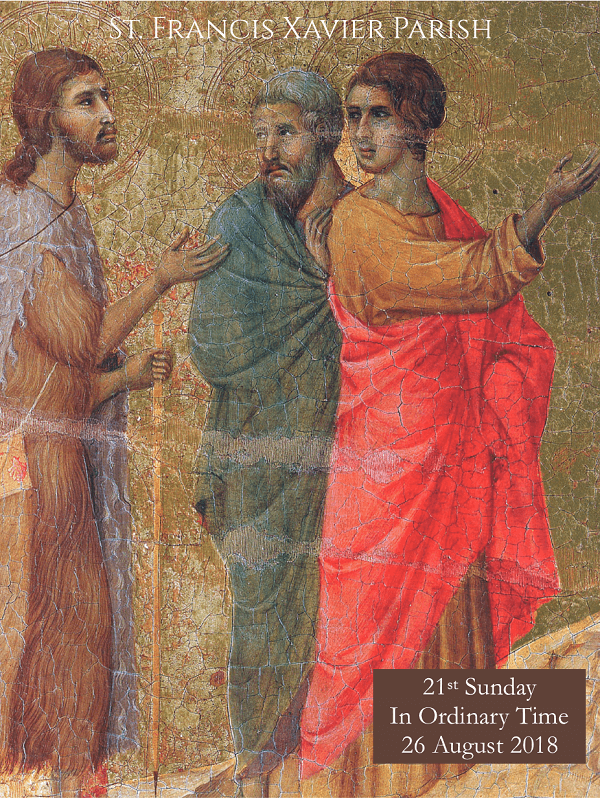
To aid us in our scriptural meditation, we place on this week’s bulletin cover a work by the great medieval Sienese painter, Duccio, entitled Christ on the Road to Emmaus (1311). Duccio was a master innovator who took icon painting and gave it legs. Because of the great works of his Florentine contemporary, Giotto, who pioneered what was to be called “the Renaissance”, Duccio the Tuscan has tended to fade into the background. Yet, Duccio’s is a pure religious art. He breathed life into sacred art making it appear to move on its own. He transformed our prayer into a spiritual exercise.
Here we see Jesus catching up with two disciples who have left him. They did not leave because of Jesus’ Eucharistic discourse, but because Jesus had been put to death and they were dismayed. Jesus went after them because all they needed was encouragement. Interestingly, Jesus did not go after those who left Him over His proclamation of the Holy Eucharist. Those disciples left Jesus in protest over the His Precious Body and Blood. In doing so, they became themselves an enduring sign of what “protestant” would – in time – come to signify.
–Steve Guillotte, Director of Pastoral Services

by SFXparish | Aug 17, 2018 | BLOG
“To the one who lacks understanding, [Wisdom] says, Come, eat of my food, and drink of the wine I have mixed! Forsake foolishness that you may live; advance in the way of understanding.” (Prv 9:4-6)
In his excellent Catholic Dictionary, Father John Hardon defines wisdom as “knowledge that is so perfect that it directs the will to obey God’s commands”. Since wisdom is an act of the mind moving the will to obey, it is a knowledge which not only understands perfectly, but trusts perfectly. Wisdom is thus such a complete confidence in the truth of God that it can only lead to faithful action; not only in a general way, but in a way particular to each person. Without wisdom a person cannot discern the will of God. That the will of God is so rarely discerned is only proof that so many proceed without wisdom.
In order to gain the perfect knowledge of wisdom, one must pray. Wisdom is not just a group of catchy sayings and clever proverbs to speak or apply as the occasion arises. It has little to do with fortune cookies or Facebook. Instead, wisdom is attained by a daily intimacy with God, the source of all truth and knowledge. Wisdom is gained by knocking on the door of God (Lk 11:9-10).
For the Catholic, not only is wisdom a virtue, it is a person – that is, a Divine Person. In Sacred Scripture, the Book of Sirach opens with a personification of Wisdom (Sir 1:1-10). This might have always seemed nothing more than a poetic allegory had it not been for the Apostle John speaking of Jesus as the Divine Wisdom (Jn 1:1-5; 14; 18). St. John calls Jesus the “Logos” (the Word) or Wisdom through which the Father creates all things. This wisdom was never meant to reside solely on a stone tablet, but to be released though the Spirit as teacher, advocate, and Redeemer.
As our quote above (taken from today’s first reading) suggests, it is folly for man to not advance in wisdom. In consideration of this, we place on our bulletin cover for this 20th Sunday in Ordinary Time, a work by the late medieval Florentine master Giotto, entitled Foolishness or Stupidita (1306). This work painted as a fresco in the Scrovegni Chapel in Padua, Italy is part of a series on the Seven Virtues and Vices.
On the bottom tier of one side of the long chapel wall, the vice of foolishness is painted in a niche set opposite the virtue of prudence or practical wisdom. Giotto paints the allegory of foolishness in bird costume – a long-tailed and pinioned Roman tunic with matching feathered head piece. The body of this person is somewhat misshapen to emphasize how unsuited man is to flying. “Folly” (we might call this character) is depicted as a lunatic, or perhaps a medieval Icarus who in his hubris (pride) flew too close to the sun and crashed. In fact in many of the other images in this series, God appears painted in one of the upper corners so that the allegorical figure can reach out to the divine. Here however, Folly waves a club as if to try to force a way into heaven. Now that would be true foolishness; for to discern wisdom once must be docile and humble of heart.
–Steve Guillotte, Director of Pastoral Services
by SFXparish | Aug 10, 2018 | BLOG
The Jews murmured about Jesus because he said, “I am the bread that came down from heaven, “and they said, “Is this not Jesus, the son of Joseph? Do we not know his father and mother? Then how can he say, ‘I have come down from heaven’?” (Jn 6:41-42)
Five weeks ago on the 14th Sunday in Ordinary Time, we read at Holy Mass (from the Gospel of Mark) how Jesus came to the synagogue of his “native place”. While many who heard Jesus speak “were astonished at his teaching”, they still “took offense at him” (Mk 6:3). This was not only because Jesus spoke boldly, but because many of these same people who listened to Jesus said that they knew His mother and father and many of his relatives. That is, since Jesus did not arrive on the scene as a prophet of unknown origin, he could not be from God; he could not have come down from heaven.
Thus we find ourselves now on this 19th Sunday in Ordinary Time, in the midst of the renowned Bread of Life discourse in Chapter 6 of John’s Gospel, with a similar situation. Jesus has just been teaching that He is “the bread that came down from heaven” and some of the people claiming to know his mother and father (or perhaps only that he has a mother and father) reject the testimony of Jesus as coming from God.
There is much to consider here, but two points are salient. First, the people who are offended seem not to be bothered by Jesus calling himself the “bread from heaven” (they will be bothered in Jn 6:60). What offends them now is the part about Jesus coming down from heaven since they know he was born of Mary. Therefore, what truly offends them (whether they realize it or not) is the Incarnation, the miraculous event of the virgin conception of the Son of God (Lk 1:30-31; 38). The “Son of God” claim is of course what will most offend them; so much so that they will kill Jesus for claiming this (Lk 22:69-71).
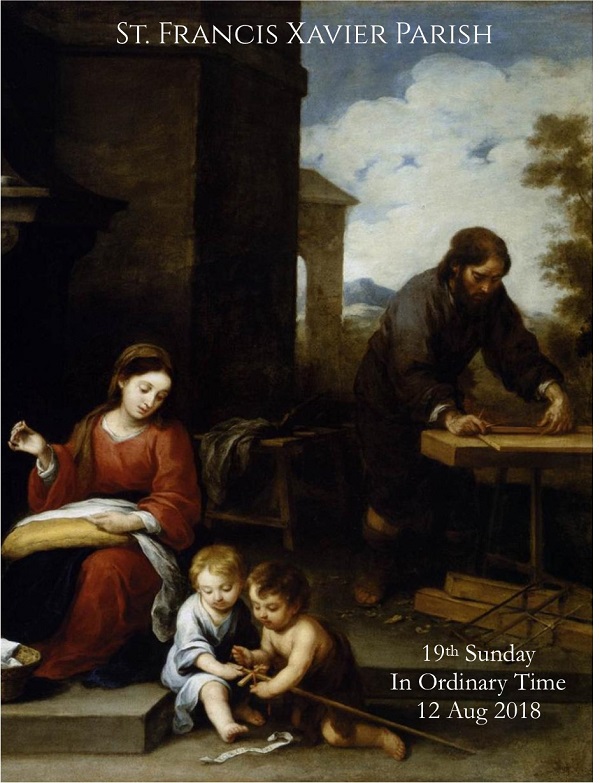
Since we are reflecting on how Jesus came down from heaven into the world, it would quite fitting to place on our bulletin cover a picture of the Annunciation (Lk 1:26-38). However, we did not do so to avoid any confusion over the liturgical seasons (the Feast of the Annunciation happens in March, yet the theme is also deeply reflected upon in Advent). We chose instead to focus simply on what the people in today’s gospel reading are focused on: the presence of Jesus, Mary, and Joseph – the Holy Family.
Hence we present an endearing work by the great Spanish Baroque artist, Bartolome Esteban Murillo, entitled The Holy Family with the Infant John the Baptist (1670). The baroque of Murillo is always a subdued zeal: fervor immersed in solemnity. Murillo paints here ordinary people at ordinary work with the vivid exception of the infant John the Baptist helping the infant Jesus prepare His cross. This is the work of Murillo: mystery brush-stroked into the ordinary. That is also the work of God.
In the Catholic liturgy, “ordinary time” is never ordinary. It is always imbued with the mysteries of God.
-Steve Guillotte, Director of Pastoral Services
by SFXparish | Aug 4, 2018 | BLOG
“… They said to him, “What can we do to accomplish the works of God?” Jesus answered and said to them, ‘This is the work of God, that you believe in the one he sent’.” (Jn 6:28-29)
The very first work that man renders to God is faith. In one sense, this statement settles the debate over whether “faith alone” or “faith and good works” is the way to salvation, since faith is to be considered man’s first good work in the pursuit of his salvation (Phil 2:12).
However, any discussion about faith and/or good works (charity) is meaningless without reference to grace. There would be no faith without grace. Thus, in truth, the first “work of God” spoken of in today’s gospel reading is not one that we perform, but one that God performs in us with his gift of grace. This grace generates in each of us a free choice: to believe or not to believe. In believing in Jesus – “the one [God] sent” – we perform our first good work from which all other good works arise. We call this primary work – the act of faith.
Sadly, when Jesus told the crowd to believe in him, they asked him for a sign. That is, they asked him for proof. They asked Jesus specifically “What can you do?” (Jn 6:30). This was the same thing Herod asked of Jesus before sending him back to Pilate for judgment (Lk 23:8-11). This is because the yearning of proof tends toward judgment. However, the yearning of grace tends toward belief.
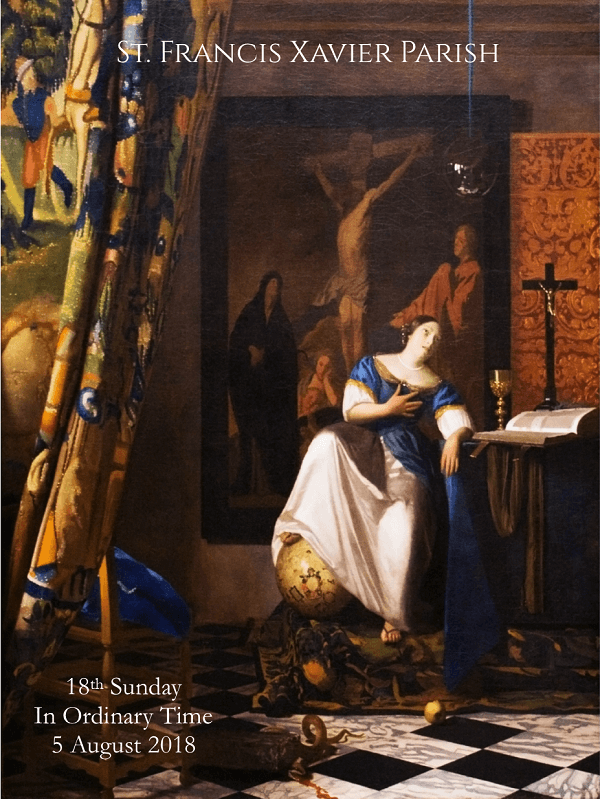
To express this yearning on this 17th Sunday in Ordinary Time, we place on our bulletin cover a work by the Dutch master, Johannes Vermeer, named Allegory on Faith (1672). In this busy Baroque scene, the woman dressed in blue, white, and gold is Faith. She places her right hand over her heart to show that faith is belief that trusts in another. She wears pearls to indicate that faith, as with hope and love, is a pure elemental virtue. She sets her right foot on a globe signifying that faith steps upon the world and conquers it spiritually. Faith then rests her left arm on a table. However, that his table is covered with cloth matching the color of Faith’s dress, and that on the table are stole, chalice, crucifix, and book (probably a Roman missal), it appears that what Faith leans upon is in fact an altar. Lastly, that the table rests upon a platform of steps also points to the table being an altar. Interestingly, this artwork has also been called Allegory of the Catholic Faith, since so much of the Catholic faith rests upon the altar and the Eucharistic sacrifice.
Other points of interest in this painting are the translucent globe representing the eternity of the divine and the crucifixion scene behind Lady Faith which directly relates to two other items on the checkered floor: the apple and the snake. The crucifix towers over the apple which represents original sin, while the passion and death of Jesus squashes the snake, shown crushed by the corner stone (Mt 21:42).
Vermeer unveils his entire scene of Faith by the pulling back of a curtain. In a similar way, our life of faith is revealed by the drawing light of grace.
-Steve Guillotte, Director of Pastoral Services
by SFXparish | Jul 28, 2018 | BLOG
“Jesus went up on the mountain, and there he sat down with his disciples… When Jesus raised his eyes and saw that a large crowd was coming to him, he said to Philip, “Where can we buy enough food for them to eat?” He said this to test him, because he himself knew what he was going to do.” (Jn 6:3;5-6)
What parent has not asked his or her little child a question which the parent already knew the answer to? Good parents do this all the time in the raising and rearing of their children. When the parent tests the child with love, the parent allows the child some youthful independence to strengthen the child’s interest and resolve, while the child learns trust and loving dependence from the knowing, truthful parent.
Now Jesus and God the Father are one (Jn 10:30). Hence, Jesus has the traits of His goodly Father. We most often call Jesus our “brother”; but if Jesus is a brother, he is a big brother with divine fatherly instincts to instruct his younger siblings. In our quotation from Sacred Scripture taken from today’s gospel reading for this 17th Sunday in Ordinary Time, we observe Jesus asking Philip a fatherly question – a question which Jesus already knows the answer to.
To what can the question of Jesus to Philip be compared? It is like a father who has taken his son into deep wilderness, and while in a forest many miles from the nearest hardware store the father asks his son, “Where can we buy a flashlight around here”? Jesus was up on a mountain and there were no fish markets around which makes His question all the more stunning or rather all the more fatherly; for the best questions a Catholic father could ever ask his child are not those that lead his child to the obvious, but to the mysterious. However, the father first needs to take the time to understand the mystery himself.
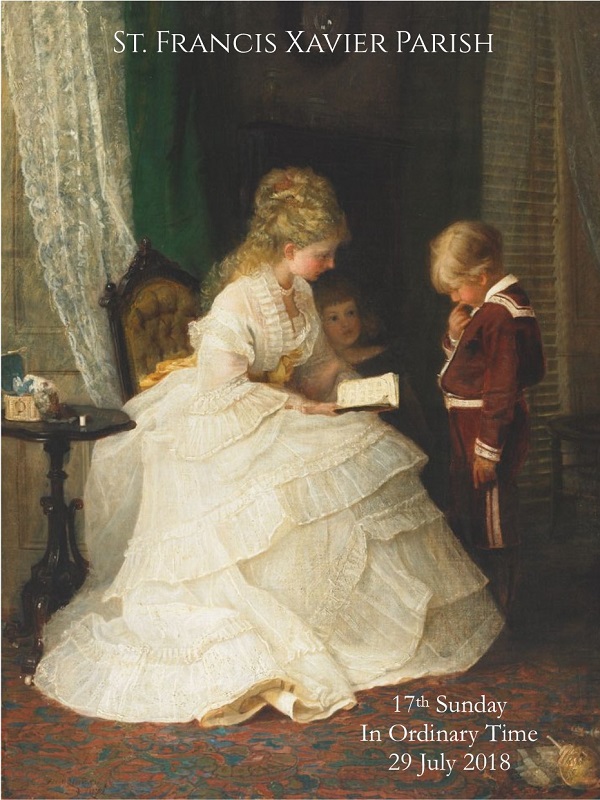
In order to further make our point, we have placed on our bulletin cover a work by the great English genre painter, Frederick Morgan, entitled, A Testing Question. Frederick was taken out of public school at the age of fourteen and homeschooled by his father who was himself an artist. A portraitist by trade, Morgan eventually took to painting endearing scenes of English youth and country life.
Here we see a young mother with son and daughter in what appears a quite comfortable sitting area. In the lower right corner of the picture there appears to be a doll and perhaps a top where the young boy, now being tested, had been playing with his younger sister (who is now more interested in her brother’s answer to the question)! The young girl looks at the boy with eager interest; perhaps she thought he knew everything. But now the mother puts to him a question that requires reflection as seen by the boy’s quizzical posture.
The mother may be examining her son in his schoolwork, but for our purpose she might just as well be questioning him on his catechism. If so, what makes this painting most pertinent is the mother’s great interest in her son’s answer, an answer which she already knows – because of her own diligent religious study.
-Steve Guillotte, Director of Pastoral Services