by SFXparish | Sep 28, 2018 | BLOG
“Teacher, we saw someone driving out demons in your name, and we tried to prevent him because he does not follow us.” Jesus replied, “Do not prevent him. There is no one who performs a mighty deed in my name who can at the same time speak ill of me.” (Mk 9:38-39)
The Church is devoted to the Holy Name of God. This devotion has been handed down through our worshipful, Jewish progenitors. Out of reverence, those of the Jewish faith will not even write down the letters of the name of the “Lord”. St. Paul in his epistle to the Philippians further proclaims the name of “Jesus” to be a term of highest honor; for… God greatly exalted Him and bestowed on Him the name that is above every name, that at the name of Jesus every knee should bend, of those in heaven and on earth and under the earth and every tongue confess that Jesus Christ is Lord” (Phil 2:9-11). Paul is indicating here that the Father exalted the human name of Jesus to “Lord” thus revealing the coequal divinity of His Son who laid aside this equality to be entirely obedient to His beloved Father (Phil 2:6-8).
In the second of the Ten Commandments we are charged to honor the name of the Lord God. We accomplish this by not only avoiding all vulgar uses of God’s name but also all casual uses. The name of God, be it spoken in any form, is to be used in supplication, contrition, praise and thanksgiving; and always with great respect.
Some bible commentaries on the scriptural passage above taken from our gospel reading for this 26th Sunday in Ordinary Time have suggested that Jesus was teaching his Apostles here to avoid jealousy. Such an interpretation seems plausible since the Apostles are concerned that the independent exorcist “does not follow” them. Jesus is certainly not jealous for Himself and He reminds His disciples that their imitator performs this “mighty deed” out of respect for their work, so that even if the man casting out the demon had instead offered only to quench their thirst (because the Apostles belong to the name of Jesus) the man would surely gain a reward (Mk 9:38-39).
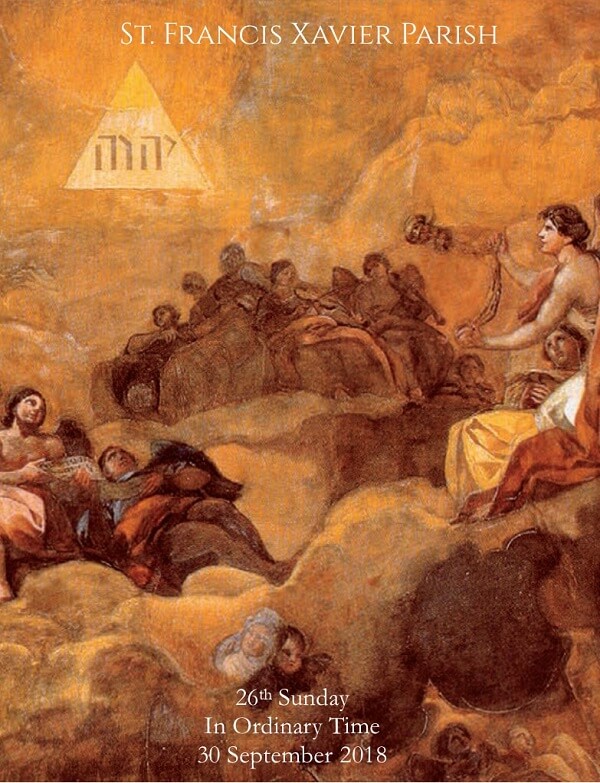
To honor the Holy Name of God, we place on our bulletin cover an image by the Spanish Romantic painter, Francisco Goya, entitled The Adoration of the Name of the Lord (1772). Goya first gained recognition after travelling to Rome and completing a series of tapestries sent back to royal palaces in Madrid. The Adoration was one of his earliest works painted on a basilica ceiling in Zaragoza, Spain – completed well before he left for Rome.
We only show a fragment of this work actually painted in panorama. Encased in a triangle (representative of the Holy Trinity) is the Hebrew expression – “I AM WHO AM” – the name given to Moses by God on Sinai (Ex 3:13-14). The heavenly host looks up in awe as a holy angel incenses the Holy Name with thurible. This baroque style fresco must have lifted the hearts of those looking up in this basilica of Our Lady of the Pillar. This work should overwhelm us with the joy we feel in our hearts when we hear the name of God spoken with due reverence.
-Steve Guillotte, Director of Pastoral Services
by SFXparish | Sep 21, 2018 | BLOG
The wicked say: Let us beset the just one, because he is obnoxious to us; he sets himself against our doings… (Wis 2:12)
Hamlet to Polonius: … Will you make sure the actors are made comfortable?
Polonius: My Lord I will give them all they deserve
Hamlet: Good heavens, man, give them more than that! If you pay everyone what they deserve, would anyone ever escape a whipping?
Justice is giving to each person that which he deserves. What he or she deserves are all the rights (and duties) customary to human nature created by God. What he or she ultimately deserves will still be determined at the final judgment by God alone as either: reward or punishment, heaven or hell.
Man should be eternally grateful for God’s mercy, since no one can stand guiltless in God’s justice. As the psalmist declares: If thou O’ Lord shouldst mark iniquities, who could stand (Ps 130:3)? We are all sinners. We are also all liars if we would not admit that at least once in our lives we thought the presence of Jesus to be “obnoxious”: His very presence pressed our conscience; we wanted to be left alone to pursue “our doings”; and the thought of His teaching made us angry or guilty or shameful.
Let it never be said that the Church’s Ordinary Time is ordinary. This week our readings compel us to reflect upon the conspiracy against Christ which receives its greatest reflection in Holy Week. However, rather than calling us to reflect primarily upon Christ’s suffering we are led from the 1st reading to the Gospel reading for this 25th Sunday in Ordinary Time to consider our evil desires that led to Christ’s suffering. Vengefulness, pride, jealousy, and ambition are the vices we are to avoid. Gentleness, humility, compliance, and mercy are the virtues we are to pursue so as to follow Jesus the “just one” (1 Pt 2:23).
Jesus is the just one beset by His enemies: beset before entering the world (Gn 3:15); beset at the time of His arrival (Mt 2:16); beset at the outset of His earthly mission (Lk 4:29). His mission came to completion through the cruelty of his enemies (Lk 23:21). Yet he did no wrong (Lk 23:22).
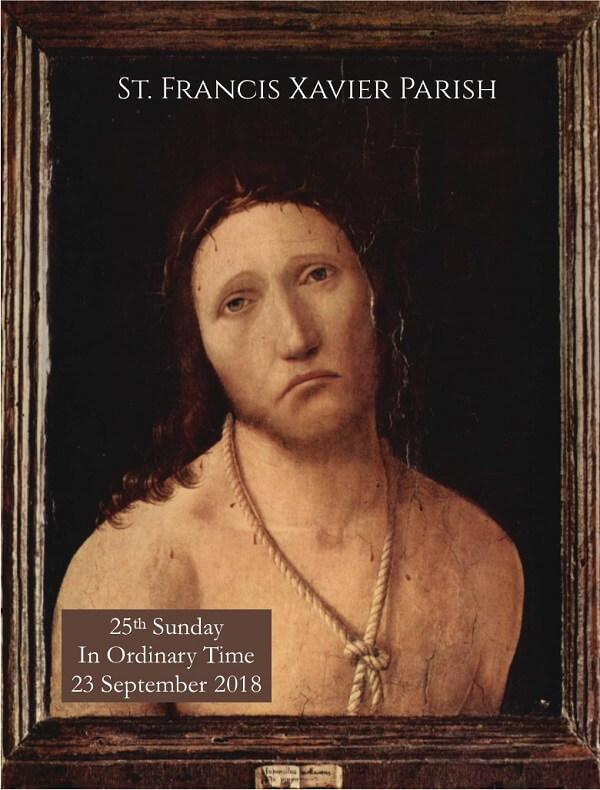
Hence, to bring forth the genuine spiritual emotion of sorrowfulness so necessary to seeing our own sins of jealousy, vengefulness, pride, and ambition toward each other we place on our bulletin cover a work of the Early Renaissance painter, Antonello de Messina, entitled Ecce Homo (“Behold the Man” – 1474). Messina’s work is sometimes acknowledged as being of the “Venetian School”, yet he first trained in Naples while immediately afterward setting up shop in his native Messina in Sicily. Messina introduced oil painting into Italy and was a master of religious portraiture as seen in the painting we examine today.
Here we see Jesus, the “just one”. His eyes and mouth speak of sadness, but also of great disappointment in those who have been unjust. The cord around the neck of Christ indicates His acceptance of bondage as the price of our release from it. Not much more ought to be said here. This is an image better approached in silence. We should all spend time meditating upon it.
-Steve Guillotte, Director of Pastoral Services
by SFXparish | Sep 14, 2018 | BLOG
“Whoever wishes to come after me must deny himself, take up his cross, and follow me. For whoever wishes to save his life will lose it, but whoever loses his life for my sake and that of the gospel will save it.” (Mk 8:34-35)
Many of the statements Jesus made while on earth were spoken exclusively to His disciples or to his smaller group of twelve Apostles. However in regard to the quotation above taken from today’s gospel reading, Jesus “summoned the crowd” showing His intention to speak this instance to all mankind.
It is important to emphasize this point because the words spoken by Jesus are so radical in expression and meaning that one may think that they apply only to those pursuing religious life. One can easily forget that these words are for all who would follow Christ, no matter their station in life, as evidenced by Jesus summoning the entire crowd to listen.
In order to fully grasp this instruction of Jesus, we must take note of the sequence of His directive: denial, taking up, following. Many Christians don’t often keep to this order, putting the “taking up” before the self-denial, as if the cross comes first. For example, the Christian might speak of a caregiving role or difficulty with a child, spouse or employer, or a chronic medical condition as a “cross” requiring self-denial. That is, the cross is reduced to a physical difficulty or some personal (exterior) burden. Yet, it is in the interior life that one discovers one’s true cross.
To properly apply the “doctrine of the cross” to the spiritual life we must pay close attention to the steps Jesus presents. Self-denial comes before taking up the cross. This means that we are not to wait until something bad happens or some duty is heaped upon us before putting away our worldly attachments. It is possible that what we think is our cross is not our cross at all as far as the spiritual life goes since what we are carrying may have more to do with our circumstance than with our purposeful self-denial. For example, we might think that some person or condition is our cross to bear, when in truth the cross we need to carry is our lack of patience with that person or condition. In such a case we are called first to deny the temptation to impatience, which then we take up as a cross in order to follow our patient Lord.
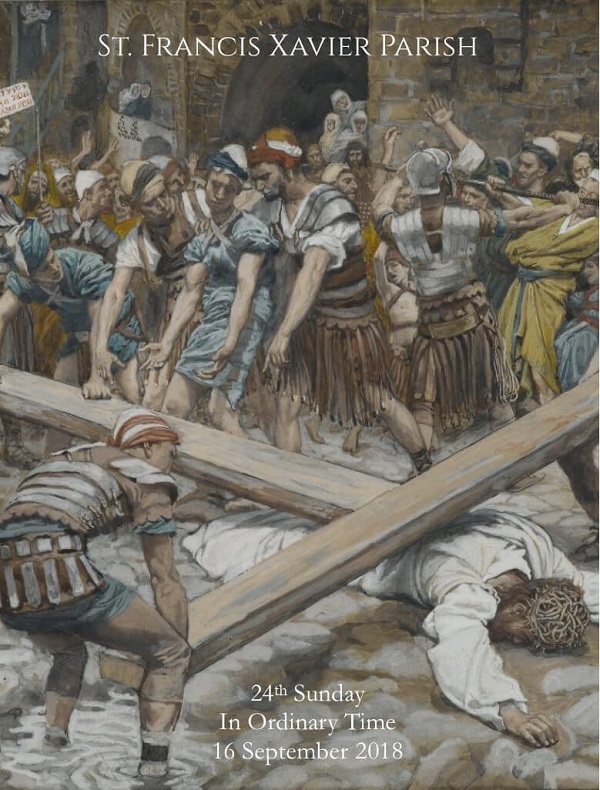
In order to put some meat on the bones of our gospel quotation we have placed on our bulletin cover for this 24th Sunday in Ordinary Time a detail of a painting by the French artist, James Tissot, named Simon the Cyrenian Compelled to Carry the Cross with Jesus. This work depicts a scene difficult to behold: Our Lord face first on the ground. Jesus has fallen beneath the weight of His cross and Simon is pressed into service by the Roman soldiers. Simon leans his head and body back as if in hesitation, yet his hands are outstretched not only so as to lift something, but as to receive something. He receives his own cross through denying his doubt and hesitation. He receives his own cross through lifting up the cross of Christ. Let it be so with us – for the sake of the Gospel.
–Steve Guillotte, Director of Pastoral Services

by SFXparish | Sep 7, 2018 | BLOG
Thus says the LORD: Say to those whose hearts are frightened: Be strong, fear not! Here is your God, he comes with vindication; with divine recompense he comes to save you. (Is 35:4)
This scriptural quotation aptly applies to how we should respond to the present state of Church affairs regarding the sexual mistreatment of children and seminarians so well camouflaged over the years by some of our bishops and cardinals. Yet it applies also to how we should face the general malady of our society and culture and our daily spiritual struggles against malicious powers. Not knowing what awaits us from so many external and internal threats, the people of God will often tend toward fear and doubt. Yet God declares that we “fear not” for he comes to rescue his Church; and God assures us that those who suffer in his stead will receive their compensation.
Through Isaiah God not only encourages us to “fear not”, but to “be strong”. This is not easy today. Just standing up for common sense (and basic physiology) by saying, for instance, that marriage is between one man and one woman may be cause for being labeled a “bigot”. Most people today don’t want to confront the rabid culture. Even those who begin with strength are worn down over time by the persistent foolish mantras of the media, entertainers, coworkers; even friends and family members. Yet it has ever been the case that to love God more than mother, father, sister, brother, and friend (Mt 10:37-38) one must “be strong” with the help of grace.
Grace is where we strive to gain our strength, for grace is nothing less than the strength of God. Our bodies certainly have physical strength: we can push back against an opposing force, resist the cold and heat, lift this or that object; that is, we can use our physical strength to confront physical powers. However there are other powers, diabolically spiritual, that tempt our natural powers to want more than what is natural – even what is unnatural. Our reason and our will may be able to identify such infiltrations, but on their own they find it difficult to master themselves against temptation: temptation to fear, to doubt, to transgress. In his frailty, man needs the strength of God (1 Cor 1:25).
Hence we place on our bulletin cover for this 23rd Sunday in Ordinary Time, a work by the American realist painter, Henry Tanner, entitled Daniel in the Lion’s Den (1917). Tanner was the only African-American student when he entered the Pennsylvania Academy of Arts. His struggle with racism in Philadelphia eventually led him to Paris where he was accepted into the French Academie. The work that we examine today was formally accepted at the Salon.
Here we see Tanner’s Impressionistic influence – soft brushstrokes obliging a mystical air. The prophet Daniel is painted in the “light of grace” under which even the lion bows. Daniel leans silently in trusting prayer – “fearing not”. The Christian must also approach danger this way. He cannot avoid danger for he is a follower of Christ. For a time he must undergo trial as proof of the genuineness of faith (1 Pt 1:6-7). He (or she) does so under the auspices of grace.
-Steve Guillotte, Director of Pastoral Services
by SFXparish | Aug 31, 2018 | BLOG
“Well did Isaiah prophesy about you hypocrites, as it is written … “in vain do they worship me,
teaching as doctrines human precepts”. You disregard God’s commandment but cling to human tradition.” (Mk 7:6-7)
For many years now Church Tradition has suffered from neglect. Long before our present condition, in which we have erroneously built a chasm between pastoral care and church teaching in order to “catch up with the times”, many believers had already been abandoning the foundations of the faith. One sign of this was so many Catholics referring to Church teaching as “man-made laws”. This is simply tragic since God became man to give us these laws.
When we read the quotation above taken from the Gospel of Mark for this 22nd Sunday in Ordinary Time, it may seem that Jesus is belittling religious practice in favor of His commandments of love and mercy. Sadly, some lead catechists in the Church today would like us to think just that: that tradition and charity are competitors. However, Jesus’ primary purpose here is not to deride religious devotions but only to ensure that man’s worship is always inclined toward the love of God and neighbor. Hence, our genuflections, blessings, purifications, etc. must never be solely acts of outward piety leaving us satisfied with ourselves (and dissatisfied with others). Our religious rituals must be rather humble, inward gestures expressing reverential love to God.
In today’s gospel reading Jesus addresses the noble ritual of washing hands while St. Mark provides commentary on the custom of Jewish purification of ordinary household items. Such actions are not futile; they are admirable when performed as a reminder that all can be dedicated to God. However, keeping these observances, while neglecting the practice of mercy, leads to hypocrisy and vanity. Jesus thus teaches His disciples that real defilement comes through an impure soul, and in vicious desires which need purification through repentance. In other words, what brings about man’s sanctification (2 Tim 2:21) is his adherence to specific virtues (i.e. moral doctrine inspired by grace).
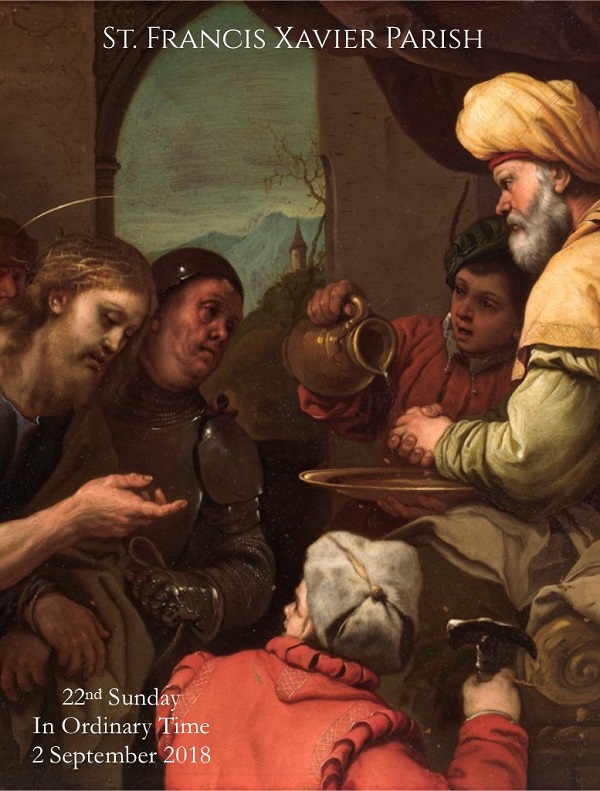
In order to expand on today’s reading of Sacred Scripture we place on our bulletin cover a detail of a work by the Italian late-Baroque painter, Luca Giordano, entitled Pilate Washing His Hands (1660). This is one of his more subdued works similar in tone and size to his Adoration of the Magi. Many of Giordano’s works were of classical myths while some of his Christian art anticipated the Rococo style shown in extravagant ceiling paintings (e.g. his Triumph of Judith).
In this image we see the hand of a soldier, a visual device moving our eye from the dejected face of Jesus to the wary washbowl of Pilate. Pilate looks at Jesus as if to impress upon Him his innocence in Jesus’ condemnation and conviction. Jesus does not look at the “washing of hands” because he goes to his death not under human authority, but in obedience to his Father in heaven. For our purpose we know that the self-purification of Pilate was no substitute to the mercy Pilate refused to extend to Jesus – unjustly condemned. No amount of hand washing can ever amend the slaying of God. Sacred Scripture and Tradition teach us that only the mercy of God can accomplish that (2 Thes 2:15).
-Steve Guillotte, Director of Pastoral Services