by SFXparish | Nov 29, 2018 | BLOG
“There will be signs in the sun, the moon, and the stars… And then they will see the Son of Man
coming in a cloud with power and great glory. But when these signs begin to happen, stand erect and raise your heads because your redemption is at hand.” (Lk 21:25; 27-28)
Those who pray the Rosary each day are blessed at least twice per week to meditate on that miraculous event known as The Ascension (if they follow the regimen of St. John Paul II and pray the Glorious Mysteries on Sundays and Wednesdays). Meditation is necessary since when we think too hastily on Jesus’ ascension into heaven we miss out on its profound continuity; for as we shall see, it is not an event confined to the past, but a promise illuminating the future.
It is this promise of the return of Jesus that we celebrate during Advent. While Christians wait for the celestial signs predicted by Jesus, we seek also signs of grace within our hearts. One sure sign of grace is how joyous we become over the heritage which Jesus left us. Thus, we set aside time to pray and worship over the precious events of His life on earth such as the Incarnation and Nativity (even as we pray the Joyful Mysteries of the Rosary). We battle against the disruptions of the secular, commercial Christmas which advance upon our Advent meditation. We celebrate Advent not only as a season of preparation for Christmas, but because Advent and Christmas are both seasons for preparation of the triumphant return of our Lord to the earth. All our Advents and all our Christmases embolden our hope in the return of Jesus Christ known as the “Second Coming”.
How do we prepare for this coming? St. Paul tells us in this Sunday’s second reading “to be blameless in holiness… at the coming of our Lord Jesus” (1 Thes 3:13). This is a tall order, for who among us is blameless and holy! The answer to this question is: the one who is sanctified through earnest repentance and forgiveness; for it is the extraordinary mercy of God that he forgives the sincere and repentant sinner who also, in imitation of God, forgives those who trespass against him.
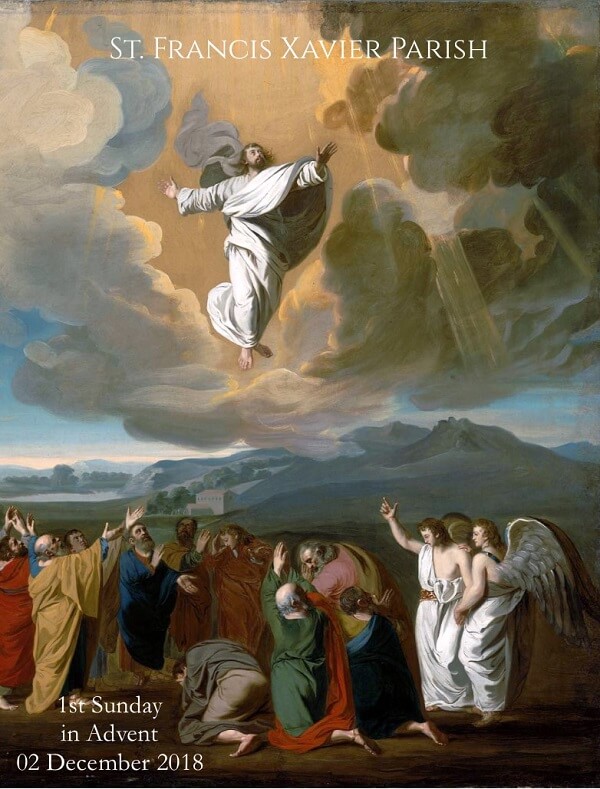
In order to commemorate and prepare for the return of Jesus Christ, we place on our bulletin cover for this 1st Sunday in Advent a painting by the neoclassical artist John Singleton Copley entitled The Ascension (1775). Copley was born in Boston, MA and although he moved to England in 1775, his prior painting in colonial America left him famous enough to have a square, hotel, and plaza named after him. Even while residing in England he maintained a quiet sympathy for the American Revolution and became friendly with John Quincy Adams.
Our focus for this painting today is on the angels in the lower right quadrant. While the Apostles linger on the Mount of Olives after losing physical sight of Jesus, the angels proclaim, “Men of Galilee, why are you standing there looking at the sky” (Acts 1:11)? The angels then offer assurance that Jesus will return in the same way he was seen going into heaven. Our call then is not to stand lurking at what is past, but to faithfully evoke our Christian memory while prayerfully preparing for our future glory.
–Steve Guillotte, Director of Pastoral Services
by SFXparish | Nov 23, 2018 | BLOG
Jesus answered, “My kingdom does not belong to this world”… So Pilate said to him, “Then you are a king?” Jesus answered, “You say I am a king. For this I was born and for this I came into the world, to testify to the truth.” (Jn 18:36-37)
Kingship was granted to man when God uttered these words to him, “… fill the earth and subdue it. Have dominion over the fish of the sea, the birds of the air, and all the living things that crawl on the earth” (Gn 1:28). Some would say that this command of God granted to man only “stewardship” over the earth. However, as the psalmist declares, “the kings set themselves, and the rulers take counsel together, against the Lord and his anointed (Ps 2:2)…” indicating that all men are as kings in the world, even though each is tempted to use his personal dominion to usurp God’s all-encompassing authority.
Just as all baptized Christians share in the “common priesthood”, so they also share in the common kingship. This kingship extends beyond the confines of the world. Once God is victorious, his dominion will be given to his disciples so that they may “wreak vengeance on the nations, and chastisement on the peoples, to bind… their nobles in chains of iron, to execute on them the judgment written, such is the glory of all the faithful” (Ps 149:7-9). Still, it is God, not man, who writes the judgment (Mt 7:1).
The dominion of man failed in Eden and has been failing ever since. It is not surprising then that God was affronted when the Israelites demanded an earthly king to rule over them (1 Sam 8:7-8). God is the Supreme King over all and since man’s share in kingship had been spoiled, so that he no longer practiced dominion with love, but instead with greed and suspicion, God warned the Israelites that they would suffer under a national kingship; and so they did, even being led back into idolatry (1 Kg 11:4-7).
When we speak of our common kingship, we really speak of a renewed, spiritual kingship which comes exclusively through Christ the King. Jesus, the prince of peace and king of heaven and earth, restores our human dignity, raising it to royalty as we become through Him holy sons and daughters of God (2 Cor 6:18). It is only through the merit of our goodly king, Jesus Christ, that our dominion is restored; a dominion which we must exercise with wisdom and compassion if we are not to fall back into corruption.
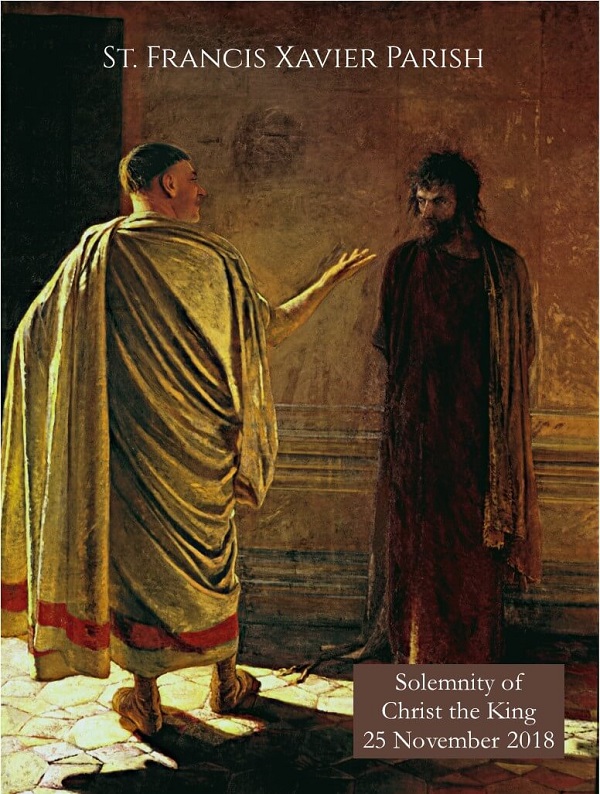
This Sunday we celebrate the Feast of Christ the King. In acclaiming Jesus thus we place on our bulletin cover a work by the Ukrainian realist Nikolai Ge entitled What is Truth (or Christ and Pilate) (1890). This work is representative of today’s gospel narrative.
Sadly, Ge had associations with radical socialists and Gnostics. Still, this painting of his is effective in portraying how the kingship of Christ is stripped of all worldly pretense so as to perfectly testify to eternal truth. In this image, the figure of Pilate (i.e. representing cruel and disgraced kingship) may stand in the limelight for a time, casting a shadow of debasement upon the world. But it is Jesus Christ who emerges as the true light of the world (Jn 9:5) and in His kingdom, Jesus is the everlasting light (Rv 21:23).
–Steve Guillotte, Director of Pastoral Services
by SFXparish | Nov 16, 2018 | BLOG
“And then they will see ‘the Son of Man’ coming in the clouds… then he will send out the angels and gather his elect from the four winds, from the end of the earth to the end of the sky”. (Mk 13:26-27)
Advent (only two weeks away) is not only a season of preparation for the arrival of Christmas; it is another annual opportunity to receive the kingdom of heaven as a child (Mt 18:3). We say “another” because how many Advents have passed us by without any burst of youthful, animated expectation. To understand Advent one must understand the heart of a child which has less to do with preparation and all to do with expectation.
Adults prepare for things. This is understandable since they are the ones most responsible for final outcomes. In this very busy day and age there are always activities to be started and finished. Even when the expectation of a vacation comes along, it still requires preparation; and it’s the adults who do the preparing.
Young children are not much for preparation (their parents are the ones who see to all that stuff). However, children are all about expectation. Their expectation can also be tireless like when they find fun in something their father did and expect it to be done over and over again: “Do it again, Daddy!” To them it’s been done and only needs to be done again. No consideration or preparation is necessary.
Catholic adults need an injection of expectation into their lives. We are not speaking of earthly expectation which is always bounded. Expectation, as any small child can tell you, must be boundless. What so many adults do not realize is that they will never find happiness in earthly expectations because these always require or get bound up in earthly preparations. Nor can the adult necessarily return to the unsullied expectation of a child. His only chance of reviving expectation is through prayerful contemplation. Advent is a time and place for that revival.
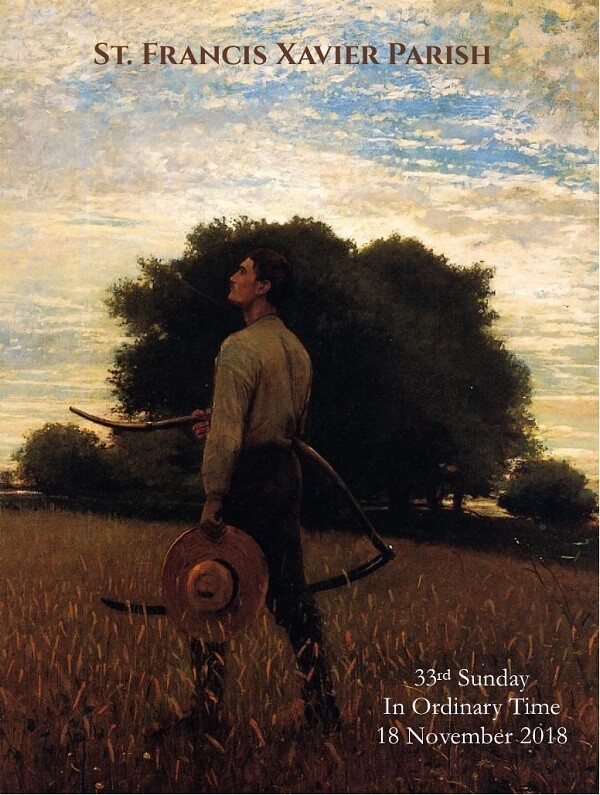
As we begin our march toward Advent, let us meditate on beautiful art. Let us today think on the image we have placed on our bulletin cover for this 33rd Sunday in Ordinary Time. This is a work by the 19th century American master, Winslow Homer, entitled Song of the Lark. Homer was no mere purveyor of insincere realism. He is the American answer to Jean-Francois Millet, yet thoroughly New England in style. Homer was born in Boston, raised in what was once rural Cambridge, and was the leading landscape and seascape painter of his time.
In our image we do not see the lark; neither does the young farmer who is depicted. He stands there in a posture of honor with sickle at his side and hat off, listening, as in a moment of reverence. For us this image serves as an allegory; for the lark, which in art is emblematic of daybreak, is also symbolic of Christ, the bringer of the new dawn of hope (Lk 1:78-79).
In our farmer we find one who has given up being active so as to be contemplative. He is not preparing. He is anticipating. This is where we need to be this Advent season: looking heavenward in quiet, joyful, interior, expectation, forsaking all preparation, for a time.
–Steve Guillotte, Director of Pastoral Services
by SFXparish | Nov 8, 2018 | BLOG
“Amen, I say to you, this poor widow put in more than all the other contributors to the treasury. For they have all contributed from their surplus wealth but she, from her poverty, has contributed all she had…” (Mk 12:43-44)
Jesus instructs us in today’s Gospel reading that our church offerings are to be a sacrifice. He gives us the example of the poor widow who makes an offering to the temple not out of her “surplus” but from what little she has to manage her own domestic affairs. This does not mean that the widow gave to the temple, say, that which she owed her landlord for rent, but perhaps it was an amount that would have helped her purchase a new broom, a new bowl, or even a hearty breakfast. It was certainly all she had, for Jesus accounts it as her “livelihood”.
What Jesus does not tell us is how the woman became a poor widow. Was she already poor when she lost her husband, or was she at one time a rich widow? If we take the latter case as our example then we would surmise that she fell on hard times or else perhaps because of her great charity in serving the kingdom of God she became poor deliberately through her generous giving. This latter conclusion is not so remote in that she has now reached a point of saintliness offering even the little that she has to God.
Underlying this gospel story is the fact that Jesus is God. As God He is exercising here His divine omniscience, for how else could He know that “all” those making their temple offerings in His presence were not making a sacrifice by doing so. We might like to think that at least one other person there gave from his need; however Jesus knew that all the other contributors that day were holding back; that is, holding back for themselves what they had generously received from His Father.
Yet, let us not mistake God for some great accountant or bean counter in the sky. Jesus is not so fretful about percentages. It is possible that while one of the worshipers gave only out of his surplus to the temple that day, yesterday he gave out of his savings to a poor widow. What is essential to understand here is that Jesus wants us to become diligent in giving kindly to God whenever the opportunity arises, and that one can never really be said to be giving to God if instead of giving from what he has, he gives only from what he has left over.
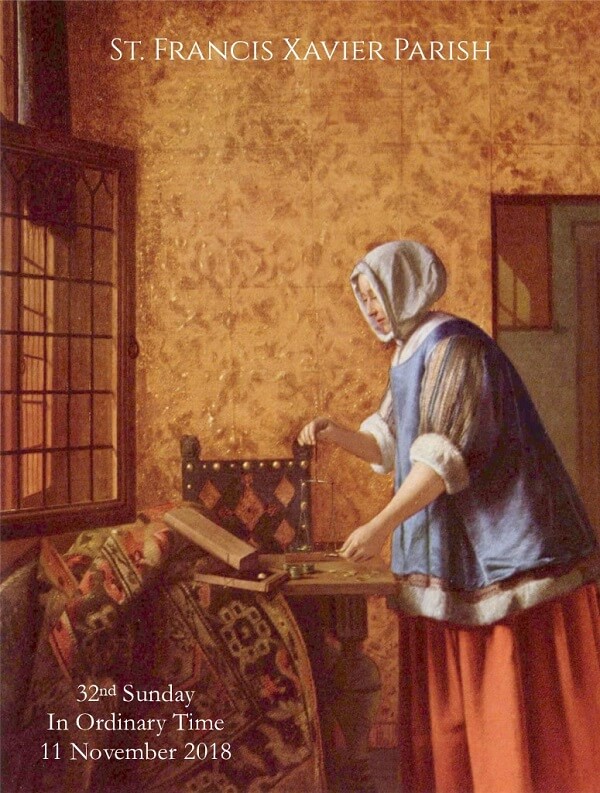
For this 32nd Sunday in Ordinary Time we place on our bulletin cover a work by the Dutch painter Pieter de Hooch, entitled Woman Weighing Gold Coins (1664). De Hooch was part of the Dutch golden-age and the “window light” genre which greatly influenced another Dutch master, Johannes Vermeer (compare this work to Vermeer’s Milkmaid). Here our woman is weighing her gold coins so as to estimate their value and her savings. She is richly dressed surrounded by lush tapestry and ornate furniture. However, if she is our widow, we find her here only starting out on her sanctification as she will eventually come to prefer storing up treasure in heaven (Mt 6:19-20).
–Steve Guillotte, Director of Pastoral Services

by SFXparish | Nov 4, 2018 | NEWS
Thank you to all who came out to donate blood on Sunday, 28 October. We had 21 people show up and 15 units donated. Thanks to all parishioners and others who either gave or attempted to in this event… FOR LIFE!