by SFXparish | Dec 28, 2018 | BLOG
“Son, why have you done this to us? Your father and I have been looking for you with great anxiety.” And he said to them, “Why were you looking for me? Did you not know that I must be in my Father’s house?” But they did not understand what he said to them. (Lk 2:48-50)
There are solid families, broken families, dysfunctional families, and caring families, and some families that have been over time all of the above. Yet, how many families do you know that are holy families. Rather, how many families do you know that make it their daily effort to be holy. In point of fact you may know some families right in this parish which pursue holiness; you may live in such a family. Further, you may be aware that a family is made holy in the same way a church is made holy: not by the imperfect people who fashion it, but by Jesus Christ who instills it.
Such is the story of the Holy Family of Nazareth. No doubt, Joseph was a holy and righteous man (Mt 1:19); no doubt, Mary was a holy and blessed virgin; but without Jesus Christ we would not have the Holy Family. It is the same with churches: without Jesus Christ we would have no “Holy (Apostolic) Church” as we declare in our Nicene Creed at Holy Mass (which by the way is made “holy” by the Eucharistic sacrifice of Jesus Christ).
Holiness does not always require complete understanding, as our quotation above from today’s Gospel reading indicates. What the Blessed Virgin Mary did not fully comprehend she would always contemplate in her heart (Lk 2:51) thus perfecting her holiness. We might call the Holy Family the Wondrous Family because as we see in our quotation from Sacred Scripture, even anxious and fearful moments conclude in wonderful revelations; for in the Finding of the Temple, that mysterious narrative about Jesus when he was only twelve years old, the world receives the first installment of the unveiling of the Holy Trinity as Jesus relates to his parents that God is Father and Son (with the disclosure of the Holy Spirit still to come)!
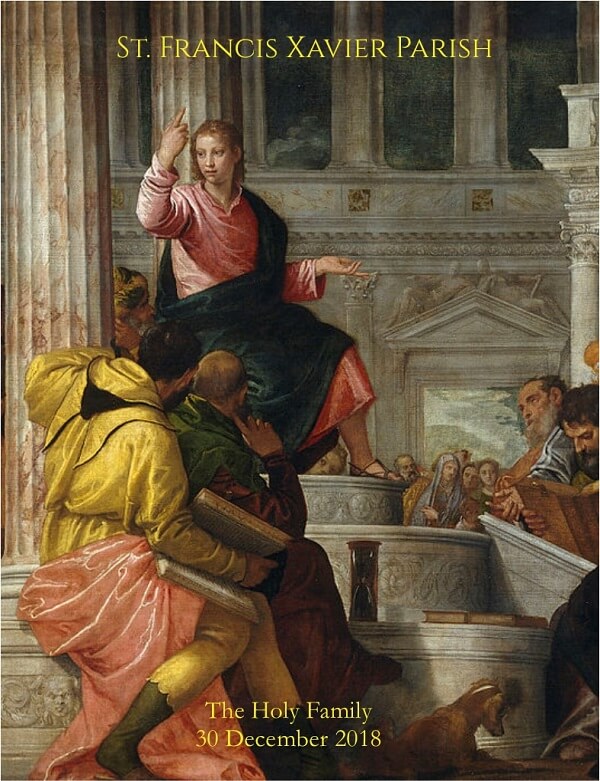
To celebrate this Sunday’s feast of The Holy Family we display on our bulletin cover a work by the Venetian master, Paulo Veronese, entitled Christ among the Doctors (1560). This painting is in panorama and so we are able to show you only a portion of it. Veronese places Jesus “on high” to show that He is the Word-descending to the earth . This is a classical High Renaissance work which depicts the Jewish temple court as a Greek “agora” with columns and colonnades (not seen here) – a place of assembly and debate. The figure of Jesus is seen pointing toward heaven with his right hand, while gesturing outward with his left, thus indicating His visitation from His Father. In the background we see Mary and Joseph inquiring about their missing son.
Veronese himself makes a clever artistic gesture by positioning Mary so as to point in the direction of her divine Son. It is as if we have fast forwarded from the Temple in Jerusalem to the wedding at Cana where she tells the wine servants, “listen to Him” (Jn 2:5). Even today she speaks this to us: to each and every one our parish families.
– Steve Guillotte, Director of Pastoral Services
by SFXparish | Dec 21, 2018 | BLOG
When the angels went away from them to heaven, the shepherds said to one another, “Let us go, then, to Bethlehem to see this thing that has taken place, which the Lord has made known to us.”
So they went in haste and found Mary and Joseph, and the infant lying in the manger. (Lk 2:15-16)
There are few images more endearing to the Christian faith than the scene known as the Adoration of the Shepherds. It is a scene perhaps less noble yet more charming than the Adoration of the Magi. While the kings travelled many miles in caravan from foreign lands following a star to offer homage, the shepherds were keeping night-watch over the sheep when angels announced to them the birth of the Messiah. The magi were prosperous gentiles; the shepherds were rustic Jews such that the angelic message – “for today in the city of David a savior has been born for you” – certainly had its full, intended effect. The magi followed a bright star that perhaps could be seen by day; the shepherds were custodians of the night, guardians in the darkness called forth into the glorious light. In Catholic art, the biblical narrative of the shepherds adoring the new born Jesus is most often shown at night so that the light in the image is Jesus Himself.
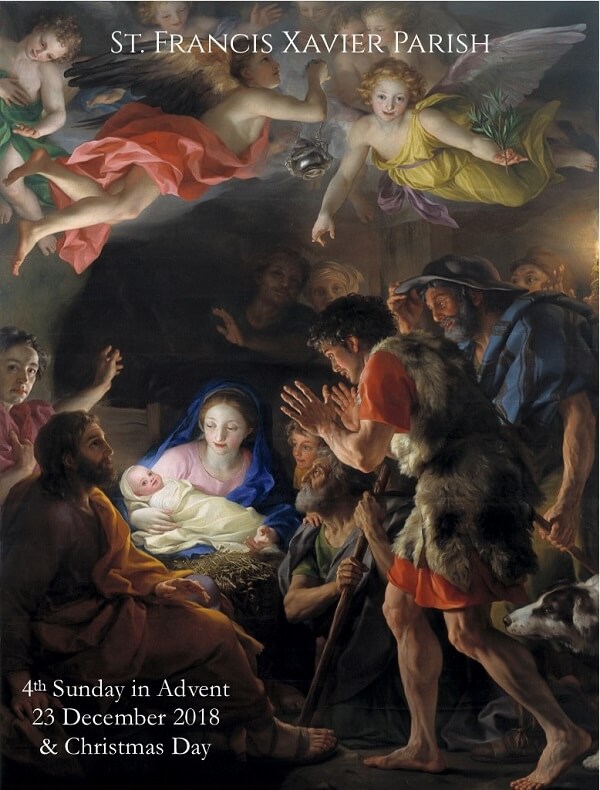
For this 4th Sunday in Advent and for our 2018 celebration of Christmas we are using for our reflection a quotation taken from the Christmas Mass at dawn. To properly emphasize these words from Sacred Scripture we have chosen to adorn our bulletin cover with a work by the eclectic painter Anton Raphael Mengs entitled (of course) The Adoration of the Shepherds (1770).
Mengs is a very interesting character. He was born of a Danish, Jewish father in German Bohemia and raised in the Jewish faith. His father took him to Rome when he was thirteen years old and only three years later he returned to Saxony to become a court painter at the age of sixteen. On his second visit to Rome, Mengs married a peasant girl who had once posed for his paintings. He married her after converting to Catholicism. He became the director of the Vatican school of painting. Upon his death he was buried in a Catholic Church in Rome dedicated nationally to the Netherlands. He was the father to twenty children.
In our beautiful image we see the confluence of many styles: the exuberant color of the Baroque, the theatrical energy of Rococo, the contrasting light of Tenebrism, and the introduction of forms later to be associated with the Neoclassicism style founded by Mengs. Mengs also unites the three orders of being: the preternatural (the angels), the supernatural (the God-made-man) and the natural indicated by the many human images, but also by the single canine – representative of the celebration of all God’s creation.
Angels incense above in the liturgy of heaven; one angel holds an olive branch while pointing in the direction of the earth. On earth the peaceful light of the Christ Child is surrounded by hands of praise forming the four points of the compass (Joseph’s hand being “south”) indicating the far reaching vitality of the moment. Mengs has painted both a divine and bucolic scene.
May your hearts be filled with the joy and wonder of the adoring shepherds! Blessed Christmas!
–Steve Guillotte, Director of Pastoral Services
by SFXparish | Dec 14, 2018 | BLOG
“Sing joyfully, O Israel! Be glad and exult with all your heart, O daughter Jerusalem! The LORD has removed the judgment against you, he has turned away your enemies; the King of Israel, the LORD, is in your midst…” (Zep 3:14-15)
Angels appear often in sacred scripture. The term “angel” in Greek means “messenger” and angels have been, since the creation of man, the great messengers of God. The angels are also the great proclaimers of God’s glory in heaven. Interestingly, there is a not-too-serious debate among some Bible buffs as to whether or not angels actually sing. Those who contend that angels do not sing state that while you find them in sacred scripture praising God and shouting for joy, the Hebrew word for “singing” is never plainly used to describe their activity. However, those who say that angels do sing will quote Job 38:7: “the morning stars sang together and all the sons of God shouted for joy”. This use of poetic parallelism regarding angels (morning stars) equates singing with “shouting for joy”. Thus, the Book of Job has the angels singing in wonder while God creates. J.R.R. Tolkien went even further in his work The Silmarillion since he has the Divinity sit and watch as the music of his angels spills out into the void to create the universe. Shakespeare made his own contribution to the debate with a prayer for the dying Hamlet that “flights of angels sing thee to thy rest”. Perhaps it is just that the speech of angels is so melodic that it resounds as beautiful song when pronounced fervently.
One thing we do know is that man (male and female) has an affinity for song. On this Gaudete or Rejoice Sunday we should participate all the more in joyful song to the Lord. The high liturgy of the Church is always celebrated in song or chant. While we will never know for sure what the speech or song of angels sounds like until we reside with God in our resurrected bodies, we may fairly surmise for now that when we sing our hymns of praise and thanksgiving, we do so in imitation of the angels soaring in the liturgy of the Most High.
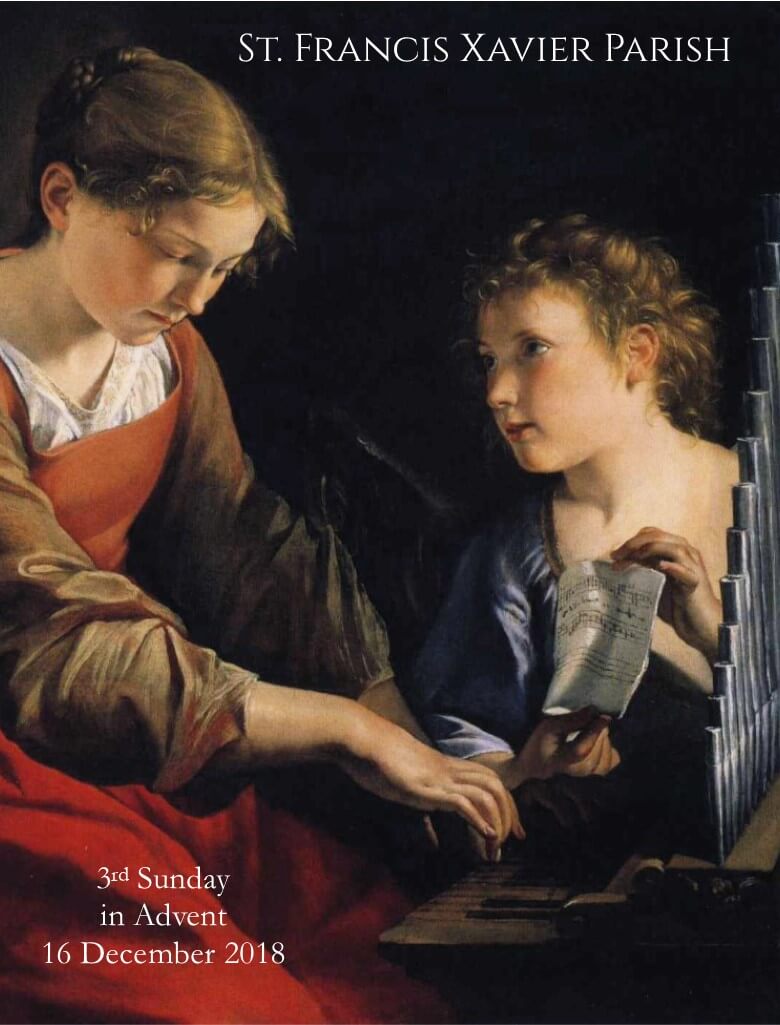
In order to ruminate on the corporate song of angels and men on this Third Sunday of Advent, we have placed on our bulletin cover a Mannerist work of Orazio Gentileschi, entitled St. Cecelia with an Angel (1621). One can still see in this work the influence of Caravaggio in light and color. However, this later work of Gentileschi appears to be a return to Mannerism as seen for instance in the sophistication of the posture of Cecelia’s wrist and fingers and the somber intimacy of saint and angel.
Sadly, we are not able to show the entire painting which is almost as wide as it is tall. Still we can see St. Cecelia, patron saint of Church music, being inspired by the Spirit as symbolized by the celestial being holding up sheet music to Cecelia who needs not look up to read, for she perceives it in her soul. Cecelia plays on a (simple) pipe organ – the instrument which the Vatican II council declared to have special status in the Church liturgy.
Let us rejoice in song this Advent, singing proclamations to the Holy Trinity with the angelic host.
–Steve Guillotte, Director of Pastoral Services
by SFXparish | Dec 6, 2018 | BLOG
Jerusalem, take off your robe of mourning and misery; put on the splendor of glory from God forever… For God will show all the earth your splendor: you will be named by God forever the peace of justice, the glory of God’s worship. (Bar 5:1,3-4)
The observance of Advent has a penitential aspect. This aspect is not as pronounced as in Lent when penitence is palpable in its sorrowful expression of Christ’s Passion. In Advent we liturgically mourn over what had been lost. In a properly and spiritually dramatic fashion we attempt to pray like those faithful Jews who suffered not only military occupation but severance and estrangement from God. For the loyal Jew – one of the remnant of Israel – this separation was part of his historical reality, for he was: a foreigner in Canaan, a slave in Egypt, one despoiled by Assyria, one carried away by Babylon, and one subjugated by the Greeks and Romans. In all these miseries, the ancient Jews felt not only the physical and material suffering of their malefactors, but also the punishment and loss of their benefactor, the Lord God.
Still, the righteous Jew was not without hope. The psalmist declares in today’s liturgy of the word sung between the readings from Baruch and Saint Paul, “those who sow in tears shall reap rejoicing”. This describes precisely the crux of Advent: mourning awakening expectation; for our remembrance of sorrow is not without purpose. Our Advent tribute to mourning is one of beatitude, a ritual sadness leading to indwelling happiness. It explains the heart of every Christian who navigates his or her sufferings on earth through the straits of grace on the way to heaven.
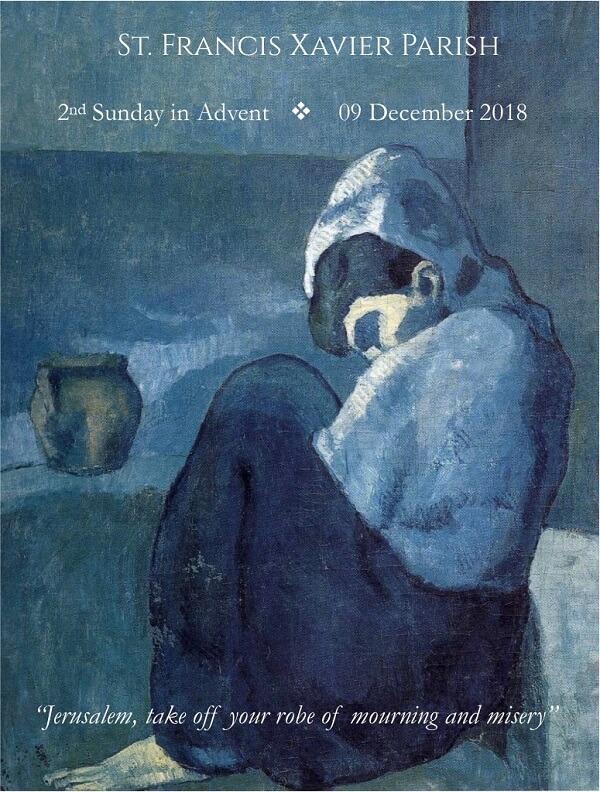
To bring out the message of the Prophet Baruch we have created our own allegory of hopeful mourning. We place on our bulletin cover for this 2nd Sunday in Advent a work by the Spanish modern painter, Pablo Picasso, entitled, The Crouching Woman (1902). This work is representative of Picasso’s “blue period” said by him to have begun around the time of the suicide of one of his close friends. For about three years (1901-1904) Picasso is believed to have endured a period of deep depression that flowed off his palate and onto his canvas until he entered his cheerier “rose period” in 1904. During his blue period the figures in Picasso’s paintings were often alone and grieving.
Thus, we use the isolated figure of The Crouching Woman as a symbol of Jerusalem in “mourning and misery.” Jerusalem is encouraged by the prophet Baruch to take off her robe and “to put on the splendor of glory from God forever.” Interestingly, this image could have been used a few weeks back for the Sunday reading from the First Book of Kings about the widow, Zarephath. Here we see the sad and isolated woman whose jug of oil was running dry and who was making ready to lay down and die (1 Kgs 17:12). In a way the widow herself was a symbol of Jerusalem which suffered drought for its insolence toward God. However, Elijah brought the widow the hope of rain and sustenance in famine in the same way we are to experience spiritual recovery during Advent. Let us cast off the blue of sadness and place within out hearts the rose of peace and hopefulness.
–Steve Guillotte, Director of Pastoral Services
by SFXparish | Dec 5, 2018 | NEWS
We want to extend our gratitude to all who came to our parish game show night which raised over $7,000 for our Seminarian/Vocations Fund. Near 70% of the donations came directly from parishioner sponsorship. We are starting to build a small “war chest” for the Lord as we continue to support (from our parish) two seminarians, one deacon candidate, and a postulant religious sister. But financial support would be nothing without spiritual support – so keep praying!