by SFXparish | Jan 24, 2019 | BLOG
He stood up to read and was handed a scroll of the prophet Isaiah. He unrolled the scroll and found the passage where it was written: “The Spirit of the Lord is upon me…” He said to them, “Today this Scripture passage is fulfilled in your hearing.” (Lk 4:16-18;21)
Isaiah was a great 8th century prophet who faithfully counseled King Hezekiah against the Assyrians and who foretold the Babylonian Captivity and its liberation by Cyrus the Great. He also prophesied, as noted above in our quotation from today’s first reading, about the arrival of the Messiah, the anointed king who would rescue the Jewish nation from their enemies and establish lasting peace. Thus when Jesus read from the scroll in the synagogue at Nazareth and announced that Isaiah’s messianic prediction was being fulfilled in Him, He was announcing to a people who knew this passage well, yet were unprepared for it to come true in their own “hearing”. Even though they knew of the great works Jesus performed in Capernaum on the Sea of Galilee (Lk 4:23), their ears were dull and their hearts slow to credit Jesus as Isaiah’s promised one.
The people of Israel and Judah at the time were hoping for a Messiah, but not one who preached a gospel of repentance and peace. The nation of the Jews waited upon a descendant of David who would cast out by arms and by the power of God all their enemies and reestablish the prosperity of Jerusalem as a glorious city worthy of foreign tribute. Instead, the people should have been more attentive to the prophecy of Isaiah which declared the savior to be God’s suffering servant (see for example Is 52:13-53:12). Little did these listeners in Nazareth know that in trying to usher Jesus off a cliff in response to His claim of being the Messiah, they themselves set in motion the public hostility toward Jesus which would eventually lead Him to his salvific Passion.
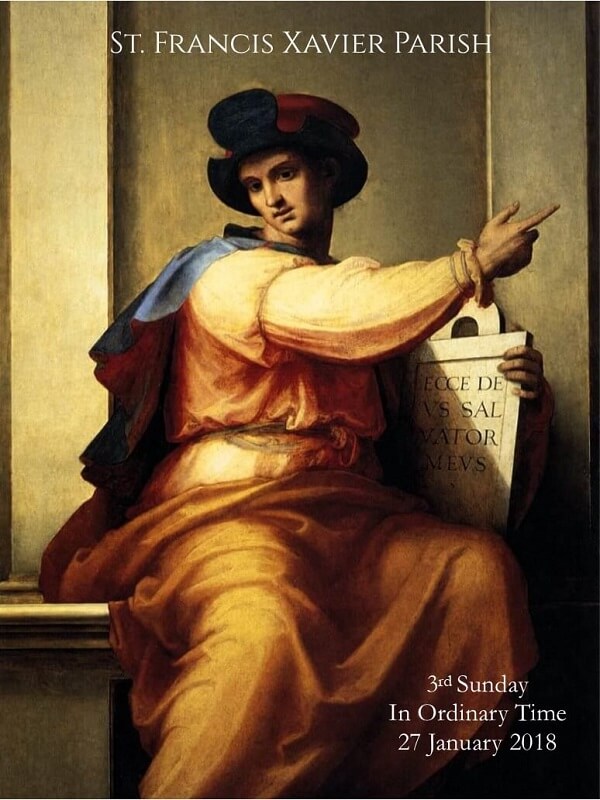
In order to commemorate Isaiah on this 3rd Sunday in Ordinary Time, we have placed on our bulletin cover an image entitled, Prophet Isaiah (1516), painted by the High Renaissance Italian, Fra Bartolomeo. Bartolomeo trained as an artist but became a Dominican Friar around the year 1500. He returned to painting as a religious and formed an artistic friendship with the great Raphael.
Bartolomeo, who forsook painting in the first several years of his religious vocation, later visited Rome where he spent time in the Sistine Chapel. A few years later he painted his version of Isaiah based on his observance of the work of Michelangelo. Fra Bartolomeo painted this work in Florence where, sadly, he died only one year later at the age of 45.
Bartolomeo gives us a very Italian looking Isaiah which would have touched the emotion of his audience. Isaiah is clothed from neck to feet with Bartolomeo’s modest approach to art. Bartolomeo wanted his work to generate a religious experience and so Isaiah holds a tablet with the words in Latin: Behold God, my Salvation. Isaiah is seen pointing toward the future or perhaps (in its original position in the Billi Altarpiece) toward another nearby image depicting Christ Our Salvation. May our lives and our actions also always point toward Christ the Savior of the world!
–Steve Guillotte, Director of Pastoral Services
by SFXparish | Jan 17, 2019 | BLOG
“… You shall be called…Espoused. For the LORD delights in you and makes your land his spouse. As a young man marries a virgin, your Builder shall marry you; and as a bridegroom rejoices in his bride so shall your God rejoice in you. (Is 62:4-5)
This is the first Sunday celebrated in Ordinary Time since the conclusion of the Christmas liturgical season. Yet still we celebrate the echoes of Epiphany with the great gospel manifestation of Jesus at the Marriage at Cana where the Virgin Mary directs her son, the Son of God, to begin his miraculous ministry. Our first reading is from Isaiah which predicts how the Lord God through the person of the Messiah would bind himself in marriage to Jerusalem, a symbol of the Church. There are many such images in the New Testament such as in the Book of Revelation when St, John’s vision on the isle of Patmos sees “a New Jerusalem coming down out of heaven from God, prepared as a bride adorned for her husband” (Rev 21:2).
In Paul’s Letter to the Ephesians he uses the image of the Church to describe the sacrament of marriage and vice versa. Jesus as the head sanctifies his body the Church, bathing it in the water of the word so that he might present it to himself as a bride “holy and without blemish” (Eph 5:27). This word once came to mankind through the mouth of Jesus Himself; now it comes through Holy Scripture and through the grace of the Holy Spirit in the sacramental life also gifted by Christ whilst He was personally present on earth. Further, Jesus offers Himself as the “bridegroom” in His answer to the question about His disciples not fasting (Mt 9:15) and in the Parable of the Ten Virgins (Mt 25:6). Even John the Baptist says that he stands in as best man rejoicing that the bridegroom, Christ, has finally come to claim His bride (Jn 3:29).
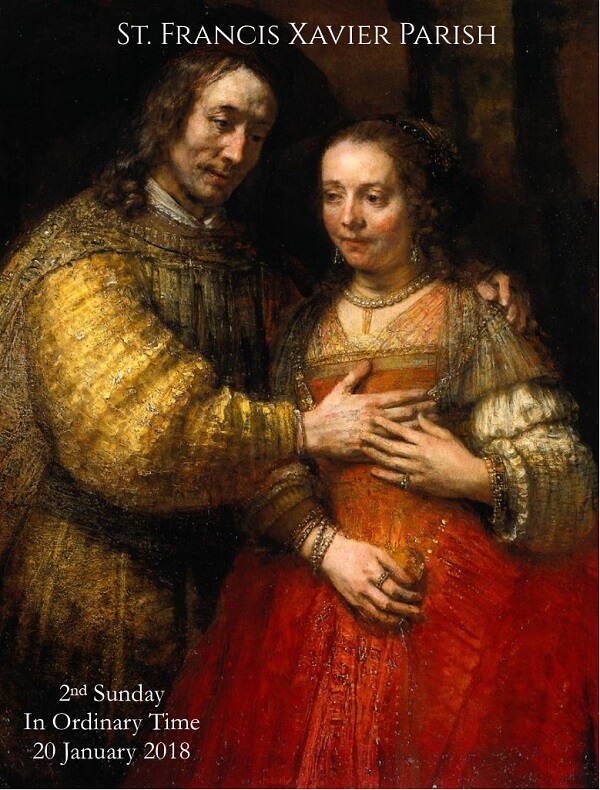
On this Second Sunday in Ordinary Time we have created a parable or rather an allegory of sorts for our bulletin cover. We use the beautiful work of Rembrandt entitled the The Jewish Bride (1666) to explain the love between Christ and His Church. Here we see the noble lord representing Christ approach his bride with a gentle, loving embrace. While drawing his bride to him with his left hand, he places his right hand over her breast so as to indicate the grace he pours into her heart. She, humble to his loving approach, only touches his hand softly with her left hand accepting affectionately his gracious love. The bride then displays tenderly the fruit of this grace (which always bears forth in wisdom and worship and good works) by placing her right hand over her womb. The noble man here is Christ-the-head; the noble woman here is Church-the-body or heaven and earth still being prepared as the New Jerusalem for its eternal nuptial to Christ on the last day in time which we all eagerly await.
Interestingly, this work has many interpretations to which we have here added our own. Perhaps, Rembrandt biographer Christopher White puts it best: this work is a “tender fusion of spiritual and physical love” (Reference: Wikipedia). So is the ministry of Christ which offers His divinity and His incarnate flesh for His beloved Church.
–Steve Guillotte, Director of Pastoral Services
by SFXparish | Jan 11, 2019 | BLOG
The people were filled with expectation, and all were asking in their hearts whether John might be the Christ. John answered them all, saying,”… one mightier than I is coming… He will baptize you with the Holy Spirit and fire.” (Lk 3:15-16)
Just a few weeks ago we wrote in this column that the essence of the Advent season is “expectation”. The Church (that is, the Holy Spirit) instructs us today that the substance of the Christmas season is also one of glorious anticipation.
Christmas concludes with the Feast of the Baptism of Jesus, and as our quotation above from today’s gospel reading testifies (although we depart the liturgical Christmas season for another “ordinary time”) our religious practice is meant to be anything but ordinary. It is meant to be full of expectation.
Sunday is always focused on Jesus Christ, especially this Sunday. However, in order to sharpen this focus, the Church presents us today with St. John the Baptist. It was on John that the expectation of the Judean people of the 1st century A.D was initially focused in their hope of salvation. This is not the first expectation surrounding the person of John. At the birth and naming of John, Luke tells us in his first gospel chapter that, “All who heard these things took them to heart, saying, “What, then, will this child be?” For surely the hand of the Lord was with him” (Lk 1:66). Remember that the Blessed Virgin Mary’s cousin Elizabeth conceived John in her old age and that John’s father Zechariah had an angelic vision whence he was struck mute, and that he regained his speech only at the naming of John. Even Jesus calls John the Baptist the greatest man born of woman (Lk 7:28) meaning that his natural capacity and constitution must have been great indeed! In this way he was easily a magnet to the people. In the Spirit, he was certainly a magnet for God.
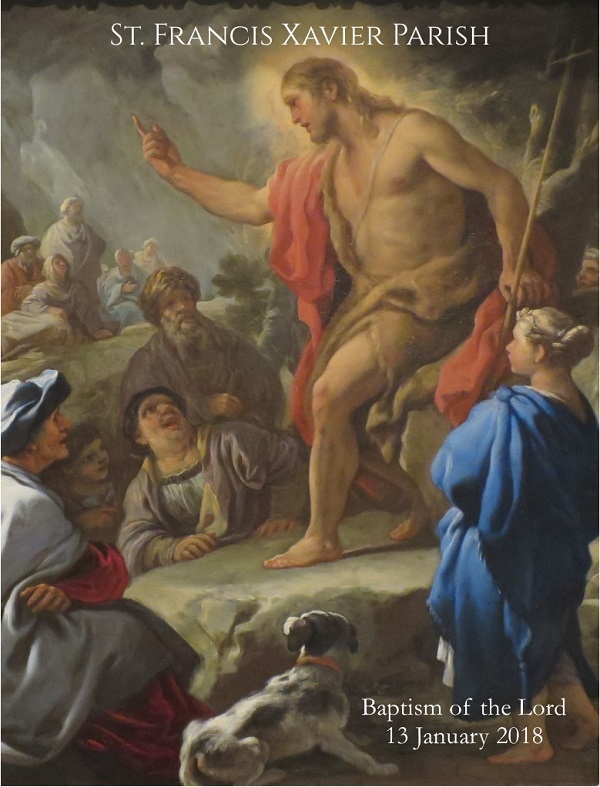
For this Sunday’s feast we place on our bulletin cover a work by the late Italian Baroque painter, Luca Giordano, entitled St. John the Baptist Preaching (1695). Giordano painted this work later in life during his residency in Spain. However, his early training was completed by a Spaniard residing in Italy – Jusepe de Ribera. This work is thoroughly Baroque. John is presented in strong physical stature and his listeners are filled with expectation as to what he will say and do. (Even the small dog has a posture of excitement). But here we see John refocusing the crowd’s expectation by pointing upward indicating that there is another coming after him; someone who comes from heaven bearing the full Godhead. John’s testimony is depicted solidly as he stands on God shown as a “rock of refuge” (Ps 18:2 & 71:3).
John tells his followers, “One mightier than me is coming”. In fact, this mightier one had arrived many years earlier in a manger in Bethlehem. He did as John had foretold and sent His Holy Spirit to enliven the faithful with grace. Jesus will come one last time, as we say in our creed, “in glory to judge the living and the dead”. If we approach His coming with expectation and joy, rather than with apathy or dread, then we show ourselves to be true disciples of hope in God.
–Steve Guillotte, Director of Pastoral Services

by SFXparish | Jan 11, 2019 | NEWS
Thank you to all parishioners, parish apostolates, and others who contributed to our Annual Christmas Shoe Drive (2018) for children living in a Rwandan village. This year we raised $4,000 to be used only for the purchase of shoes by Father Leonard Kayondo when he returns home to his country soon. God Bless you all for your generosity!
by SFXparish | Jan 4, 2019 | BLOG
Rise up in splendor, Jerusalem! Your light has come, the glory of the Lord shines upon you. See, darkness covers the earth, and thick clouds cover the peoples; but upon you the LORD shines (Is 60:1-2)
The word epiphany means “appearance” or “manifestation”, specifically an appearance or manifestation of the divine – a glorious revelation occurring in world history. Still an epiphany is not for everyone to see. When an epiphany does occur there are only certain people chosen to perceive it. Epiphanies are especially given to those whose hearts are ready for religious wonder: the pious Jewish shepherds of the field, the Eastern kings seeking clues of the One God, John the Baptist anointing Jesus in the Jordan River. Not many have seen a manifestation of the Lord. Perhaps this is because so many people today would not recognize it if they saw one; or in recognizing it would not act upon it in the thoroughly devoted and transforming way it is meant to inspire? Only God knows.
This Sunday’s Feast of the Epiphany asks each and every Catholic and all sincere seekers of God to believe, through faith, in the revelation of God; specifically in the divine revelation associated with the life of Jesus Christ, the Son of God. The Church does not require that you be present at the manifestation of God in real time, but that you only recall the words of Jesus Himself in his final beatitude and legacy left to mankind before He departed the world: “Blessed are those who have not seen and have believed” (Jn 20:29).
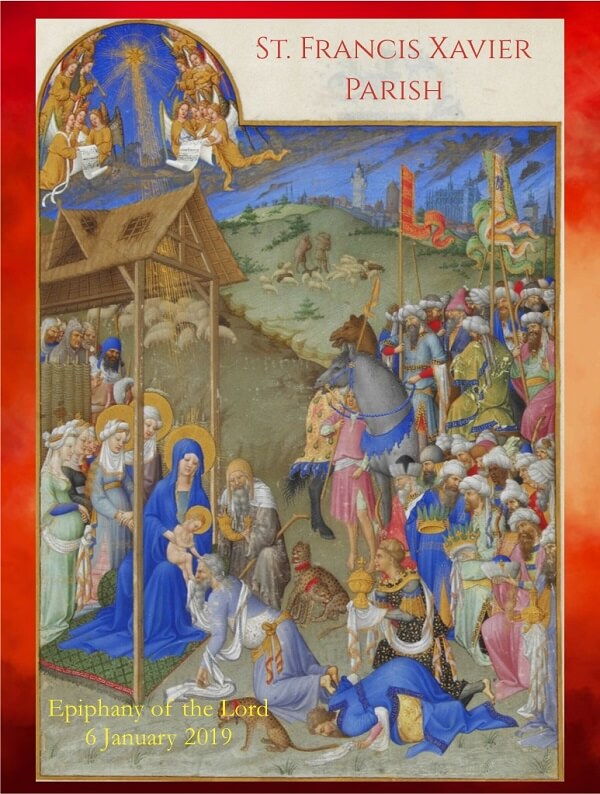
In order to celebrate this great feast day which falls on the “twelfth day of Christmas” we have placed on our bulletin cover a beautiful medieval work by the three Limbourg Brothers known as The Adoration of the Magi (1416). This piece was probably from an illuminated manuscript on parchment as part of a larger book or bible. The Limbourg Brothers were Dutch, however they were mostly active in France as masters of miniature illustration in what is known as the Late Gothic style.
This painting, typical of the talented brothers, is a panoply of activity for the artistic eye. Almost the entire right side of this tempera painting is a sea of jostling figures from which the magi emerge. Here they appear, as ones stranded by the storm still blowing from Eden. Here they represent all sincere mankind as they offer praise and thanks for their salvation, even as one king kisses the “dry land” before the infant Jesus, the wellspring of eternal life.
The scene also has its share of four footed creatures: sheep and horses, camels and leopards all present so that creation itself can express homage to the creator born on earth of Mary who is seen here already in her heavenly royalty while she presents her Son to others for adoration. Above we see the shepherds at night engaged with their own manifestation of angels who themselves offer “Gloria” amidst the shining star in praise of Emmanuel, God-with-us. Mary is attended by ladies in waiting, one lady seen bearing the fruitfulness of the womb.
Off in the distance we see a great French Gothic city defined pictorially by two flags flying. For us, this is looming Jerusalem which will claim the life of Jesus, yet will still play its full part in salvation history (Rev 21:2). May the Lord manifest his Holy Spirit to all those who seek Him!
–Steve Guillotte, Director of Pastoral Services