by SFXparish | Feb 12, 2020 | BLOG
“If you choose, you can keep the commandments & they will save you; if you trust in God, you too shall live; … Before man are life and death, good and evil, whichever he chooses shall be given him.” (Sir 15:15; 17)
God made man free. This means God gave man the power to act of his own accord. Man has the power to act or not to act – and if he chooses to act – the power to act one way or another. Man can choose his own way and he can do so deliberately taking into consideration what is good or bad and what is right or wrong. Thus God gave man not only the power of freedom but the proclivity for prudence which allows man to seek after what is beneficial and honorable and to avoid what is detrimental and dishonorable.
Freedom does not happen without responsibility. The misuse of freedom results in injury to one’s self or injury to others (often resulting in punishment to one’s self). This is the rule of life and the rule of law. It is also the law of God. Being made in the image of God we understand the cooperating principles of freedom and responsibility: that overreaches in freedom result in pain and in penalty. Or do we understand this any longer?
So many people today appear to be frustrated and angry because they cannot grasp that their errant moral behavior is the cause of their frustration and anger. They suffer personally and spiritually because they cannot distinguish between what is actually good and what only appears to be good (yet is actually bad). A person who is unable to discern between the good and the bad has little chance of knowing the right from the wrong. His corrupted conscience will continue to stray from the path of happiness.
It is for this reason that knowledge and practice of God’s commandments are so needed today. Our quotation above from the Book of Sirach reveals an ancient wisdom: each person chooses the good or evil he or she ends up with. God lures no one to Hell; God lays out before man life and death. Man chooses his own way. God wants to lead man to Heaven, but each man can refuse God’s truth and grace in his own unrepentant free will.
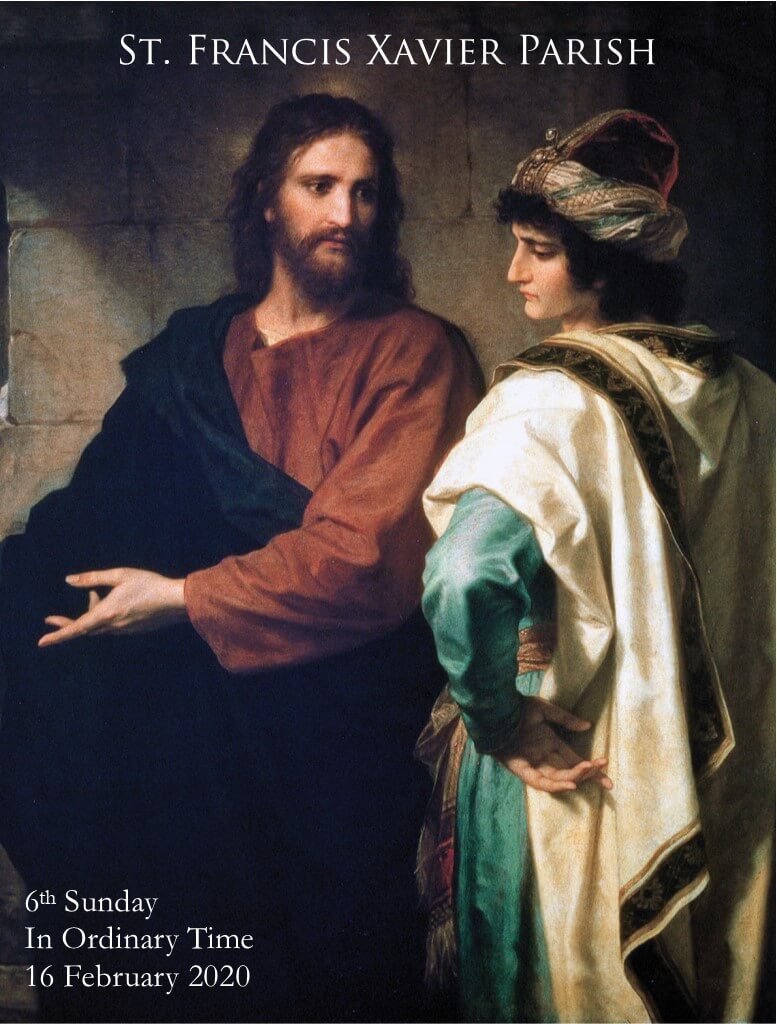
For this 6th Sunday in Ordinary Time we have placed on our bulletin cover a work by Heinrich Hofmann entitled Christ and the Rich Young Ruler (1889). Hofmann was a German Academic painter heavily influenced by the Italian masters of antiquity. Hofmann dedicated himself to images portraying the life and activities of Jesus.
Here we see Jesus offering the young man a choice: to continue his rich worldly lifestyle or to follow Him to the riches of God’s kingdom. Unseen on our bulletin cover (due to the width of the painting) is a frail, ill man cared for by a woman who resembles the Blessed Mother. Hofmann paints Jesus asking the young man to use his riches to serve others rather than only himself. The young man looks away in obstinacy. We know he goes away sad (Mt 19:22).
The young man need not gone away. He could have stayed with Jesus selling all he had for the “pearl of great price” (Mt 13:45-46). He could have prudently chosen, at that moment, everlasting happiness.
-Steve Guillotte, Director of Pastoral Services
by SFXparish | Feb 6, 2020 | BLOG
“You are the light of the world… Just so, your light must shine before others, that they may see your good deeds and glorify your heavenly Father.” (Mt 5:14; 16)
In our regular reading of Sacred Scripture we will come across some passages which appear to contradict each other. For example, today Jesus tells his disciples to show their good deeds to others, while at another time He commanded them to “take care not to perform righteous deeds in order that people may see them” (Mt 6:1). On the surface it appears that Jesus is instructing His disciples to do two opposite things. However Jesus never does anything only on the surface. His meaning always delves deeper.
The teachings of Jesus are not for the superficial or slothful but for those who through grace seek His greater understanding. Surface contradictions in Sacred Scripture should never pose any threat to the believer. In this case the Christian will come to see these passages from Matthew as two pieces clinging together in the same complete puzzle.
The teaching of Our Lord is always spiritual. In this case the two sayings each encourage us to have a proper spiritual intention. Thus, when we perform an act of charity do we intend that people see us or see God? Do we desire, even a little, to be in the spotlight or is our intent to shine the light upon God? Do we seek (even a little) to glorify ourselves or do we seek entirely to glorify God?
The answers to these questions are very important because what Jesus wants is not that we should hide our good deeds but that we should not perform them with the purpose of making ourselves look good to others. For instance, when a Christian posts a picture of himself on social media performing some charitable act does he do so for the purpose of making himself look good to others or for the exclusive purpose of glorifying God? Because this is a spiritual matter, this is an interior question which each Christian must answer within his own conscience. The answer to this question and the intention of the believer will determine if the Christian is walking on the path of Christ.
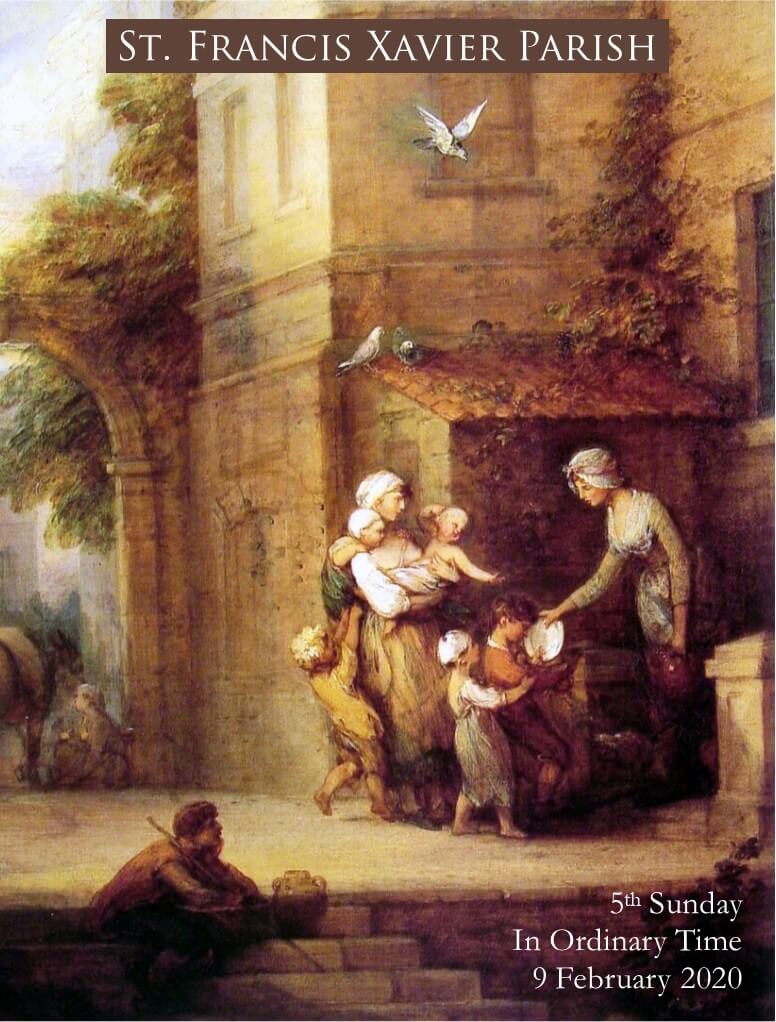
For this 5th Sunday in Ordinary Time we place on our parish bulletin cover a work by the 18th century English painter Thomas Gainsborough entitled, Charity Relieving Distress. Gainsborough painted in the Rococo and Academic styles progressing from portraits to landscape-portraits to far reaching country landscapes. The work we examine today is actually a bit of an oddity for its use of classical features and its classical appearance, uncharacteristic of the artist.
The importance of this work to us is the unassuming appearance of the woman offering charity to the poor. She is wholly engaged in the task, seemingly thinking nothing of herself. Gainsborough has even cornered her in by his architecture so that her charity is blocked from view on most sides. Only the man sitting on the steps who appears not poor (he has both basket and jug) can directly see her good deeds. This man peers at the woman without her knowing it as he is moved to admiration and contemplation over her humble and loving concern.
Let us perform charitable acts inspired by prayer and grace, and let us think only of glorifying God.
-Steve Guillotte, Director of Pastoral Services
by SFXparish | Jan 30, 2020 | BLOG
Simeon blessed them and said to Mary his mother, “Behold, this child is destined for the fall and rise of many in Israel, and to be a sign that will be contradicted–and you yourself a sword will pierce”. (Lk 2:34-35)
Perhaps some of you have attended a baptism where the infant to be anointed was asleep until the time of the sacramental blessing. This makes one wonder about the baby Jesus at His blessing in the Temple of Jerusalem while He was in the secure and restful care of Mary and Joseph.
Yet there appear to be no artistic representations of the infant Jesus sleeping during His Presentation in the Temple forty days after his birth; in most of these images he appears quite awake and active. There are however, excluding the Presentation theme, some famous paintings of Jesus asleep as an infant. Bellini, Mantegna, and Longhi have all painted lovely works of the baby Jesus sleeping. What all these images show in common is the Blessed Mother adoring and meditating upon her divine son.
We know that the Blessed Mother meditated upon her infant son. St. Luke tells us so at least twice (Lk 2:19 & Lk 2:51). Furthermore, what mother has not found “sleep time” the best time to adore the wonderment of her child? However, after her meeting with the temple prophet Simeon, Mary’s meditations would have been tinged with foreboding for Simeon told her that she, the Mother of God, would also suffer the contradiction of the Son of God, for “you yourself a sword will pierce”. It is this prediction at the Presentation of the Temple, and the Blessed Mother’s consequent reflection upon it, which we examine here on this feast day of the same name.
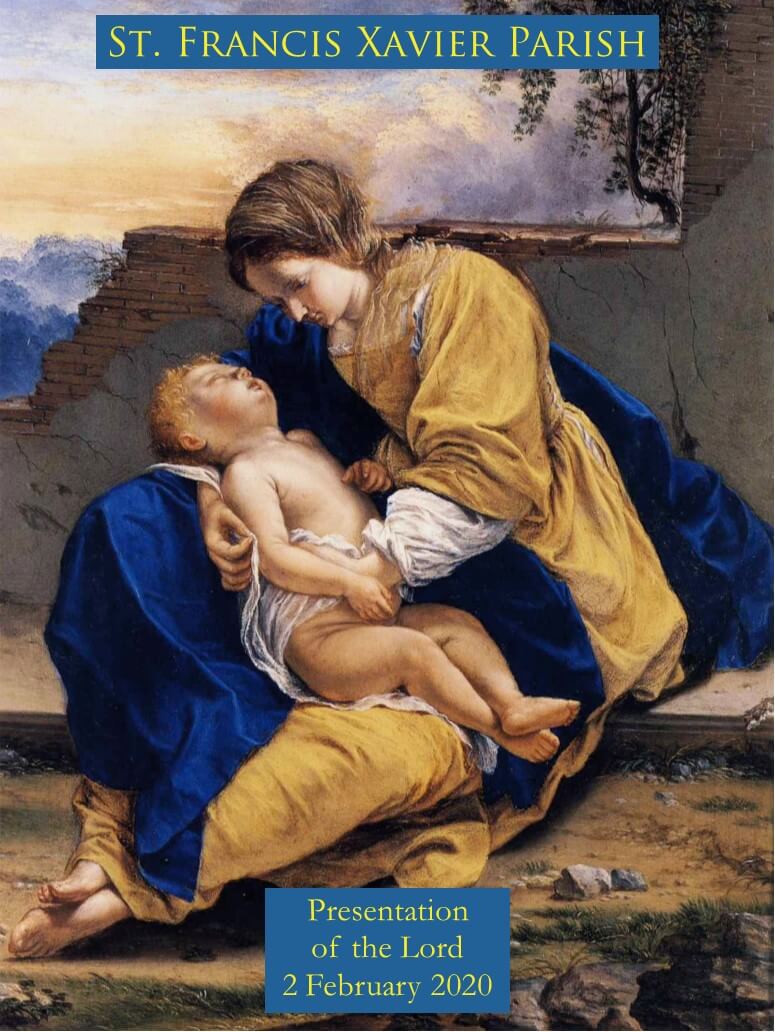
Thus, we have placed on our bulletin cover a most excellent representation of the sleeping infant Jesus by the Mannerist master Orazio Gentileschi entitled Madonna & Child in a Landscape (1622). Gentileschi was a Tuscan, who moved to Rome, then to Genoa, to France and finally to England where he died in London, once a court painter. He had a daughter, a masterful Baroque painter, Artemisia, who surpassed her father’s imitation of Caravaggio.
In our image, Blessed Mary sits leaning against a broken wall anticipating the fallen Temple (Mk 13:1-2) just as she reflects deeply upon the temple of her son’s body (Jn 2:19). Mary cradles Jesus gently as he rests in her arms and upon her legs. We might just begin and end our meditation here if it were not for Gentileschi’s insight and our present consideration of the words of Simeon.
Gentileschi has painted for us a subtle Pieta; a gentle prevision into the Passion. The head of Jesus is limp and tilted back as in scenes of His Deposition while his feet are crossed as in scenes of His Crucifixion. Jesus is asleep but in a posture depicted when He is taken down from the Cross. This image is tender in beauty, but also in sorrow as Mary feels the first prick of the sword that will penetrate to her Immaculate Heart. She sits after the Presentation in a place of desolation yet wraps her divine son in the gold and lapis colors of her cloth mirrored in the sky above, taking the observer beyond the Passion to the glorious Ascension. This is a sign to us that in only a few weeks we too will be ushered into Christ’s paschal mystery.
-Steve Guillotte, Director of Pastoral Services
by SFXparish | Jan 23, 2020 | BLOG
As he was walking by the Sea of Galilee, [Jesus] saw two brothers, Simon who is called Peter, and his brother Andrew, casting a net into the sea; they were fishermen. He said to them, “Come after me, and I will make you fishers of men.” (Mt 4:18-19)
The word fish is most often used as a noun, however its meaning varies greatly as a verb. In the card game “Go Fish” the player who asks incorrectly for a card from his opponent is sent back to the stack to choose a blind card. “To fish” in this case means grabbing at what one cannot see. Fishing can also mean “searching” such as when investigators cast a broad net to gain information and are sometimes accused of going on a “fishing expedition”.
Commercial fishermen today search with more precision using new technology and in fishing grounds where they expect to find fish. Even the rod fisherman seeks reliability by staking out his favorite spot to cast his line.
In the search for His twelve Apostles, Jesus acted with far greater precision and planning. His selection of fishermen was providential in that God formed these men in the wombs of the wives of fishermen just so that the phrase “fishers of men” might reverberate through salvation history. God’s determination to inject fishermen into the divine narrative set the stage for Jesus to perform miracles as vigorous metaphors for the vastness of His kingdom (Lk 5:6), to compare His kingdom to a great net (Mt 13:47) and to teach his disciples to move beyond the shallow out into the deep (Lk 5:4). It is also not coincidental that Our Lord chose to tell this story by lake and by sea (e.g. Mt 13:1 & Lk 5:1).
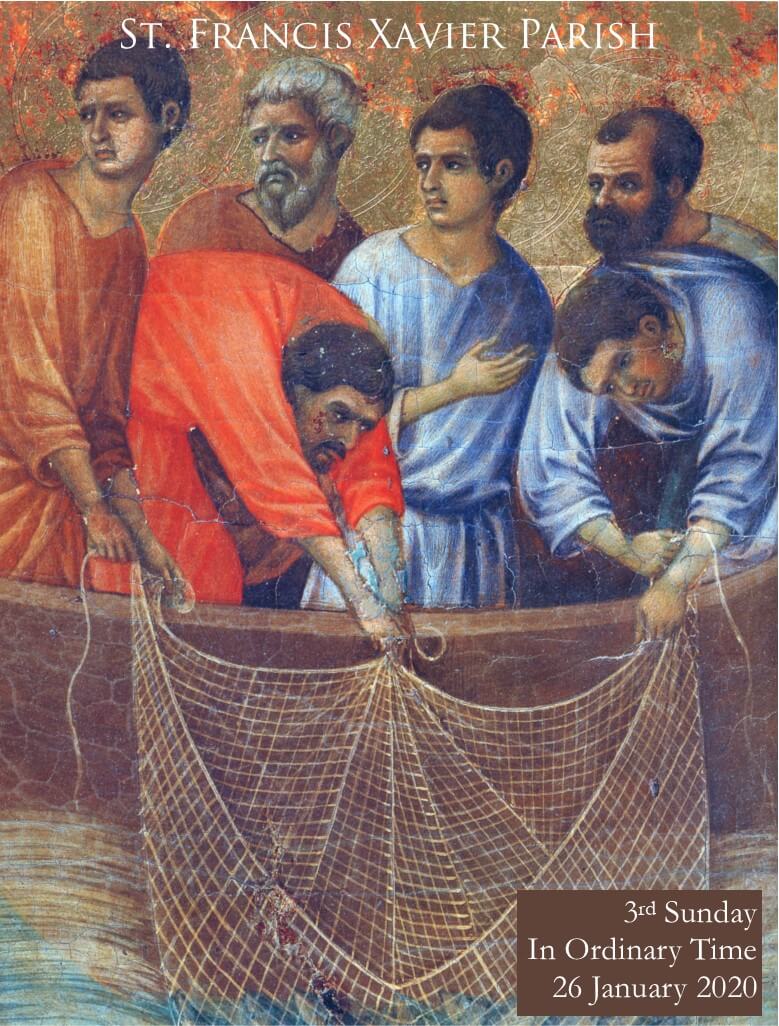
For this Third Sunday in Ordinary Time we place on our parish bulletin cover a fragment of a work by the Sienese medieval master Duccio entitled Appearance of Christ to the Apostles (1311). Duccio was one of those artists who bridged the gap between the Gothic and Renaissance periods. He is historical proof that the rebirth of art in Europe began during the Middle Ages.
This work is an allegory of Christ’s call since only four of the Apostles were known in the Bible to be fishermen. Unseen in the image are Christ who stands on shore and Peter who walks on water toward him. For our purpose we will say that from left to right stand John, Andrew, Matthew and James (we have chosen Matthew as third in this order for his hand over his chest indicating the traditional “who, me?” posture). In any case those standing have lost interest in fishing and are drawn wholly to the Lord who is calling them. For us Thomas is the bent apostle to the far right with only a single grip on the net, but the apostle dressed in red (for the Sacred Blood he will cause to spill) is Judas. He has both hands engaged in his earthly task, inattentive, back turned to Jesus; more engrossed with the price that this great catch will bring.
This image is presented here to remind us that Jesus searches for us; He calls us. Have we listened for the call or have we been inattentive, doubtful or indifferent; or have we been like Peter stepping boldly out into the deep?
-Steve Guillotte, Director of Pastoral Services
by SFXparish | Jan 16, 2020 | BLOG
The LORD said to me: You are my servant, Israel, through whom I show my glory. Now the LORD has spoken who formed me as his servant from the womb… (Is 49:3)
The womb is a blessed place. Any place ought to be held blessed which is the fundamental and foremost cradle of all human life. Without the womb there would be no human life. Even those modern vices of fetal surrogacy and fashioning children in laboratories would fail utterly without the womb as their anchor and agent.
The womb is the nursery endorsed by nature for the original nourishment of children. It should be highly honored. The womb and its fertility should be respected and venerated as the vessel of life chosen by God. It should not violated for personal goals. The womb is not just good for something; as the kernel of femininity it is good-in-itself. Thus no person should ever take it upon himself (or herself) to use the womb for their own profit nor ever cause it violence. The womb is inviolate; direct abortion being directly abhorrent to it. Any man who would traffic or purge the womb is a brigand and a home invader; any woman who would freely offer it violence is as a priest who would desecrate his own tabernacle.
During this week many of our parishioners will march for life in Washington D.C.! They hope as best they can to form a circle of protection around the womb from all its violators. But just as much as this, they hope to shine a light on the beauty of God’s creation in the womb and the special dignity due to each and every individual knitted in the womb, intentionally or not, as the image of God.
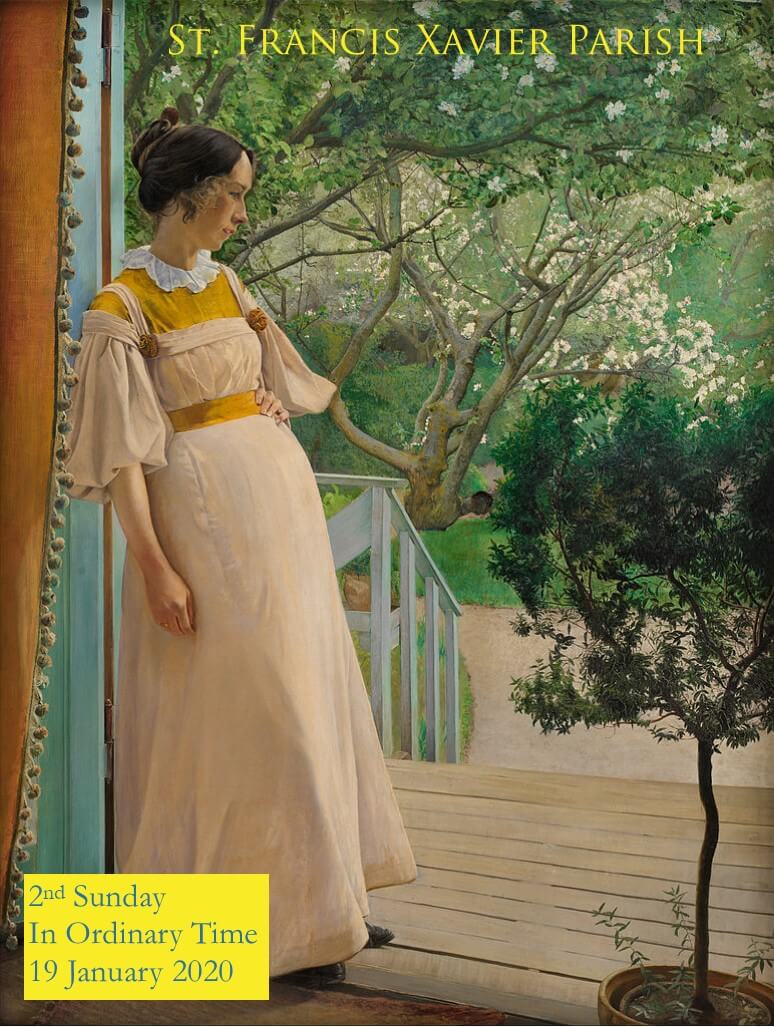
For this 2nd Sunday in Ordinary time, just as we depart the Christmas season, we place on our bulletin cover for this month dedicated to the cause of life, a work by the 20th century Danish painter L.A. Ring entitled, At the French Windows; an Artist’s Wife (1897). Ring is considered both a realist and a symbolist, painting works that range between realism and symbolism. His scenes vary from pastoral landscapes to the genre of laborers to dark spiritual images.
In the scene adorning our bulletin cover some experts have surmised that Ring, an atheist, was contrasting ordered humanity with untamed nature by the contrast of the pregnant woman with a gnarled nearby tree. However, we think this is applying the symbolist interpretation too radically toward a work based solidly in realism.
If there is any symbolism here it appears to be a celebration of life through a flower motif. The bending posture of the tree is in fact realism; realistic for instance to a Hawthorn as are its white blossoms which express here the fruitfulness of the artist’s wife. Ring paints his wife as a long-stem flower leaning in the opposite direction of the small tree near to her. The gold ribbon around her waist emphasizes her “blossoming” child. Blooms decorate her dress as even her neckline appears as white petals. Taken as a whole, the artist’s wife is depicted as a Brown-eyed-Susan expressing the bourgeoning landscape of life.
As noted, it is said that Ring was an atheist. Yet, even a sincere atheist expecting a child cannot fail to see the wonder and loveliness of the womb in full bloom; nor can a sincere artist refrain from painting its blessedness.
-Steve Guillotte, Director of Pastoral Services
by SFXparish | Jan 9, 2020 | BLOG
After Jesus was baptized, he came up from the water and behold, the heavens were opened for him… And a voice came from the heavens, saying, “This is my beloved Son, with whom I am well pleased.” (Mt 3:16-17)
How many of you will contend that if God spoke about you to others that he would declare how well-pleased he is? How many of us could say with certainty that everything we think, say, and do in the course of an average week is well-pleasing to the Lord. Would we not admit at least a few things wanting in ourselves; perhaps more than a few things that God would find unpleasing?
How many of us wake up in the morning with the distinct purpose of pleasing God? Are the first words that pass our lips, “Lord Father, help me to spend this entire day pleasing you”? Perhaps we should consider starting our day like this to be in the correct disposition of love toward God.
Many of us who try to do what is right and just in the eyes of God do so because we want to avoid God’s punishment. This is not a bad thing, but it could and should be better. Better for us if we were to do what is right and just in order to please God.
“Father” is the name Jesus revealed to us concerning the One Lord who sent Him to earth. This Holy Name is itself instructive because it implies that we are to become like little children (Mt 18:3) in order to know and love God as an ever-loving Father. That is, we are to put off our worldly “maturity” so as to please God as ever-loving children.
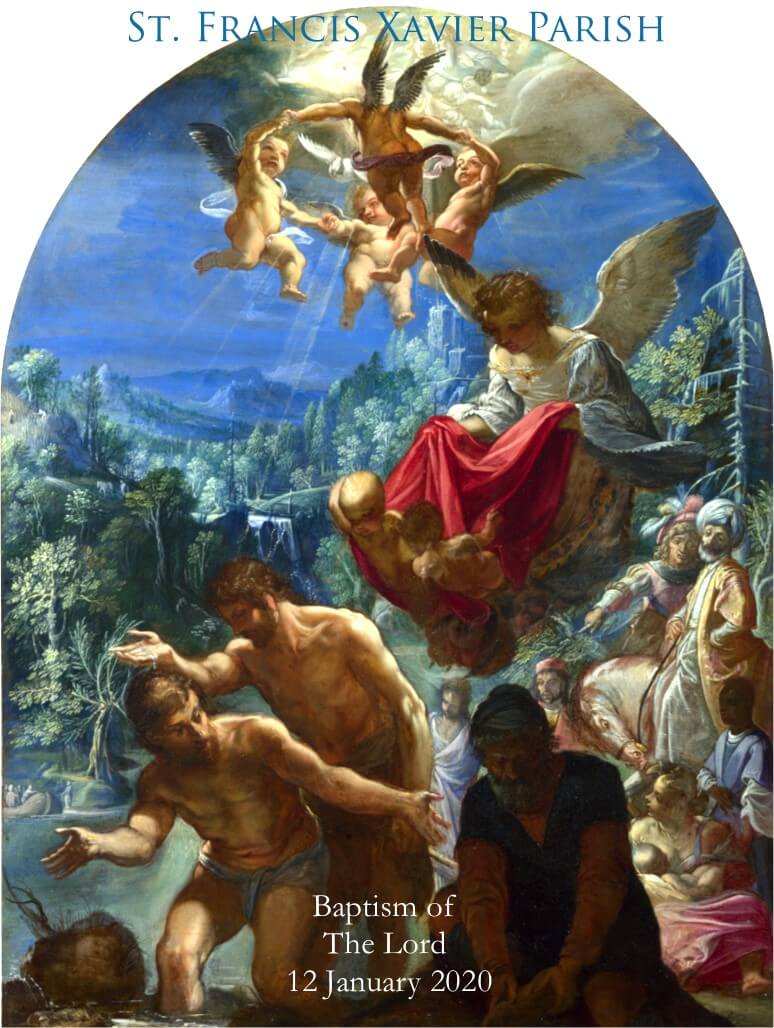
For this year’s celebration of the feast of the Baptism of the Lord, we have placed on our bulletin cover a work by Adam Elsheimer entitled Baptism of Christ (1599). Elsheimer was a German Baroque painter who made his way to Rome absorbing its methods and adapting these to his German training. He eventually converted from Lutheranism to Catholicism. His style was influential on the Germanic (Dutch) traditions of Rembrandt and Rubens, the latter with whom he became friends.
Baptism of Christ is a complex work using diagonals. The first traverses from God the Father who sends the Holy Spirit (dove and rays) through a ring of cherubs to descend upon Jesus. The second begins from a large angelic being and two cherubs carrying a kingly robe in which to enwrap Jesus after his baptism.
This painting is also a symbolic piece. The right hand of John (pouring water) and the two outstretched arms of Jesus form the Sign of the Cross used in Baptism. Further, Jesus peers at a man taking off his shoe as if to bathe his feet in the blessed water. This man represents one who is oblivious or even disdainful to the water of grace – one with whom God is not pleased In contrast to this man, the people in the background appear to symbolize various nations that will eagerly come to be baptized in Christ.
Ours is not a difficult choice between following the law of God (in fear of punishment) or pleasing God (out of love). Just as Elsheimer integrates his German training into the Roman style, so are we called to incorporate God’s laws into the practice of love, so as to fulfill the glorious, divine pleasure.
-Steve Guillotte, Director of Pastoral Studies