by SFXparish | Jul 30, 2020 | BLOG
Thus says the LORD… Heed me, and you shall eat well, you shall delight in rich fare. Come to me heedfully, listen, that you may have life. (1 Kg 3:5,9,10)
Heedfully is not a term we use in daily conversation. You won’t tell your children to do their homework “heedfully” although perhaps you should, since besides teaching them a new word you would be telling them to be especially attentive to their assignment. However, perhaps it is best that we don’t use this word too often in common speech. In this way we can reserve it for Sacred Scripture and for God’s use in encouraging us to be especially attentive to him.
This week (August 3rd) we are reinstituting some of our overnight Eucharistic Adoration hours so that we may be heedful of the Lord. Throughout the pandemic our parish church has been open every day for prayer before the Blessed Sacrament in the tabernacle. Many have availed themselves of this opportunity. However, our parishioners and Eucharistic friends have been ever eager to return to the contemplation of the Real Presence of the Lord fully exposed in our beautiful monstrance, thus to come to Christ “heedfully” that they may have a fuller life of grace.
In today’s first reading God calls us to be especially attentive in listening to him. If we want to know everything that God has to say, then we must listen to Jesus. Further, God calls us to his table telling us to “eat well” that we “may have life”. In our gospel reading Jesus signals this divine banquet in His “multiplication of the loaves”, a foreshadowing of the Holy Eucharist in which Christ offers His Body, Blood, Soul and Divinity to all who believe that He can do this (and that He does do this at every Holy Mass). Now Eucharistic Adoration is not Holy Communion. It does not hold as high an honor as the substantial reception of Christ’s Sacred Body & Blood. Yet, Adoration has its own high office as a heedful waiting upon Jesus; a special devotion that upholds and increases in us the Eucharistic life we are called to live.
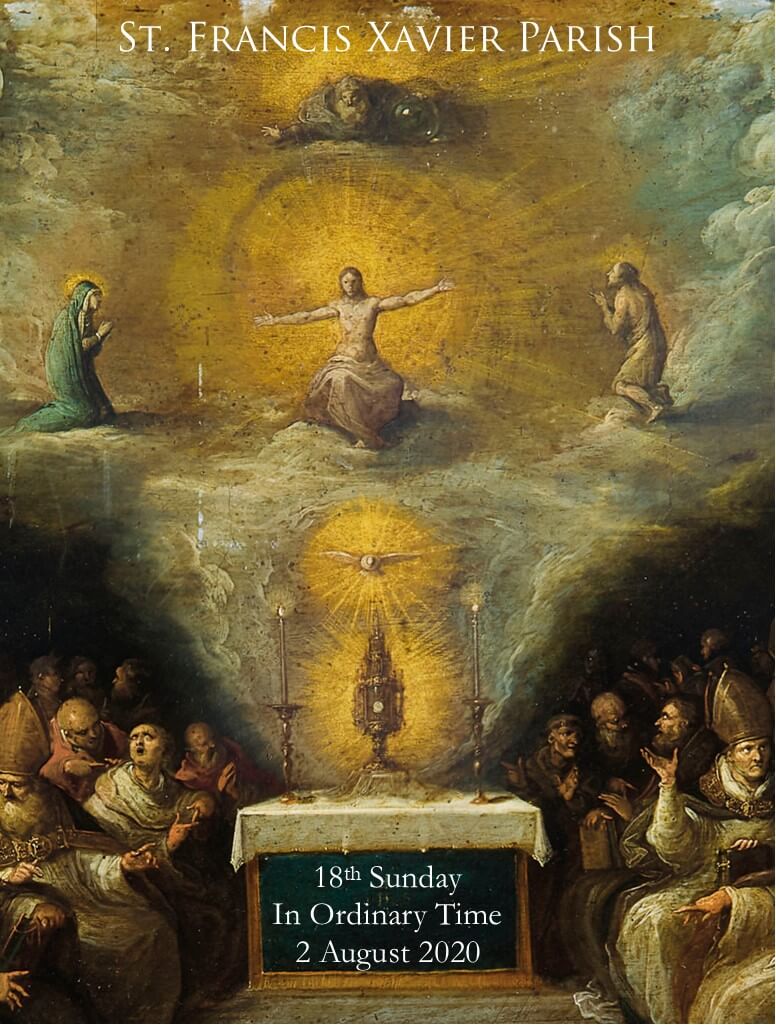
For this 18th Sunday in Ordinary Time we place on our bulletin cover a work by the Flemish painter Frans Francken the Younger entitled The Disputation of the Holy Sacrament, a work of oil and gold on copper. Francken came from a family of painters and his work varies from genre to religious to allegorical. We might say that this work is a Eucharistic allegory. It does not portray a classical myth or a historical event but a revelation of what is actually occurring during Eucharistic Adoration.
Francken was especially apt at creating lovely altarpieces. Here the church altar itself becomes the central feature of his painting. Francken lived during the latter part of the Protestant Reformation when the horizontal debate (which he paints here) over the Real Presence of Jesus in the Eucharist was at its contentious height. Beside this argument Francken proposes in pigment the incontrovertible vertical truth: that Jesus is wholly present in the Blessed Sacrament. In fact, he paints this mystery as fully Trinitarian, such that the Real Presence of Jesus proceeds to us from the Father through the Holy Spirit. Francken even places the Blessed Mother and John the Baptist as witness to this truth, as he illuminates the Holy Host with the same brightness as the divine figures.
Let us be ever-heedful to the mystery of the Most Blessed Sacrament in Eucharistic Adoration.
-Steve Guillotte, Director of Pastoral Services
by SFXparish | Jul 24, 2020 | BLOG
God said, “Ask something of me and I will give it to you.” Solomon answered… “Give your servant… an understanding heart to judge your people and to distinguish right from wrong…The LORD was pleased that Solomon made this request. (1 Kg 3:5,9,10)
Most of the time in our prayer, we are asking things of God. We make petitions for ourselves and intercessions for others. We are the ones who initiate the requests or supplications. We may even feel at times that we are knocking at a closed door behind which is an empty room. We do not consider often enough that God is already present asking us to ask something of him as this Sunday’s first reading indicates.
So what is the spiritual difference? Why should I not just ask God anytime for anything I want? Why should I have to wait on God to ask me to ask him for something? There is a vast disparity between these two approaches. When I initiate the asking without considering that God is always the initiator I forget about the gifts that God has to offer. I choose my petitions from my own gift register, not God’s. However, when I wait upon the Lord to ask me to ask for something, I have begun to trust that God already knows what is good for me, and I will know much better what to ask for.
Remember the instruction of Jesus: God knows how to give good gifts to his children (Lk 11:13). However, these gifts are from God’s shelf and God’s treasury and they all proceed from the Holy Spirit (Lk 11:13). Notice that in our quotation above from Sacred Scripture, God does not ask Solomon to ask him for “anything”. God tells Solomon to ask for “something”, specifically “ask something of me”. The objective of our petitions should always have its source and fulfilment in heaven. In this way our requests, whether they be for the benefit of the body or the spirit, will always correspond with our final destiny.
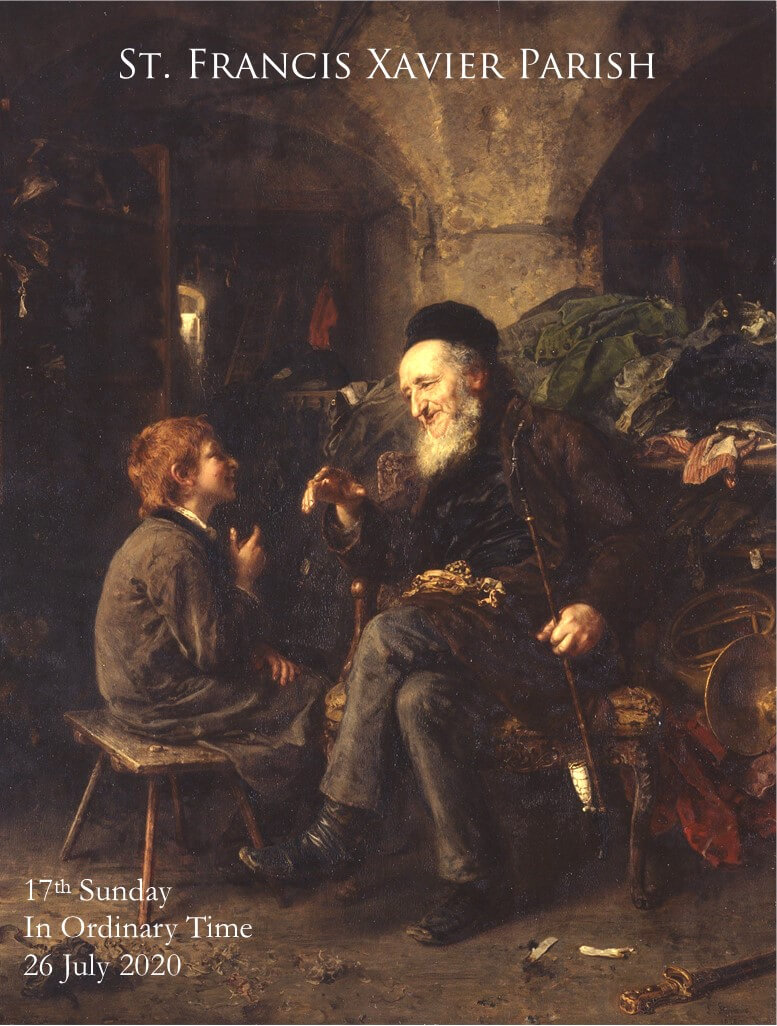
For this 17th Sunday in Ordinary Time we place on our bulletin cover a work by the German painter Ludwig Knaus entitled Solomonic Wisdom (1878). Knaus was a portraiture and genre painter and his images of cheery rustic peasants were quite romantic, ranging from being optimistic to almost frolicking. Like other German Romantics he painted visions of pastoral joy in calming landscapes as in his famous work The Girl in the Meadow (1857).
In our bulletin image we see a young man intently listening and in his turn repeating his instruction. The teacher appears to be a Jewish elder who is eager to offer his wisdom which must be comprehensive for the symbols painted in this piece. On the floor lies a sword and behind the elder a horn indicating his knowledge of both history and the arts. He sits in an ancient structure which is seemingly timeworn yet its vaulted ceiling shows that at a time it was a magnificent structure. Near the light over the boy’s head is a ladder indicating the ascent of knowing. This boy comes seeking knowledge, but not just any knowledge. He desires to learn the wisdom of his past.
We contend that the boy is like the young Solomon who puts prudence before materiality and earthly pleasure. The elder man represents God who has a cache-reserve of many virtues and wisdoms that he wants us to ask of him. These gifts sit in a deep, everlasting chamber ready to be lent out just for the asking.
-Steve Guillotte, Director of Pastoral Services
by SFXparish | Jul 15, 2020 | BLOG
There is no god besides you who have the care of all… For your might is the source of justice; your mastery over all things makes you lenient to all. (Wis 12:13, 16)
Even if one were to rule a nation with all just laws and administer those laws with perfect equity so that only what was right and good was dispensed to every person through the executive power and through the courts, there would still be injustice without the might to oblige what is good and right since man is so often apt to err and sin. In our pursuit of justice-for-all we can never be so foolish as to think that man can regulate his own communal behavior without enforcement of the law. “Govern thyself” is a fine maxim for moral behavior but one ill-equipped to manage a large state.
Promoters of the natural law do not declare that “might is the source of justice” as does the writer of the Book of Wisdom. If might is the source of justice then physical power, not natural right, would rule the law. Catholics believe in “right over might” yet they still understand the proper use of might in maintaining was is just and right. The author of the Book Wisdom also understands this by stating that God has care over all. This means that God’s might it perfectly applied in just judgements because he cares for all that he has created and wills that none of it should suffer loss or punishment. Yet it does. Humans suffer especially because of the misuse of their God-given freedom.
God is patient and lenient with us. St. Peter tells us so: “[God] is patient with you, not wishing that any should perish, but that all should come to repentance” (2Pt:3:9). That is, God’s leniency is given for the benefit of our salvation, but never so we may abuse his love and justice. Even in matters of human justice, clemency should be given to those who express sincere sorrow over their wrongdoing and the will to amend their ways. Yet, leniency always risks future suffering. Even Our Lord concedes that His leniency may cause the suffering of others or else as in today’s Gospel reading, Jesus would not allow the weeds to grow in the midst of the wheat. (Mt 13:28-29)
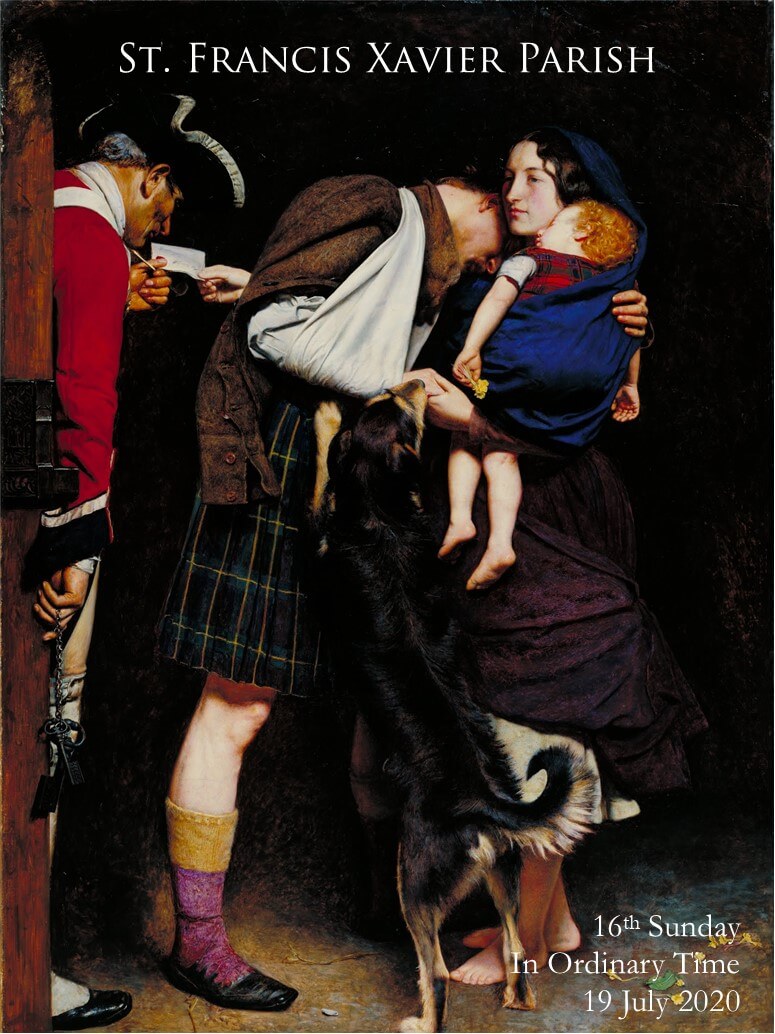
For this 16th Sunday in Ordinary Time we place on our bulletin cover a heartfelt work by the English Romantic John Everett Millais entitled, Order of Release (1853). Here is a Scottish prisoner being released by a written order from an English jail. The man released has an injured arm. Did he resist a just arrest? Or was he mistreated by his captors? We cannot say. We know that both these scenarios occur. Millais paints the same leaning posture by jailor and prisoner; the former inspecting the order; the latter seeking his wife. The man’s reception is interesting. The canine is excited, but notice that his nose points to the union of hands. The child sleeps as if this was an ordinary event, but may be worn out by crying. The wife is stalwart. She has come on business. Her face, not focused on the British soldier, indicates both family and national pride and the effort it took to gain the release.
What we have here is a scene resulting from leniency. Every act of leniency is best when it brings about a reunion of love. This is especially the case with the leniency of the Most High.
-Steve Guillotte, Director of Pastoral Services
by SFXparish | Jul 9, 2020 | BLOG
Some seed fell among thorns, and the thorns grew up and choked it… The seed sown among thorns is the one who hears the word, but then worldly anxiety and the lure of riches choke the word and it bears no fruit. (Mt 13:7, 22)
The “Word of God” means all the wisdom in Sacred Scripture particularly the four Gospels of Jesus Christ sown in the world for man’s salvation. It also means Jesus Christ, the Son of God, who was always with God and of whom John the Apostle says all things came to be through the Word, and without the Word nothing came to be (Jn 1:3). Thus the Word of God also means God’s eternal providence expressed not only in Sacred Scripture but in creation itself establishing the very plan of the universe.
Catholics believe that there are two great revelations of God. The one we most speak of is recounted in the Holy Bible. God reveals himself to us in the Word through inspired writers who have recorded God’s activity in the history of the world. The other revelation, the one we speak less of and seem to have forgotten, is the world itself, the design of which makes clear the purposes of God. The purposes of God are not fleeting but eternal so that, for example, the creation of male and female is an everlasting principle of life fixed not only on earth but in heaven to be forever embodied in the Resurrection of the Body.
Now the reason why so many people today are falling away from the wisdom of the Word given by God in Sacred Scripture is because they have already fallen away from the wisdom offered in the world made by God. When we no longer believe that killing a child in the womb is wrong or that sexual activity between persons of the same gender is wrong, we have already come to reject the disclosure of God through the world. We have allowed our anxieties, fears and doubts sown by the devil in the world, to choke the revelation of God clearly shown in the schema of the world (Rom 1: 20-21). Not only this, but if we continue to reject the wisdom of God set in human nature, we will purpose to go against God and to falsely remake human nature in any image that relieves us of our swelling anxieties.
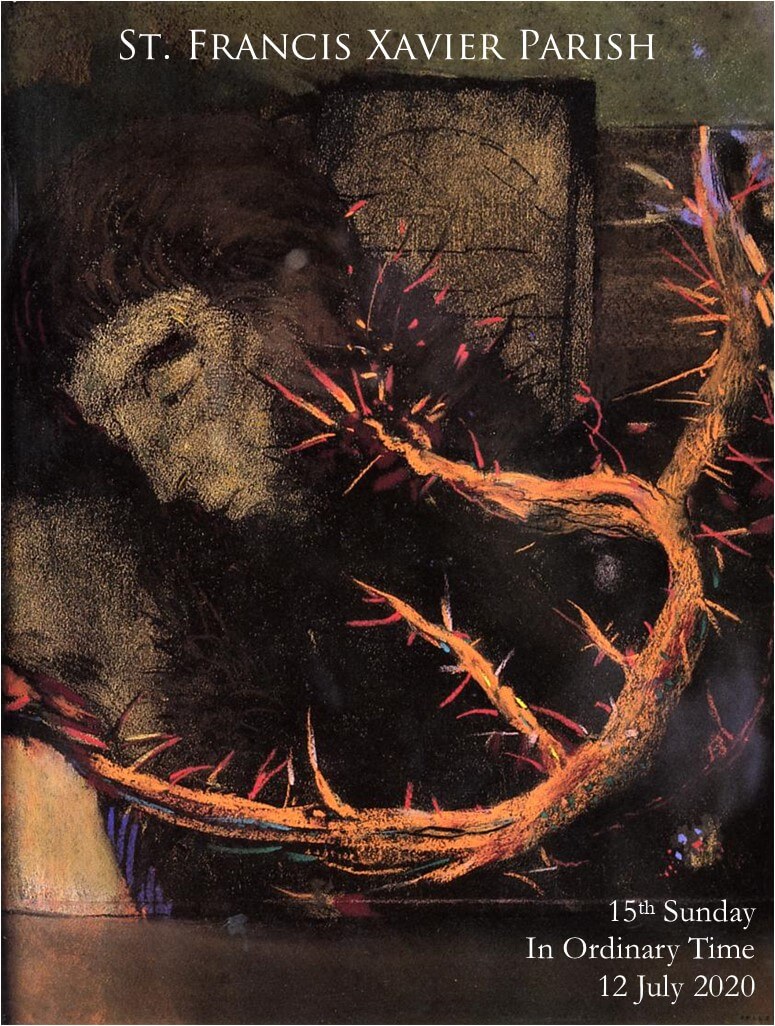
For this 14th Sunday in Ordinary Time we place on our bulletin cover a work by the Symbolist painter Odilon Redon, entitled Christ with Red Thorns (1897). Redon is said to have ushered in Surrealism. His interest in Asian and Western spiritual culture places him solidly within symbolic art and as an apparent successor of the likes of William Blake. He painted several meditations on Christ and while certainly not orthodox in intention, many serve as respectable images of Our Lord to be considered for deeper interpretation.
Here is Christ, hung upon the cross. He wears no crown of thorns. The thorns instead act as a climbing plant spreading out over the Christ figure attempting to creep and overtake the Passion and the cross. They even pierce the face of Christ, his human nature. This is symbolic in that Christ is the vine and we are His branches. Thus what we see here is a clash between vine and thorns; nature and grace against fabrication and corruption. This is what we are experiencing today: the great battle between original and immutable truth and diabolic and sham forgery.
-Steve Guillotte, Director of Pastoral Services
by SFXparish | Jul 2, 2020 | BLOG
See, your king shall come to you… He shall banish the chariot from Ephraim, and the horse from Jerusalem; the warrior’s bow shall be banished, and he shall proclaim peace to the nations. (Zec 9:9-10)
It seems unlikely that we will be witness to any more Christian victories such as at Covadonga (722 AD), Tours (732), Lepanto (1571) and Vienna (1683). Christendom, or the concerted and united effort to maintain Catholic practice and civil concord on the earth, has past. Not only this but Western civilization has suffered a self-inflicted de-Christianization and a deconstruction of classical wisdom which causes its enemies to celebrate and see blood. Even today, with fiery impatience and vigor many of the so-called “peacemakers” hasten to topple all vestiges of the Christian acumen from the foundations of human culture.
So how does one truly make peace? Peace will always be that tranquility gained through the establishment of a right and just order. Heavenly peace, an altogether different and more perfect affair, will come about only when Our Lord Jesus comes and rids the world of all instruments of unjust war. Yet even the removal of all weapons could never bring about peace if the heart of man was to still seek power and prosperity through violence and deceit. If you take away all the devices of war and leave alive the malice of man, there could be no peace.
Jesus Christ is the Prince of Peace. He will bring order and peace finally with the separation of the sheep from the goats (Mt 25:31-32); from those who advocate for authentic peace and those who advocate for cruel upheaval; for it is faith and reason immersed in the love of Christ that brings peace and all those who attempt peace with that other sort of love, earthly and emotional, without faith and reason, will only ever achieve pandemonium.
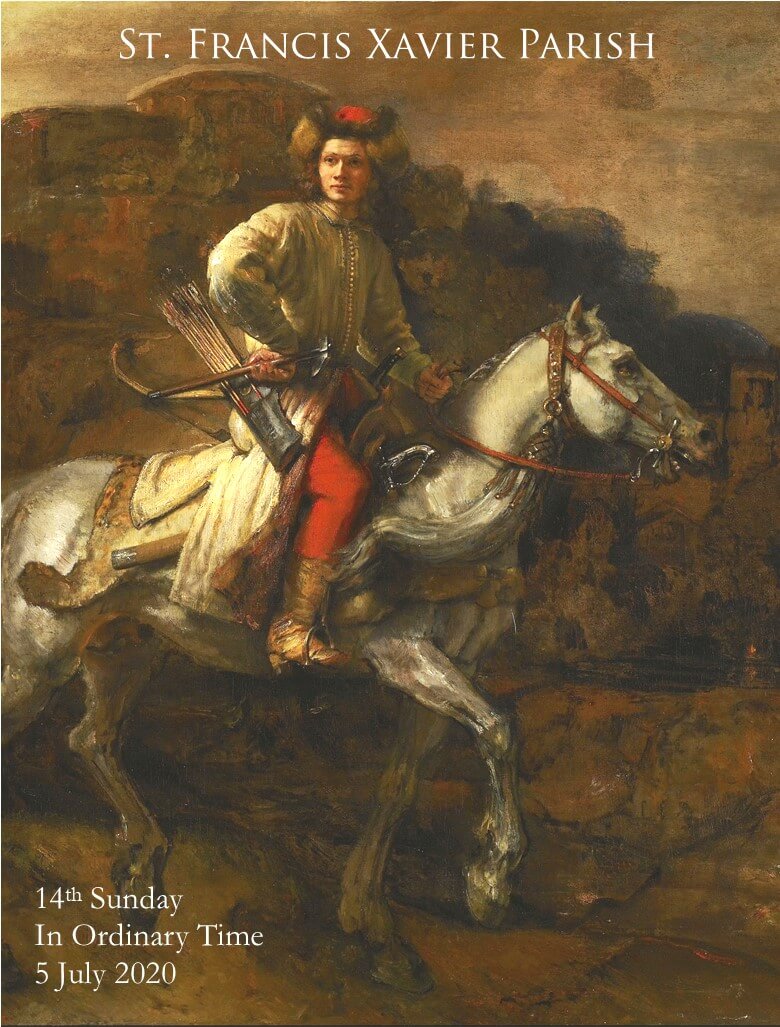
We place on our bulletin cover for this 14th Sunday in Ordinary Time a masterful work attributed to the Dutch artist Rembrandt entitled The Polish Rider (1655). We say “attributed” because no one knows for sure, although it is most likely the work of Rembrandt’s brush and not that of one of his students as some have surmised.
This is an intriguing work for reasons more than the mystery of its origin. It is classical and Christian in temperament for depicting one so ready to do battle for the truth yet so restrained by the prospect of peace. The expression on the face of this rider is timeless for its vigilance and intrepidness. His posture on his horse accompanied by his forward perception indicate that he is riding side to side as a guardian and not forward as an aggressor. Even the way he holds his battle pick with his right hand settled on his hip indicates that he is willing to await an answer from his enemy. His horse is as stalwart as he, undisturbed by any threat, displaying symbolically the interior peace of his master. This young nobleman bears pick, bow, knife and sword and rides not humbly upon the colt of the Messiah (Mt 21:6-9) yet he would as soon lay down his arms for Christ since he knows well the words of the psalmist: “[God] takes no delight in the strength of horses, no pleasure in the runners stride. Rather the Lord takes pleasure in those who fear him, those who put their hope in his mercy” (Ps 147:10-11).
-Steve Guillotte, Director of Pastoral Services
by SFXparish | Jun 25, 2020 | BLOG
So she said to her husband, “I know that Elisha is a holy man of God. Since he visits us often, let us arrange a little room on the roof and furnish it for him… Sometime later Elisha arrived and stayed in the room overnight. (2 Kg 4:9-11)
For those of us who remember when Steven Booth first arrived at the parish as a young man seeking counsel about the call to the priesthood… this is a glorious time! Steven Booth was ordained “Father Steven Booth” on June 13th 2020, the memorial of St. Anthony of Padua.
In the rite of ordination the bishop asked the director of vocations if Steven was deemed “worthy” to enter the priesthood. It was affirmed that this was the case. To be deemed worthy to be a priest is no small matter. God is the first one to do the deeming. This is because God is the only one who can do the redeeming. However, we the parish church also play a part in assuring the worthiness of the priest candidate. We accomplish this through our close association with the candidate over many years determining if he understands and believes the teachings of the Church, has a heart of charity, and draws ever closer to the image of Christ through prayer and study. Those deemed worthy should be graciously received into the priesthood. Those deemed unworthy; those who are a danger to the flock in any way should be escorted out of the seminary.
In our gospel quotation above, Elisha the holy man was cared for by “a woman of influence” (2 Kg 4:8). Elisha would dine with her when he was passing by her home. The woman even asked her husband to make a simple shelter for Elisha. This Shunammite woman deemed a spiritual worthiness in Elisha and desired to be in his company. She offered him material support for he had given up house and home and property and goods to follow the Lord. Yet she did not give him too much too often lest she tempt him with worldliness. In the gospel today, Jesus also does not speak of treating those that follow the Lord with an overabundance. A “cup of cold water” is all that is necessary (Mt 10:42). This meager gift may not seem much however Jesus uses this image not only to speak about the one who gives but also about the one who receives, for “the little one” of God should seek only to be refreshed and never to be exalted (Mt 23:12).
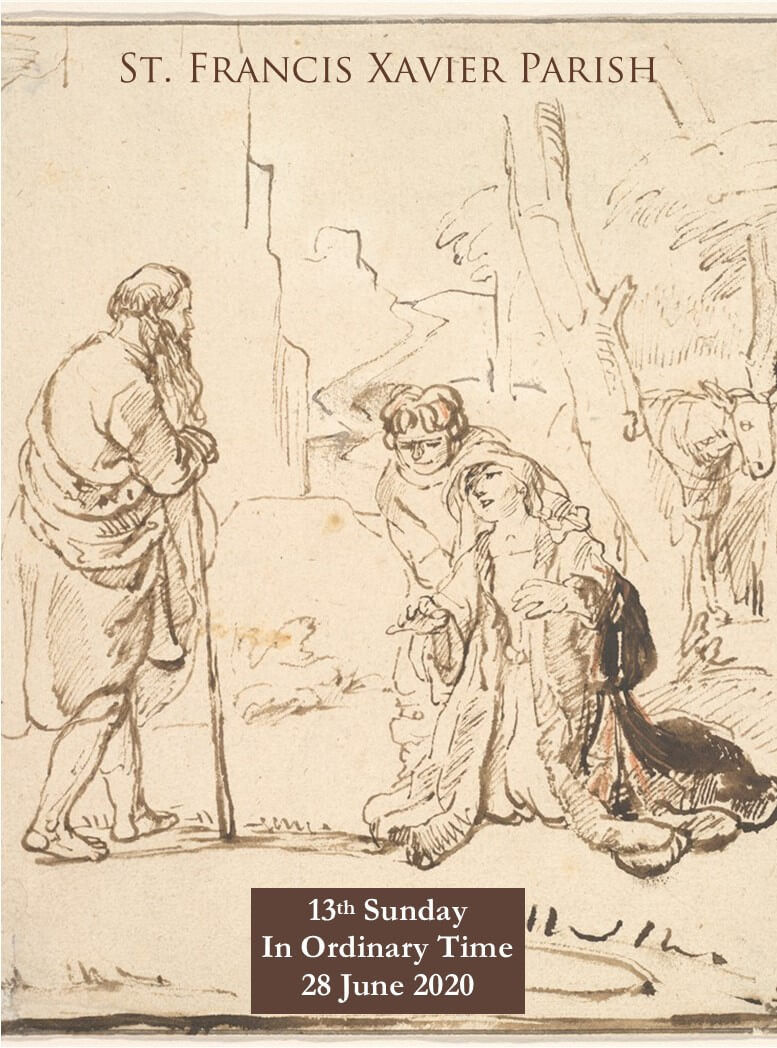
For this 13th Sunday in Ordinary Time we place on our bulletin cover a drawing of brown ink on paper by the Dutch artist Samuel van Hoogstraten entitled Elisha and the Shunammite Woman (1650 –courtesy Harvard Art Museum). Hoogstraten received his early training in the school of Rembrandt and he became a skilled painter of the Dutch Golden Age. The work we use today may not be a magnificent work, yet it is a lovely drawing of the meeting of Elisha with the woman guided by Elisha’s aide, Gehazi.
What event does this image depict. Is it the first meeting of the lady and the prophet? Is it when Elisha offers her a gift? Is it when Elisha tells her she will bear a son? Or is it just after Elisha raises her child from the dead? We cannot say for sure. What we can say exactly is that the image portrays the devoted association of lady and prophet. She honors him for his service and office, while he places his staff of office at her service. Their pious and proper affection is deemed worthy of each other, and of God.
-Steve Guillotte, Director of Pastoral Services