by SFXparish | Sep 10, 2020 | BLOG
Wrath and anger are hateful things, yet the sinner hugs them tight. The vengeful will suffer the LORD’s vengeance, for he remembers their sins in detail. (Sir 27:30 – 28:1)
Vengeance in the human heart is the angry portion of justice. Vengeance, or the infliction of punishment upon one who has done moral wrong, is not a bad thing in itself as it is certainly a part of justice. The only thing is – vengeance belongs entirely to God (Dt 32:35).
God gives the law to man to temper his desire for vengeance and because he wants man to exercise his power of reason in his relations. Law is always meant to be an “ordinance of reason” so that it will be “blind” to emotion and to ensure that the punishment of the guilty will be based on uprightness and not on anger, pride, envy, etc.
If vengeance belongs to God alone (in the sense that God’s anger is always perfect and justifiable) then we should avoid acting like it falls to us to dispense it. We should avoid seeking revenge, which is the term we use for describing man’s emotional pursuit of personal justice. In the act of revenge, one person (or a group of persons) takes it upon themselves, outside Church and State law, to inflict injury (physical or otherwise) on the offending (or apparently offending) party. Once the vengeful person or group has abandoned the law to act outside it, all kinds of dangerous things can be marshaled up along with injuries that perpetuate on both sides leading to individual and factional feuds. When this occurs there needs be called into play a legitimate authority to restore the law and to remind the individuals or factions involved to respect the rule of law and its enforcement.
In today’s first reading we reflect on revenge as a spiritual matter. We read that God sees wrath and anger in his children as hateful things and he wants to separate his beloved from these vices utterly. Man is also warned that when vengeance becomes an intentional activity which deliberately ignores the counsel and justice of God, it is a very grave sin that God remembers in his divine judgment.
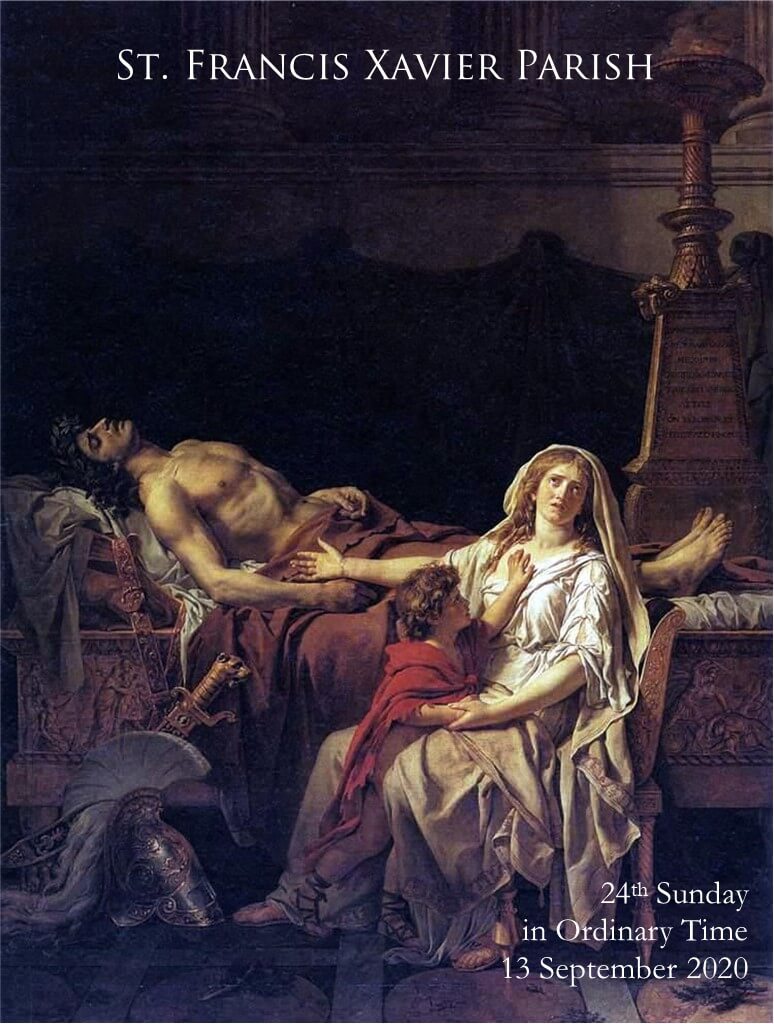
For this 24th Sunday in Ordinary Time we place on our bulletin cover a work by Jacques-Louise David entitled The Pain of Andromache (1783 – From Wikiart). David was a Neoclassical artist and portraiture painter in the decades before the French Revolution after which he was given by Robespierre full control of the arts in the French Republic. As we know from reading about that radical revolution, the “Republic” specialized heinously in the art of revenge.
Our bulletin image captures the sad effect of revenge. Prince Hector lies dead on his bed after being killed in combat by Achilles, vengeful for the death of his friend Patroclus. The gods restored Hector’s corpse which had been dragged over the beach of Troy by Achilles. Hector thus died not in war, but in single combat over revenge. We see Hector’s wife Andromache lamenting and praying over her loss and her son Astyanax lamenting over her lamentation. This succession of suffering is indicated by the interweaving of arms which begins with Hector’s lifeless right arm continuing to his wife’s right arm, through her body to her son’s right arm and finally through the boy’s left arm to his mother’s breast.
Vengeance itself results in a succession of injury and suffering. Thus the need to forgive “seventy-seven times” if one is to truly imitate God (Mt 18:22).
-Steve Guillotte, Director of Pastoral Services
by SFXparish | Sep 3, 2020 | BLOG
Thus says the LORD: You, son of man, I have appointed watchman for the house of Israel; when you hear me say anything, you shall warn them for me. (Ez 33:7)
The Church offers “vigil” Mass because of the many duties and complications the modern world has imposed upon Sunday especially the requirement of work. Still, there was a time when the vigil was not the celebration itself, but the liturgical preparation with accompanying prayers and fasting for the celebration to follow the next day. The vigil was once the expectation; it was not the culmination.
In any case it is vital that the Church recapture the practice of keeping vigil especially in our trying times. The term “vigil” is of course closely related to its first cousin: vigilance. To be vigilant means to be “watchful”. This is why the vigil rite was once only preparative to the main celebration asking us to wait upon the Lord with alert anticipation like an eager child waits for Christmas morn.
Toward our culture we have not been vigilant. Over the long watch of decades or even centuries we have not kept vigil over the increasing secularization of daily life. Perhaps if Christians had peacefully but firmly refused the requirement to work on Sunday, we would not be so reliant now upon the vigil Mass, while certainly we would have shown our state authority that while we respect its administration of the work day, we reject its incursion on the Lord’s Day.
Yet, Catholics and other Christians are a compliant lot. We have been taught to respect authority and not to disobey unless in the case of great moral failing. The problem is that when great moral failing finally arrives it finds us comfortable and sleepy, unable to be roused to address injustices against religious liberty. Christians are not “of-the-world” hence we are the antithesis of the Marxist protestor who in succumbing to be reduced to an economic and political unit claims the world as his own. Yet, while the world may not be our destiny, Christians are still the stewards of the world for the Creator, still defenders of what is rightly God’s.
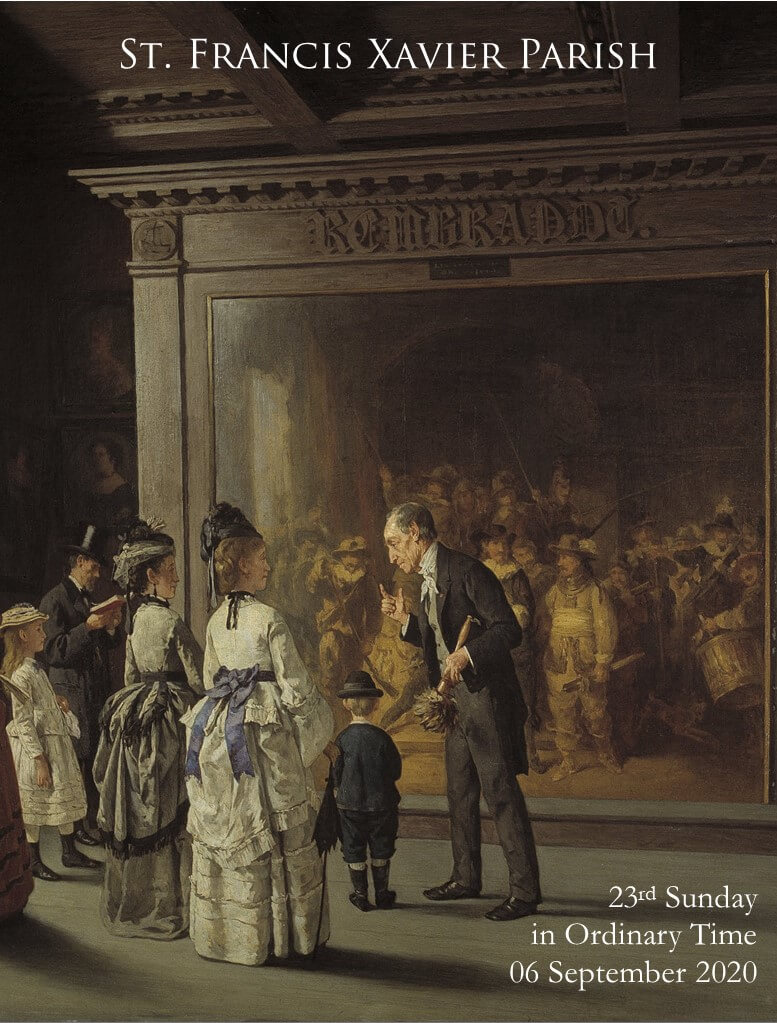
For this 23rd Sunday in Ordinary Time, we place on our bulletin cover a work by Swedish painter August Jernberg entitled Night Watch (1885). Jernberg was an academic painter and practitioner of the Dusseldorf School which put forward genre and allegorical works. The Night Watch of Jernberg was itself an allegorical work which incorporated the original Night Watch of Rembrandt as the basis of its symbolic message.
Here we see visitors to Trippenhuis, the Netherlandish academy of arts, which houses the original Night Watch of Rembrandt situated on the large wall in Jernberg’s image. In this painting a militia captain and his civic guardsmen set out into the city to keep civil order. The ladies and gentleman standing near the painting represent society’s attachment to the comfort provided by this order. Only the young boy standing completely still facing the wall is thoroughly engrossed by the painting within the painting. It is as if he sees the inevitable discord that arises when pleasure replaces virtue as the culture’s primary motivation.
We are the Church Militant. We watch against sin and temptation and the injustice it incurs and we warn the world against these. The world may not listen, but this does not mean that we abandon our post. We keep up the watching and the warning for all those who will listen.
-Steve Guillotte, Director of Pastoral Services
by SFXparish | Aug 27, 2020 | BLOG
I say to myself, I will not mention him, I will speak in his name no more. But then it becomes like fire burning in my heart, imprisoned in my bones; I grow weary holding it in, I cannot endure it. (Jer 20:9)
Someone I once knew faulted me for being “addicted to religion”. This person was disturbed at how my belief in heaven colored all that I saw on earth. Interestingly, if I had spoken all day in support of liberal progressive subjects and of nothing else, this person would have judged me to be a concerned and vital citizen, but because I spoke often about God, it seemed that I required time in a rehab clinic.
Addictions never turn out well. The inordinate desire and extreme consumption of any apparent good as the one and only good always ends in unhappiness. This goes not only for those substances we consume but also for those social experiments that consume us: feminism, socialism, communism, and our new oligarchic capitalism, to name a few. True, religion too can be addictive if practiced as extremism. However, in my own humble assessment, those of us “religionists” who believe that killing a child in the womb is wrong, that hospice care is far superior to suicide, that marriage is a union of the male and female founded in nature, and that it should be legally permissible (and always advisable) for a man to enter into counseling if he thinks he is a woman, are not practicing extremism, but exercising right reason.
Now the interior suffering that the prophet Jeremiah speaks of in today’s scriptural passage (above) is not the woe of an excessive craving, but the holding back of divine adoration. The soul of Jeremiah is so united with the spirit of his creator that he cannot but speak of him. Even though Jeremiah faces pain and mistreatment when he speaks out the Lord’s word, he sees it as an even greater violence to himself when he keeps it in! This is not an addiction. This is a devotion.
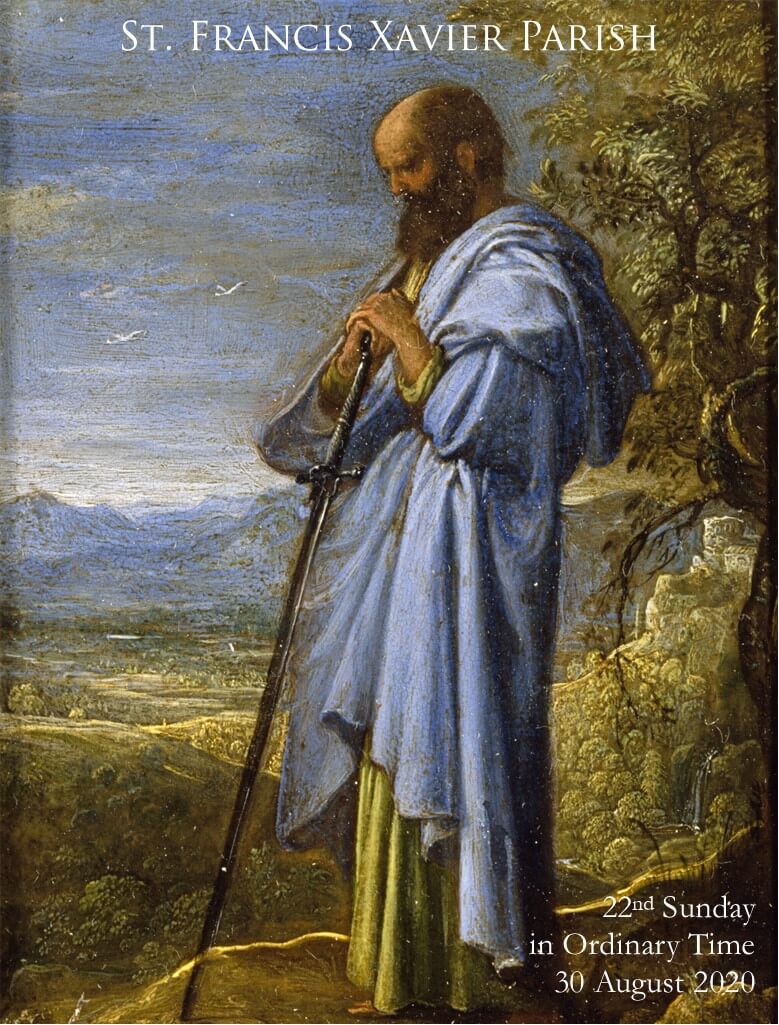
For this 22nd Sunday in Ordinary time, we place on our bulletin cover a painting by the Baroque master Adam Elsheimer entitled St. Paul (Wikiart-1605). Elsheimer was a German painter who made his way to Rome absorbing its methods and adapting these to his German training. He eventually converted from Lutheranism to Catholicism. His style was influential on the Germanic (Dutch) traditions of Rembrandt and Rubens, the latter with whom he became friends.
Even though this image is of St. Paul, it is reminiscent of Jeremiah and of all who feel exiled for speaking their faith. Here Paul stands head bowed leaning on a sword, not for doing battle, unless one means battle for the Gospel of Jesus Christ. Paul is painted here in a lovely pastoral scene and the image is meant to emote in us a sense of peace for having spoken out on behalf of God, his commandments, and his virtues. Paul’s clothing even takes on the color of the landscape which not only makes for a beautiful synchronized image but bespeaks the universality of Paul’s mission, “I have become all things to all, to save at least some” (1 Cor 9:22).
Lastly, Elsheimer places Paul upon the heights as one who has risen above the world through the knowledge of God. Paul must descend into the world, and we who know what Paul knows must follow him, burning interiorly and helplessly to speak the Good News.
-Steve Guillotte, Director of Pastoral Services
by SFXparish | Aug 20, 2020 | BLOG
And so I say to you, you are Peter, and upon this rock I will build my church, and the gates of the netherworld shall not prevail against it. (Mt 16:18)
Gates generally don’t prevail; at least they don’t in any kind of military offensive. Armies don’t move about in great mobile enclosures with gates that open and close gobbling up their enemies like a giant Pac Man. It is true that a strong and protected gate can add to a sturdy defense and hence may “prevail” against those trying to enter. However, it is difficult to see how “the gates of the netherworld” could think of prevailing against the Church of Christ in this way, since the Church is never eager to enter into hell.
If this be the case, then why does Jesus tell Peter that the gates of hell will not prevail against the Church? A gate’s primary duty is to maintain the coming-and-going in and out of the enclosure of which it is a part. Gates are generally kept closed to discourage entrance, yet opened as a sign of welcome. Gates are only as large as they need to be to let in only those things, the sizes of which are not too large for keeping out. Otherwise they are stationary devices that don’t make it their business to go about prevailing over other things.
However, considering our quote above from Sacred Scripture it is what stands behind the gate that most wants to prevail over the Church. The netherworld, the spiritual domain of the devil and his minions, ever desires to widen its enclosure with fallen souls. It expands through temptation and sin and broadens its reach and territory attempting to park its gate as close as it can to the Church. Yet, while evil may enter the Church through sinful priests, religious, and laity, the netherworld itself can never prevail against the Church because it cannot prevail against Jesus who has already vanquished its greatest weapon – eternal death.
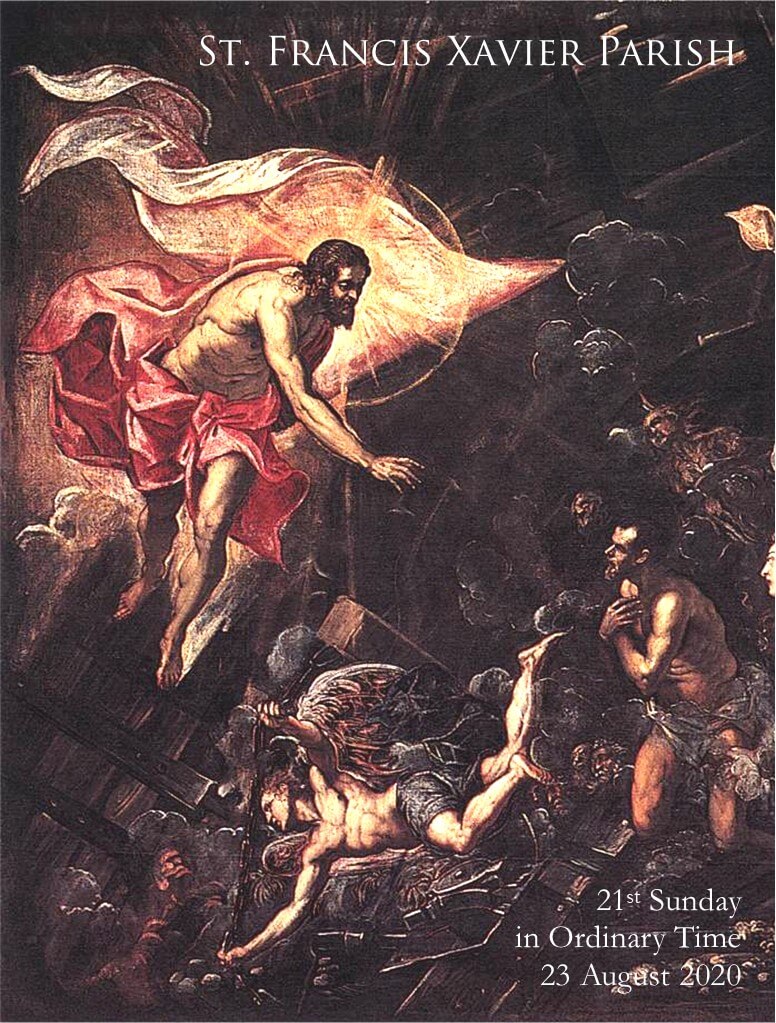
On this 21st Sunday in Ordinary Time we place on our bulletin cover a detail of a Mannerist painting by the great Venetian master Tintoretto entitled, The Descent into Hell (1568). Tintoretto “broke through the gates” of the High Renaissance freeing Italian art from its classical restraint allowing for a more active and dramatic representation of the actions of Jesus Christ.
Here we see Christ on Easter Saturday descending into Hades to free souls from an enduring death. Below the hovering Christ is the gate of the dark netherworld broken asunder so as to release all those who died since Adam. Each will receive divine judgement and hopefully the freedom of God. An angel below Jesus carries a chain he has taken off of one of the dead, perhaps even from Adam who had been desperately awaiting this day. Unseen in our painting fragment are many more people in shadowy form and one nude female of bright appearance who must certainly be Eve, now redeemed by Christ the new Adam (1 Cor 15:22).
Natural death still reigns today over man on earth as a healthy reminder of his mortality and need for God. Everlasting death in the netherworld is also still a likelihood for those who deliberately disregard God’s truth and his command of mercy. But the risen Jesus, the Easter Christ, is the great sign (Mt 16:4) that each and every human person may skirt the gates of hell if only he repents and believes in the Gospel (Mk 1:15) thence proceeding through the gates of heaven.
-Steve Guillotte, Director of Pastoral Services
by SFXparish | Aug 13, 2020 | BLOG
Thus says the LORD… The foreigners who join themselves to the LORD, ministering to him, loving the name of the LORD… will be acceptable on my altar, for my house shall be called a house of prayer for all peoples. (Is 56:1, 6-7)
You have probably read how the United States Representative from New York, Alexandria Ocasio-Cortez, recently denounced the statue of the missionary priest St. Damien of Molokai (which stands in the U.S. Capitol’s National Statuary Hall), as part of a “pattern” of “patriarchy” and “white [supremacy]”. This charge has been ably addressed by many such as Dr. Paul Kengor (Catholic World Report), Michael Warren Davis (Crisis Magazine) and Bishop Robert Barron of Word on Fire (who called Ms. Cortez’s comments “ridiculous”). We will not add here to their fair criticism.
Yet what was absent from these critical pieces was a constructive (and instructive) declaration about the mission of the Church which sadly even the Church has not made in response to Rep. Cortez. So here it is: The Church which has been sent out by Christ with a special commission to make disciples of all nations is not, nor ever will be, a vehicle for “colonization” but rather for evangelization and the salvation of souls. It is vital that we repeat this to all who want to claim or infer that the mission of the Church is, by its evangelical activity, racist, when it sets out earnestly to overcome paganism and false religion in various nations and cultures.
The unjust inference perpetrated by Rep. Cortez – that the very missionary work of Father Damien is supremacist and colonizing – is sad-to-say perpetrated even within the Church itself. For example, just before the 2019 Amazon Synod, Father Corrado Dalmonego of the Consolata missionaries serving in Amazonia made it a matter for boasting that his order has baptized no one in over five decades! What such churchmen do not realize is that while they sit pitifully self-satisfied in a place of “presence and dialogue” there is an ever-growing enemy which sees even their watered-down mission as nuisance and ideologue. In response to this hostility, Catholics need to boldly declare for the Great Commission of Our Lord even under threat of being called “racists”.
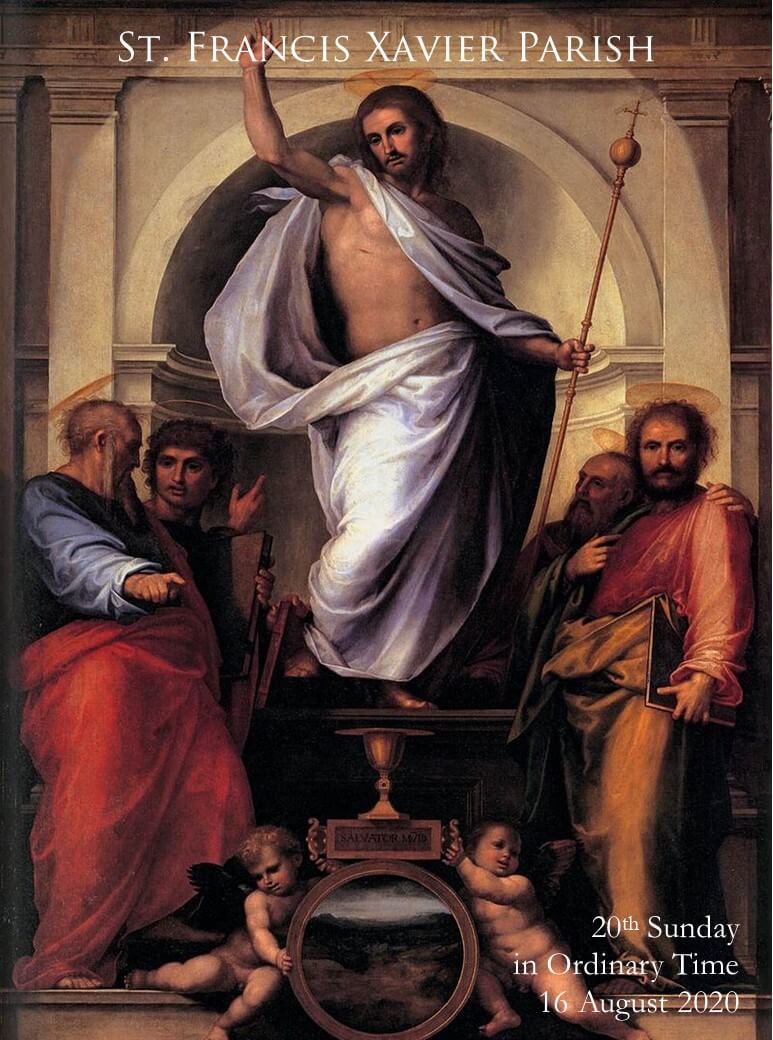
For this 20th Sunday in Ordinary Time we place on our bulletin cover a work by the High Renaissance master Fra Bartolomeo entitled Christ with the Four Evangelists (1516 – Wikiart). Bartolome was a Dominican Friar who resided mostly in Florence. He was friends with Raphael and each gained artistically from their association.
Here is the High Renaissance: classical architecture, idealized and precise human figures, flowing, clinging cloth and postures of virtuous purpose. St. John (the youngest shown) points to Jesus where all evangelization begins. The gospel writer standing near him points outward indicating the command to take Jesus out into the world. The two evangelists on our right embrace in a show of solidarity as the one in the forefront (right) looks forward as if to challenge us to profess Christ to others. Upholding this cause to bring all peoples into the Church is the chalice of the Blood of Christ, the Holy Eucharist, while the mirror below it reflects the world as a dry wilderness without the Good News of Jesus.
Let us never treat the word of God, the commission to make new disciples, and the teachings of the Church as an affront to race, and culture. They are the great hope of both.
-Steve Guillotte, Director of Pastoral Services
by SFXparish | Aug 6, 2020 | BLOG
At once Jesus spoke to them, “Take courage, it is I; do not be afraid.” Peter said to him in reply, “Lord, if it is you, command me to come to you on the water.” He said, “Come.” (Mt 14:27-20)
For the virtue of fortitude to arise in Christian hearts it must play out in two parts. First, we ought to come to firmly believe that God is present to us. Second, this belief should instill within us courage for acting boldly especially on God’s behalf.
If you have ever been in a situation where the primary reason you were not frightened was because you had someone with you who not only made you feel safe but actually provided for your safety, then you can grasp the spiritual sense of what it is like to have faith that God is present.
If you ever had to walk through a dark labyrinth but became separated from your trustworthy companion and received no response after calling out to him for hours, would you not “take courage” after suddenly hearing his voice exclaim, “It is I, do not be afraid”. This is the kind of interior assurance we seek to have in the spiritual life when we walk with God through the mazes of our life. Yet this is only the first part of Christian fortitude.
If upon hearing the voice of your reliable companion, fear of your situation still grips and paralyzes you from moving towards him, then you may not benefit from the voice of your friend calling you. It is the same in the spiritual life. Belief that is not transformed into courage makes you stay put. This prevents you from following God’s commands in a perilous world. Sadly, you may even convince yourself that you are just fine staying put, so that you even risk losing your belief.
In the spiritual life it is imperative that we act like Peter and demand that God command us. We must of course also be like Peter in being ready to act on God’s command. However, as we see in today’s gospel reading, even if our courage is not perfect and we falter, Jesus is there to pull us up. Still, in the life of faith we must be willing to jump out of the security of our earthly vessels into the arms of God if spiritual courage is to be fruitful.
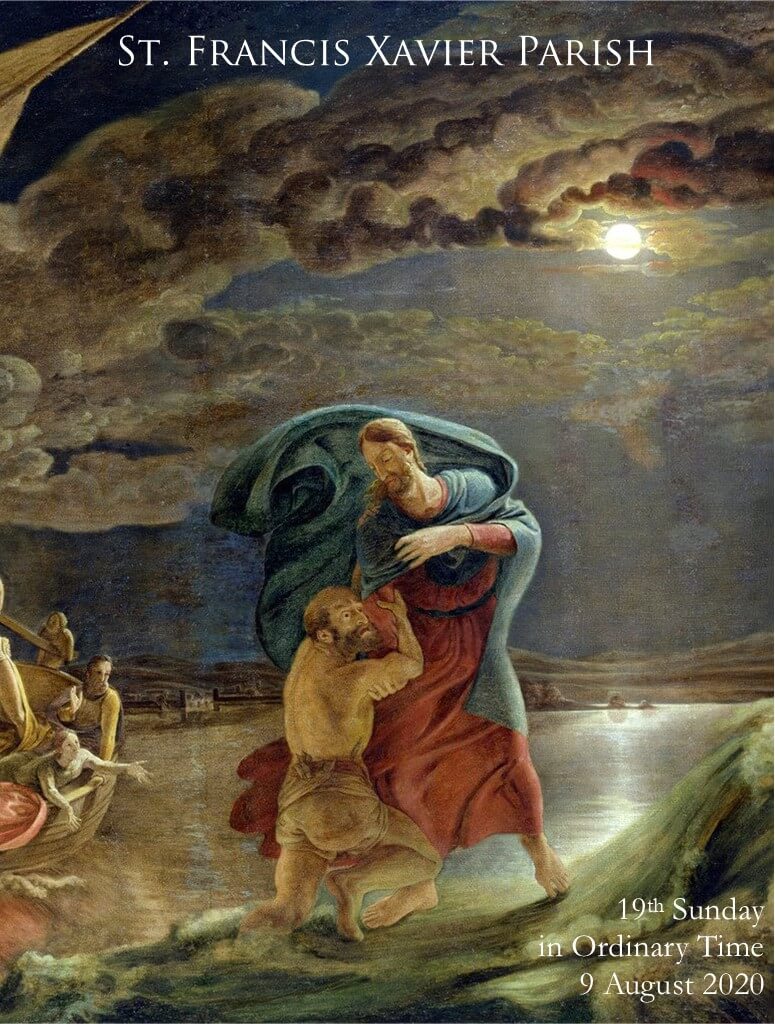
For this 19th Sunday in Ordinary Time, we place on our parish bulletin cover a detail from a work by the German Romantic artist, Phillip Otto Runge entitled Peter Walks on Water (1806). Runge’s Romanticism veered from romantic naturalism to esotericism and hence to a personal theology which caused Runge to collide with the leaders of his Protestant faith.
In our image we see Peter and Jesus riding a wave on the Sea of Galilee under an ominous moonlit sky, the light of which draws our eyes downward toward these two figures. Christ’s cape forms the shape of a turbulent wave indicating his divine authority over nature. Those in the boat (mostly unseen) show the same apprehension as Peter whose fear overcomes his faith indicated by his left leg sinking into the sea. Peter’s eyes are on the natural surroundings not where they should be – on the supernatural Jesus. Jesus for his part is thoroughly engaged in saving Peter, symbolic of his desire to save all humanity.
Let us believe through grace that Jesus is always present, and let us take courage in His presence.
-Steve Guillotte, Director of Pastoral Services