by SFXparish | Mar 14, 2019 | BLOG
The Lord God took Abram outside and said, “Look up at the sky and count the stars, if you can. Just so,” he added, “shall your descendants be.” Abram put his faith in the LORD, who credited it to him as an act of righteousness. (Gn: 15:5-6)
When God spoke with Abram and promised him a great reward, Abram responded that a reward or gift would be pointless since he had no children on whom to bestow it; and Abram was already aged. God responded that the gift he would give to Abram was in fact an abundance of children down to many generations. Abram (eventually named Abraham by God) thus becomes (through his wife Sarah) the father of Isaac, who becomes the father of Jacob, who becomes the father of the nation of Israel. But this is not all that God intended.\
St. Paul elucidates God’s promise to Abraham not in terms of offspring, but in terms of faith. He recalls God’s other promise to Abraham – to make him the “father of many nations” (Gn 17:5) which at the time the promise was sealed was the exact moment God first called the once pagan Abram, “Abraham”. Paul explains that Abraham becomes a father through faith (Rom 4:16) and thus the “father of us all” who come to God through faith. The essential promise that God made to Abraham was to create the Church: the People of God, through Abraham’s example of faith.
We might wonder why God did not become angry with Abraham when he questioned the efficacy of God’s gift. It is because it was an entirely unselfish inquiry. A “reward” appeared meaningless to Abraham without its perpetuity; without it being able to be shared with those who would come after him. Abraham could have bequeathed God’s gift to those outside his family – to a servant not of his household (Gn 15:2) – but symbolically and mystically this gift would not have led to the spiritual household God intended: the household of the faithful which would adhere to the commands and love of the Son of God (Rom 4:24).
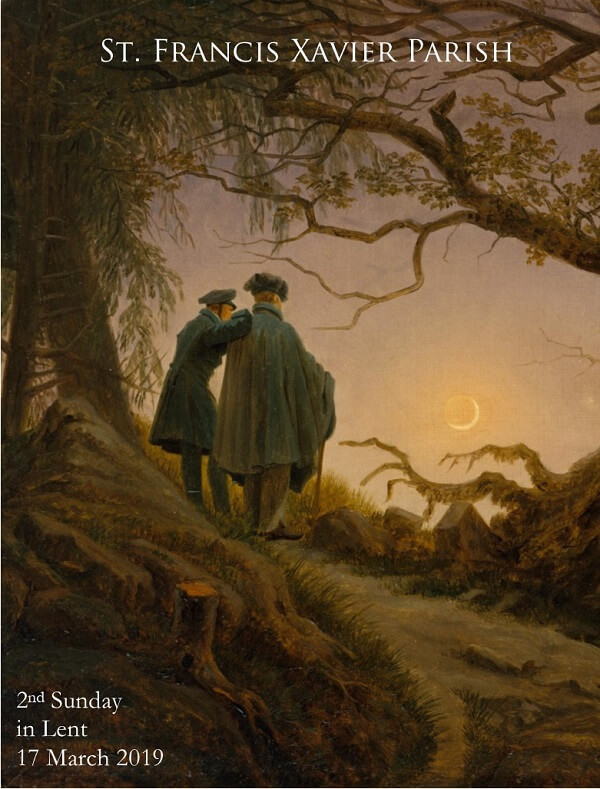
In order to commemorate the meeting between God and Abram, we place on our bulletin cover for this 2nd Sunday in Lent a painting by the German landscape painter Caspar David Friedrich, entitled Two Men Contemplating the Moonlight (1830). Friedrich painted in the Romantic style which reacted against the classical method. The Romantics believed the classical style to be too preoccupied with convention which could not properly and profoundly allow man’s free reflection upon nature. We, however, use this piece by Friedrich to create a visual allegory, not for a scrutiny of the natural, but of the supernatural: the spiritual contemplation of that intimate covenantal moment between God and Abraham.
Here God is represented in angelic dialogue as he leans slightly bent upon Abram’s shoulder. He is bent to show that God is of-old and wise beyond all ages; even his creation, the trees and rocks, bend in honor of his eternal presence. Abram however is represented rather straight and still as one held back in stasis until the future of faith comes to life fully in the Holy Spirit. God shows Abraham his future – which is us: we who believe in Jesus Christ.
-Steve Guillotte, Director of Pastoral Services
by SFXparish | Mar 7, 2019 | BLOG
“If you are the Son of God, throw yourself down from here… Jesus said to him in reply, “It also says, You shall not put the Lord, your God, to the test.” (Lk: 4:9;12)
If you are a parent, then it is very likely you have had recourse to the phrase, “You are testing my patience”. It is very unlikely though that you ever said, either as a parent or otherwise, “You are testing my humanity”. This is unfortunate because our human nature is tested regularly by our present culture to become less human. We are tested over life in the womb, gender in the body, sex outside of marriage, and the practice of religion in society. We are asked to “choose” about intrinsic values which in nature invite little or no choice. In effect, our humanity is tested by a rebellious power each and every time we are challenged to give up our inherent human freedom for a licentious inhuman freedom.
No doubt God could be heard (if we listen close enough in prayer) saying often to us, “You are testing my patience”. We are most fortunate that God is patient; patient with a purpose. For as St. Peter tells us: “The Lord does not delay his promise, as some regard “delay,” but he is patient with you, not wishing that any should perish but that all should come to repentance” (2 Pt 3:9). God knows that we will test his patience, and he is forbearing so that we will come to be sorry for our sins – sorry that we have tested his patience.
The devil is another matter altogether. Long ago God’s patience ran out with the devil (Is 14:12) who being of the angelic order has a will most deliberate and fixed. Lucifer was never satisfied just to test God’s patience. He set out to test God’s divinity. We see this in today’s gospel reading where he challenges Jesus to throw himself from the parapet of the Temple so that God the Father might have to act to save Him. He wanted Jesus to test God as God, and thus to tear at the very fabric of divine trust within the Holy Trinity. However, Jesus would not test the Lord God, His beloved Father.
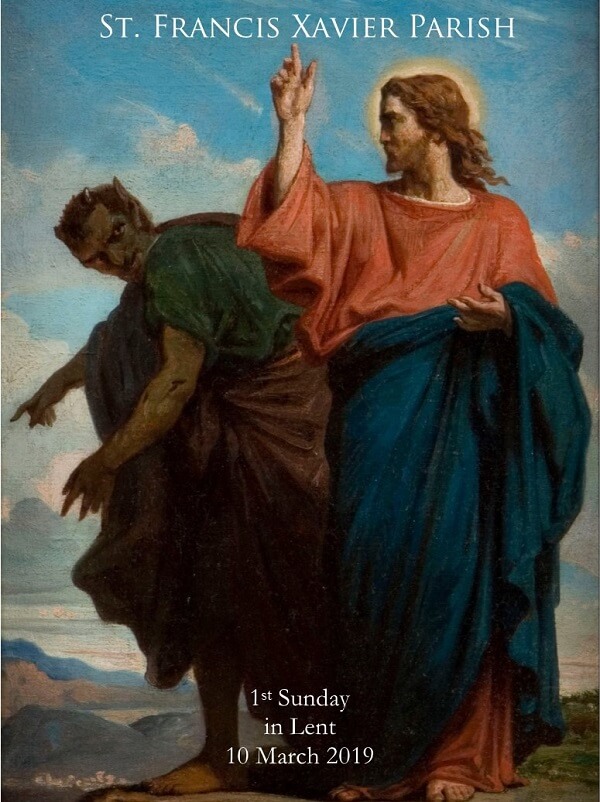
In order to encapsulate this event, we have placed on our bulletin cover for this 1st Sunday in Lent a painting by the French Academist, Felix Joseph Barrias entitled, The Temptation of Christ by the Devil (1860). Barrias was a historical classicist who also painted ancient religious scenes in the classical style. In this oil on canvas Jesus is actually on the mountain top in the moment of being tempted by the devil to take rule over the world (Lk 4:6). Yet we can also surmise here Satan inviting Christ to throw himself downward so that His Father’s angelic host would lift him up and carry him to safety (Lk 4:10-11). Jesus instead points upward indicating that He is always obedient to his Father’s will and that the rule of His kingdom is in heaven.
Barrias paints the devil in all his disfigurement; for when the devil challenged God’s divinity he forfeited the angelic beauty graced to him by the Lord (Gn 3:1). In defying the mastery of God, the devil sought self-mastery. All he gained was self-defacement, as do his followers today.
-Steve Guillotte, Director of Pastoral Services
by SFXparish | Feb 28, 2019 | BLOG
Jesus told his disciples a parable, “Can a blind person guide a blind person? Will not both fall into a pit? (Lk: 6:42)
We begin our reflection on this Sunday’s gospel reading with a rhetorical question. In it Jesus is being obvious that one who cannot see certainly cannot guide another who needs guiding. In order to comprehend the full sense of this scriptural passage, we must always recall that the parables of Jesus have a deeper spiritual meaning.
On a few occasions Jesus called the Pharisees “blind guides” chastising them for neglecting major virtues and institutions while being preoccupied with lesser religious traditions. Jesus chides them for placing too heavy an emphasis on external piety while giving insufficient attention to interior devotion (Mt 15:14 & Mt 23:24, 26).
For Jesus, the kingdom of heaven is within (Lk 17:21). This does not mean that Jesus spoke against liturgy; quite the opposite! He wanted to elevate the temple (Mt 23:17), revere the altar (Mt 23:18), and honor the sacrifice on the altar (Mt 5:24) by inspiring a proper disposition toward all three. Yet, he rightly regarded as serious the temptation toward pride in the outward practice of religion and the self-satisfaction of personal piety (Mt 23:5-7). Instead, the true practice of religion – imitation of Christ in both charity and worship – is its own reward; it should never result in special privilege for any Christian.
Jesus teaches that the eye is either the window to purity or to sinfulness (Mt 6:22-23) and there are many reasons a person may suffer spiritual blindness. There is also what some call the “mind’s eye” or the imagination where one can fall under the practice of idolatry by raising up something or some person to a greater place than it or that person rightly deserves. Pride, anger, lust, envy, gluttony, avarice & sloth, the Seven Deadly Sins, are no less deadly today for infecting the eye or intellect of the human soul.
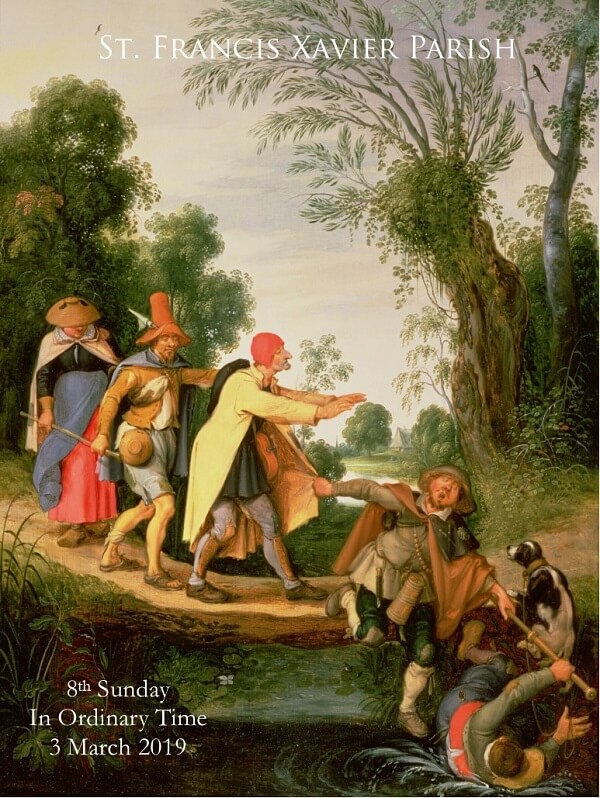
In order to assist us in our reflection for this 8th Sunday in Ordinary Time , we place on our bulletin cover a work by 17th century Flemish Baroque artist Sebastian Vrancx, entitled The Parable of the Blind. Vrancx was the primary innovator of military battle painting in the Netherlands. His particular ability of filling landscapes with small but very active figures (as with his predecessor, Pieter Bruegel) allowed for his achievement. Vrancx was also contemporary with Peter Paul Rubens and also a Counter Reformation artist. Vrancx once painted a Crossing of the Red Sea in which the pharaoh’s men were Protestants and Turks drowned in their hot pursuit of the Church.
The men depicted in our bulletin image, however, cannot even cross a stream. This somewhat, comic parable has a deeper spiritual meaning in that it shows a major point about human history especially in our own culture: that those without the guidance of God will rely instead upon each other’s worldliness on a journey that leads them ever downward on a diagonal path toward Hell.
Of the figures in our painting: some hold on; some reach out; some leap forward! Yet all our “blind” and will fall down without the guidance of Word and Sacrament.
–Steve Guillotte, Director of Pastoral Services
by SFXparish | Feb 22, 2019 | BLOG
Abishai whispered to David: “God has delivered your enemy into your grasp this day… But David said to Abishai, “Do not harm him, for who can lay hands on the LORD’s anointed and remain unpunished?” (1 Sam: 26:8-9)
In this Sunday’s gospel reading Jesus attaches a greater demand of love onto the commandment to love. He tells his disciples “love your enemies, do good to those who hate you” (Lk 6:27). From there he counsels that when struck by another we should “turn the other cheek” and when another takes what is ours we should not demand it back.
Respectively, each of these instructions goes counter to our human impulse to defend ourselves and our property. However it must be pointed out that these teachings of Jesus are not about pacifism or communism; Jesus is not concerned here with negating the natural human rights to self-protection and property. What Jesus is always concerned with is living life in imitation of His Father in heaven. This is why the conclusion of today’s lesson is that we, as His disciples, behave as “children of the Most High” who is “kind to the ungrateful and the wicked” (Lk 6:35). Jesus is asking us to forgo the human for the divine, because it is for the divine that we have been created (1 Jn 3:2).
To understand this we must recall that we were once enemies of God. Since Adam, man has abused the gifts of God; and if we have not cursed him, we have certainly forgotten him. We would still be enemies of God if not for the redemptive act of Jesus Christ, who ransomed himself for our salvation through the forgiveness of our sins (Lk 1:77). God offered us his love even when we set ourselves against him (Ps 2:2). Without overcomplicating today’s gospel reading, let us say that God is asking that we his children become like Him and offer our love to those who set themselves against us.
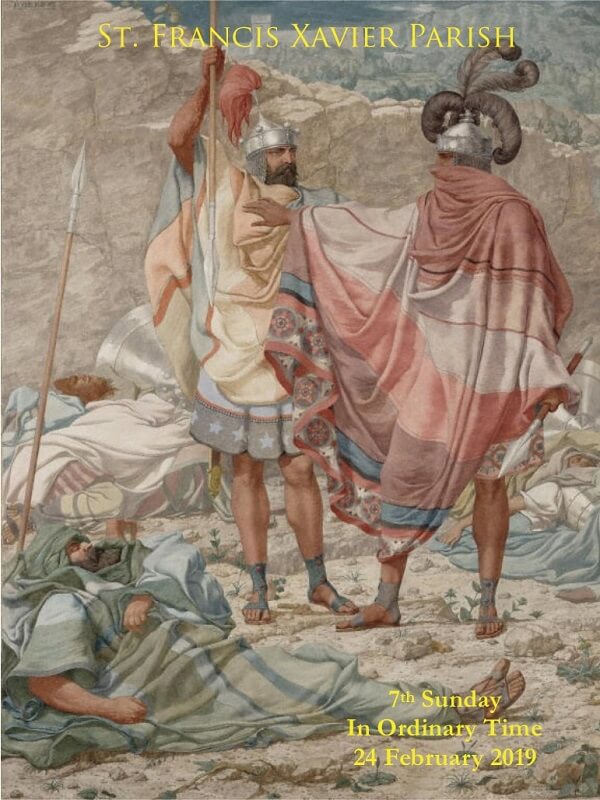
Reaching back into the Old Testament for an early example of clemency (and even love) toward an imposing enemy, we have placed on our bulletin cover for this 7th Sunday in Ordinary Time a painting by the Victorian era artist, Richard Dadd, entitled David Spareth Saul’s Life (1854). Dadd, a British Romantic painter, moved back and forth between genre and fantasy. The latter was sadly also Dadd’s reality, as much of his painting was produced in a London psychiatric hospital. Some of Dadd’s works may be compared to Hieronymus Bosch (d. 1516) for these scenes were filled with many strange figures in minutia, except perhaps in less awkward poses than in Bosch.
In our bulletin image we see King Saul sleeping on the foreground in his battle camp while David and his companion Abishai stand over Saul. Neither spear, nor shield, nor guard, nor even mountainside can protect Saul from being delivered into David’s hand as was the will of God. Yet we also see David putting out his right hand to prevent the lance thrust that would have pinned Saul’s corpse to the ground. David spares his enemy because his first duty is to God – to not destroy God’s anointed one. David would rather risk his enemy’s wrathful pursuit than pursue a course forbidden by God. He would rather suffer the pain of his enemy than the pain of becoming like his enemy.
–Steve Guillotte, Director of Pastoral Services
by SFXparish | Feb 14, 2019 | BLOG
Blessed is the one who trusts in the LORD, whose hope is the LORD. He is like a tree planted beside the waters that stretches out its roots to the stream (Jer 17:7-8).
There is no faith without grace. In chronological order, the process of human redemption goes this way: grace, faith and good works. One may certainly perform good works from one’s own human will, yet such natural works gain no merit before God unless they flow from the confluence of supernatural charity. One can also have natural faith: he or she can for example have faith in their neighbor, trust in their sports team, in their hairdresser, in their firemen, and in their military; but no one can come to trust in God unless he drinks first “from the stream by the wayside and therefore lifts up his head” (Ps 110:7). In fact, no one can even say “Jesus Christ is Lord” unless he sips from the abundant waters of grace (1 Jn 4:2-3 & 1 Cor 12:3).
In our first reading today, the prophet Jeremiah is making reference to the first psalm of David which contrasts the way of the wicked man with that of the good man, or rather with that of the graceful man. The graceful man is “blessed” as “he is like a tree planted by streams of water” (Ps 1:3). The leaves of this tree “never wither” while it is always prosperous and fruitful. The transpiration of its roots draws water from the fountain of life. The blessedness of this tree commences and remains through it having faith and hope in the Lord God.
In the second psalm (in the Book of Psalms) we are instructed as to what this tree symbolizes. It is Jesus, the “anointed one” (Ps 2:2), the Christ. It is he who comes into the world to stand in the streams of the Jordan, not so he can drain the physical “energy” of that river as some demi-god or superhero, but so that he may plant himself upon the earth as the renewed Tree of Life which drinks eternally from the Holy Spirit. It is from this tree that we (as branches) are fed and prosper unto everlasting salvation (Jn 15:4-6).
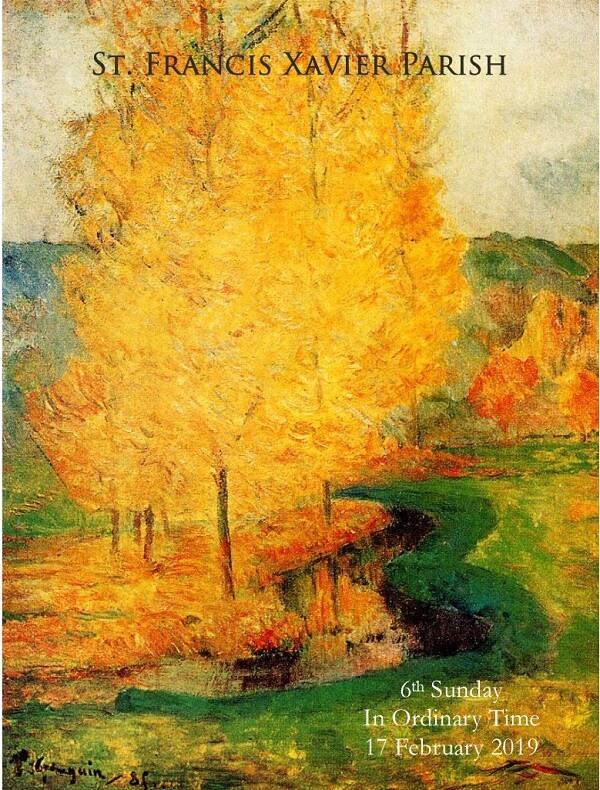
Just as the psalmist creates a symbol of grace with tree and stream, so do we on our bulletin cover for this 6th Sunday in Ordinary Time. The image we have chosen for this purpose is by the French Post-Impressionist Paul Gauguin, entitled By the Stream, Autumn (1885). Gaugin still paints here in the Impressionist style, but one can see in this earlier period in Paris how he already begins to experiment with the flattening of bright, bordered, and compartmentalized color. We still have light and the reflection of light as in Impressionism, but now it is a soaked up light so that even the reflection in the stream has become the color of the trees and field, synthesized as it were in the post-impressionist method.
Yet, we do not want to take our comparison of tree-and-stream with Christ-and-grace too far urging some Zen-like moment, and so be absorbed into a meditation upon nature itself. Our goal as Christians is not nature, but super-nature; always the movement of grace. This comes to us as a free gift of God to all who repent and believe in the gospel of Jesus Christ (Mk 1:15).
–Steve Guillotte, Director of Pastoral Services
by SFXparish | Feb 8, 2019 | BLOG
“Put out into deep water and lower your nets for a catch.” Simon said in reply, “Master, we have worked hard all night and have caught nothing, but at your command I will lower the nets.” (Lk 5:4-5)
The boats of Jewish fisherman on the Lake of Gennesaret were unlikely to be large vessels and so their nets for catching fish were much smaller than the nets of our modern fishing crafts. So when Jesus challenges Peter and his crew to go out “into deep water”, he was not sending Peter out to drag up fish from the bottom of the sea but to trust Him in a precarious situation, especially since fishing in deep water is not particularly safe or sound practice when one is already tired.
Jesus being the Word and Wisdom of God was playing out for Peter a parable in real life so that he would understand that his abundant catch of fish, through the power of Jesus, serves as an analogy of catching men through that same power. This power of God which we call grace is present to all disciples of Christ who seek to benefit from it. Grace is no “force” or “energy”, but the power of the Holy Spirit freely gifted to those who believe in Jesus Christ and his saving mission. All baptized Catholics are called to this mission to add to the great catch of souls that will fill the school of heaven.
The fish are very slippery these days and our nets unsure. As to the fish, they are much more difficult to catch than, say, were the pagans-of-old, many who before converting to the faith held strongly to belief in the natural law, trusting in: the exclusivity of marriage, the modesty of the body, the biology of two genders, the respect of elders, the esteem of tradition, and deference to moral authority. As to our nets, they need to be sturdier and more sound to receive and catch our contemporary zigzagging fish. Such fish cannot be caught by simply floating a “welcome” sign. They must be sought in faith, seized by truth, and secured in love.
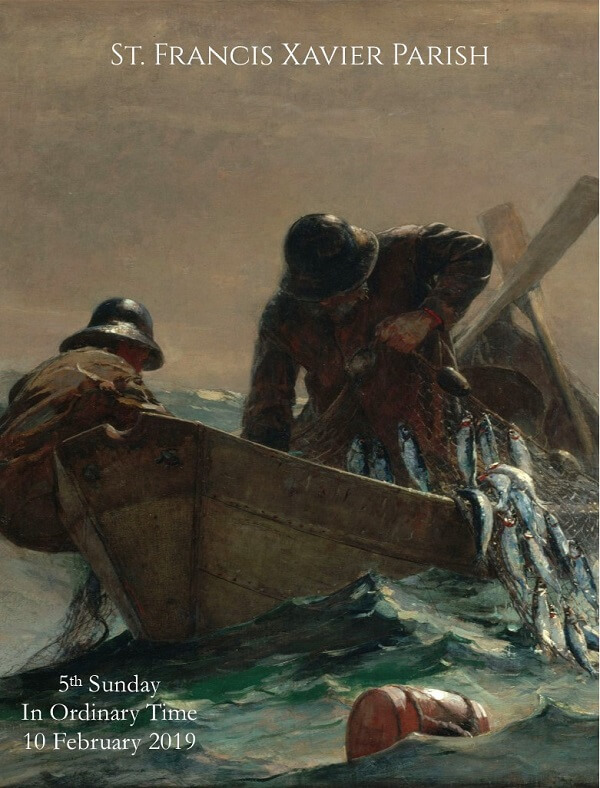
In order to put this vision to task we are using two images from American maritime painter Winslow Homer in this bulletin for this 5th Sunday in Ordinary Time. The first, Mending the Nets (1881), which is on page four, serves for us as an allegory that we need to set aside quiet time to reflect and even contemplate God’s will as we repair our Church and weave our approach to catching souls. The second, which adorns our bulletin cover, is entitled The Herring Net. This is what we do after we have rested and worshipped and been counseled by the Lord. It is indicated by robust action, the willingness to go out into the deep, and the fortitude to endure the dangerous waters amongst the raging waves that rock the boat of the world each and every day. This needed approach requires sharp spiritual senses, the resolution to drag the net over and over again, the steadiness of faith to not fall into sin or doubt, and the strong arms of Church teaching to carry home God’s capture. Let us pray and get to work.
–Steve Guillotte, Director of Pastoral Services