by SFXparish | Jun 17, 2020 | BLOG
“Jeremiah said: “I hear the whisperings of many: ‘Terror on every side! Denounce! Let us denounce him!’ All those who were my friends are on the watch for any misstep of mine. (Jer 20:10-13)
Do not we all feel like Jeremiah these days? Mention God and be denounced at work; defend a moral principle and be suspected by neighbors; question the full motivation of the latest cultural movement and be pummeled on social media. What is patently different in our situation from Jeremiah’s is that the enemies of God’s disciples no longer whisper. They bellow, they accuse, they threaten; they “cancel” you out and are proud of doing so!
In our time of many social movements, some peaceful and some brutal, Catholics should concern themselves with their own movement: the movement of the Holy Spirit. This is the authentic movement because it originates in God. It moved Peter to declare to those who would denounce him: “We must obey God rather than men” (Acts 5:29). As a catholic movement it is universal. Here is Peter again: “In truth I see that God show’s no partiality. Rather in every nation whoever fears him and acts uprightly is acceptable to him” (Acts 10:34-35). Acceptance in Christ is therefore based on reverence and virtue, not on education or economic status, not on nationality or race. Acceptance, however, does still relate to creed: to the Christian “credo” or “I believe” that Jesus Christ is the Son of the living God (Jn 3:16). It is God’s acceptance that we are meant to strive for, not the approval of (1 Thes 2:4) or the conformity with man (Rom 12:1-2) especially not post-modern man who lacks peace in his spirit while seeking power in his flesh.
Throughout history, man has been pressured and denounced into leaving the counsel of God. Many men and women once virtuous have been whittled down slowly but steadily into vice, first by the requirement of being tolerant, then by being open and accepting, and finally by coming to full agreement with what is evil in the sight of God. Confusion, doubt, and fear of denunciation and isolation have all weighed heavily on Christian souls, many who have altogether abandoned their justifying faith to gain justification from the prevailing culture.
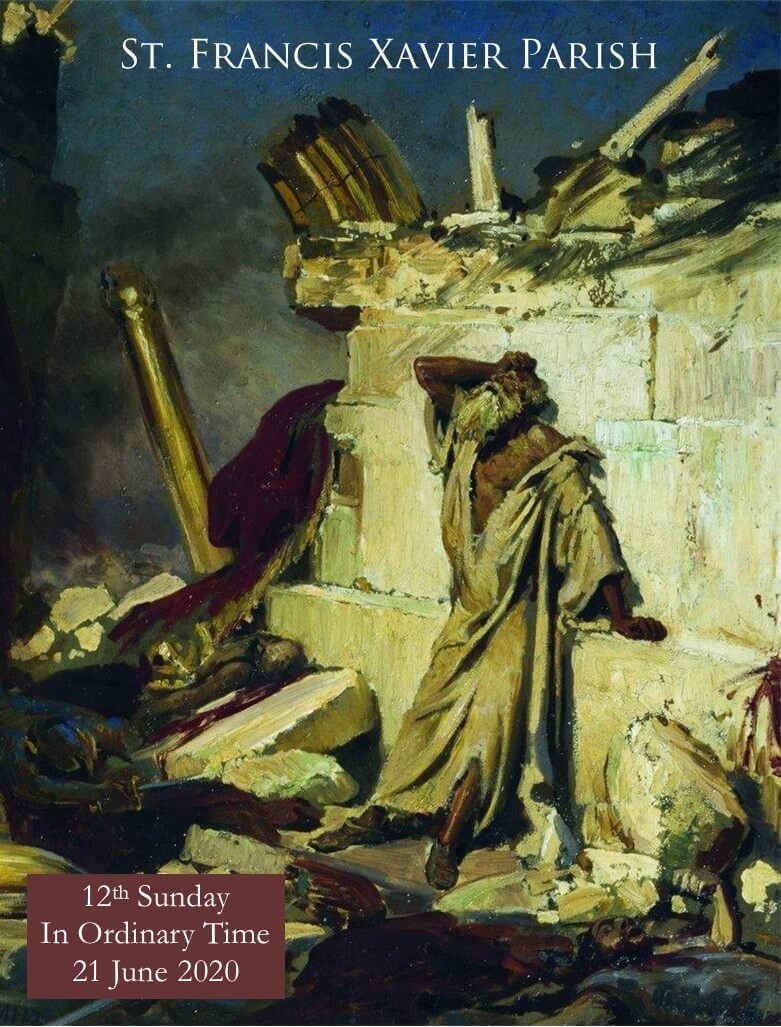
On this 12th Sunday of Ordinary Time, in a time that is certainly not ordinary, we place on our bulletin cover a work by the Russian realist Ilya Repin, entitled Cry of Jeremiah on the Ruins of Jerusalem (1870/Wikiart). This painting is utilized here to depict a spiritual rather than a historical reality. It represents the human soul confronting the dismantling of the divine law and the natural law. First comes the loss of beauty, truth, and goodness in the mind and heart of man, then this loss manifests itself in observable ways: the self-destruction of the soul and the annihilation of well-ordered society.
Here we see Jeremiah lamenting the loss of life as three bodies barely discernable from the wreckage lie bloody on the ground. Yet what is most telling in this image is the veil of the temple near the toppled golden pillar whose crimson folds appear as a waterfall of blood pouring out from the temple stones. This is the Church losing its lifeblood, its faith and its wisdom, by following a worldly way; a way that does not lead to joy and peace, but to frustration and destruction.
–Steve Guillotte, Director of Pastoral Services
by SFXparish | Jun 11, 2020 | BLOG
“I am the living bread that came down from heaven; whoever eats this bread will live forever; and the bread that I will give is my flesh for the life of the world.” (Jn 6:51)
Today is the solemn feast of Corpus Christi, or the Most Holy Body and Blood of Our Lord Jesus Christ. We ought to celebrate it with an especial glorification in appreciation of our communal homecoming to the sacrament of the Holy Eucharist after an absence of a few months. Hopefully this absence has magnified our devotion to this precious divine gift, a devotion which just a few months ago had been shown to be severely deficient.
As we recall, not long before the COVID-19 virus hit we were talking about recent polling showing that many Catholics no longer believe in the Real Presence of Jesus Christ in the Holy Eucharist. This was disturbing enough to prompt some bishops and priests to put forth letters and instructions that in Holy Communion we receive the Body, Blood, Soul, and Divinity of Jesus Christ. Then the virus hit. The pandemic gained the greatest attention in the Church while the theme of the Holy Eucharist was shelved again as Our Lord became unobtainable not due to any shortage of wheat.
On this feast day we do well to consider the proximity of two Eucharistic occurrences: first, statistical proof that faith in the Holy Eucharist has greatly diminished and second, that this same Holy Eucharist became inaccessible to the faithful.
Now when one occurrence follows upon another, this does not mean that one caused the other. We cannot say with certainty that God withdrew the Holy Eucharist from us as a consequence of our lack of communal faith. However, we cannot wholly discount this either. Nor do we mean to suggest that God sent a deadly virus only to remind us of his Real Eucharistic Presence. Yet, even through a very physical event such as a deadly pandemic, God will inject his own spiritual meaning into the Church. As men we felt deeply the restrictions of the pandemic; as churchmen we felt intensely the withholding of the Blessed Sacrament. As we emerge from these constraints have we grown in our devotion to the Real Presence? Have we come to understand that it is the Holy Eucharist that binds us in faith not only as a sign but as a supernatural grace in the very Divine Person whose Body and Blood we must worthily consume? Do we now realize that we gather on Sunday and everyday to partake in Christ and not merely in some prayed-over bread?
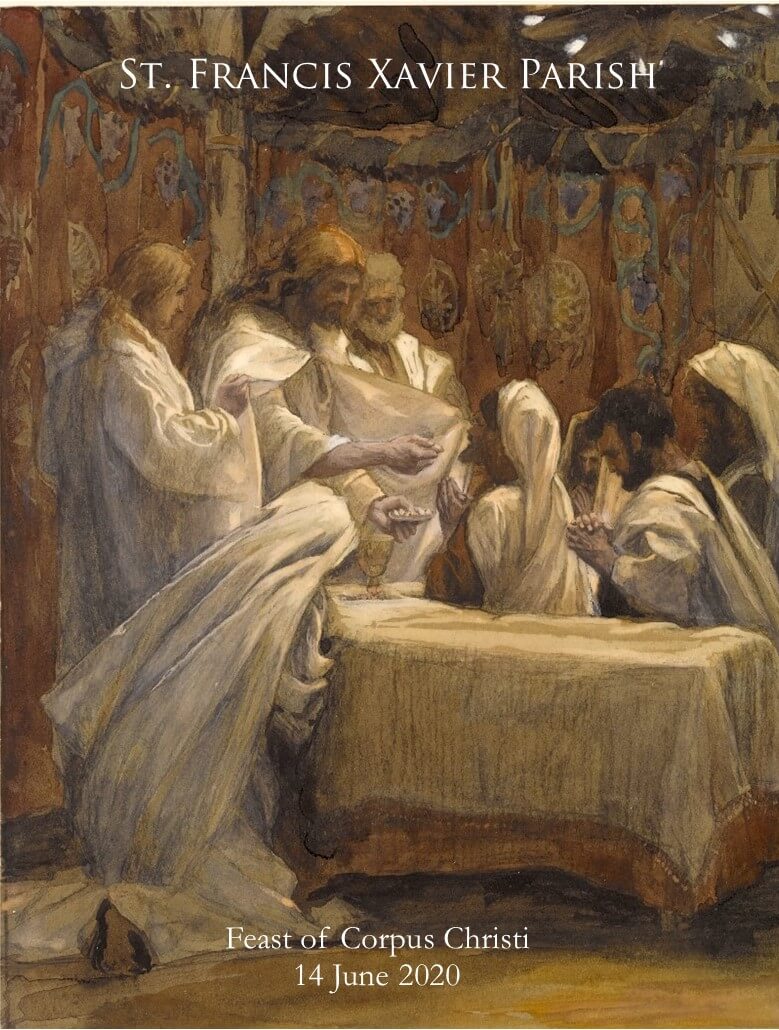
On this Feast of Corpus Christi we place on our bulletin cover a detail of a work by the French realist James Tissot entitled The Communion of the Apostles (1894 – Brooklyn Museum). Tissot was influenced by Degas and Manet although Tissot never fully transitioned to Impressionism, keeping one individualized foot in the realm of romantic realism.
Here we have a work reminiscent of the earth tones of Rembrandt which lend a somber solemnity to its telling. Christ appears as a “priest of Melchizedek” wearing a humeral veil held aside reverently by Saints Peter and John. This is a very liturgical piece so that even the table appears as an altar rail. Jesus distributes Holy Communion indicating that this is His Body while the Apostles kneel in worship. The thirteenth figure kneeling with face unseen must be our Blessed Mother.
Let us likewise adore Jesus in His most Blessed Sacrament.
-Steve Guillotte, Director of Pastoral Services
by SFXparish | Jun 5, 2020 | BLOG
The grace of the Lord Jesus Christ and the love of God and the fellowship of the Holy Spirit be with all of you. (2 Cor 13: 13)
It is quite possible that in spending so much time trying to understand the mysteries of our faith by studying the more difficult passages of the Bible that we overlook the simple passages that propound the mysteries of our faith with far less difficulty. We see this with the last sentence of today’s second reading taken from the very last sentence of the last chapter of Paul’s second letter to the Corinthians whereby he offers a brief farewell salutation that unlocks our hearts to the mystery of the Holy Trinity.
You won’t read the term “Holy Trinity” in the Bible, but you will find many instances of it. For example, Paul closes his second letter to the local church of Greek believers in Corinth with a blessing that asks for grace, love, and fellowship by attributing each one of these supernatural gifts as aspects of the three divine persons of the Blessed Trinity. The name of “God the Father” may not be obvious in Paul’s farewell address, but understanding correctly Saint Paul to be a pious Jew we are assured that his reference to “God” means “God the Father”.
The Father is the everlasting foundation of the Godhead and is often referred to by the Apostles and Church Fathers as “God”. This does not implicate his Son and Spirit as lesser beings than God, as the Jehovah Witnesses would wish us to believe. The Son and the Holy Spirit are God too. They are God by being of the same divine substance proceeding from the Father in their existence (Being). The mystery here is that they eternally proceed from the Father so that there was never a time when they did not exist and were not with the Father. In the language of the Bible, especially the New Testament, “God” often means “Father” only to stress that specific divine person who begets the Trinitarian Godhead although there was never a time when the Holy Trinity was not begotten.
Bedazzled yet? Good, you should be! For not even the great minds of St. Augustine or St. Thomas Aquinas could precisely and adequately describe the infinite Godhead. To accomplish this they would have had to been able to describe the indescribable. This is why it is best to speak about the Holy Trinity through esteemed pulsations of the heart such as the blessing offered by Paul to the Corinthians; for the deep mysteries of God are often best understood by the heart, being made manifest through praise and blessings… and sacred art!
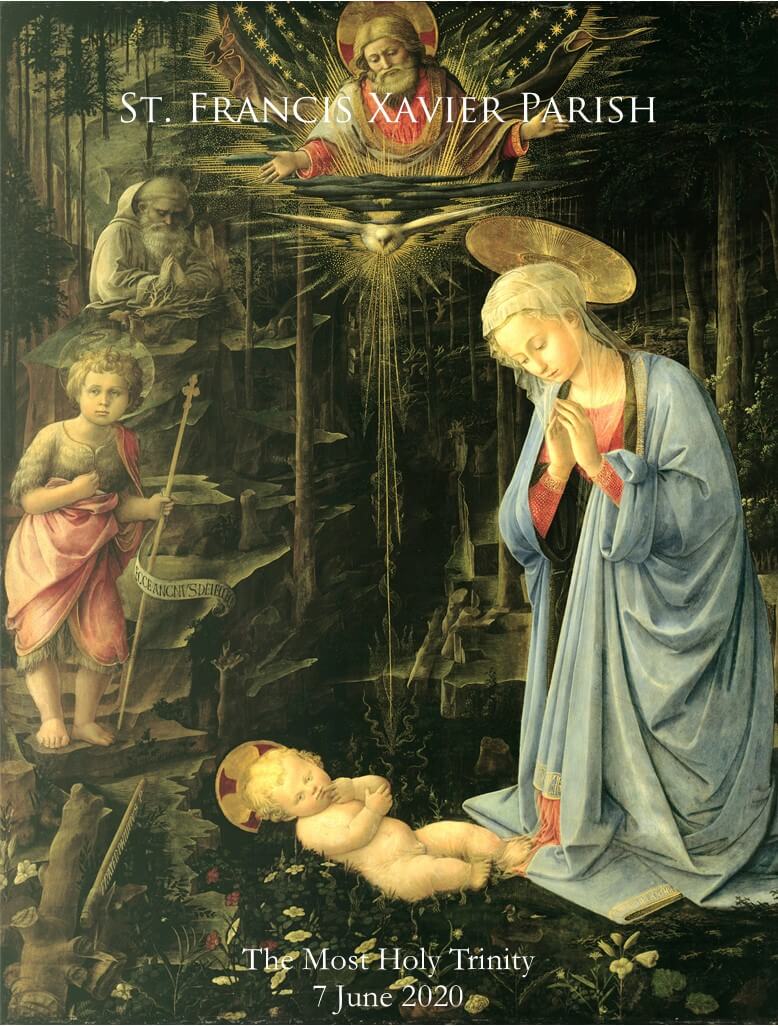
Thus we place on our bulletin cover for this Most Holy Trinity Sunday a work by Fra Filippo Lippi entitled Mystical Nativity or Adoration in the Forest (1459). Here we see an image of the Nativity which is intentionally expressive of the Holy Trinity. Lippi has used the primordial forest as a symbol of timelessness to disclose the three Eternal Divine Persons: Father, Son and Spirit. Both the Blessed Mother and St. Romuald (upper left) pray in Adoration to the Son, who in His assumed human nature authentically reveals the Father (Jn 14:9). Lippi also paints John the Baptist in a separate space to the left standing on a rock holding a banner which reads, “Behold, the Lamb of God”.
Long before there was life on earth, there was ever-abiding Life. There was without beginning the never-ending Most Holy Trinity.
-Steve Guillotte, Director of Pastoral Services
by SFXparish | May 28, 2020 | BLOG
When the time for Pentecost was fulfilled, they were all in one place together… Then there appeared to them tongues as of fire, which parted and came to rest on each one of them. And they were all filled with the Holy Spirit (Acts 2:1-4)
This year Pentecost Sunday falls on the last day of May, the day we conclude our traditional month-long devotion to the Blessed Virgin Mary. This is therefore a fortuitous invitation to reflect on the Blessed Mother during this solemn feast especially since our salvation began when the Holy Spirit came upon the Virgin Mary at the Annunciation (Lk 1:35). So where do we find Mary at Pentecost?
The first reading for the Sunday Mass of Pentecost opens at the beginning of chapter two of the Acts of the Apostles where St. Luke says that “they were all in one place together”. To learn who “they” refers to we must go back to Acts chapter one before the story of the appointment of Matthias as the new apostle. In Acts 1:14 Luke tells us that “they” includes the Apostles, some pious women, and “Mary, the mother of Jesus…” all dedicated to communal prayer.
Because of this understanding it became ordinary practice for Catholic artists to portray the Blessed Mother at ground zero for the descent of the Holy Spirit. The Acts of the Apostles further implies Mary’s presence at the feast of Pentecost since Peter, having just received the Holy Spirit, goes out and proclaims to the crowd in Jerusalem how King David prophesied that the Messiah would be one of his descendants (Acts 2:30). This assertion of Peter on the day of Pentecost to the Jewish people makes sense only in reference to and in the presence of Mary who is the one who could attest to this descendancy with certainty. (Church tradition has it that Mary herself was a descendant of David through David’s son Nathan).
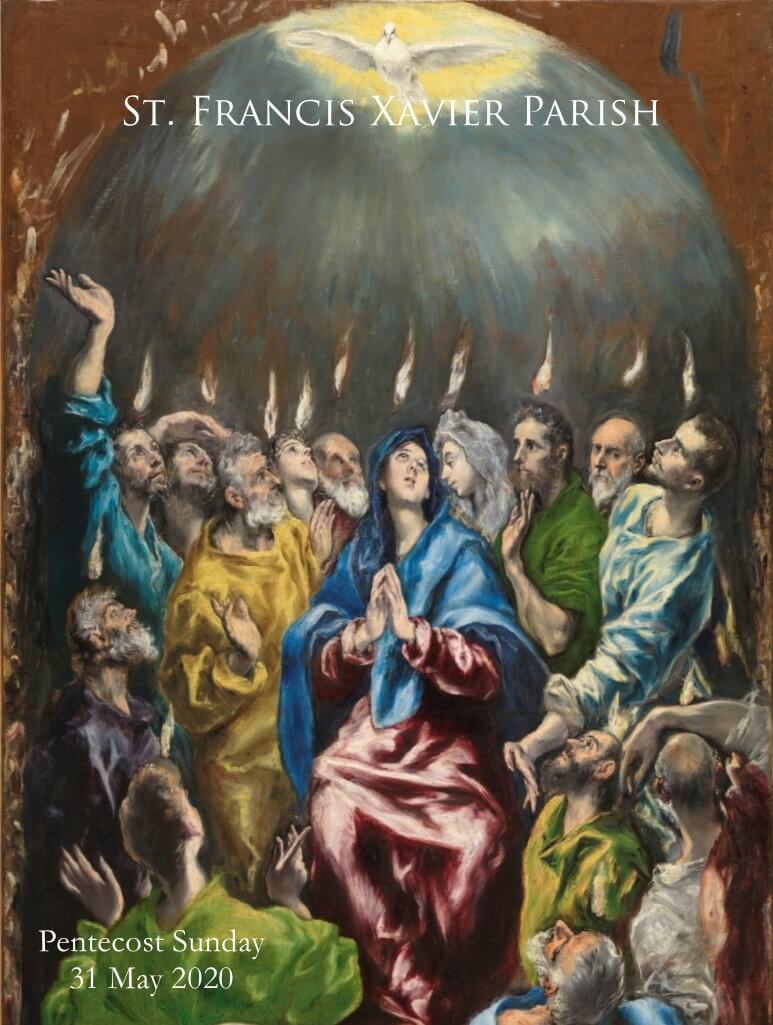
On this Pentecost Sunday we place on our bulletin cover a work by the Spanish Mannerist painter El Greco entitled Pentecost (1600). El Greco’s distinctive use of brightening color which renders solid forms as illuminated figures anticipated the work of Paul Cezanne. However, Cezanne did not grasp the spiritual mastery of El Greco.
In this image we have the disciples of Christ “all in one place together”; apostles and women of faith, and the Blessed Mother of God at the epicenter. Many of the figures look up in praise and amazement. Mary, however, peers upward with the expression of one having an interior conversation with the divine as she had at the Annunciation. One man in the painting looks out beyond the frame as if to remind us that the Holy Spirit is present in the here and now. Below the white dove high above is a falling windstorm which imparts tongues of flame sending a prism of color through the garments of all who are gathered. El Greco emphasizes the role of Mary at Pentecost by using the extended hands of many of the apostles to define the space allotted to Mary, a place familiar to Holy Spirit: to his descent and to his dwelling.
On this last day of May dedicated to Mary we transition to a celebration of the Holy Spirit, a transition as natural (and as supernatural) as the providential spiritual union of the Paraclete and the Blessed Virgin Mary.
-Steve Guillotte, Director Of Pastoral Services
by SFXparish | May 21, 2020 | BLOG
After Jesus had been taken up to heaven the apostles… entered [Jerusalem]… they went to the upper room where they were staying. All these devoted themselves with one accord to prayer, together with some women, and Mary the mother of Jesus, and his brothers. (Acts 1: 12-14)
Many years before St. Luke referred to Mary as “the mother of Jesus” in his Acts of the Apostles, Mary prophesied (during her visitation to her cousin Elizabeth) that “all generations” (or ages) would call her “blessed” (Lk 1:48). In fact, St. Elizabeth filled with the Holy Spirit (Lk 1:41) weaves this wonderful theme into Mary’s Magnificat by declaring Mary “blessed” three times immediately before Mary’s proclamation.
Mary’s prophecy has been fulfilled in the Catholic Church which reverently calls her, “Blessed Mother” and “Blessed Virgin Mary”. Yet some still claim that Luke’s Gospel only meant to point out that in the future people would say things like “Mary was blessed to be the mother of the savior” and that Mary’s prediction did not mean that “blessed” should be given to her as a title. Yet, how else would all the generations have accomplished calling Mary “blessed” without using that term in her title? It appears that many generations of Protestants by not using this term for Mary have forgotten about it completely even neglecting (and sometimes abusing) the blessedness of Mary, while at the very least tending to normalize Mary as a common, rather than a “blessed”, instrument of God.
The key to understanding the wonder of the Church’s singular fulfillment of this prophecy of Mary is found right in the Bible: it is there for all Christians. It is found in Luke’s portrayal of Elizabeth. First, Elizabeth calls Mary blessed “among women”, hence among all women for all time. Then she calls the fruit of Mary’s womb “blessed” meaning not only that Jesus is blessed (for He is of course divine) but that Mary is a blessed instrument. Finally, Elizabeth declares that Mary is blessed because she “believed” what was spoken directly to her from God, thus anticipating the words of Jesus to the woman in the crowd which do not, as some say, lessen Mary’s role but elevate it . Luke, our earliest Mariologist, recounts that event specifically to emphasize Mary’s unique faith (Lk 11:27-28). Two other points must be made. First, John the Baptist leapt in the womb of Elizabeth at the sound of Mary’s greeting and second, Elizabeth calls Mary “the mother of my Lord” which if this does not translate to you as “Blessed Mother of God” (Greek: theotokos) then, respectfully speaking, you have hardened your heart!
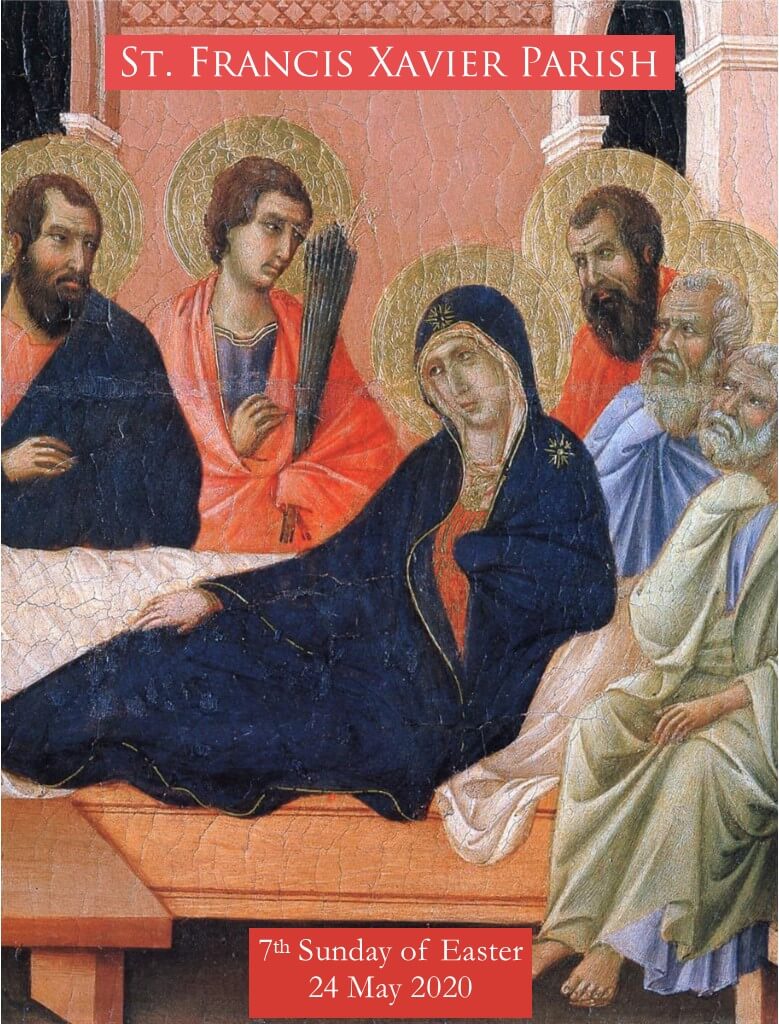
On this 7th Sunday of Easter we place on our bulletin cover a fragment of a work by the medieval Siennese painter Duccio entitled The Apostles of Mary (1311). We see here Mary surrounded by apostles. Mary is on a couch, yet she is not reclining as one at rest but upright and ready for conversation. Duccio has created a sort of religious symposium with Mary at the center. A symposium was a Greek banquet of men-only lying on couches while, for instance, they debate over an important subject. Hence in the Byzantine (Greek) artistic style Duccio replaces the likes of Socrates and Alcibiades with the Blessed Virgin Mary as the apostles gather around her.
In fact, this work is most often called The Virgin’s Farewell to the Apostles. Thus, the apostles have come to be near the Blessed Mother to glean all that they can from her before she reclines into her holy death or Dormition, thence proceeding to her glorious Assumption.
In this month to Mary, let us recall all the well-deserved titles of Mary and let us become as overjoyed as Elizabeth and John the Baptist when each of her titles reaches our ears.
-Steve Guillotte, Director of Pastoral Services