by SFXparish | Nov 8, 2018 | BLOG
“Amen, I say to you, this poor widow put in more than all the other contributors to the treasury. For they have all contributed from their surplus wealth but she, from her poverty, has contributed all she had…” (Mk 12:43-44)
Jesus instructs us in today’s Gospel reading that our church offerings are to be a sacrifice. He gives us the example of the poor widow who makes an offering to the temple not out of her “surplus” but from what little she has to manage her own domestic affairs. This does not mean that the widow gave to the temple, say, that which she owed her landlord for rent, but perhaps it was an amount that would have helped her purchase a new broom, a new bowl, or even a hearty breakfast. It was certainly all she had, for Jesus accounts it as her “livelihood”.
What Jesus does not tell us is how the woman became a poor widow. Was she already poor when she lost her husband, or was she at one time a rich widow? If we take the latter case as our example then we would surmise that she fell on hard times or else perhaps because of her great charity in serving the kingdom of God she became poor deliberately through her generous giving. This latter conclusion is not so remote in that she has now reached a point of saintliness offering even the little that she has to God.
Underlying this gospel story is the fact that Jesus is God. As God He is exercising here His divine omniscience, for how else could He know that “all” those making their temple offerings in His presence were not making a sacrifice by doing so. We might like to think that at least one other person there gave from his need; however Jesus knew that all the other contributors that day were holding back; that is, holding back for themselves what they had generously received from His Father.
Yet, let us not mistake God for some great accountant or bean counter in the sky. Jesus is not so fretful about percentages. It is possible that while one of the worshipers gave only out of his surplus to the temple that day, yesterday he gave out of his savings to a poor widow. What is essential to understand here is that Jesus wants us to become diligent in giving kindly to God whenever the opportunity arises, and that one can never really be said to be giving to God if instead of giving from what he has, he gives only from what he has left over.
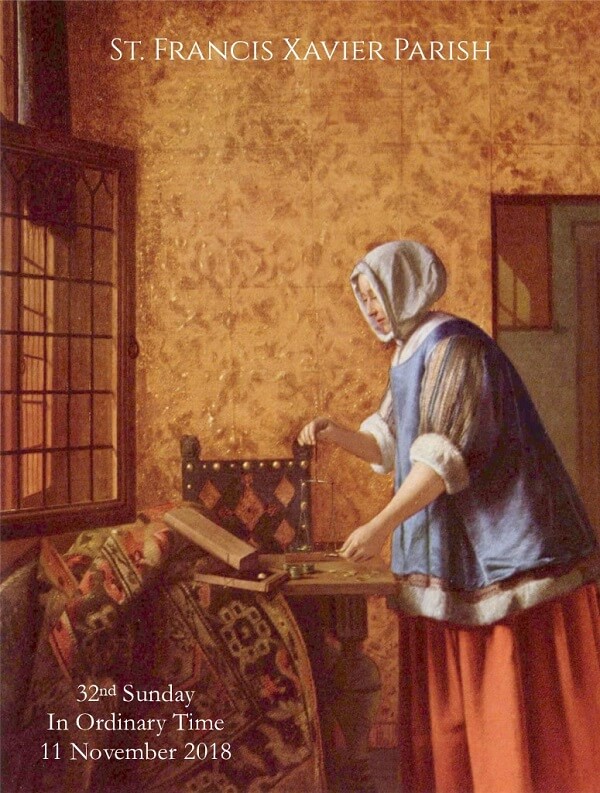
For this 32nd Sunday in Ordinary Time we place on our bulletin cover a work by the Dutch painter Pieter de Hooch, entitled Woman Weighing Gold Coins (1664). De Hooch was part of the Dutch golden-age and the “window light” genre which greatly influenced another Dutch master, Johannes Vermeer (compare this work to Vermeer’s Milkmaid). Here our woman is weighing her gold coins so as to estimate their value and her savings. She is richly dressed surrounded by lush tapestry and ornate furniture. However, if she is our widow, we find her here only starting out on her sanctification as she will eventually come to prefer storing up treasure in heaven (Mt 6:19-20).
–Steve Guillotte, Director of Pastoral Services
by SFXparish | Nov 1, 2018 | BLOG
Moses spoke to the people, saying: “Fear the LORD, your God, and keep, throughout the days of your lives, all his statutes and commandments which I enjoin on you, and thus have long life… and prosper the more.” (Dt 6:2-3)
For the ancient Israelites, as with most ancient nations, material prosperity was believed to be directly related to divine favor. Many pagan nations known to Israel created their pantheon of gods based on their physical and societal needs (e.g. fertility, agriculture, war, etc.). Is it any wonder then that the One True God reached out to Israel with a promise of prosperity since the children of Jacob had spent some four hundred years living under the sway of Egyptian idolatry (Num 12:40). At that time and place the Israelites were only equipped for following a miraculous Moses, not a sacrificial Messiah; for they were spiritual infants not yet ready for the solid food of the Gospel (1 Cor 3:1-2).
The pagan gods were of course consistently untrustworthy (1 Kg 18:27). This was simply because the gods were no gods at all (Is 45:5) and so their lack of activity and their arbitrary morality made them appear only more aloof and in need of constant appeasement. Thankfully it was the One True God who reached out to the Abrahamic people; the One True God who is “slow to anger and abounding in mercy” (Ps 145:8). Further, the God of Abraham and Moses arrived on the human scene with a moral code without comparison (Ps 147:19-20). This proved that God has not only a divine will but a divine nature, guaranteeing the One True God as thoroughly trustworthy.
It is the providence of God that after man enters bondage through sin he is brought back from the ignorance and fear of idolatry through the gift of prosperity. Once made prosperous through the activity of God, man begins to trust God. Once man trusts, he draws nearer; even “wrestling” with God through admonishment and trial (Gn 32:25). Only then does man reach spiritual maturity – coming to know and love God as he leaves behind prosperity for intimacy.
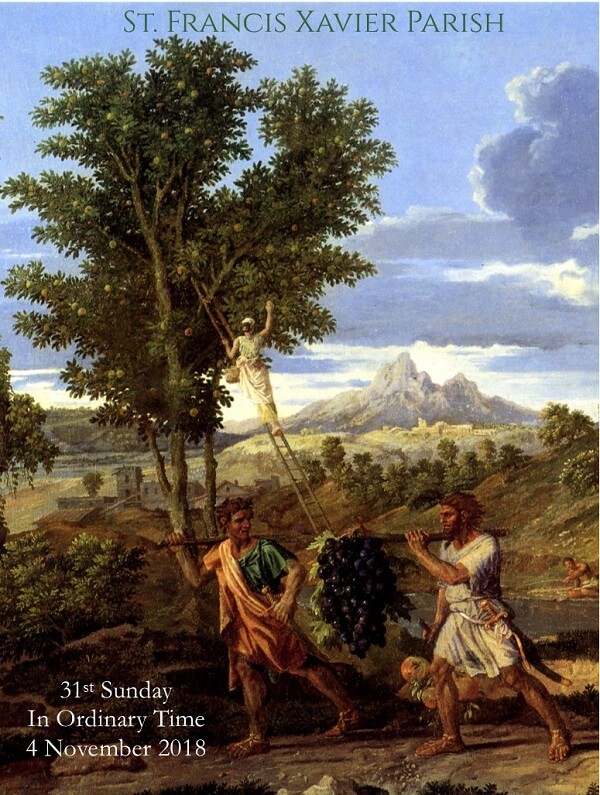
To give image to the revelation of prosperity (just one installment of divine providence), we place on our bulletin cover for this 31st Sunday in Ordinary Time, a work by the 17th century classicalist painter, Nicholas Poussin, entitled Autumn (The Spies with the Grapes from the Promised Land)(1664). Poussin ran away from his French rural home to Paris where he began his formal training at the age of 18. However, Poussin’s heart carried him to Rome where he found fascination with the works of Raphael. Thus, Poussin discovered his own classical style with its rationality and balance, yet combining this with the brilliant air and color of the baroque.
In our painting we see the scouts of Moses returning from the land of Canaan with signs of prosperity. They return after forty days carrying a large cluster of grapes as well as figs and pomegranates (Num 13:23). While impressed with the land’s fruitfulness, the scouts returned in fear of the land’s strong citizens. Thus, our first reading today serves as a lesson of faith – the disciple of God must trust through every earthly trial so as to gain eternal prosperity.
–Steve Guillotte, Director of Pastoral Services
by SFXparish | Oct 26, 2018 | BLOG
“Take courage; get up, Jesus is calling you.” He threw aside his cloak, sprang up, and came to Jesus. Jesus said to him in reply, “What do you want me to do for you?” The blind man replied to him, “Master, I want to see.” Jesus told him, “Go your way; your faith has saved you.” (Mk 10:49-52)
The Gospel reading this Sunday recounts the story of Bartimaeus, a blind man sitting on a roadside who called out to Jesus as He departed from Jericho with a large crowd in tow. Bartimaeus not only called out to Jesus, he called out for “pity”; not only did call out for pity, he called out for “the Son of David”. This tells us that Bartimaeus was a faithful Jew who understood the ancient prophecies and believed Jesus to be of the tribe of Judah and the princely line of David, so that as prince Jesus could offer “pity” to His subjects.
Yet more than this Bartimaeus understood sacred scripture concerning the “anointed one”, the “Christ” or “Messiah” – the one who could give sight to the blind (Is 42:7). Bartimaeus reminds us of Tobit, a righteous Jew who became blind in a trial of faith and awaited the mercy of God (Tob 2:10; 11:11-13). Here however, the Son of God, the creator and master of Raphael (the savior of Tobit) arrives himself to save Bartimaeus. The crowd tried to silence Bartimaeus; they wanted to stay in the moment just as Peter desired to remain on Mount Tabor with Jesus, Moses, and Elijah (Mt 17:4). However, Jesus came to earth to fulfill the words of Isaiah and his resolute purpose would not be hindered.
St. Matthew in his gospel instructs us how we are to approach Jesus when we petition Him: with courage. More to the point Bartimaeus is told to “take” courage which indicates that he is to receive this virtue from the Holy Spirit who moves him to call out to Jesus. Through the gift of fortitude the faith of Bartimaeus is emboldened in this moment of reckoning; a moment which he has perhaps awaited many a year.
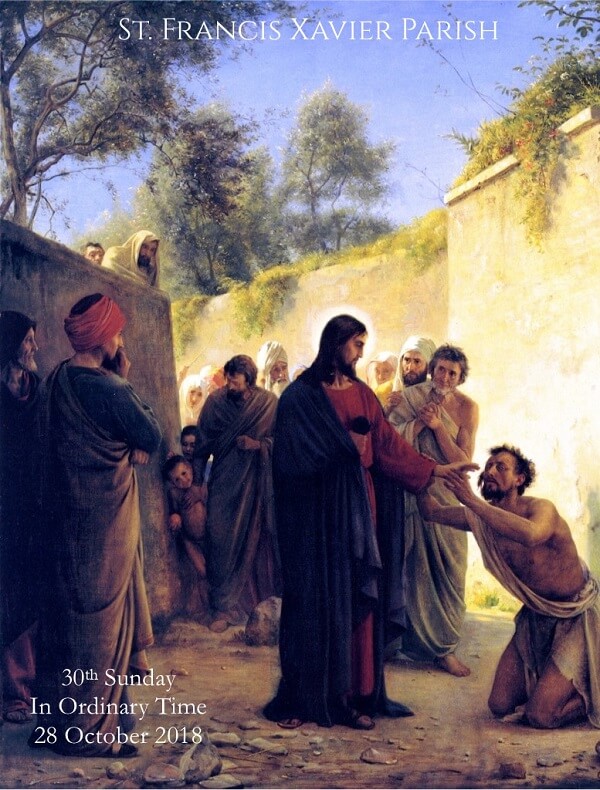
In order to help us gain an observance of such courageous faith, we place on our bulletin cover for this 30th Sunday in Ordinary Time a work entitled Healing of the Blind Man by Jesus, completed by the Danish master Carl Bloch in 1871. Bloch who trained at the Danish Academy, travelled through Italy, and was influence by the works of Rembrandt, became himself a painter in the genre style of Denmark. Thus, even his religious works tender a sense of everyday village life.
Here we see Our Lord depicted as healing Bartimaeus on the roadside of a walled street or passageway. One of the Apostles appearing just over the right shoulder of Jesus holds back the crowd. Over Jesus’ left shoulder two men watch in prayerful anticipation. Above the wall on the left are curious onlookers; while the men on the lower left of the scene take the posture of skeptics. Whether they will become believers or accusers of Jesus after the miraculous healing, we cannot say (Jn 9:15-18).
What we can say is that faith and courage are first cousins. Faith gives us courage, and courage stirs our faith.
–Steve Guillotte, Director of Pastoral Services
by SFXparish | Oct 19, 2018 | BLOG
“For the Son of Man did not come to be served but to serve and to give his life as a ransom for many.” (Mk 10:45)
Redemption is the salvation of humanity by Jesus Christ. This is not to say that the God the Father and God the Holy Spirit do not participate in salvation. They fully do. However, Jesus Christ is the called the “Redeemer” of humanity simply because He is the ransom of humanity.
We get our word redemption from the Latin redemptio meaning “a buying back” or “ransom”. Since Adam, (and until the time of Jesus’ appearance on this earth), humanity had been kept in bondage by the devil due to sin. Satan’s original temptation was a lure to entice the children of God away from the Father and abduct them from their proper home. Once ensnared, humanity was put to hard labor under pride and paganism, thus sealing its captivity to sin.
Further, because man is free and deliberately took the devil’s bait as something apparently good, man is culpable and liable to punishment. Hence, man’s captivity was not only a bondage per se, but also a debt needing payment which could never be fully met by man since the one deserving payment was God. It is an inexorable truth that man alone possesses nothing precious enough to serve as justice for mortgaging back his many grievous offenses to God. Man’s condition after the Fall was thus most pitiable.
There is nothing more precious to the Father than his only Son, Jesus Christ. Thankfully, Jesus loves us with such an immensely merciful love that He offered up for a time His divine equality (Phil 2:6-7) (which He always ontologically possesses in the Holy Trinity) to become the ransom to buy back man’s spiritual liberty as a matter of justice. This was a most worthy ransom! This was a price to pay man’s debt in-full for all eternity. The payment was the Passion and Death of Our Lord Jesus on the Cross to which Jesus nailed man’s corrupted nature restoring it through the perfected human nature He Himself assumed in the Incarnation.
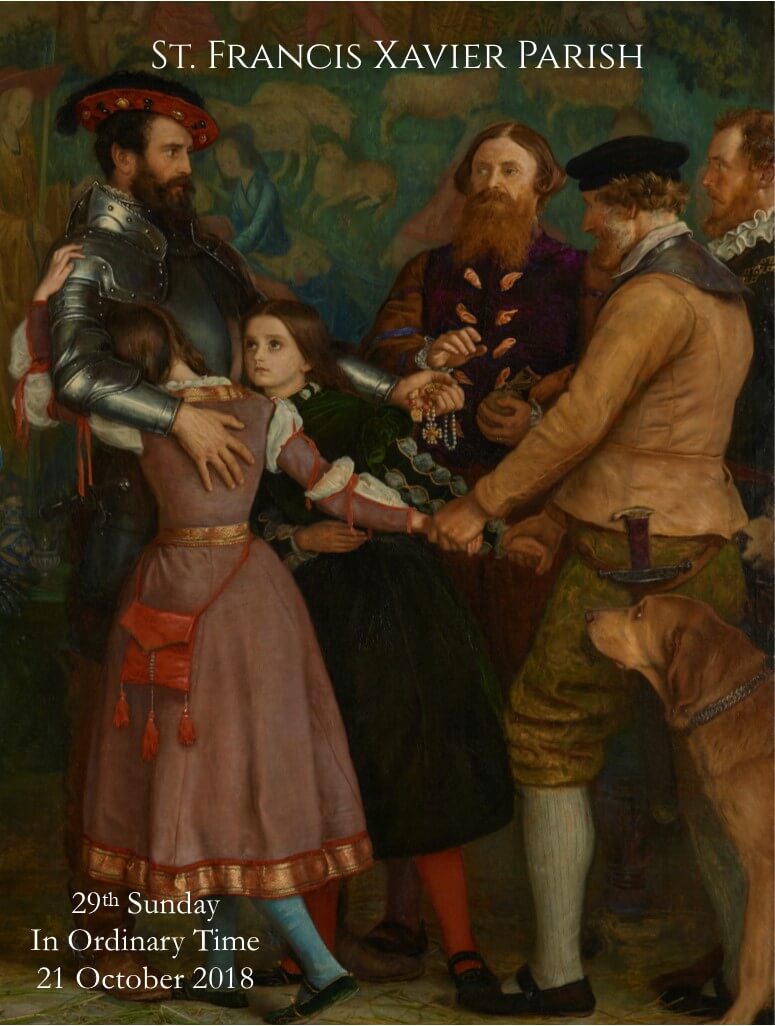
Any beautiful Passion scene might serve as a striking image for our Gospel reading for this 29th Sunday in Ordinary Time. However, since we are not in Lent we use another image from art history as an allegory for the sacrifice of Christ: John Millais’ The Ransom (1862; courtesy The J.P. Getty Museum, Los Angeles). Millais founded the Pre-Raphaelite school which recaptured the naturalistic spirit of the late medieval and early Renaissance periods.
In this image we see the kidnapper, a pirate still holding or just about to release two young girls he had taken captive. The father of the girls offers some precious jewels which another kidnapper (facing outward) reaches out to grasp. One girl has already begun to embrace her father who takes her under his arm. The intensity of the figures contributes to the force of the moment, one full of mistrust. Only the hound offers a calm and somber look to mellow the mood.
There is much more we could pack into our allegory if space allowed. Suffice it to say that the soldier-knight is Christ; yet he does not offer gold or pearls, but his very self, a priceless offering in exchange for the debt of our sinfulness. Perhaps only in heaven will we fully grasp the mystery of the great injustice our sin affected; and the need of a ransom which only God himself could pay on our behalf.
–Steve Guillotte, Director of Pastoral Services
by SFXparish | Oct 12, 2018 | BLOG
“…Indeed the word of God is… sharper than any two-edged sword, penetrating even between soul and spirit … able to discern reflections and thoughts of the heart. No creature is concealed from him, but everything is … exposed to the eyes of him to whom we must render an account. (Heb 4:12-13)
Ever since his first transgression in the Garden of Eden, man has tried to hide his sin from God (Gen 3:8). Man has a knack for hiding his turpitude by burrowing deep into his soul and squirreling away his offenses. In fact by accumulating an assortment of lesser venial sins without confession and reparation, man creates a cushiony nest on which to deposit his greater sins, so as to not feel their full weight as he should. Once the soul becomes a padded fortress for sin it builds battlements to defend itself against admonishment so that it may continue on as is, unabashed and unashamed.
In order to breach the heart of the sinner, God sends his Word to pierce the conscience, so that the person might feel sharply the severity of his sinfulness. If the person be honest, then he will suffer the scrutiny of the Lord like the burning Sun since “nothing escapes its heat” (Ps 19:7). If he be dishonest, then he will seek the shade or rather the shadows in which to hide his sins. Yet, this is of no avail because all men “must render an account” to God in the end.
Nor does a person have to live in serious sin to avoid God. He may just be lazy and dismissive toward deeper religious devotion. When Ignatius Loyola met Francis Xavier at the University of Paris, Francis did not take the word of God and Ignatius seriously until these two young Basque nobles were united in friendship. The word of God through Ignatius lanced the soul of Francis Xavier to whom Ignatius had asked, “What will it profit a man to gain the whole world and lose his own soul?”(Mk 8:36)
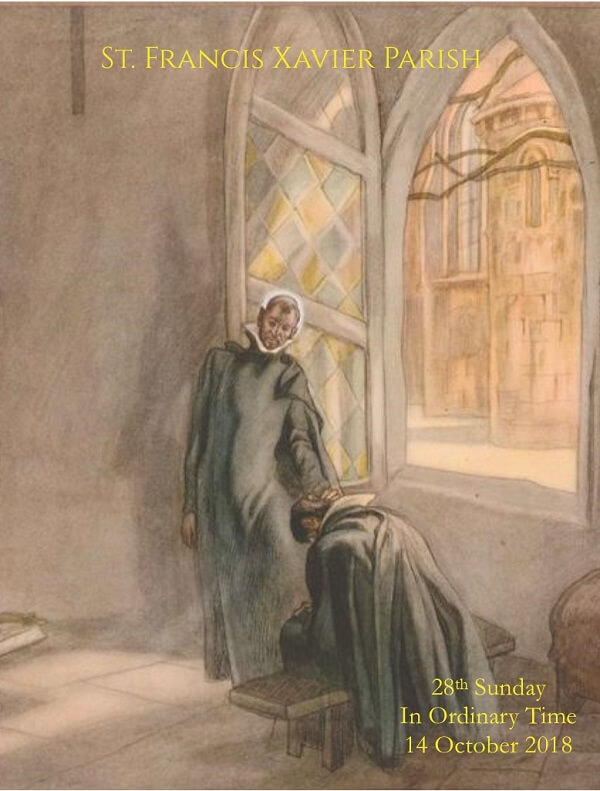
In order to memorialize this sentiment raised in today’s second reading from the Letter to the Hebrews, we place on our bulletin cover for this 28th Sunday in Ordinary Time a work by the Spanish Expressionist, Carlos Saenz de Tejada (d. 1958), Plate 4 from his series The Life of St. Ignatius Loyola. Expressionism reacted to the Neoclassical and Romantic tendencies of the Academic Art of Europe which depicted myths, legends, and famous events of ancient, medieval, and contemporary history. The modern Expressionist however sought the personal, subjective perspective in order to “express” an emotion or mood.
Tejada’s work has been compared to Art Nouveau and this work bears this out. However, “Plate 4” also bears the spiritual legacy of El Greco with elongated and uplifting tone and figures. Not only the posture of Loyola (standing) and Xavier (sitting), but the serene yet stoic scene emits the sacred mood of Francis finally capitulating through Ignatius to the word of God. Francis accepts the austerity of religious life symbolized by the scantily supplied room, while God frees him for a new and glorious life shown by the open window. We can “feel” Francis Xavier gaining his soul and leaving the world behind.
–Steve Guillotte, Director of Pastoral Services
by SFXparish | Oct 5, 2018 | BLOG
But Jesus told them… from the beginning of creation, ‘God made them male and female… and the two shall become one flesh.’ So they are no longer two but one flesh. Therefore what God has joined together, no human being must separate.” (Mk 10:5-6; 8-9)
First, God made them male and female. Second, God made them to function as one. Third, God made them into a union. Fourth, God made the union indissoluble on earth.
Any craftsman who builds one thing from two parts knows that the parts must be entirely complimentary since only by fitting one part true to the other part can a single new thing be made as a distinct creation. Further he knows that the two parts must be different: they cannot tie together if they are exactly the same; one must “accept” the other. If they are the same, they each remain a “part” existing “apart”. But if made differently yet exclusively for each other, being mutually measured to join together, then they form a unity, a single unit.
Such is the case with the man and the woman and marriage. When we speak of parts here, we do not speak only of physical parts. God made the man and the woman to unite physically as a sign of the fecund love that was to further unite them emotionally and spiritually. Unlike some physical parts in which one receives the other, in matrimony the man and woman receive each other sacredly with full consent and with full commitment praying that God’s grace will be the bond between them.
The male and the female were made by God for each other. Thus they must dispose of all the overused drama, comedy, gossip, and cliché about how men and women can never understand each other. God made them to understand each other and so they must make this their solemn daily labor. They must make every effort to know and admire the other’s traits and to seek out God’s binary wisdom which is an everlasting wisdom still realized in heaven.
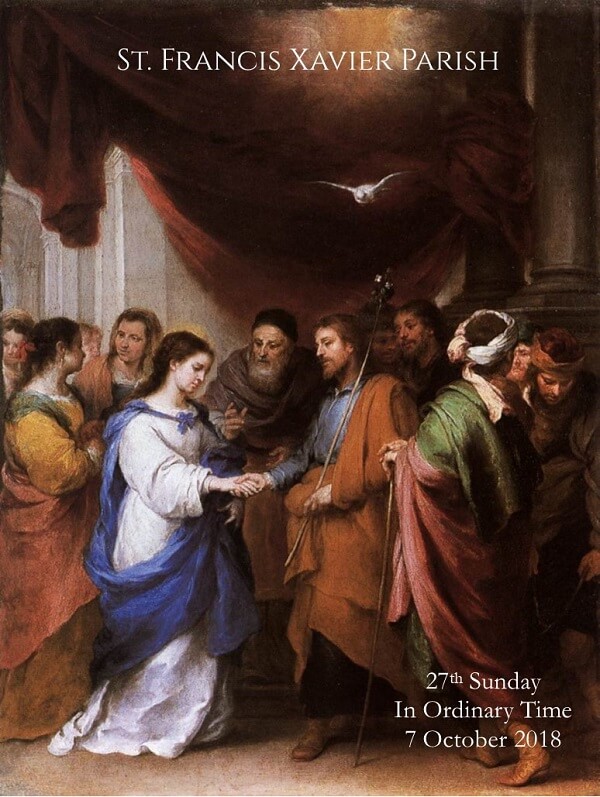
To assist us in our reflection upon the man, the woman, and marriage for this 27th Sunday in Ordinary Time, we place on our bulletin cover a work by the great Spanish painter, Bartolome Esteban Murillo, entitled, The Marriage of the Virgin (1670). Murillo paints soft, bright and ethereal figures; figures which if not confined to their linear frames might just scatter as dissipating puffs of cloud. Yet, Murillo’s figures behave as reserved as Early Renaissance artists could paint them; except for the additional spiritual sense of the Baroque which draws in our hearts.
Mary and Joseph stand hand-in-hand with no eye contact so that we might meditate on their sincere interior purpose and commitment. A blessing is offered, but the true blessing is that of grace shown by the descent of the Holy Spirit indicating that it is God who joins the bride and groom in one new spirit. The staff of Joseph flowers through God’s approval while other suitors less worthy hold bare rods and branches, one even snapping it for its unfruitfulness. It is fruitless because this man’s heart lacks the full consent and commitment needed for a valid marriage before God. Perhaps he showed up because of a personal attraction. However, that, on its own, validates nothing.
-Steve Guillotte, Director of Pastoral Services