by SFXparish | Oct 14, 2020 | BLOG
Then they handed him the Roman coin. He said to them, “Whose image is this…” They replied, “Caesar’s.” At that he said to them, “Then repay to Caesar what belongs to Caesar and to God what belongs to God.” (Mt 22:19- 21)
Justice is giving to each person that which is due to him. God is a person, albeit a Divine Person, who is ever entitled to his own due. In truth, every good thing is due back to God because every good thing comes from God.
Now what good and sincere person who received a rich bequeathal from another good and sincere person would not be thankful and earnestly set out to please that person with a return from all that was given him. Only a thankless and covetous person would not want to please the generous person who bestowed a great gift upon him.
God, most generous, gives us many good things, but the greatest of these is LIFE. The life of man is especially precious because it comes with a promise of eternal life to those who gratefully repay their fruitfulness to God. Therefore, the best way that man can give God his due is to cultivate human life, and what is “human life” except each and every human life created with a rational soul at the moment of conception.
Now a good man will always cultivate human life by assisting the poor, the expectant mother and child, the widow, the orphan; his fellow man in need. However, in our time the good man is told that the expectant mother and child is not really his concern. Caesar or “the world” may still allow the good man to contribute to the health of the unborn child but also demands that he contribute to its death: Caesar wants to tax the good man to pay for abortions. Hence, Caesar no longer wants only a census tax to pay for the born; he wants a death tax to destroy the unborn. Mind you, Caesar has the sonogram; he can look inside the womb. He ought to ask his citizens the same question that Jesus asked about the Roman coin – “Whose image is this?” But Caesar is fearful that the answer will come back, “It is in the image of God”.
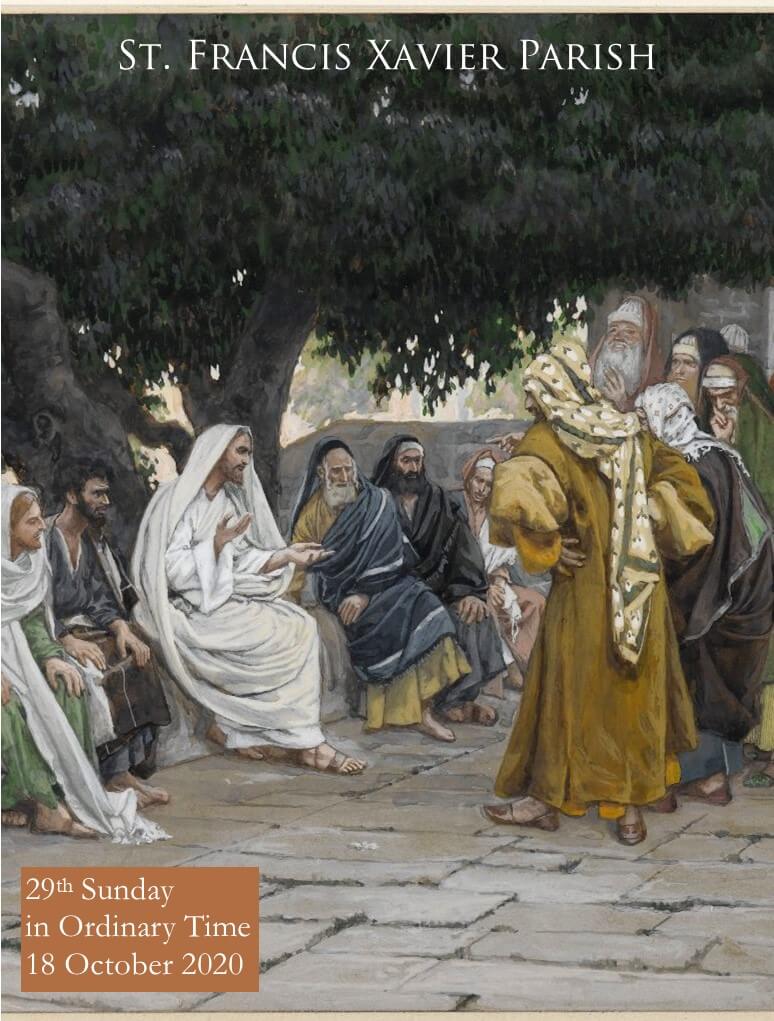
For this 29th Sunday in Ordinary Time we place on our bulletin cover a work by the French painter James Tissot entitled The Pharisees and The Sadducees Come To Tempt Jesus (1894; Courtesy Brooklyn Museum). Tissot was a prolific illustrator of the activities of Jesus and he offers many artistic insights into Jesus’ mission.
Here we see Jesus confronted in the public square by his religious enemies. Most of the postures of the Pharisees and Sadducees seem aggressive or angry, however one with hand-on-chin appears willing to ponder Jesus’ words, while another who hears raises his eyes to praise God. For His part Jesus raises His hands in brotherhood and invitation while His Apostles sit by as if stymied as to how to act amongst all these teachers of the Law. A beautiful olive tree overhangs the scene. Thus Tissot offers a sense of serenity, yet there remains a tension in this encounter that will soon lead Jesus to be condemned, first by Jewish authorities and then by Caesar.
Present day Caesar continues to be very suspicious of his good citizens – those of us who only desire to give back to God what is God’s.
-Steve Guillotte, Director of Pastoral Services

by SFXparish | Oct 9, 2020 | NEWS
by SFXparish | Oct 8, 2020 | BLOG
The king said to him, ‘My friend, how is it that you came in here without a wedding garment?’ But he was reduced to silence. Then the king said to his attendants, ‘Bind his hands and feet, and cast him into the darkness outside...” (Mt 22:11- 13)
In the Lord’s Prayer we petition God the Father by asking, “Thy will be done, on earth as it is in heaven.” Is it any wonder then that this once most pervasive prayer has become less so in a world that would appear to retort, “My will be done, in heaven as it is on earth”? For is it not true that we live in a time when we would prefer that God conform to us, rather than we conform to him.
Now it seems to be that the many people today who are giving up the practice of Christianity still believe in life-after-death. This is not surprising since pagans have always believed in life-after-death in one form or another. However, today belief in heaven is becoming very personal with as many notions about life-after-death as there are people to imagine them. However one thing that all these novel notions have in common is the removal of all or most moral conditions for the attainment of heaven. Each man has taken over God’s judgment seat and has granted himself amnesty. No savior, no redeemer, no priesthood is needed. Entrance into heaven is as easy as being born.
Perhaps it would be, if man were as holy as God. But heaven is a place of holiness because it is where God is. Thus, man must be made holy if he is to reside there. Yet, no man can achieve holiness on his own. He must be purified by Jesus Christ who perfected human nature in Himself and ascended into heaven to prepare a place for us (Jn 14:3). Without Jesus Christ there is no heaven for man.
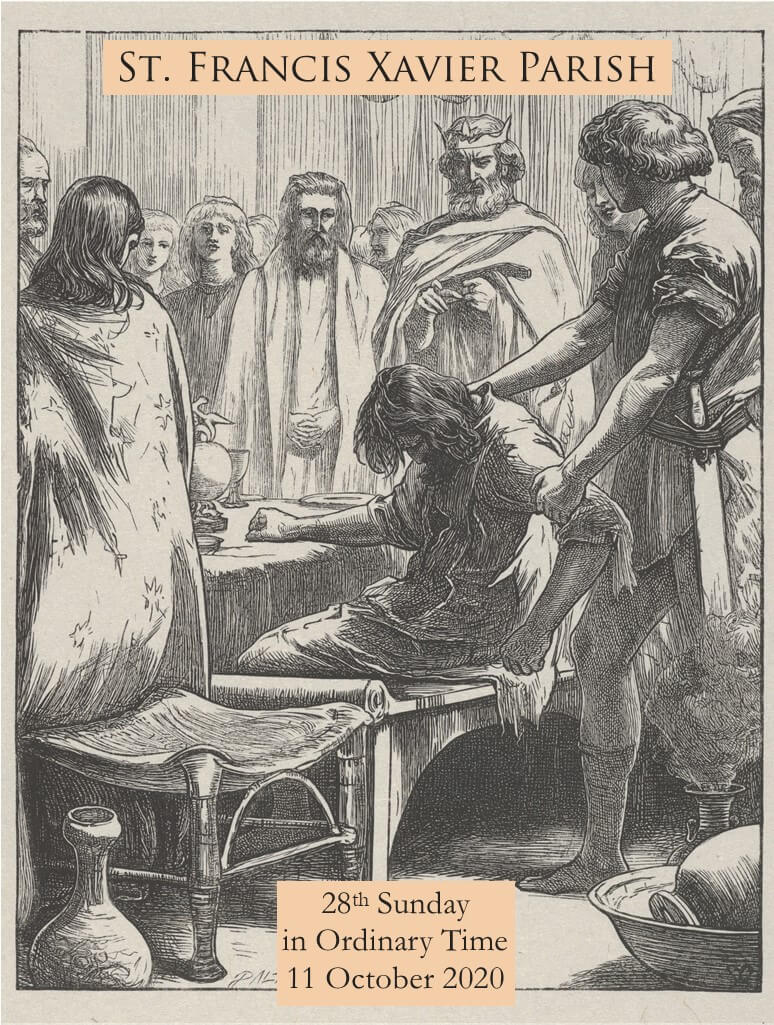
On this 28th Sunday in Ordinary Time, we place on our bulletin cover the image of a wood-cut engraving by the Pre-Raphaelite painter, John Everett Millais, entitled The Marriage Feast (courtesy The Met). This was just one work by Millais in a series of parables crafted for a private patron.
Here we see the man, silent before the king, being removed from the wedding feast. His garment is tattered but this does not mean that he is poor. It is a symbol of the man’s unrepentance, for he has tried to enter into heaven without purification. In fact, his silence means that he will not confess his sins, yet in his stubborn pride still expects a seat at the king’s table. Yet his pride fails him and he lowers his posture and eyes before the king of heaven. Notice that there is no cheer over his removal. Even the guard who removes him does so gently and soberly.
Catholics believe and proclaim with the psalmist, “Holiness befits your house O Lord” (Ps 93:5) We believe that one must be holy to enter into heaven. For most of us who die with restitution still needed to be paid, there is purgatory or a “purging” of all that is not holy in us; “for you will not be released until you have paid the last penny” (Mt 5:26). Thankfully, our Lord is a kind and merciful creditor. He forgives our debts, as we forgive our debtors. Though our sins be as scarlet, nothing is impossible for God. But the grace of God is needed. No one can force open the gates of heaven, unless He be Jesus, the Son of God.
-Steve Guillotte, Director of Pastoral Services
by SFXparish | Oct 1, 2020 | BLOG
Finally, he sent his son to them, thinking, ‘They will respect my son.’ But when the tenants saw the son, they said to one another, ‘This is the heir… They seized him, threw him out of the vineyard, and killed him. (Mt 21:37-39)
Admirers of The Lord of the Rings will recall that great line J.R.R Tolkien put into the mouth of Gandalf the White when speaking to the Lord Denethor of Gondor: “Authority is not given to you, steward, to deny the return of the king”. Denethor was one in a long line of stewards whose duty it was to keep the kingdom secure until the rightful king would return. But Denethor had grown proud and lustful for power and his response to Gandalf portrays this: “The rule of Gondor is mine and no other’s”!
Tolkien, a faithful Catholic, once said that he despised allegory, yet even he could not prevent the Holy Spirit from working through his art to express Christian symbolism. In a way the exchange between Gandalf and Denethor points to the parable we read in this Sunday’s gospel, while along with this parable reaches far back to God’s original providence concerning man’s creation, existence, and purpose.
Recall the words of God to Adam and Eve in the Book of Genesis; how God gave them dominion over the earth; how he commanded them to “cultivate and care for it”. God made them stewards of his magnificent creation and the first fruit of this stewardship was man’s naming all that was created (Gn 2:20); for he was made in the image of God’s mind and heart.
Sadly, we recall how our first parents were cast from their preternatural garden for being unfaithful stewards. Adam and Eve were caretakers of two holy trees – one for them (Life) and one for God (Knowledge or Revelation which belongs to God alone), but they forgot their stewardship and tried to usurp God’s tree for themselves. This was the first sin and man’s first failure of his stewardship which would be as a curse and harbinger to all men through all time who would, fallen from grace, make themselves kings of God’s domain in which they were meant tenderly to be children and heirs.
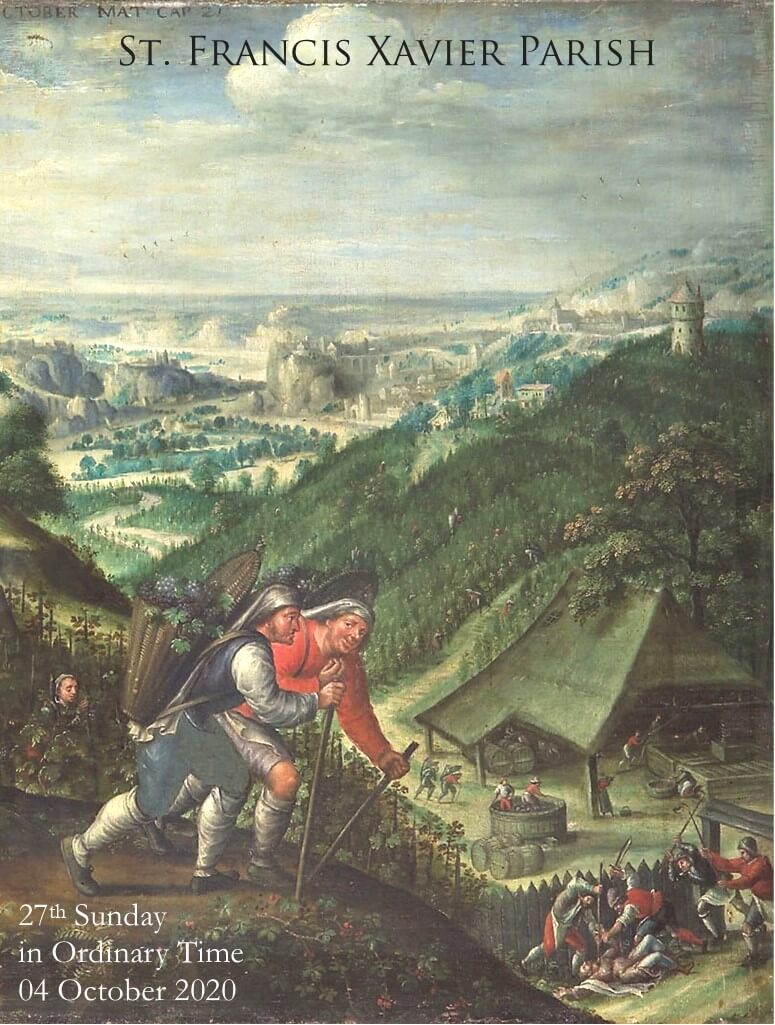
For this 27th Sunday in Ordinary Time we place on our bulletin cover a work by the Flemish painter Marten van Valckenborch entitled Parable of Wicked Husbandmen (1590). Valckenborch lived through the Beeldenstorm or the mob destruction of Catholic sacred images that occurred in 16th century Europe. Thus, he left Belgium for Aachen, France where he continued his landscape painting while taking up also religious allegory and symbolic painting of biblical parables.
Our painting is too panoramic for us to see the far left of the image where Valckenborch has painted the father in the parable sending off his son to take authority over the vineyard. In the right portion of the painting we see two workers carrying the plentiful fruit of the vineyard. In the bottom right of the image there are the tenants of the vineyard murdering the beloved son of the planter and owner of the vineyard. They are like those who to this day take from creation without sharing and who murder inside and outside of the womb.
Such self-proclaimed kings have declared themselves enemies of God and his Church. Let us pray for these enemies that they will remember that they were first made to be beloved children and heirs of the Creator.
-Steve Guillotte, Director of Pastoral Services
by SFXparish | Sep 24, 2020 | BLOG
“A man had two sons. He came to the first and said, ‘Son, go out and work in the vineyard today.’ He said in reply, ‘I will not,’ but afterwards changed his mind and went.” (Mt 21:28-29)
Man has free will. It is one of the two excellent powers in the human soul besides the intellect which God has given to man to form him in the divine image and to distinguish him from the animals. The great Greek philosopher Aristotle called man “rational animal” to indicate that man, although a physical creature needing nourishment and having material appetites, is also capable of reasoning beyond his basest desires to pursue a life of virtue.
Man’s freedom allows him to say in his heart and with his lips, “I will” or “I will not”, and then to act accordingly. However, because man struggles interiorly within his conscience he will sometimes act differently than what he has spoken. A person may say that he will help with some activity then in a moment of selfishness decide not to show up. The same person may at another time say firmly that he will not assist, but later does so because he knows how much his assistance is needed.
In today’s gospel reading God uses this deviation in man’s will to explain something important about the spiritual life: that it is the one who not only changes his mind, but the one who changes his life deliberately by following Jesus that finds the path to “righteousness”.
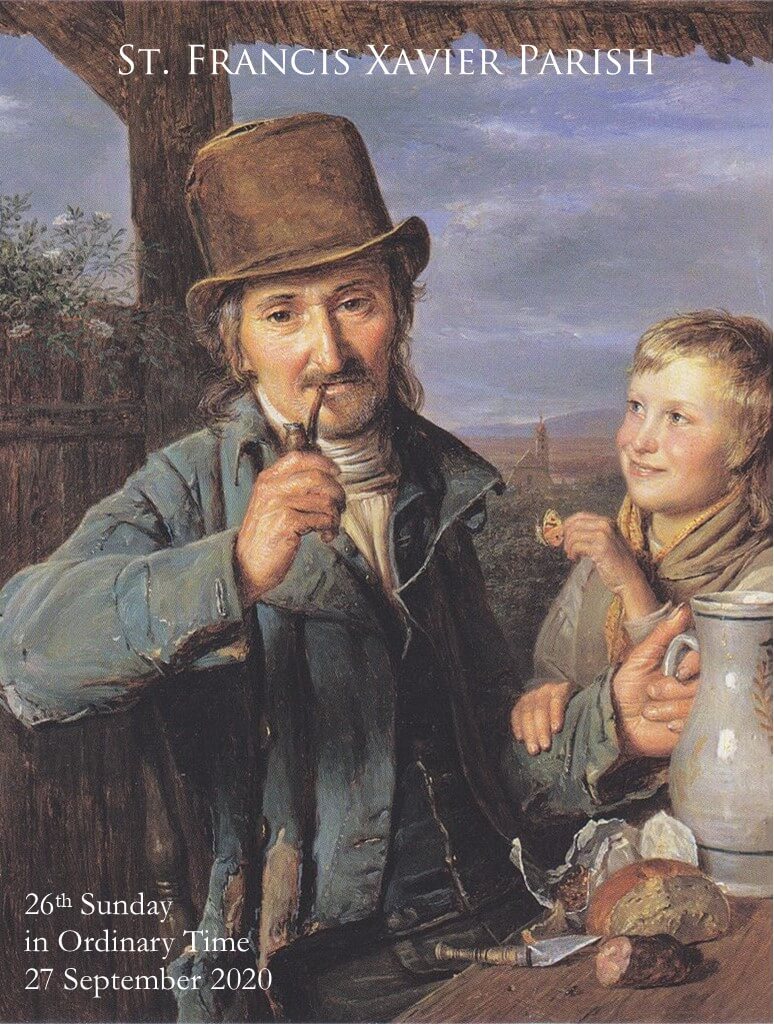
For this 26th Sunday in Ordinary Time we place on our bulletin cover a work by the Austrian Romantic painter, Ferdinand Georg Waldmuller entitled The Day Laborer with His Son (1823). Waldmuller painted in a style known as Biedermeier. While this style seems to display a realism because of its pastoral scenes, it lacks the serious and often somber expression of the bucolic life of say the realist Jean-Francois Millet. This is because Biedermeier is fundamentally romantic and its works portray an optimism, a cheer, and even a pious communal revelry that is thoroughly indicative of this Austrian movement.
In our work we see the father in today’s parable after a long day at work in the vineyard enjoying bread, meat, drink, and pipe. He is joined there by his son who for our purpose is the same son in the parable that came out to work with his father after initially saying that he would not. The father looks toward us with satisfaction and pride in his son. His young son places his right hand on his father’s left arm to get his attention to show him the butterfly he has caught in the field. The son has the look of one who wants to please his father in the same way that Jesus set out to please His. Behind them is a vast landscape of greenery signifying that their work has produced much fruit. The other son who said that he would come (but did not) is not in the scene. In a way that son is like the prodigal son of another parable who we can only hope at a later time will change his mind and return to his father’s vineyard.
If we have said “I will not” to God our Father in any way, there is still time to change our mind and say “I will” and then to do it. We have a perfect example of how to do this in Jesus, the one and only divine Son.
-Steve Guillotte, Director of Pastoral Services