by SFXparish | Sep 13, 2019 | NEWS
We are gearing up for another month dedicated to human life. In October we hold our traditional Baby Bottle Campaign in which you fill baby bottles with coin (or bills) to donate to a local pregnancy resource center which offers alternatives to abortion and faithful support through and beyond pregnancy. Next we will hold a parish Blood Drive on Sunday 20 October with the usual mobile clinic in our parking lot. Lastly, we will once again join in prayerful vigil in Attleboro across from the single remaining abortion clinic in our diocese. Our 40 Days for Life sponsorship day will be Saturday 26 October. October has a few other surprises, so stay tuned!
by SFXparish | Sep 13, 2019 | NEWS
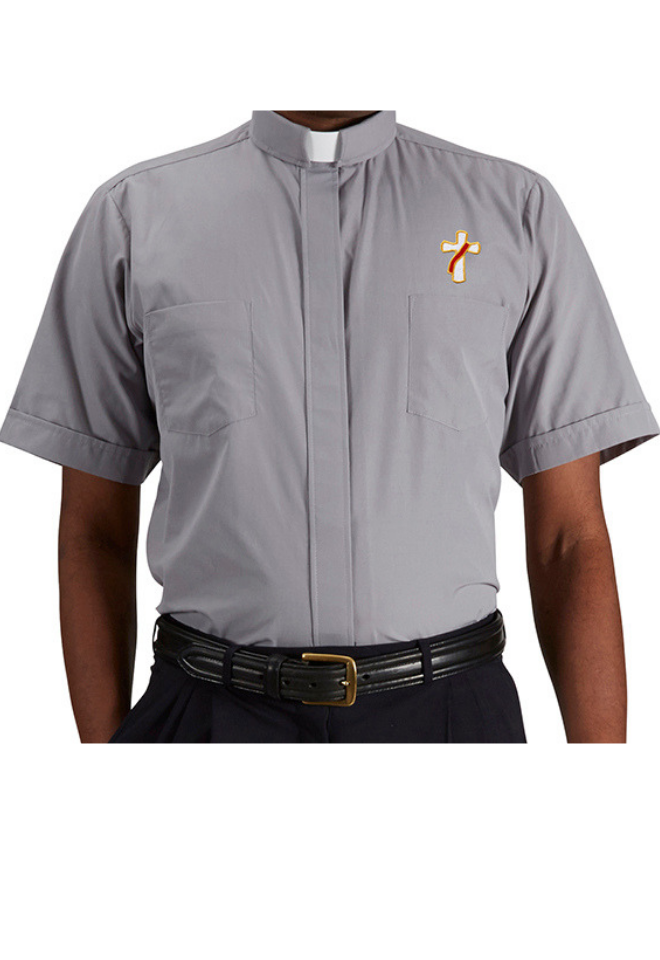
Bishop Edgar da Cunha has issued a decree that all diocesan permanent deacons now have the option to wear clerical attire when performing ministerial duties such as hospital visits, weddings, baptisms, funerals, etc. Permanent deacons can now wear a clerical collar. The specific color decreed by the bishop for the deacon is “grey” to distinguish him from the diocesan priest who wears black. The deacons may also wear other identifiers such as the deacon lapel pin, especially if the deacon is wearing a suit jacket.
Our Deacon David Pepin has welcomed this opportunity to cloak himself in this new ministerial attire which is put forth to instruct all of us of that the deacon is an ordained minister of the church.
by SFXparish | Sep 12, 2019 | BLOG
“Beloved: I am grateful to him who has strengthened me, Christ Jesus our Lord, because he considered me trustworthy in appointing me to the ministry. I was once a blasphemer and a persecutor and arrogant, but I have been mercifully treated…” (1 Tim 1:12-13)
In the month of October our parish will present a Pauline study on grace. This will coincide with the introduction of the theme for our year of faithful inquiry entitled “Your Grace is Enough for Me, O Lord” which is a paraphrase taken from 2 Corinthians 12:9.
Even before this formal announcement, this theme had already made itself known to us over the last few Sundays in our Gospel readings. Two weeks ago Jesus instructed us to conduct our lives with humility. He gave us the parable of the man who takes a lower place on earth so that he may be raised to a higher place in heaven. This raising up only occurs through grace. Last Sunday Christ asked us to renounce all that we have so that we might be his disciples. Yet why do we give these things up except so we might gain a greater portion of grace? And what discipleship do we seek if not the discipleship of grace? All Christian roads start from and lead back to grace; every destination of the Christian spiritual life finds its starting point in baptism. “Your Grace is Enough for Me, O Lord” is not simply a clever theme, it is our wake-up call, a trumpet blast in the ears of those slumbering through the walk of life, lazily following or avariciously chasing after the things of the world which lead the soul away from God and lessen its desire for a life of grace.
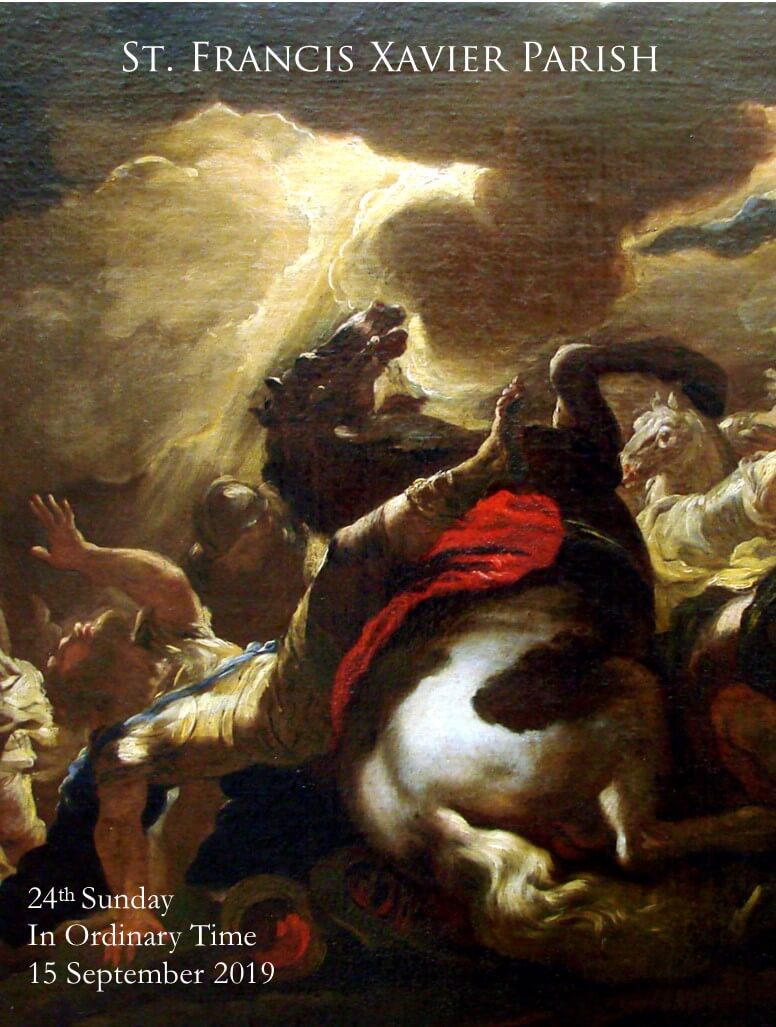
To help us get ready for our examination of the life and essential teachings of St. Paul, we place on our bulletin cover for this 24th Sunday in Ordinary Time a work by the Italian Baroque master, Luca Giordano, entitled The Conversion of St. Paul (1690). Giordano was a painter-artisan; he mastered the epic of Tintoretto and the illumination of Caravaggio, all while his mature baroque anticipated the ethereal tones of the Rococo. His painting was majestic and fast making him the perfect artist for painting spaces of worship: walls and domes in lively fresco.
In the full image (not seen here) of the Conversion, Paul seems as an Alexander the Great amidst a battle scene with twisting figures, human and equine, falling here and their collapsing upon each other, while tack and garments are tossed about as flags in a mighty wind. A great storm from above falls upon the mass of bodies and the light of heaven emerges through dark clouds throwing all into disarray and blinding the zealous Pharisee named Saul. While many of the figures cover their faces from the light, the man to be called “Paul” puts out one hand to break his fall while the other hand reaches out to heaven as his eyes look directly into the divine light above him. Giordano shows Paul accepting his ministry with immediacy, turning his usual zealousness without hesitation in the sole direction of Christ.
–Steve Guillotte, Director of Pastoral Services
by SFXparish | Sep 5, 2019 | BLOG
‘… After laying the foundation and finding himself unable to finish the work the onlookers should laugh at him and say, ‘This one began to build but did not have the resources to finish.’ (Lk 14:29-30)
Our present age has increasingly little interest or regard for the resources of the past. Modern eras tend to be that way. We care about the next smart phone, the next e-book, the next technological breakthrough more than we seem to care about an in-person conversation, a classic tale, or knitting. Secularism, materialism and consumerism all contribute to this departure from the past and tradition.
Even the Church has had a hand in this. For instance, the recent LCWR Conference of women religious spoke much about “making meaning” but little to nothing of “making it” with the stuff of our rich ecclesial past. Many others in the Church today can’t say the word “tradition” without wincing. To still others the Latin Mass for example is the “old Mass”; old, of course, being a bad thing. What these individuals have yet come to understand is that without a high regard for the ancient and historical Mass, there comes about eventually little interest in the Mass itself. A family, a country, a Church without its past is as St. James says – like a man who sees his own face in the mirror and after walking away promptly forgets what he looks like (Ja 1:23).
Here at St. Francis Xavier Parish we try very hard not to forget. The use of relics makes us remember the saints, incense makes us remember the Holy of Holies, male altar servers makes us remember the Last Supper; Eucharistic Adoration makes us remember the Real Presence of Jesus. We believe that we have a duty to remember; a piety for fully living out our belief or else what is this Gift of Holy Spirit for? If we don’t recall our heritage day after day, who else will encourage us to do so?
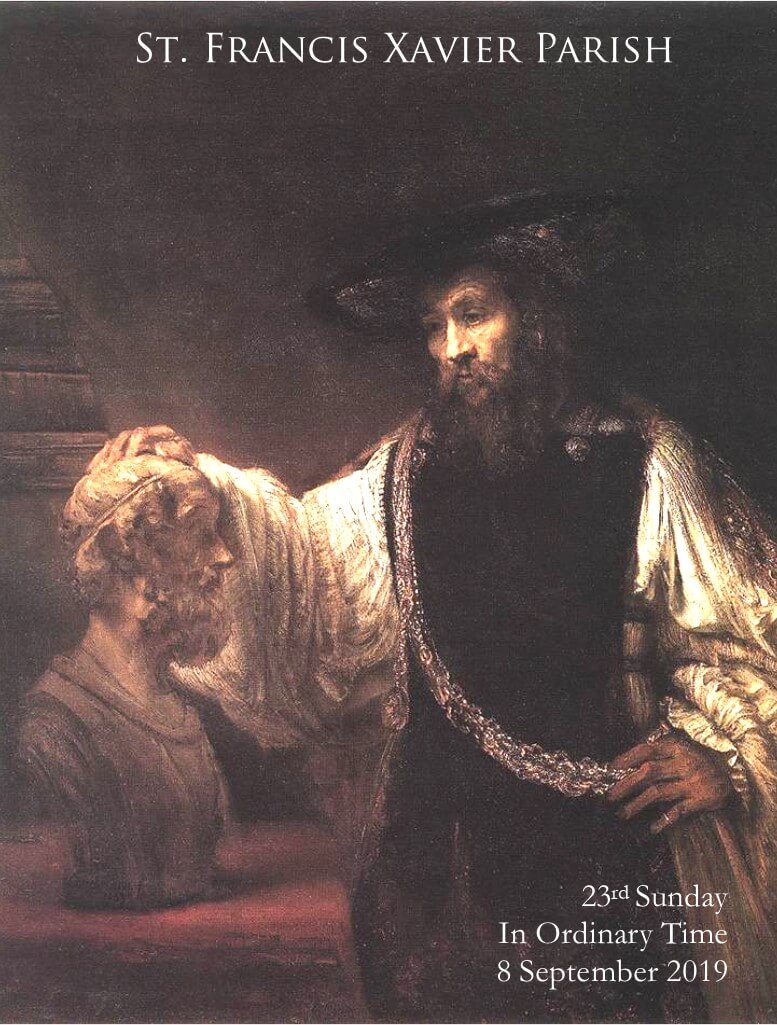
Hence we have deposited on our bulletin cover for this 23rd Sunday in Ordinary Time a work by the Dutch master, Rembrandt, entitled Aristotle with a Bust of Homer (1653). The Dutch Baroque was subdued compared to its Italian and the Spanish expression, but its magnificent use of light emerging from darkness offers a wonderful contemplative experience.
Here is the great Greek philosopher Aristotle presented as a Dutch noble with his hand resting on the head of the Greek epic poet Homer. Aristotle looks back at least three centuries into his past and recalls the literary heritage which raised and educated him. He honors it with his entire posture in quiet reflection. If we can imagine Aristotle just a moment before, with both hands on his hips before he reaches out to touch the bust, it would bespeak a bearing of surprise such as “Well, what do we have here!” Homer was blind, but Aristotle gives him sight; for the past is blind without those in the present to give it vision.
What we see in this image is a discovery of the past. So then, what of us? Was not the rediscovery of our most vital resources the best, intended purpose of Vatican II – a rediscovery of the Church Fathers and the original meaning of our faith and liturgy? Why then do we insist today on looking past our blessed past?
–Steve Guillotte, Director of Pastoral Services
by SFXparish | Aug 31, 2019 | BLOG
Rather, when you hold a banquet, invite the poor, the crippled, the lame, the blind; blessed indeed will you be because of their inability to repay you. (Lk: 14:13-14)
Jesus gives us a new beatitude in today’s gospel reading: Blessed are those who give and are not repaid. This appears a peculiar teaching since in the Parable of the Talents Jesus indicates that even his Father in heaven expects a return on his investment (Mt 25:26-27).
Yet, we know that the Father has all and needs nothing. Humanity can give nothing to God that would increase his household. God gives grace to all men and he gives more grace to those who use it to do his will (Mt 25:28-20). The return that God expects for his gift of grace is not for the benefit of his own increase, but for our benefit. His repayment is our rise in virtue; his recompense is the happiness we gain in becoming like him. God’s joyful compensation is sharing all that he has with his children who are overjoyed at receiving it.
Thus, the meaning of today’s gospel quotation is that God wants us to be like him who gives and cannot be repaid. The Father desires that we find intrinsic value in giving. This giving does not always have to be monetary. Even if it is monetary, it must first and foremost be spiritual. In a sense our Christian giving is always a passing on of grace and we should always recall that all that we give, be it material, physical, or spiritual, is originally quarried from the mountain of God so that none of us can say definitively “this is mine”. Even our charity finds its source in God since what we give is not ours and what we are repaid returns to its source.
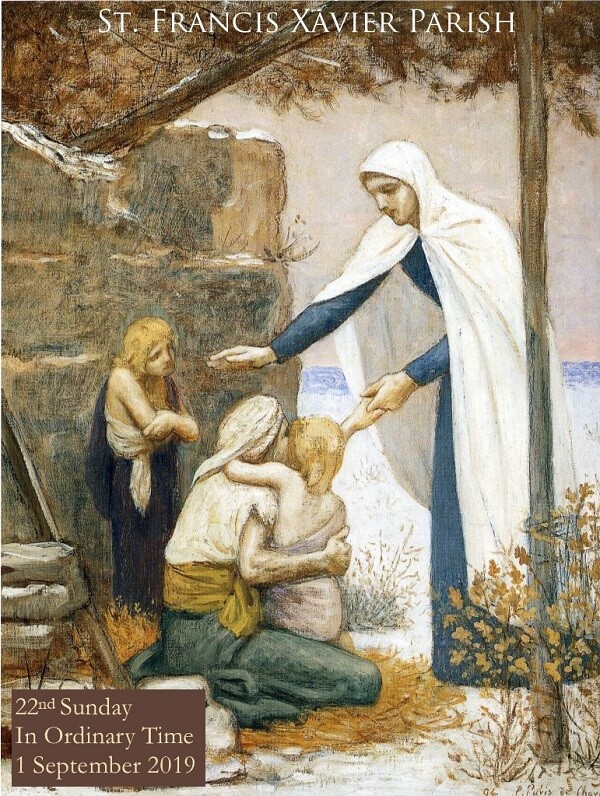
Thus we place on our bulletin cover for this 22nd Sunday in Ordinary Time a painting by the Romantic and Symbolist painter, Pierre Puvis de Chavannes, entitled Charity (19th Century). Its imagery and temper is reminiscent of the Pre-Raphaelites yet it is a purely symbolic work. However, the symbolism of de Chavannes is not that of, say, William Blake. De Chavannes is more reserved in his allegory and his symbolic craft does not lead into fantasy but is rooted solidly in a “romantic-realism” if we may be permitted the expression.
Here we see Lady Charity using her left hand to assist to their feet a mother and daughter while offering with her right hand a sign of blessing. The Lady has come to rescue this poor family from insecure and desperate lodging. The family has been sheltering against the elements in what does not even amount to a lean-to. Their backs are to a wall and they have only one post and one beam with some dead tree branches to shed the elements. The girl standing appears quite chilled. The family has huddled on a bed of straw surrounded by what appears as snow.
Lady Charity might be for us the Blessed Virgin Mary on one of her visitations. In any event she has come to rescue and give comfort to those who cannot repay her. Hence, this Lady is truly blessed.
–Steve Guillotte, Director of Pastoral Services