by SFXparish | Aug 20, 2020 | BLOG
And so I say to you, you are Peter, and upon this rock I will build my church, and the gates of the netherworld shall not prevail against it. (Mt 16:18)
Gates generally don’t prevail; at least they don’t in any kind of military offensive. Armies don’t move about in great mobile enclosures with gates that open and close gobbling up their enemies like a giant Pac Man. It is true that a strong and protected gate can add to a sturdy defense and hence may “prevail” against those trying to enter. However, it is difficult to see how “the gates of the netherworld” could think of prevailing against the Church of Christ in this way, since the Church is never eager to enter into hell.
If this be the case, then why does Jesus tell Peter that the gates of hell will not prevail against the Church? A gate’s primary duty is to maintain the coming-and-going in and out of the enclosure of which it is a part. Gates are generally kept closed to discourage entrance, yet opened as a sign of welcome. Gates are only as large as they need to be to let in only those things, the sizes of which are not too large for keeping out. Otherwise they are stationary devices that don’t make it their business to go about prevailing over other things.
However, considering our quote above from Sacred Scripture it is what stands behind the gate that most wants to prevail over the Church. The netherworld, the spiritual domain of the devil and his minions, ever desires to widen its enclosure with fallen souls. It expands through temptation and sin and broadens its reach and territory attempting to park its gate as close as it can to the Church. Yet, while evil may enter the Church through sinful priests, religious, and laity, the netherworld itself can never prevail against the Church because it cannot prevail against Jesus who has already vanquished its greatest weapon – eternal death.
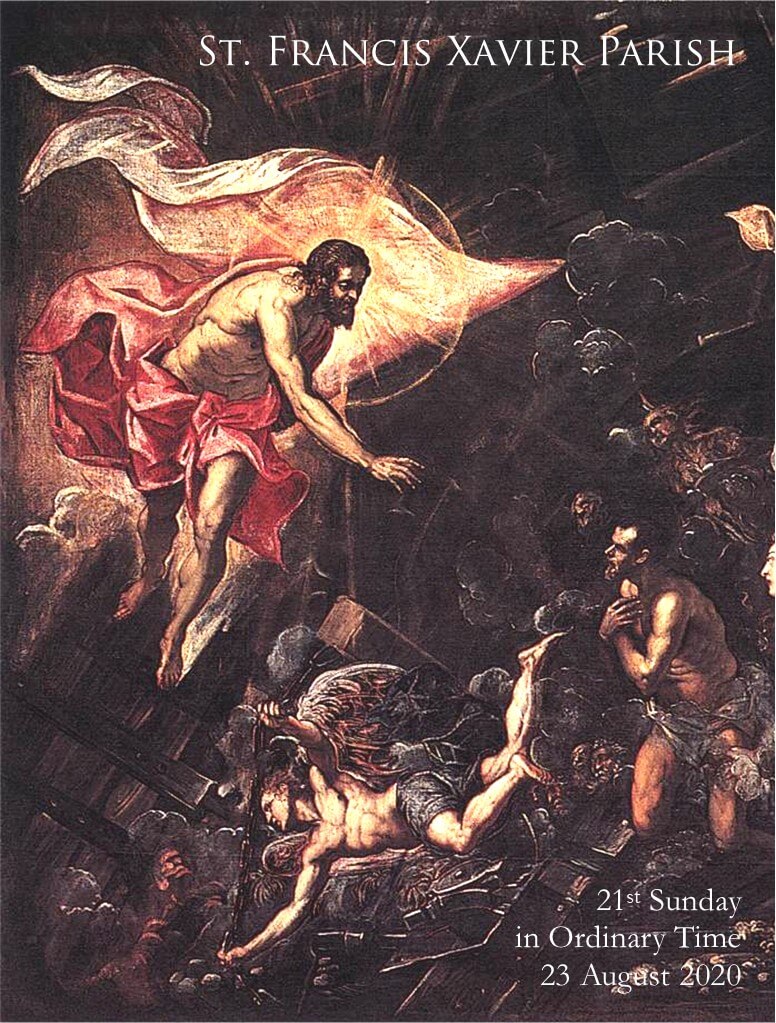
On this 21st Sunday in Ordinary Time we place on our bulletin cover a detail of a Mannerist painting by the great Venetian master Tintoretto entitled, The Descent into Hell (1568). Tintoretto “broke through the gates” of the High Renaissance freeing Italian art from its classical restraint allowing for a more active and dramatic representation of the actions of Jesus Christ.
Here we see Christ on Easter Saturday descending into Hades to free souls from an enduring death. Below the hovering Christ is the gate of the dark netherworld broken asunder so as to release all those who died since Adam. Each will receive divine judgement and hopefully the freedom of God. An angel below Jesus carries a chain he has taken off of one of the dead, perhaps even from Adam who had been desperately awaiting this day. Unseen in our painting fragment are many more people in shadowy form and one nude female of bright appearance who must certainly be Eve, now redeemed by Christ the new Adam (1 Cor 15:22).
Natural death still reigns today over man on earth as a healthy reminder of his mortality and need for God. Everlasting death in the netherworld is also still a likelihood for those who deliberately disregard God’s truth and his command of mercy. But the risen Jesus, the Easter Christ, is the great sign (Mt 16:4) that each and every human person may skirt the gates of hell if only he repents and believes in the Gospel (Mk 1:15) thence proceeding through the gates of heaven.
-Steve Guillotte, Director of Pastoral Services
by SFXparish | Aug 13, 2020 | BLOG
Thus says the LORD… The foreigners who join themselves to the LORD, ministering to him, loving the name of the LORD… will be acceptable on my altar, for my house shall be called a house of prayer for all peoples. (Is 56:1, 6-7)
You have probably read how the United States Representative from New York, Alexandria Ocasio-Cortez, recently denounced the statue of the missionary priest St. Damien of Molokai (which stands in the U.S. Capitol’s National Statuary Hall), as part of a “pattern” of “patriarchy” and “white [supremacy]”. This charge has been ably addressed by many such as Dr. Paul Kengor (Catholic World Report), Michael Warren Davis (Crisis Magazine) and Bishop Robert Barron of Word on Fire (who called Ms. Cortez’s comments “ridiculous”). We will not add here to their fair criticism.
Yet what was absent from these critical pieces was a constructive (and instructive) declaration about the mission of the Church which sadly even the Church has not made in response to Rep. Cortez. So here it is: The Church which has been sent out by Christ with a special commission to make disciples of all nations is not, nor ever will be, a vehicle for “colonization” but rather for evangelization and the salvation of souls. It is vital that we repeat this to all who want to claim or infer that the mission of the Church is, by its evangelical activity, racist, when it sets out earnestly to overcome paganism and false religion in various nations and cultures.
The unjust inference perpetrated by Rep. Cortez – that the very missionary work of Father Damien is supremacist and colonizing – is sad-to-say perpetrated even within the Church itself. For example, just before the 2019 Amazon Synod, Father Corrado Dalmonego of the Consolata missionaries serving in Amazonia made it a matter for boasting that his order has baptized no one in over five decades! What such churchmen do not realize is that while they sit pitifully self-satisfied in a place of “presence and dialogue” there is an ever-growing enemy which sees even their watered-down mission as nuisance and ideologue. In response to this hostility, Catholics need to boldly declare for the Great Commission of Our Lord even under threat of being called “racists”.
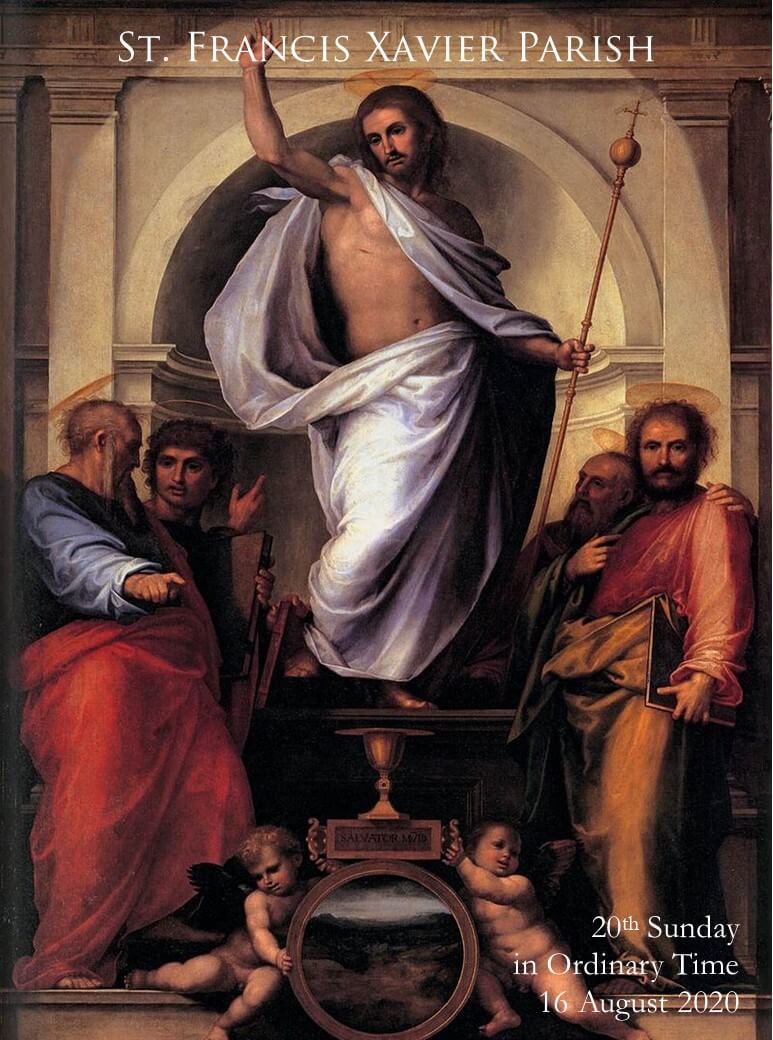
For this 20th Sunday in Ordinary Time we place on our bulletin cover a work by the High Renaissance master Fra Bartolomeo entitled Christ with the Four Evangelists (1516 – Wikiart). Bartolome was a Dominican Friar who resided mostly in Florence. He was friends with Raphael and each gained artistically from their association.
Here is the High Renaissance: classical architecture, idealized and precise human figures, flowing, clinging cloth and postures of virtuous purpose. St. John (the youngest shown) points to Jesus where all evangelization begins. The gospel writer standing near him points outward indicating the command to take Jesus out into the world. The two evangelists on our right embrace in a show of solidarity as the one in the forefront (right) looks forward as if to challenge us to profess Christ to others. Upholding this cause to bring all peoples into the Church is the chalice of the Blood of Christ, the Holy Eucharist, while the mirror below it reflects the world as a dry wilderness without the Good News of Jesus.
Let us never treat the word of God, the commission to make new disciples, and the teachings of the Church as an affront to race, and culture. They are the great hope of both.
-Steve Guillotte, Director of Pastoral Services
by SFXparish | Aug 6, 2020 | BLOG
At once Jesus spoke to them, “Take courage, it is I; do not be afraid.” Peter said to him in reply, “Lord, if it is you, command me to come to you on the water.” He said, “Come.” (Mt 14:27-20)
For the virtue of fortitude to arise in Christian hearts it must play out in two parts. First, we ought to come to firmly believe that God is present to us. Second, this belief should instill within us courage for acting boldly especially on God’s behalf.
If you have ever been in a situation where the primary reason you were not frightened was because you had someone with you who not only made you feel safe but actually provided for your safety, then you can grasp the spiritual sense of what it is like to have faith that God is present.
If you ever had to walk through a dark labyrinth but became separated from your trustworthy companion and received no response after calling out to him for hours, would you not “take courage” after suddenly hearing his voice exclaim, “It is I, do not be afraid”. This is the kind of interior assurance we seek to have in the spiritual life when we walk with God through the mazes of our life. Yet this is only the first part of Christian fortitude.
If upon hearing the voice of your reliable companion, fear of your situation still grips and paralyzes you from moving towards him, then you may not benefit from the voice of your friend calling you. It is the same in the spiritual life. Belief that is not transformed into courage makes you stay put. This prevents you from following God’s commands in a perilous world. Sadly, you may even convince yourself that you are just fine staying put, so that you even risk losing your belief.
In the spiritual life it is imperative that we act like Peter and demand that God command us. We must of course also be like Peter in being ready to act on God’s command. However, as we see in today’s gospel reading, even if our courage is not perfect and we falter, Jesus is there to pull us up. Still, in the life of faith we must be willing to jump out of the security of our earthly vessels into the arms of God if spiritual courage is to be fruitful.
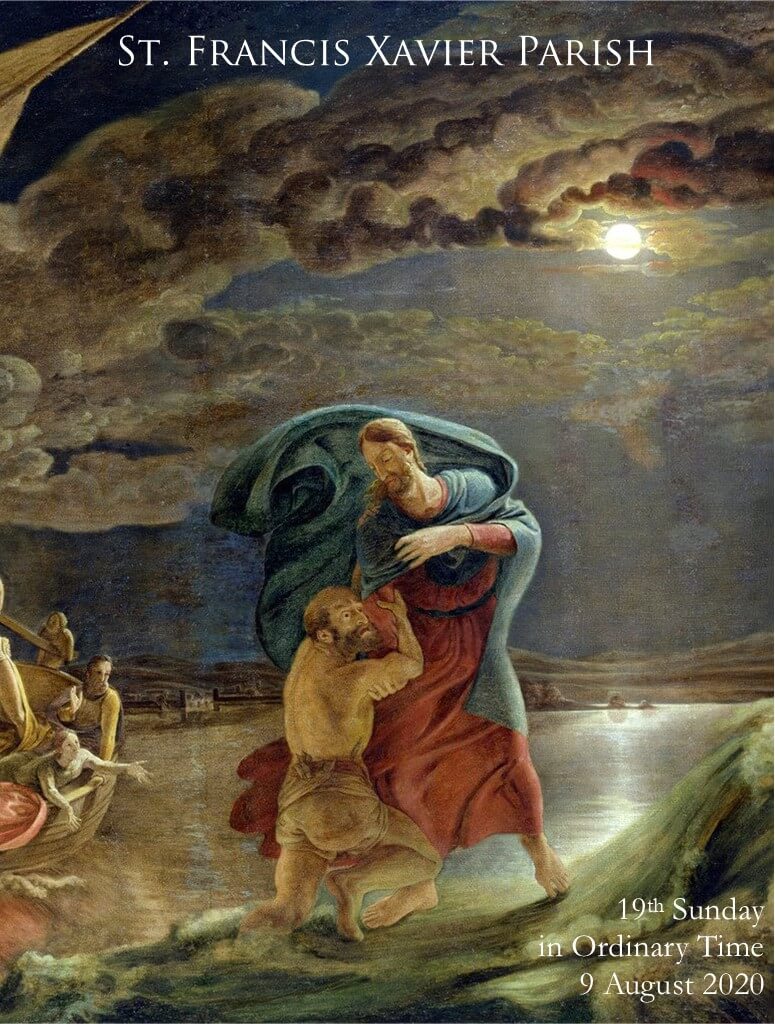
For this 19th Sunday in Ordinary Time, we place on our parish bulletin cover a detail from a work by the German Romantic artist, Phillip Otto Runge entitled Peter Walks on Water (1806). Runge’s Romanticism veered from romantic naturalism to esotericism and hence to a personal theology which caused Runge to collide with the leaders of his Protestant faith.
In our image we see Peter and Jesus riding a wave on the Sea of Galilee under an ominous moonlit sky, the light of which draws our eyes downward toward these two figures. Christ’s cape forms the shape of a turbulent wave indicating his divine authority over nature. Those in the boat (mostly unseen) show the same apprehension as Peter whose fear overcomes his faith indicated by his left leg sinking into the sea. Peter’s eyes are on the natural surroundings not where they should be – on the supernatural Jesus. Jesus for his part is thoroughly engaged in saving Peter, symbolic of his desire to save all humanity.
Let us believe through grace that Jesus is always present, and let us take courage in His presence.
-Steve Guillotte, Director of Pastoral Services
by SFXparish | Jul 30, 2020 | BLOG
Thus says the LORD… Heed me, and you shall eat well, you shall delight in rich fare. Come to me heedfully, listen, that you may have life. (1 Kg 3:5,9,10)
Heedfully is not a term we use in daily conversation. You won’t tell your children to do their homework “heedfully” although perhaps you should, since besides teaching them a new word you would be telling them to be especially attentive to their assignment. However, perhaps it is best that we don’t use this word too often in common speech. In this way we can reserve it for Sacred Scripture and for God’s use in encouraging us to be especially attentive to him.
This week (August 3rd) we are reinstituting some of our overnight Eucharistic Adoration hours so that we may be heedful of the Lord. Throughout the pandemic our parish church has been open every day for prayer before the Blessed Sacrament in the tabernacle. Many have availed themselves of this opportunity. However, our parishioners and Eucharistic friends have been ever eager to return to the contemplation of the Real Presence of the Lord fully exposed in our beautiful monstrance, thus to come to Christ “heedfully” that they may have a fuller life of grace.
In today’s first reading God calls us to be especially attentive in listening to him. If we want to know everything that God has to say, then we must listen to Jesus. Further, God calls us to his table telling us to “eat well” that we “may have life”. In our gospel reading Jesus signals this divine banquet in His “multiplication of the loaves”, a foreshadowing of the Holy Eucharist in which Christ offers His Body, Blood, Soul and Divinity to all who believe that He can do this (and that He does do this at every Holy Mass). Now Eucharistic Adoration is not Holy Communion. It does not hold as high an honor as the substantial reception of Christ’s Sacred Body & Blood. Yet, Adoration has its own high office as a heedful waiting upon Jesus; a special devotion that upholds and increases in us the Eucharistic life we are called to live.
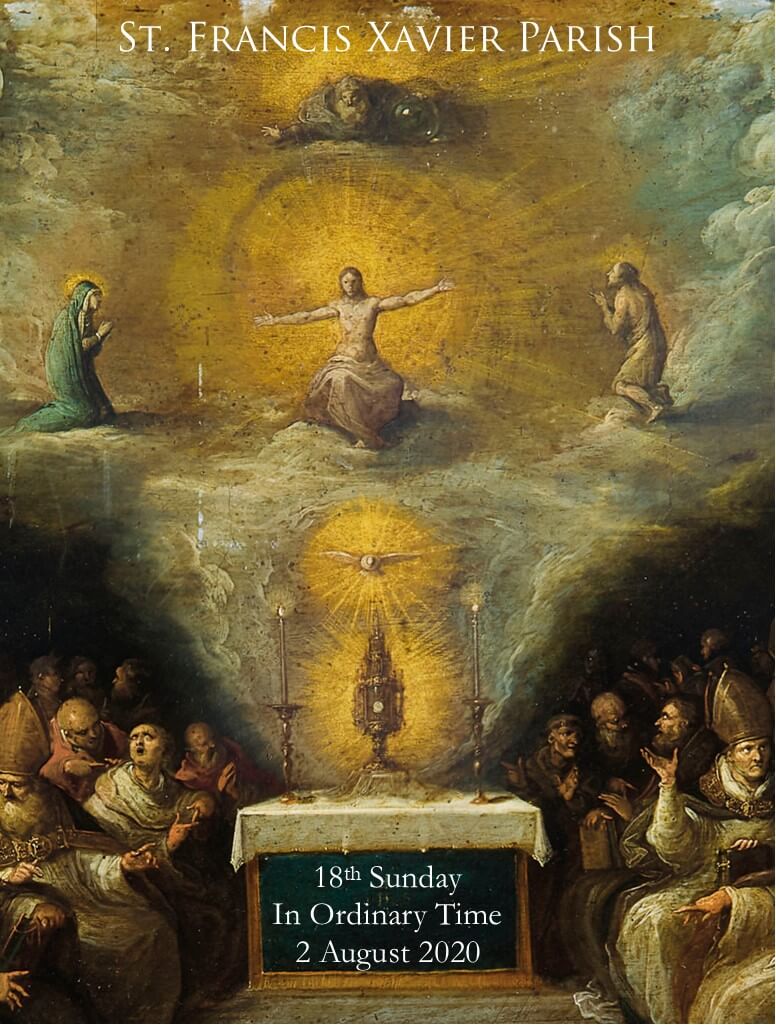
For this 18th Sunday in Ordinary Time we place on our bulletin cover a work by the Flemish painter Frans Francken the Younger entitled The Disputation of the Holy Sacrament, a work of oil and gold on copper. Francken came from a family of painters and his work varies from genre to religious to allegorical. We might say that this work is a Eucharistic allegory. It does not portray a classical myth or a historical event but a revelation of what is actually occurring during Eucharistic Adoration.
Francken was especially apt at creating lovely altarpieces. Here the church altar itself becomes the central feature of his painting. Francken lived during the latter part of the Protestant Reformation when the horizontal debate (which he paints here) over the Real Presence of Jesus in the Eucharist was at its contentious height. Beside this argument Francken proposes in pigment the incontrovertible vertical truth: that Jesus is wholly present in the Blessed Sacrament. In fact, he paints this mystery as fully Trinitarian, such that the Real Presence of Jesus proceeds to us from the Father through the Holy Spirit. Francken even places the Blessed Mother and John the Baptist as witness to this truth, as he illuminates the Holy Host with the same brightness as the divine figures.
Let us be ever-heedful to the mystery of the Most Blessed Sacrament in Eucharistic Adoration.
-Steve Guillotte, Director of Pastoral Services
by SFXparish | Jul 24, 2020 | BLOG
God said, “Ask something of me and I will give it to you.” Solomon answered… “Give your servant… an understanding heart to judge your people and to distinguish right from wrong…The LORD was pleased that Solomon made this request. (1 Kg 3:5,9,10)
Most of the time in our prayer, we are asking things of God. We make petitions for ourselves and intercessions for others. We are the ones who initiate the requests or supplications. We may even feel at times that we are knocking at a closed door behind which is an empty room. We do not consider often enough that God is already present asking us to ask something of him as this Sunday’s first reading indicates.
So what is the spiritual difference? Why should I not just ask God anytime for anything I want? Why should I have to wait on God to ask me to ask him for something? There is a vast disparity between these two approaches. When I initiate the asking without considering that God is always the initiator I forget about the gifts that God has to offer. I choose my petitions from my own gift register, not God’s. However, when I wait upon the Lord to ask me to ask for something, I have begun to trust that God already knows what is good for me, and I will know much better what to ask for.
Remember the instruction of Jesus: God knows how to give good gifts to his children (Lk 11:13). However, these gifts are from God’s shelf and God’s treasury and they all proceed from the Holy Spirit (Lk 11:13). Notice that in our quotation above from Sacred Scripture, God does not ask Solomon to ask him for “anything”. God tells Solomon to ask for “something”, specifically “ask something of me”. The objective of our petitions should always have its source and fulfilment in heaven. In this way our requests, whether they be for the benefit of the body or the spirit, will always correspond with our final destiny.
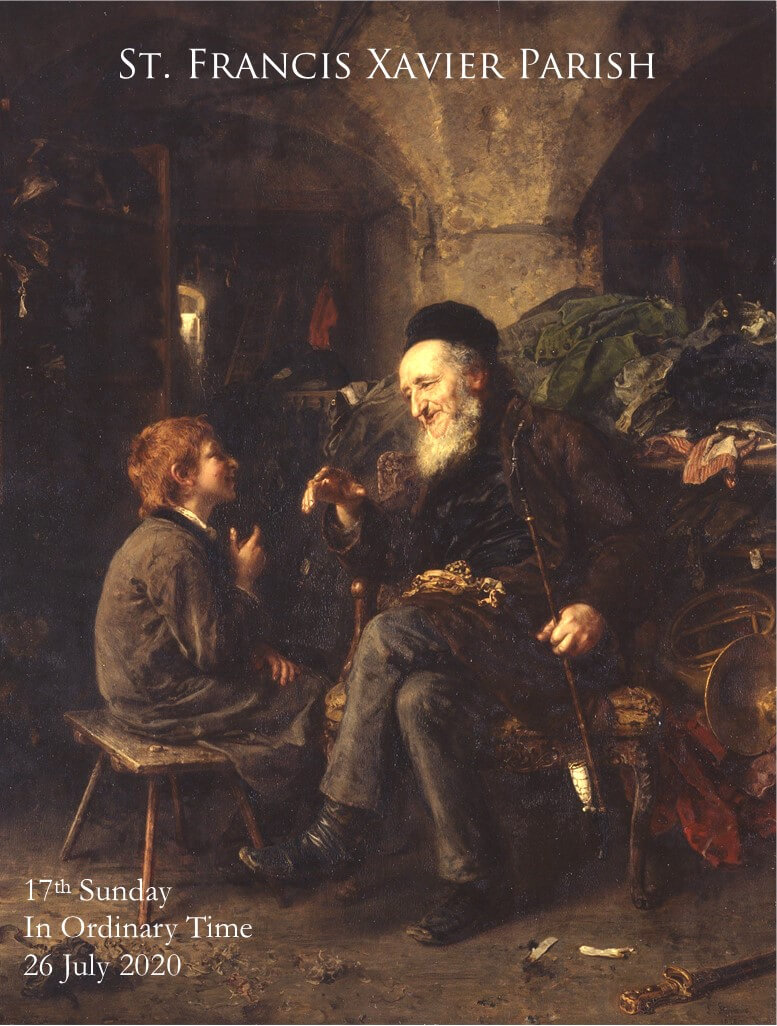
For this 17th Sunday in Ordinary Time we place on our bulletin cover a work by the German painter Ludwig Knaus entitled Solomonic Wisdom (1878). Knaus was a portraiture and genre painter and his images of cheery rustic peasants were quite romantic, ranging from being optimistic to almost frolicking. Like other German Romantics he painted visions of pastoral joy in calming landscapes as in his famous work The Girl in the Meadow (1857).
In our bulletin image we see a young man intently listening and in his turn repeating his instruction. The teacher appears to be a Jewish elder who is eager to offer his wisdom which must be comprehensive for the symbols painted in this piece. On the floor lies a sword and behind the elder a horn indicating his knowledge of both history and the arts. He sits in an ancient structure which is seemingly timeworn yet its vaulted ceiling shows that at a time it was a magnificent structure. Near the light over the boy’s head is a ladder indicating the ascent of knowing. This boy comes seeking knowledge, but not just any knowledge. He desires to learn the wisdom of his past.
We contend that the boy is like the young Solomon who puts prudence before materiality and earthly pleasure. The elder man represents God who has a cache-reserve of many virtues and wisdoms that he wants us to ask of him. These gifts sit in a deep, everlasting chamber ready to be lent out just for the asking.
-Steve Guillotte, Director of Pastoral Services